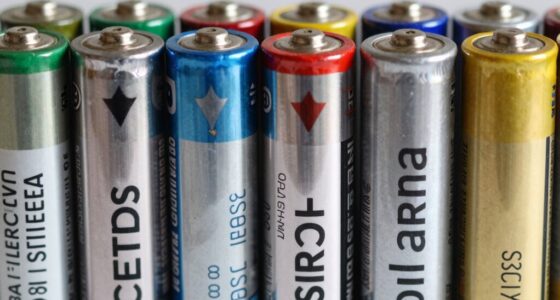
When charging a battery, you won’t get 100% of the input energy stored because internal resistance, chemical processes, and heat losses all cause energy to escape. As the battery ages or if you charge quickly, these inefficiencies increase, reducing overall efficiency. This means less energy is stored than you supply. If you want to understand the science behind these losses and how they affect battery performance, there’s more to explore.

Get backup power and energy gear delivered free with Prime
- Fast, free delivery on millions of items
- Prime Video, Amazon Music and more included
- Member-only deals all year
Key Takeaways
- Not all input energy reaches the battery due to internal resistance and heat losses.
- Chemical and physical inefficiencies prevent 100% energy transfer during charging.
- Battery aging increases internal resistance, reducing charge efficiency over time.
- Rapid or high-demand charging generates more heat, decreasing overall efficiency.
- The charge efficiency factor explains why stored energy is always slightly less than supplied energy.

Have you ever wondered how effectively a battery converts the energy you put into it during charging? It’s a question that reveals a lot about how batteries work and why the concept of a 100% charge efficiency isn’t quite what it seems. When you charge a battery, not all the energy you supply makes it to the other side as usable power. Instead, some of it is lost along the way, primarily as heat and through internal processes. This energy loss means that even if the charger supplies a certain amount of energy, the battery may store slightly less, making the actual efficiency less than perfect.
One of the main factors that influence this process is battery degradation. Over time, as you repeatedly charge and discharge your battery, its internal materials break down gradually. This degradation affects how well the battery can hold and deliver energy. As the battery ages, its internal resistance increases, making it harder for it to accept the full amount of energy during charging. Consequently, more energy gets lost as heat, and less is available for use. This ongoing degradation is why a battery’s charge efficiency can decline over its lifespan, meaning you’re not getting the same performance as when it was new.
Energy loss during charging isn’t just about aging; it’s also tied to the fundamental physics of how batteries operate. When you charge a battery, ions move through the electrolyte, and electrons flow through the circuit. These processes aren’t perfectly efficient. Resistance within the battery’s components causes some energy to dissipate as heat. Even with advanced technology, no battery can convert 100% of the input energy into stored electrical energy. There’s always some inefficiency—whether from internal resistance, chemical reactions, or heat dissipation—that results in a lower actual state of charge than the input suggests. Additionally, internal resistance increases as the battery ages, which further reduces efficiency and increases heat loss.
Understanding this discrepancy helps explain why a “full” charge isn’t truly 100% effective. If a battery’s charge efficiency is, say, 95%, then charging it to 100% only results in about 95% of that energy being stored effectively. The rest is lost, mostly as heat. This energy loss impacts overall battery performance, especially during high-demand situations or rapid charging, where inefficiencies become more pronounced. Recognizing that a battery’s charge efficiency isn’t perfect encourages smarter energy management and helps you set realistic expectations for battery performance over time. Ultimately, it’s a reminder that batteries, while powerful, are inherently imperfect energy converters, and their efficiency varies depending on age, usage, and design.
battery charge efficiency tester
As an affiliate, we earn on qualifying purchases.
As an affiliate, we earn on qualifying purchases.
Frequently Asked Questions
How Does Temperature Affect Charge Efficiency?
Temperature impacts charge efficiency through thermal effects that influence battery performance. When temperatures are too high or too low, chemical reactions inside the battery become less stable, reducing efficiency. You’ll notice performance drops if temperature stability isn’t maintained, as extreme heat or cold hampers energy transfer. Keeping batteries within ideal temperature ranges ensures better charge efficiency, minimizing energy loss and extending battery life.
What Role Does Battery Age Play in Efficiency?
Battery age impacts efficiency because aging effects cause degradation over time. As your battery gets older, its ability to hold and deliver charge diminishes due to chemical changes and wear. This battery degradation leads to lower overall efficiency, meaning you won’t get the same performance as when it was new. So, aging effects are a key factor that reduce your battery’s charge efficiency, especially after many charge cycles.
Can Charging Speed Impact the Efficiency Factor?
Charging speed can definitely impact your efficiency factor. Rapid charging often causes higher heat, which can reduce battery efficiency over time. Proper charging protocols and power management help mitigate this, ensuring safer, more efficient charging. Slow, steady charging maintains better efficiency, while fast charging may lead to energy losses. By managing charging speed carefully, you preserve battery health and maximize overall efficiency, preventing unnecessary energy loss during the process.
How Does Different Charger Quality Influence Efficiency?
Imagine your charging experience is a rollercoaster, and your charger’s quality is the thrill factor. If you pick a low-quality charger, it’s like riding a shaky, unpredictable ride—disrupting charger compatibility and causing inconsistent power output. High-quality chargers ensure a smooth, reliable flow of power, maximizing efficiency. So, you’ll get faster, safer charges, and your device stays happier longer, thanks to a charger built for the ride.
Is There a Way to Improve Charge Efficiency Over Time?
You can improve charge efficiency over time by managing your charging habits. Limiting charging cycles, avoiding deep discharges, and maintaining ideal temperature help boost energy retention. Using quality chargers also minimizes energy loss. Regularly calibrating your device ensures accurate battery readings, and avoiding fast charging when unnecessary reduces stress on the battery. These steps help sustain higher efficiency, ensuring your device retains energy better and prolongs overall battery health.
Conclusion
Think of your battery like a busy water wheel. Just as not all water that pours in turns the wheel perfectly, not all energy you put in is gained back. The Charge Efficiency Factor is your wheel’s secret—showing that some energy always slips away, no matter how perfect your setup seems. So, remember, in the world of batteries, what goes in doesn’t always come out perfectly, and understanding this keeps your energy game strong.
Halloween Picks
halloween
As an affiliate, we earn on qualifying purchases.