If you’re deciding between MPPT and PWM, know that MPPT controllers can nearly double your power harvest, especially in cloudy weather or larger systems, by adjusting voltage to maximize efficiency. PWM controllers are cheaper and easier to install, making them suitable for small, sunny setups. However, if your system faces variable conditions or you want maximum energy, MPPT’s higher cost may be justified. Continue exploring to discover which option suits your needs best.

Get backup power and energy gear delivered free with Prime
- Fast, free delivery on millions of items
- Prime Video, Amazon Music and more included
- Member-only deals all year
Key Takeaways
- MPPT controllers maximize energy harvest, especially in variable weather and larger systems, leading to significant power gains over PWM.
- For small, high-sunlight setups, PWM’s lower cost and simplicity often suffice, with minimal performance difference.
- MPPT can improve system efficiency by 20-30%, but the benefits diminish in straightforward, high-insolation environments.
- Higher initial costs and installation complexity of MPPT are justified mainly in larger or shaded systems needing optimal performance.
- In minimal setups or consistently sunny conditions, PWM remains a cost-effective choice with negligible energy loss.
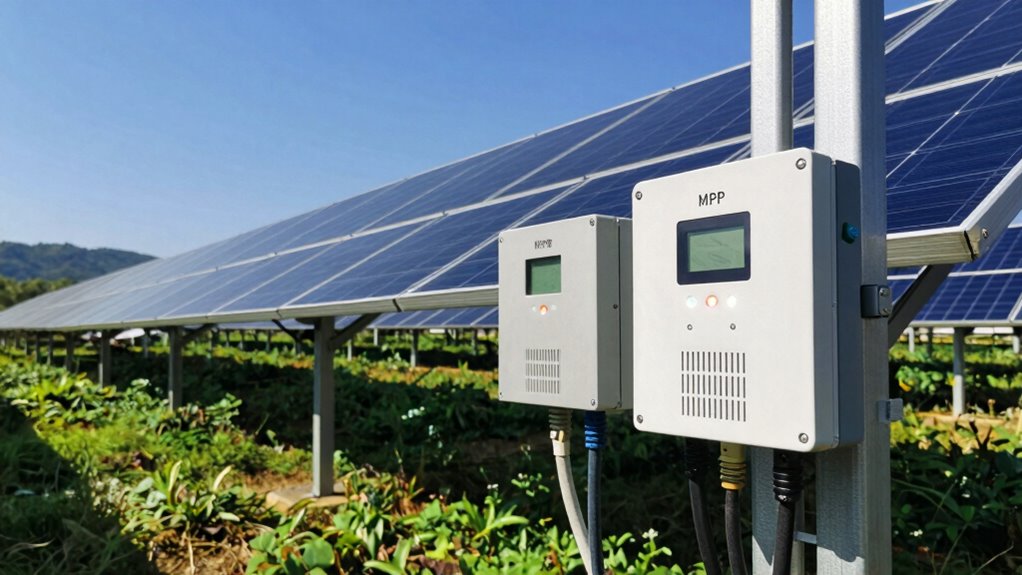
Are you trying to decide between MPPT and PWM solar charge controllers for your system? If so, understanding the differences is essential to maximize your solar investment. One of the key factors to consider is battery efficiency. MPPT controllers are designed to optimize the power transfer from your panels, especially when the sunlight is less than ideal or during temperature fluctuations. They adjust their voltage to match the battery’s needs, extracting the maximum available power. This means your batteries charge more efficiently, reducing charging times and extending their lifespan. PWM controllers, on the other hand, connect the panels directly to the batteries at a fixed voltage, which often results in less efficient charging, especially in varying conditions. While PWM controllers are simpler, they don’t optimize power transfer as effectively, potentially leading to slightly lower battery efficiency over time.
Installation costs also play a *crucial* role in your decision. PWM controllers tend to be more affordable upfront and easier to install because of their straightforward design. They don’t require complex wiring or additional components, making them a popular choice for small or simple setups. MPPT controllers, however, come with a higher initial price tag due to their sophisticated technology and additional features. The installation process can be more involved, sometimes requiring extra wiring or specialized knowledge. Despite the higher installation costs, many users find that the improved battery efficiency and better utilization of their solar panels justify the investment in MPPT controllers, especially for larger or more complex systems.
Another aspect to *evaluate* is your system’s size and your typical sunlight conditions. If you’re running a small, budget-conscious setup with high sunlight exposure, a PWM controller might suffice. Its lower costs and ease of installation make it a practical choice. Conversely, if you have a larger system, shaded conditions, or areas with fluctuating sunlight, MPPT controllers can *dramatically* boost your system’s overall performance. They can harvest more power from your panels, even in less-than-ideal conditions, translating into better energy savings over time. Keep in mind that the efficiency gains with MPPT become more noticeable as your system grows or faces variable weather.
As an affiliate, we earn on qualifying purchases.
Frequently Asked Questions
Can PWM Be More Cost-Effective Than MPPT in Certain Conditions?
Yes, PWM can be more cost-effective than MPPT in certain conditions. If your solar panel system operates under relatively stable, low-voltage conditions, PWM offers cost savings due to its simpler design. It also features easier installation, making it ideal for straightforward setups. While it might not maximize power gain like MPPT, for small or shaded systems, PWM’s lower investment and simplicity often outweigh the benefits of MPPT.
How Does Temperature Affect MPPT and PWM Efficiencies?
Imagine you’re camping in scorching heat, and your solar setup’s efficiency varies. Temperature effects cause MPPT to perform better in high heat, as it adjusts to changing conditions, maintaining efficiency. PWM’s efficiency variation is less significant but can drop slightly with temperature swings. So, in hot environments, MPPT generally offers more consistent performance, especially when temperature effects impact the overall power output.
Are There Specific Solar Panel Types Better Suited for PWM?
If you’re choosing a PWM controller, opt for solar panels with compatible voltage ranges and low voltage sensitivity. These panels typically have a fixed voltage close to the controller’s voltage, ensuring efficient power transfer. Thin-film panels or those with lower open-circuit voltages work well. Avoid high-voltage or highly sensitive panels, as PWM controllers can’t optimize their output, leading to less efficient energy harvesting.
What Maintenance Differences Exist Between MPPT and PWM Controllers?
Think of your controllers like different types of engines—one needs more fine-tuning. MPPT controllers generally require less frequent maintenance, offering longer controller longevity, but troubleshooting can be trickier if issues arise. PWM controllers are simpler, making troubleshooting easier, but may need more attention over time. Overall, MPPT units might last longer with less fuss, while PWM controllers are friendlier for quick fixes.
How Do Shading Conditions Influence the Choice Between MPPT and PWM?
Shading conditions, especially partial shading, heavily influence your choice between MPPT and PWM controllers. If your solar panels experience frequent shading, an MPPT controller is better because it maximizes power by adjusting to varying light levels. PWM controllers struggle under shading, wasting energy. So, if shading is common on your site, investing in an MPPT system boosts efficiency, ensuring you get the most out of your solar setup.
Conclusion
When choosing between MPPT and PWM, remember that MPPT can boost your system’s efficiency by up to 30%, especially in colder or cloudy conditions. However, it might not always be worth the extra cost for small setups. If your panel voltage isn’t markedly higher than your battery voltage, PWM could be enough. Consider your climate and system size—sometimes, the simple option saves you money without sacrificing performance.
Halloween Picks
halloween
As an affiliate, we earn on qualifying purchases.