TL;DR

Get backup power and energy gear delivered free with Prime
- Fast, free delivery on millions of items
- Prime Video, Amazon Music and more included
- Member-only deals all year
Rep. Rob Menendez introduced the Socket Full of Sunshine Act, the first federal bill aimed at legalizing plug-in solar panels. It would require state public utility commissions to consider rules enabling the systems and create a program to help lower-income households afford them. The proposal does not itself establish a nationwide standard or make the technology legal everywhere.
U.S. Rep. Rob Menendez (D-N.J.) introduced the Socket Full of Sunshine Act on Monday, the first federal bill aimed at legalizing solar panels that plug into a standard wall outlet. The proposal would direct state public utility commissions to consider rules enabling the systems and create a program to help lower-income households afford them, including renters.
The bill would require all state public utility commissions to consider rules that would allow Americans to use plug-in solar. The source report does not say the proposal would impose one specific set of technical rules on states. It also calls for a program to help lower-income households access the technology; details about eligibility, funding and administration were not included in the report.
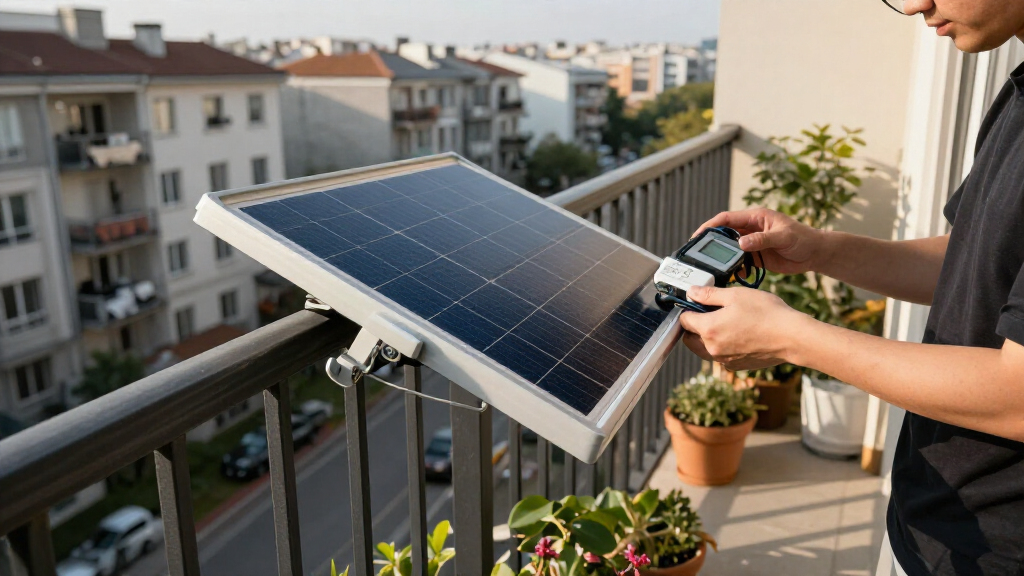
Balcony solar systems typically use one to four panels connected to a regular 120-volt outlet. They can provide electricity for some household uses when sunlight is available, but the systems generate less power than a typical rooftop array. The report says potential savings depend on local electricity rates and describes payback periods as short as 2.5 years, compared with more than 10 years for a more powerful rooftop system. Those figures are estimates, not guaranteed outcomes for every household.
Menendez said in a statement that rising electric bills are squeezing families and that plug-in solar could help them cut costs. He argued that rules and fees are limiting access. Those are the sponsor’s case for the legislation; the bill’s effects on bills, adoption and household savings have not been established.
A Federal Push on Household Solar
The proposal addresses a gap between growing interest in small-scale solar and the state-by-state regulatory landscape. A federal requirement for regulators to consider rules could put plug-in systems on more state agendas, while the proposed assistance program recognizes that upfront costs may be a barrier, particularly for households with limited incomes.
For renters, who may not be able to install rooftop panels, a system that plugs into an outlet could offer another way to generate some household electricity. But the practical effect would depend on what state regulators decide, whether safe, certified products are available, and how any assistance program is designed. Introduction of the bill alone does not authorize residents to use the systems nationwide.
As an affiliate, we earn on qualifying purchases.
States Set the Current Rules
The United States does not have a single standard for the safe use of plug-in solar, according to the source report. Instead, rules vary among states. Utah passed the first state law legalizing plug-in solar last year, and 10 additional states passed laws this year, including California, Colorado, Maryland and Virginia.
Those 10 states are awaiting plug-in solar kits certified as safe by a nationally recognized testing laboratory, such as UL Solutions, the report said. Lawmakers in more than 20 other states introduced bills this year but did not get them across the finish line. Menendez’s proposal seeks a federal role in a policy area that has so far advanced through state legislation and regulation.
“Families are getting squeezed by electric bills that keep going up.”
— U.S. Rep. Rob Menendez, in a statement
Key Details Still Pending
The bill’s legislative prospects, timetable and specific funding arrangements are not established in the source report. It is also unclear how state commissions would meet the requirement to consider rules, or what standards they might adopt. The proposal’s text and implementation details would be needed to assess the scope of the assistance program and any conditions on participation.
Safety certification remains a practical issue. The report says states that passed laws are waiting for certified plug-in solar kits; it does not identify when those products will be available or how quickly states may put rules into effect. The article also does not establish what savings a particular household would realize, since output and costs vary with sunlight, system size, electricity prices and other local conditions.
Bill Advances and State Rulemaking
The next federal milestone is whether the bill advances in Congress. The source report does not identify a committee referral, hearing, vote schedule or expected timeline, so no further action date can be stated. Details of any proposed funding and the bill’s legislative path may become clearer as lawmakers consider the measure.
Meanwhile, state regulators and lawmakers remain central to whether plug-in solar becomes available in practice. The states that have passed laws are awaiting certified kits, while states where bills stalled may revisit the issue. Even if the federal proposal moves forward, the report does not indicate that it would immediately replace state rules with a uniform national standard.
Key Questions
What is the Socket Full of Sunshine Act?
It is a bill introduced by Rep. Rob Menendez that would require state public utility commissions to consider rules enabling plug-in solar and create a program to assist lower-income households.
Would the bill make balcony solar legal across the United States immediately?
No such immediate nationwide effect is described in the source report. The proposal would require state regulators to consider rules; it does not establish that every state would adopt the same rules or that systems could be used everywhere as soon as the bill is introduced.
How do plug-in solar systems work?
They typically use one to four solar panels connected to a standard 120-volt outlet. They can supply some electricity when the panels receive sunlight, but produce less power than a typical rooftop solar array.
Can households count on a particular payback period or savings?
No. The source report gives an estimated payback period as short as 2.5 years and says savings depend on local electricity rates. Actual results would vary by household and location; the figures are not guaranteed.
What happens next for the bill?
Its path through Congress remains unclear. The source report does not provide a committee schedule, vote date or timeline. State rulemaking and the availability of certified systems also remain part of the next steps for practical adoption.
Source: rss
Fall Picks
fall essentials
As an affiliate, we earn on qualifying purchases.