For most households seeking solar generators for home backup, I would start with the EF ECOFLOW DELTA Pro: its 3,600Wh capacity and 3,600W output offer a strong balance for running several essential devices. The Jackery HomePower 3600 Plus is another standout for buyers who want a large-capacity unit, while the OSCAL PowerMax 6000 is aimed at those prioritizing higher stated output and a substantial solar-panel bundle. The main tradeoff is between capacity, appliance-starting power, solar charging speed, portability and the cost of adding panels. A portable power station can keep selected loads running, but it is not automatically a whole-home backup system. Read on for the full comparison and guidance on matching a unit to your outage plan.

Get backup power and energy gear delivered free with Prime
- Fast, free delivery on millions of items
- Prime Video, Amazon Music and more included
- Member-only deals all year
Complete the kit


Key Takeaways
- Capacity and output are different limits: The 3,584Wh Jackery HomePower 3600 Plus and 3,600Wh DELTA Pro store substantial energy, but output determines which appliances can run at the same time.
- Solar bundles vary widely: The OSCAL package includes three 400W panels, while several other bundles include one or two smaller panels; included panel wattage affects recharge potential, but real-world input also depends on conditions and system limits.
- There are two distinct ways to buy the Jackery HomePower 3600 Plus: one listing includes four 200W panels and two connectors, while the other is the station alone, making the right choice depend on whether a solar array is already available.
- The smaller stations trade runtime for easier handling: The 1,024Wh DELTA 3 Classic and 1,070Wh Jackery Solar Generator 1000 V2 suit targeted essential loads better than extended multi-appliance backup.
- Several model families appear in both panel and station-only bundles: Comparing bundle contents and compatible solar input matters as much as comparing the power station name, since the base unit may be similar while the included charging setup differs.



| solar generators for home backup | Battery capacity | Battery chemistry | Weight |
|---|---|---|---|
| ABOK Ark3600 Portable Power St | 3,840Wh; expandable to 11,520Wh | LiFePO4 | — |
| EF ECOFLOW DELTA Pro Portable | 3,600Wh | LFP | 99 lb |
| EcoFlow DELTA 3 Ultra 3072Wh P | 3,072Wh | LiFePO4 | — |
| EF ECOFLOW DELTA 3 Max Portabl | 2,048Wh | — | — |
| Jackery HomePower 3600 Plus Po | 3,584Wh | — | 77.2 lb |
| Jackery HomePower 3600 Plus Po | 3,584Wh | LFP | 77.2 lb |
| OSCAL PowerMax 6000 Solar Gene | 3,600Wh | LiFePO4 | 45.5kg |
| EF ECOFLOW DELTA 3 Max Portabl | 2,048Wh | LiFePO4 | — |
| ABOK Ark3600 Portable Power St | 3,840Wh | — | 92 lb |
| EF ECOFLOW DELTA 3 Classic Por | 1,024Wh | LiFePO4 | — |
| SolarPlay Q3600 3600W Portable | 3,840Wh | LiFePO4 | 97 lb |
| Jackery Solar Generator 1000 V | 1,070Wh | — | 23.8 lb |
More Details on Our Top Picks
ABOK Ark3600 Portable Power Station with Three 200W Solar Panels
The ABOK Ark3600 pairs a 3,840Wh battery with three included 200W panels, giving home-backup buyers a substantial starting kit rather than requiring a separate panel purchase. Its 3,600W rated output and 15 ports suit several household loads at once, while expansion to 11,520Wh can extend backup time. Compared with the EcoFlow DELTA Pro, it has more capacity out of the box but a lower stated expansion ceiling; the DELTA Pro can grow to 25kWh. The ABOK’s LiFePO4 battery and app controls add useful long-term monitoring, but its advertised fast recharge figures depend on strong input and favorable conditions. The large station and panel setup also take space, and the supplied panels may not match the charging speed of a larger array.
Pros:- 3,840Wh starting capacity with expansion up to 11,520Wh
- 3,600W rated output and 15 ports accommodate a range of backup loads
- Includes three 200W monocrystalline solar panels
- LiFePO4 battery, app monitoring, and stated 4,000-cycle life
Cons:- The station and panels are reported out of stock in the supplied shipping update
- Fast recharge claims depend on receiving the stated input power and favorable conditions
- Expansion capacity is lower than the EcoFlow DELTA Pro’s stated 25kWh maximum
Best for: Households seeking a high-capacity backup kit with solar panels included and the option to add battery capacity later.
Not ideal for: Buyers who need a clearly available kit or a system expandable beyond 11,520Wh; the listed shipping update reports the station and panels out of stock, and the EcoFlow DELTA Pro supports a higher capacity ceiling.
- Battery capacity:3,840Wh; expandable to 11,520Wh
- Peak output:7,200W
- Battery chemistry:LiFePO4
- Battery cycle life:4,000 cycles
- Output ports:15
- Solar panels:Three 200W monocrystalline panels
- Maximum combined AC and solar input:3,500W
- Warranty:5 years (2-year standard warranty plus 3-year extended service)
Our verdict“Choose the ABOK Ark3600 if you want substantial capacity and panels in the package, but skip it if availability or a larger expansion ceiling is your priority.”
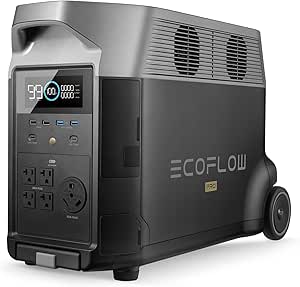
EF ECOFLOW DELTA Pro Portable Power Station, 3600Wh, 120V, 3600W AC Output
The DELTA Pro earns its place for buyers who want a system that can grow well beyond a single power station: compatible batteries and smart generators support expansion up to 25kWh. Its 3,600Wh LFP battery and 3,600W AC output make it a strong base for essential household circuits, while five charging methods give it more replenishment options than the ABOK Ark3600, whose stated expansion tops out at 11,520Wh. The tradeoff is that the DELTA Pro’s maximum capacity depends on buying compatible add-ons, and the unit itself weighs 99 pounds. It also does not include solar panels in the supplied product details. I’d favor this over the Jackery HomePower 3600 Plus when expansion range matters more than easier handling, but it is a poor fit for frequent manual moves.
Pros:- 3,600Wh LFP battery with expansion up to 25kWh
- 3,600W AC output and 15 connections support multiple loads
- Five charging methods include solar, EV station, wall outlet, car outlet, and smart outdoor generator
- Wi-Fi and Bluetooth app connectivity allow remote monitoring and control
Cons:- The 99-pound unit is difficult to move frequently
- Reaching 25kWh requires compatible extra batteries or smart generators
- Solar panels are not included in the supplied product details
Best for: Homeowners building a larger, expandable backup setup who can keep the station in one place and add compatible batteries or generators.
Not ideal for: People who need a lighter, grab-and-carry station or a complete solar kit; it weighs 99 pounds and panels are not listed as included.
- Battery capacity:3,600Wh
- AC output:3,600W at 120V
- X-Boost output:Up to 4,500W
- Battery chemistry:LFP
- Expandable capacity:Up to 25kWh
- Output connections:15
- Charging methods:EV station, solar, wall outlet, smart outdoor generator, and car outlet
- Weight:99 lb
- Dimensions:25 × 11.2 × 16.4 in
Our verdict“Pick the DELTA Pro if you want a home-backup platform with a high expansion ceiling and can accommodate its weight and add-on requirements.”
EcoFlow DELTA 3 Ultra 3072Wh Portable Power Station with Two 220W Solar Panels
The DELTA 3 Ultra is the standout here for keeping sensitive electronics running through a brief outage: its stated under-10ms UPS switching is faster than the DELTA 3 Max’s 10ms transfer time. It also delivers 3,600W continuous output and 7,200W surge capacity from a 3,072Wh LiFePO4 battery, a useful mix for demanding appliances and short interruptions. Two 220W panels are included, though they ship separately from the station, and their combined rated output is modest beside the ABOK Ark3600’s three 200W panels. That means solar replenishment may take longer, especially when household loads are running. The listed one-hour runtime is not enough to predict actual backup duration without knowing the load, so I would treat capacity and load planning as more useful guideposts than that figure.
Pros:- Under-10ms UPS switching helps reduce interruption for connected equipment
- 3,600W continuous output with 7,200W surge capacity
- Includes two 220W solar panels
- LiFePO4 battery and four charging options, including car input and Smart Generator
Cons:- The station and panels ship in separate packages
- The included 440W of solar panel capacity is lower than the ABOK Ark3600’s 600W array
- The listed one-hour runtime provides little practical guidance without a specified load
Best for: Households prioritizing rapid UPS-style switching for electronics and wanting a high-output station with panels included.
Not ideal for: Buyers needing a long-duration solar recharge setup or a clearly stated real-world runtime; the two included panels total 440W, and the listed runtime is only one hour.
- Battery capacity:3,072Wh
- Battery chemistry:LiFePO4
- Continuous output:3,600W
- Surge output:7,200W
- UPS switching time:Under 10ms
- Noise level:25dB under load
- Solar panels:Two 220W panels
- Charging methods:Wall outlet, solar, car input, and EcoFlow Smart Generator
- Dimensions:24.6 × 12.9 × 15.6 in
Our verdict“Choose the DELTA 3 Ultra for rapid UPS switching and strong output, not for the largest included solar array or a simple runtime estimate.”
EF ECOFLOW DELTA 3 Max Portable Power Station, 2048Wh LiFePO4 Battery, 2400W Output
Among these five, the DELTA 3 Max is the more manageable choice for buyers backing up a smaller set of essentials rather than trying to run a home for an extended outage. Its 2,048Wh capacity and 2,400W output are below the 3,000Wh-plus stations such as the DELTA 3 Ultra and Jackery HomePower 3600 Plus, so it offers less stored energy and lower continuous output. In return, its listed dimensions are compact for this lineup, and a 10ms transfer time supports backup use for connected electronics. The quick AC charge claim—80% in about 1.13 hours—can help between outages, but solar panels are optional. X-Boost is rated up to 3,400W for compatible appliances; I would not treat that figure as equivalent to its standard 2,400W output.
Pros:- Compact listed dimensions compared with the larger-capacity stations in this group
- 2,400W output with up to 3,400W X-Boost for compatible appliances
- Reaches 80% charge in about 1.13 hours from AC
- 10ms transfer time, app control, and LiFePO4 battery
Cons:- 2,048Wh capacity offers less stored energy than the DELTA 3 Ultra and Jackery HomePower 3600 Plus
- Solar panel is optional and not included
- Only three total power outlets are listed
Best for: Apartment residents or homeowners backing up a few essential devices who value a smaller station and quick wall charging over long runtime.
Not ideal for: Households seeking whole-home coverage, extended appliance runtime, or an included solar kit; capacity is lower than the larger DELTA 3 Ultra and the panel is optional.
- Battery capacity:2,048Wh
- Battery type:LiFePO4
- Output:2,400W
- X-Boost output:Up to 3,400W for compatible appliances
- AC charging:0–80% in about 1.13 hours
- Transfer time:10ms
- Power outlets:3
- Solar panel:Optional; not included
- Dimensions:9.4 × 12 × 19.44 in
Our verdict“Pick the DELTA 3 Max if you need compact backup for selected essentials and can accept lower capacity and a separately purchased solar panel.”
Jackery HomePower 3600 Plus Portable Power Station with Four 200W Solar Panels and Two Connectors, 3584Wh
The Jackery HomePower 3600 Plus combines a near-3.6kWh battery with four included 200W panels, making it a strong choice for buyers who want a substantial solar-ready kit and easier repositioning than the 99-pound EcoFlow DELTA Pro. Its wheels and telescopic handle help with rolling the 77.2-pound unit, though they do not make it easy to lift. Capacity expands to 21kWh per unit, below the DELTA Pro’s 25kWh ceiling, but the Jackery offers 240V output when units are paired and supports hybrid AC+DC charging. The supplied data lists only one outlet, a major limitation for a home-backup station unless additional output details are confirmed. The panels and station may also arrive separately, so the complete setup may not be available at once.
Pros:- 3,584Wh capacity and 3,600W output
- Includes four 200W solar panels and two connectors
- Wheels and telescopic handle ease rolling the 77.2-pound unit
- Supports hybrid AC+DC charging and parallel operation for 240V output
Cons:- Only one outlet is listed in the supplied specifications
- At 77.2 pounds, it remains difficult to lift or carry
- Solar panels and station may ship separately
- Per-unit expansion to 21kWh is below the DELTA Pro’s stated 25kWh maximum
Best for: Homeowners who want a high-capacity station with a large included solar array, rolling transport, and the option to build toward 240V backup with paired units.
Not ideal for: Buyers who need multiple directly available outlets or must carry the station upstairs; the listed outlet count is one and the unit weighs 77.2 pounds.
- Battery capacity:3,584Wh
- Output:3,600W
- Parallel output:7,200W
- Voltage:120V; 240V in parallel
- Battery type:LFP
- Battery cycle life:6,000 cycles
- Expandable capacity:21kWh per unit; 43kWh with multiple units
- Solar panels:Four 200W panels
- Weight:77.2 lb
Our verdict“Choose the Jackery if you want a large included solar array and rollable transport, but verify the outlet configuration before relying on it for multiple home loads.”
Jackery HomePower 3600 Plus Portable Power Station, 3584Wh, 3600W
I’d put the Jackery HomePower 3600 Plus near the top for buyers who want a substantial backup battery now and room to scale later. Its 3,584Wh capacity and 3,600W output can support a useful mix of household appliances, while expansion options reach 21kWh per unit. Unlike the OSCAL PowerMax 6000, it does not offer 120V/240V output from a single unit, so buyers planning for dual-voltage loads should compare that model closely. Jackery instead offers hybrid AC+DC charging and a stated 2-hour hybrid recharge, giving owners more ways to replenish the battery. LFP cells are specified for 6,000 cycles, and wheels help move its 77.2-pound frame across a floor. I’d skip it if frequent lifting is part of the plan; the solar panels are also sold separately.
Pros:- 3,584Wh capacity and 3,600W output suit a range of household backup loads.
- Expandable capacity supports longer outages as needs grow.
- Hybrid AC+DC charging offers a stated 2-hour recharge option.
- LFP battery is specified for 6,000 cycles, with wheels and a telescopic handle for rolling.
Cons:- At 77.2 pounds, lifting it into a vehicle or up stairs can be difficult.
- Solar panels are not included.
- 120V and 240V output is listed only when units are paralleled.
Best for: Homeowners who want a high-capacity, expandable backup battery and can roll it into place rather than carry it.
Not ideal for: Buyers who need 240V output from one unit, frequent stair transport, or a solar panel included in the package.
- Battery capacity:3,584Wh
- Output:3,600W
- Parallel output:7,200W
- Battery chemistry:LFP
- Expandable capacity:Up to 21kWh per unit; up to 43kWh with multiple units
- Charging options:Hybrid AC+DC, AC, solar, and gas generator
- Hybrid AC+DC recharge time:2 hours
- Weight:77.2 lb
- Warranty:5 years
Our verdict“Choose the Jackery if you want a scalable, long-cycle home backup system and can accommodate its weight and separate solar-panel purchase.”
OSCAL PowerMax 6000 Solar Generator with Three 400W Solar Panels
The OSCAL PowerMax 6000 is the strongest fit here for buyers who need high output and 120V/240V capability from a single station. Its 6,000W AC rating and 9,000W surge give it more headroom for demanding loads than the Jackery HomePower 3600 Plus, which is rated at 3,600W. The included three 400W panels also make this a more ready-to-charge package than the Jackery, whose solar panels are optional. That convenience comes with tradeoffs: the OSCAL weighs 45.5kg, its stated battery life is up to 3,500 cycles, and its 2-year warranty is shorter than the five-year coverage listed for the Jackery. The 5–8ms EPS switchover and app controls add useful monitoring and backup features, but I’d check the charging claims carefully because the supplied full-charge estimates differ.
Pros:- 6,000W AC output and 9,000W surge rating provide more load headroom than the 3,600W Jackery.
- 120V/240V dual-voltage output suits a wider range of home loads.
- Three 400W solar panels are included.
- EPS switchover is listed at 5–8ms, with smartphone app control.
Cons:- At 45.5kg, it is heavy to reposition or transport.
- The 2-year warranty is shorter than the Jackery HomePower 3600 Plus warranty.
- Published full-charge estimates vary between 1.44 and 1.96 hours.
Best for: Households with high-draw appliances or 240V equipment that want a solar-panel bundle and app-based monitoring.
Not ideal for: Buyers who need a lighter unit, longer listed warranty, or a clearly consistent recharge-time claim.
- Battery capacity:3,600Wh
- Battery chemistry:LiFePO4
- AC output:6,000W
- Surge output:9,000W
- Output voltage:120V/240V dual voltage
- Solar panels included:3 × 400W
- Solar charging input:2,400W
- EPS switchover:5–8ms
- Weight:45.5kg
Our verdict“Pick the OSCAL when single-unit 120V/240V output and included solar panels matter more than lighter handling or a longer warranty.”
EF ECOFLOW DELTA 3 Max Portable Power Station with 220W Solar Panel, 2048Wh
I’d choose the EcoFlow DELTA 3 Max for a smaller backup setup where rapid recharge and quick transfer matter more than multi-day capacity. Its 2,048Wh LiFePO4 battery is well below the 3,584Wh Jackery HomePower 3600 Plus, so it offers less stored energy for extended outages. In return, this package includes a 220W bifacial solar panel and lists a transfer time under 10ms, making it a more compact option for keeping selected electronics and appliances running through a short interruption. The app’s energy monitoring and charging schedules add control for people who want to manage when the unit charges. I would verify the output figures before planning around high-draw equipment: the data lists 2,400W output alongside a 3,400W X-Boost claim. With only three outlets, it also calls for a power strip or careful load selection.
Pros:- 2,048Wh LiFePO4 battery offers more stored energy than a compact 1kWh-class station.
- 220W bifacial solar panel is included.
- Transfer time is listed at less than 10ms.
- App supports energy monitoring and charging schedules.
Cons:- Its capacity is substantially lower than the Jackery HomePower 3600 Plus, limiting extended backup.
- Only three outlets are listed.
- The 2,400W output and 3,400W X-Boost figures may complicate load planning.
Best for: Homeowners who want quick-switching backup for selected devices, fast AC recharging, and an included solar panel in a smaller system.
Not ideal for: Households seeking long-duration outage coverage, many direct plug-in connections, or an unambiguous high-output rating.
- Battery capacity:2,048Wh
- Battery chemistry:LiFePO4
- Listed output:2,400W
- X-Boost output:Up to 3,400W
- Solar panel:220W bifacial
- Charging time:0–80% in about 1.13 hours
- Transfer time:Less than 10ms
- Outlets:3
- Warranty:5-year service
Our verdict“Choose the DELTA 3 Max for fast-response backup and a bundled panel, but choose a larger-capacity system for longer outages.”
ABOK Ark3600 Portable Power Station with 400W Solar Panel
The ABOK Ark3600 stands apart for connection flexibility: its 15 output ports let a household plug in more devices directly than the three-outlet EcoFlow DELTA 3 Max. With 3,840Wh of LiFePO₄ storage and a rated 3,600W output, it also has the capacity to serve as a substantial home backup source, and expansion to 11,520Wh can extend coverage. The included 400W panel and listed 2,000W solar input give it a stronger solar package than the smaller EcoFlow bundle, though the panel shipment may be delayed. This is not a unit I’d choose for frequent carrying: at 92 pounds, it is heavier than the Jackery HomePower 3600 Plus. Wheels and a telescoping handle help on flat ground, but they do not make stairs or vehicle loading easy.
Pros:- 15 output ports support several direct connections at once.
- 3,840Wh capacity is expandable to 11,520Wh.
- Includes a 400W solar panel and lists up to 2,000W solar input.
- Bluetooth app, wheels, and telescoping handle aid monitoring and repositioning.
Cons:- At 92 pounds, it is heavier than the Jackery HomePower 3600 Plus and difficult to lift.
- Output is listed at 120V, with no 240V option specified.
- The solar panel may ship later than the power station.
Best for: Households that need to connect several appliances and devices at once and can keep the station on a rollable, accessible floor.
Not ideal for: Buyers who regularly move a power station up stairs, need 240V output, or require the included panel to arrive with the main unit.
- Battery capacity:3,840Wh
- Expandable capacity:Up to 11,520Wh
- Battery type:LiFePO₄
- Peak output:4,500W
- Solar input:2,000W
- Included solar panel:400W
- Output ports:15
- Weight:92 lb
Our verdict“Choose the ABOK if you value numerous ports and expandable capacity, provided its weight and possible panel delay fit your setup.”
EF ECOFLOW DELTA 3 Classic Portable Power Station with 220W Solar Panel, 1024Wh
For a smaller home backup role, the EcoFlow DELTA 3 Classic pairs a 1,024Wh battery with 1,800W AC output and an included 220W bifacial panel. That capacity is a better match for selected essentials than whole-home-style coverage; the ABOK Ark3600, for example, stores nearly four times as much energy and offers far more ports for simultaneous connections. The EcoFlow’s advantage is its more manageable size and a listed 45-minute AC recharge to 80%, which can help during brief periods when grid power returns. Its under-10ms UPS switching is useful for connected electronics, while the 3,600W surge rating and X-Boost support provide additional starting or output flexibility. The tradeoff is limited stored energy, and the power station and panel may arrive in separate shipments. Solar recharge also depends on available sunlight.
Pros:- Compact 1,024Wh capacity is suited to essential-device backup rather than a large floor-standing system.
- 1,800W AC output with 3,600W surge supports a range of smaller loads.
- 220W bifacial panel is included, with solar charging listed at 5.8 hours under specified conditions.
- Under-10ms UPS switching and 0–80% AC charging in 45 minutes support responsive, quick-turnaround use.
Cons:- Its 1,024Wh capacity is far below the ABOK Ark3600 and limits outage duration.
- The included 220W panel can take longer to recharge the battery than a larger solar array.
- The power station and panel may arrive separately.
Best for: Apartment residents or homeowners who want compact backup for a router, communications gear, lights, and a few selected appliances.
Not ideal for: Families seeking multi-day backup, many simultaneous appliance connections, or enough stored energy for sustained high-draw loads.
- Battery capacity:1,024Wh
- AC output:1,800W
- Surge output:3,600W
- X-Boost output:Up to 2,600W
- Battery chemistry:LiFePO4
- Included solar panel:220W bifacial, N-Type
- AC charging time:0–80% in 45 minutes
- Solar charging time:5.8 hours with the 220W panel
- UPS switching time:Under 10ms
Our verdict“Pick the DELTA 3 Classic for compact, fast-recharging backup of essential devices, not for extended household coverage.”
SolarPlay Q3600 3600W Portable Power Station with 3840Wh LiFePO4 Battery and 400W Solar Panel
For buyers who need to keep several substantial loads running during an outage, I’d shortlist the SolarPlay Q3600 ahead of smaller units such as the Jackery Solar Generator 1000 V2. Its 3,840Wh battery and 3,600W rated output give it more capacity and appliance headroom, while 15 ports make it practical for powering household devices together. The included 400W panel offers a way to recharge off-grid, and the station can accept up to five compatible panels, though those extras are not included. The tradeoff is its 97-pound weight: wheels and a telescoping handle help move it, but this is not a grab-and-go backup. I’d choose it for capacity, not easy storage or frequent carrying.
Pros:- 3,840Wh LiFePO4 battery and 3,600W rated output suit heavier backup loads than the Jackery Solar Generator 1000 V2.
- Fifteen output ports, including five AC outlets, support several devices at once.
- Includes a 400W solar panel and supports up to five 400W panels.
- Wheels and a telescoping handle make rolling it easier than lifting it.
Cons:- At 97 pounds, it is difficult to carry or reposition without its wheels.
- Only one 400W solar panel is included; additional panels for faster solar replenishment must be bought separately.
- Its large capacity and dimensions may be more than needed for buyers backing up only phones, lights, and small electronics.
Best for: Households seeking a high-capacity portable backup for several appliances and devices, with room to add solar panels later.
Not ideal for: Apartment dwellers or buyers who need to carry a backup station up stairs; its 97-pound weight and large footprint make regular relocation difficult.
- Battery capacity:3,840Wh
- Battery chemistry:LiFePO4
- Peak output:5,500W
- Included solar panel:400W
- Solar input:Up to 5 × 400W panels
- Output ports:15, including 5 AC outlets
- Weight:97 lb
- Dimensions:23.9 × 11.5 × 17.95 in
Our verdict“Choose the SolarPlay Q3600 if outage coverage for multiple higher-demand loads matters more than a lightweight, easy-to-store unit.”
Jackery Solar Generator 1000 V2 with 200W Solar Panel, 1070Wh
I’d pick the Jackery Solar Generator 1000 V2 for a smaller, portable backup setup rather than whole-home coverage. At 23.8 pounds, it is much easier to move and store than the 97-pound SolarPlay Q3600, but its 1,070Wh battery and 1,500W AC output also mean less runtime and less appliance headroom. That makes it a better fit for essentials such as communications, lights, and select small appliances than for running several large loads. The included 200W solar panel adds off-grid charging, while the app’s emergency mode can cut AC charging to one hour; default charging takes about 1.7 hours. I’d factor in that the fastest setting requires app activation, and the station and panel ship separately.
Pros:- Compact 23.8-pound design is far easier to move and store than the SolarPlay Q3600.
- LFP battery is specified to retain over 70% capacity after 4,000 charge cycles.
- Three AC outlets plus USB and DC ports support a mix of home devices.
- App offers emergency, quiet overnight, and energy-efficiency charging modes.
Cons:- Its 1,070Wh capacity and 1,500W AC output limit runtime and appliance choices compared with larger backup stations.
- One-hour AC charging requires emergency mode in the app; the default full charge takes about 1.7 hours.
- The power station and solar panel ship separately, so they may not arrive together.
Best for: People in smaller homes or apartments who want a portable outage reserve for electronics, lighting, and selected modest appliances.
Not ideal for: Households aiming to power multiple high-wattage appliances or extend backup through a long outage without frequent recharging; its 1,070Wh capacity is limited beside the SolarPlay Q3600.
- Battery capacity:1,070Wh
- Battery type:LFP
- AC output:1,500W
- Surge capacity:3,000W
- Included solar panel:200W
- Charging time:1 hour with app-enabled emergency charging; about 1.7 hours by default
- Ports:3 AC, 2 USB-C, 1 USB-A, 1 DC car port
- Weight:23.8 lb
- Warranty:5 years
Our verdict“Choose this Jackery when portability and a modest essential-device backup matter more than long runtimes or high-load coverage.”
How We Picked
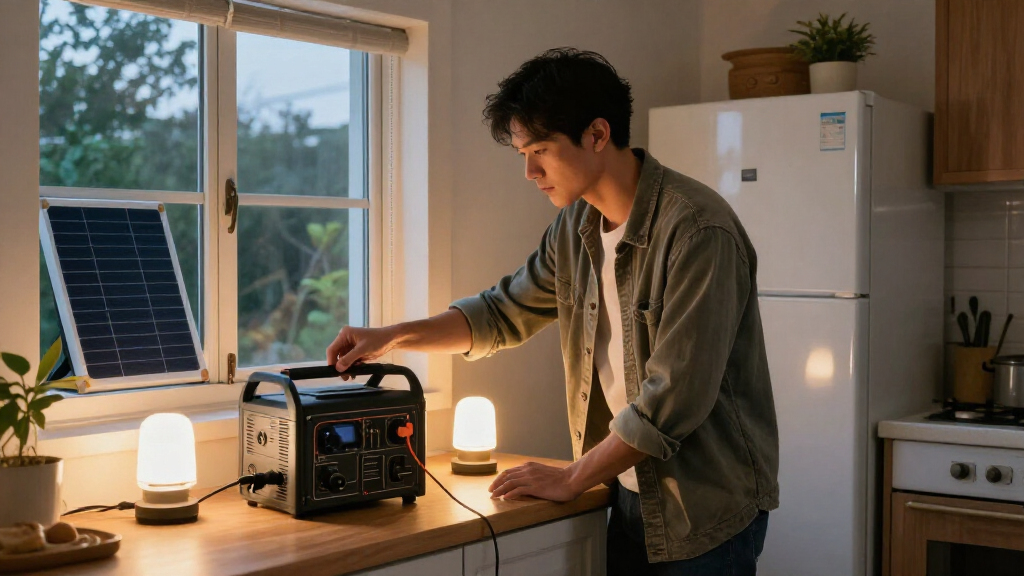
I ranked these solar generators for home backup by how well their stated capacity and AC output can support common outage priorities, such as communications, lighting, refrigeration and selected small appliances. I also compared battery chemistry where specified, the size and quantity of included solar panels, and whether a listing is a power station alone or a ready-to-charge bundle. Those details affect both likely runtime and the practical effort of building a backup setup.
The ranking favors products with a useful balance of stored energy, output and a clear path to solar charging, rather than simply rewarding the largest number on a spec sheet. I place compact units lower for extended household backup, while recognizing their value for limited loads and easier storage. Product listings do not provide every detail needed to predict performance in a specific home, so buyers should verify surge output, solar-input limits, transfer-switch support, expansion options and appliance compatibility before purchase.
| solar generators for home backup | Battery chemistry |
|---|---|
| ABOK Ark3600 Portable Power St | LiFePO4 |
| EF ECOFLOW DELTA Pro Portable | LFP |
| EcoFlow DELTA 3 Ultra 3072Wh P | LiFePO4 |
| EF ECOFLOW DELTA 3 Max Portabl | — |
| Jackery HomePower 3600 Plus Po | — |
| Jackery HomePower 3600 Plus Po | LFP |
| OSCAL PowerMax 6000 Solar Gene | LiFePO4 |
| EF ECOFLOW DELTA 3 Max Portabl | LiFePO4 |
| ABOK Ark3600 Portable Power St | — |
| EF ECOFLOW DELTA 3 Classic Por | LiFePO4 |
| SolarPlay Q3600 3600W Portable | LiFePO4 |
| Jackery Solar Generator 1000 V | — |
Factors to Consider When Choosing Solar Generators For Home Backup
Choosing a backup power station starts with the outage plan, not the panel bundle or headline wattage. I would first decide which circuits or appliances matter most, then check whether the unit can power them together and for the number of hours you need. These broader checks can help prevent overspending on capacity you cannot use—or choosing a unit that falls short when an outage lasts longer than expected.
Size Capacity Around Essential Loads
Capacity, measured in watt-hours, is a rough guide to how much energy a station stores, not a guarantee of how long it will run a device. Add up the watt-hours needed by your planned loads over the outage period, allowing room for conversion losses and changing appliance cycles. A refrigerator, for example, may cycle rather than draw its rated power continuously, while a heater can consume energy steadily and drain a battery quickly. A common mistake is to size for every household appliance instead of naming a short list of essential loads. If you need overnight refrigeration plus phones and lighting, a smaller station may fit; running several large appliances for a day calls for much more stored energy or a plan to recharge. I would use your appliances’ labels or a plug-in energy meter to estimate actual consumption before choosing capacity.
Match AC Output to Starting and Running Power
Output wattage sets the limit on what a power station can run at one time, while surge capability determines whether it can start equipment with a motor or compressor. Refrigerators, pumps and some power tools can briefly demand more power at startup than their steady running draw suggests. Check both the continuous and surge ratings against the appliance manual, and leave headroom rather than assuming a unit can sustain its maximum output indefinitely. Buyers often focus on a large watt-hour figure and overlook an output limit that rules out a key appliance. For home backup, circuit-level planning also matters: a portable unit’s AC outlets do not automatically feed a house’s wiring. If you want to power fixed circuits, confirm that the model supports an approved transfer method and arrange qualified installation where needed.
Treat Solar Panels as a Recharge System, Not a Runtime Guarantee
Panel wattage describes rated output under favorable conditions; actual charging varies with cloud cover, season, orientation, shade and temperature. A larger panel bundle can shorten recharge time, but only if the station accepts that much solar input and the panels can be connected within its voltage and current limits. Check the power station’s solar-input specifications and connector requirements before buying extra panels or combining panels from different brands. A common mistake is to assume that the wattage printed on a bundle equals power available throughout the day. For multi-day outages, think about when panels can be placed in direct sun and whether the station can still serve essential loads while charging. If reliable charging matters, compare the solar setup with wall or vehicle charging as backup options rather than relying on one source alone.
Check Whether You Need a Portable Station or Home Integration
A portable power station is easiest to use for appliances plugged directly into its outlets, but that approach can become inconvenient when you want to support selected home circuits. Home integration may require compatible equipment, a transfer switch, wiring work and local-code compliance. Not every product listing clearly establishes those details, so confirm the manufacturer’s supported setup before treating a station as a substitute for a home backup system. Buyers who only need to keep a refrigerator, modem and lamps running may prefer a straightforward plug-in arrangement. Those who expect to power fixed circuits should prioritize documented integration options and professional installation over a higher headline capacity. Also check outlet count and outlet type, since those affect how many devices can connect without extra adapters.
Choose Portability and Storage for the People Who Will Use It
Large-capacity stations can weigh enough that moving one between a storage spot and a sunny location becomes a real part of the backup plan. Consider whether the unit will stay in place, roll between rooms or need to be lifted by one person, and check its listed weight and dimensions. A compact station may be more practical for an apartment or for powering a few priority devices, even if it offers less runtime. Panel bundles add more storage and setup work, so account for where panels will be kept and how quickly someone can deploy them. Another overlooked factor is cable reach: a sunny outdoor location may not be close to the station or the appliances. I would favor a setup that the household can deploy safely and consistently over a larger one that is difficult to move or connect.
Compare Battery Life, Warranty and Expansion Before Paying More
Battery chemistry can inform expectations for cycle life, but it is only one part of long-term value. Check the warranty terms, rated cycle life if provided, operating temperature limits and the manufacturer’s guidance for storage and maintenance. Expansion batteries can extend runtime, yet they add expense, weight and possible compatibility constraints; confirm the exact supported accessories for the model and version you are buying. Do not assume two stations with similar capacities offer the same upgrade path or service support. Paying more can make sense when it buys a capability your outage plan needs, such as greater output, documented expansion or a useful solar bundle. If your planned loads are modest, a simpler station may be the better fit than buying capacity or add-ons that will rarely be used.
Frequently Asked Questions
Can a solar generator run my refrigerator during an outage?
It can if its continuous output supports the refrigerator and its surge rating can handle compressor startup. Runtime depends on the refrigerator’s actual energy use, how often its compressor runs, ambient temperature and other loads sharing the station. The larger-capacity options in this roundup are better starting points for extended refrigeration backup than the 1,024Wh or 1,070Wh models, but capacity alone does not confirm compatibility. Check the appliance label or measure its consumption, then compare that figure with the station’s output and capacity. Keep ventilation clear and follow the appliance and station instructions during backup use.
Is a 3,600Wh station enough to power my whole house?
Not automatically. A 3,600Wh rating describes stored energy, while the station’s output limits how much power it can supply at one time; large loads such as electric heating, cooking or central air can use that energy quickly or exceed the output limit. Many households use a portable station for selected essentials rather than every circuit. List the appliances you want to run, estimate their energy use and check their starting demands before deciding. If you want to power home circuits, verify transfer-switch compatibility and installation requirements instead of relying on extension cords as a whole-home solution.
Should I buy a solar-panel bundle or the power station by itself?
A bundle is convenient if you are starting from scratch and want compatible panels included, but the panel quantity and wattage vary considerably across these listings. A station-only option can make more sense if you already own compatible panels or plan to build a larger array later. Before choosing, check the station’s maximum solar input, voltage range, connectors and any rules for connecting panels in series or parallel. Rated panel wattage is not the same as guaranteed daily energy, since sunlight, shade and season affect production. Compare the full charging setup you need, including cables and panel storage, rather than judging a bundle by panel count alone.
Can I recharge a solar generator while it is powering my appliances?
Some power stations support charging and discharging at the same time, but the allowed operation and performance depend on the model. Even when supported, solar input may not keep pace with the energy being used, especially under weak sunlight or with high-draw appliances. Check the product documentation for pass-through charging behavior, solar-input limits and any restrictions on using AC outlets while charging. For a longer outage, lowering consumption often matters more than adding panels alone. Plan around likely daily energy use and available sun, and avoid relying on simultaneous charging as a guaranteed way to keep the battery level steady.
What should I prioritize if I want backup for more than one day?
For multi-day backup, plan for both stored energy and a dependable way to recharge it. A large battery helps through the first night, while a compatible solar array can replenish some energy during daylight; actual output will vary with weather and placement. Prioritize essential loads, reduce unnecessary consumption and check whether the station can accept enough solar input for your intended routine. Keep a fallback charging option in mind if clouds persist or panels cannot be set out safely. The included-panel bundles in this roundup differ, so compare their rated panel capacity with the station’s accepted input rather than assuming every bundle can sustain the same daily use.
Conclusion
For a broad mix of essential home loads, my best overall pick is the EF ECOFLOW DELTA Pro, whose stated 3,600Wh capacity and 3,600W output balance stored energy with substantial AC output. For buyers seeking a large station without assuming a panel bundle is necessary, the Jackery HomePower 3600 Plus station-only model is a strong value-oriented choice; the four-panel package suits shoppers who want panels included. I would call the OSCAL PowerMax 6000 the premium-style pick for buyers drawn to its higher stated output and three-panel bundle, while reminding them to verify solar-input compatibility and setup needs. For beginners with modest backup plans, the Jackery Solar Generator 1000 V2 offers a smaller, more focused entry point. If easy storage and targeted essentials matter most, compare that with the DELTA 3 Classic; if you need more capacity, the DELTA 3 Max options step up while remaining below the largest stations. Choose by matching your actual loads, recharge plan and installation needs—not by capacity alone.