TL;DR

Get backup power and energy gear delivered free with Prime
- Fast, free delivery on millions of items
- Prime Video, Amazon Music and more included
- Member-only deals all year
Silicon Ranch has introduced a 15-cow herd at a 3.25-megawatt solar project in Christiana, Tennessee, using equipment designed to accommodate cattle. The developer says the system cost 3% more than a standard design and sold electricity to Middle Tennessee Electric below the utility’s wholesale rate from the Tennessee Valley Authority. The project is an early utility-scale test; its performance, wider costs and potential for broader adoption remain uncertain.
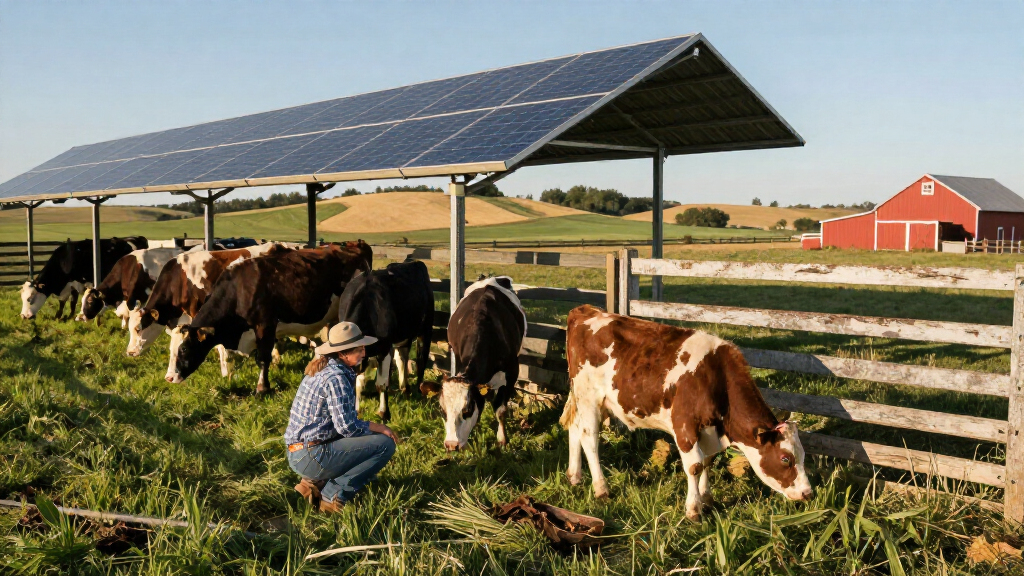
Silicon Ranch has brought 15 cattle onto a 3.25-megawatt solar site in Christiana, Tennessee, pairing utility-scale electricity generation with grazing on the same land. The project tests whether a purpose-built panel system can let cattle and solar equipment share a field without making the arrays too costly or vulnerable to damage.
The herd moves among 15 paddocks separated by electric wire, grazing Bermuda grass beneath panels mounted higher than usual. The solar developer says it began the project six months before the report. The account describes the cattle as having gained weight, but provides no measured comparison of their growth, grazing productivity or farm revenue.
Silicon Ranch designed a system it calls CattleTracker, using moderately elevated steel supports and adjusted controls for the solar trackers. In the paddock where cattle are grazing, the trackers enter “graze mode,” limiting panel tilt to about 20 to 30 degrees, rather than the maximum 60 degrees described for the system. The change is intended to keep lower panel edges above the animals.
Silicon Ranch said reinforcing the arrays added 3% to project costs compared with a standard design. The company also said it sold electricity to Middle Tennessee Electric for less than the wholesale rates the utility was paying to the Tennessee Valley Authority. The report does not provide the contract price, a cost breakdown or a longer-term financial comparison.
The project addresses a land-use problem facing both solar developers and rural communities: solar farms can prompt opposition when residents see them as replacing farmland or changing local landscapes. Grazing cattle under panels offers one way to keep agricultural activity on land that also generates electricity, rather than treating power production and farming as competing uses.
If the approach proves practical at larger scale, it could give landowners an additional source of income and help developers add generation where suitable open land is limited. Those are potential benefits, not demonstrated outcomes yet: the source report gives no revenue figures for the cattle operation and does not establish that the model will be economical across different sites.
The project also has a clear boundary as a climate measure. Solar panels generate electricity without the direct emissions of fossil-fuel power plants, but the report says the model does not address greenhouse gases from cattle, including methane associated with digestion. It is a land-sharing approach, not a solution to livestock emissions.
Products Worth Considering

EcoFlow Delta 3 Max Portable Power Station with 220W Solar Panel, 2048Wh

Anker SOLIX C300 DC Portable Power Station with 60W Solar Panel, 288Wh, 300W

Jackery Explorer 300 Portable Power Station with 40W Solar Panel
As an affiliate, we earn on qualifying purchases.
Why Cattle Need Different Arrays
Solar developers commonly use sheep to control vegetation at project sites, and research has examined crops and grasses that can grow under panels. Cattle pose a different equipment challenge: their size and behavior could damage panels or other infrastructure. Designing a solar site to accommodate them may require changes that add costs, a concern for developers seeking to maximize electricity production per acre.
The report describes the Christiana installation as the first commercially viable utility-scale project combining solar and cattle farming in the United States, according to Silicon Ranch. An earlier 2-megawatt AES project in Massachusetts sought to test the concept in the community-solar market. The distinction between those projects is attributed to Silicon Ranch; the report does not provide an independent industry-wide assessment of commercial viability.
Silicon Ranch’s design work followed a Department of Energy grant, according to the report. Rather than making the panels dramatically taller, the company adjusted their supports and operating controls. The tracker changes matter because solar panels normally rotate to follow the sun; in grazing mode, their movement is restricted to maintain clearance above the cattle.
“I thought it would work — I just didn’t think it would work this well.”
— Loran Shallenberger, who leads Silicon Ranch’s Regenerative Energy and Agrivoltaics division
Long-Term Costs and Results
The project is an early test, and long-term operating data are not provided. It remains unclear whether the panels, trackers and electrical equipment will hold up to years of nearby cattle activity, how much maintenance the system will need, or whether the reported 3% cost premium will apply to other projects.
The available account also does not quantify the cattle operation’s effect on farm income, meat production or the utility’s overall energy costs. Silicon Ranch’s description of the project as commercially viable is a company claim, and the reported electricity price comparison is not accompanied by contract figures or a stated time period.
More broadly, the evidence does not yet establish how well the model can be repeated across different herd sizes, grazing practices, climates or solar designs. Jennings said research on cattle interaction with panels is still relatively new and uncertainty remains about how the animals behave around the equipment.
Tracking the Project’s Performance
The immediate test is whether the system continues to operate reliably as the herd rotates through its paddocks. Useful follow-up information would include equipment damage and maintenance records, cattle and pasture performance, project costs over time, and the terms of the power sale to Middle Tennessee Electric.
Silicon Ranch and other developers would need results from operating projects to judge whether cattle-compatible designs can be repeated at more sites without undermining solar economics. The report does not announce a timeline for a further evaluation or additional projects, so the scale and pace of any expansion remain unknown.
Key Questions
Where is the cattle-and-solar project?
It is at a 3.25-megawatt solar site in Christiana, Tennessee, about 45 minutes southeast of Silicon Ranch’s Nashville headquarters, according to the report.
How many cattle are grazing beneath the panels?
The report describes a 15-member herd rotating among 15 paddocks. The cattle are a Murray Grey breed, which Silicon Ranch selected for its calm disposition, according to the account.
How are the panels adapted for cattle?
Silicon Ranch uses moderately elevated supports and a tracker setting called graze mode. In the active paddock, the trackers limit panel tilt to about 20 to 30 degrees so the lower edges stay above the animals.
Does the project show that solar grazing is already profitable?
No. Silicon Ranch said the array modifications cost 3% more than its standard design and that electricity was sold below the utility’s wholesale rate from the Tennessee Valley Authority. The report does not give enough financial or long-term operating data to establish profitability across the project or the wider industry.
Does cattle grazing under panels reduce livestock emissions?
The report does not say that it does. The approach combines solar generation and cattle grazing on the same land, but it does not address greenhouse gases produced by cattle.
Source: canarymedia.com