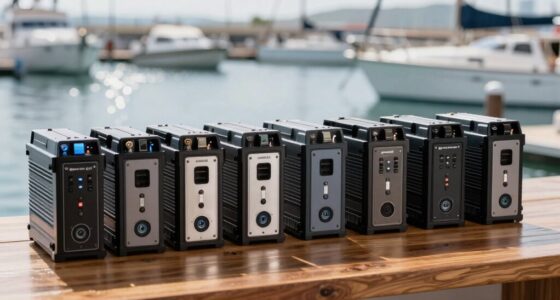
When considering solar backup power stations, the key factors are capacity, charging speed, portability, and expandability. The Anker SOLIX C1000 stands out as the best overall due to its fast charging and reliable battery. For those seeking more power, the Jackery HomePower 3600 Plus offers massive capacity and expandability, ideal for complete home backup. The main tradeoffs involve balancing size, cost, and charging times—larger models tend to be more expensive and less portable, while smaller units might not meet all backup needs. Continue reading for a detailed breakdown of these options and what suits your specific backup scenario.
Key Takeaways
- High-capacity models like the Jackery HomePower 3600 Plus excel for full home backup but come with higher costs and size considerations.
- Fast charging speeds, such as those under 50 minutes, are a hallmark of top-tier models like the Anker SOLIX C1000 Gen 2, reducing downtime during outages.
- Battery chemistry matters—LiFePO4 batteries provide longer life and better safety, making them a preferred choice in this category.
- Portability varies widely; smaller units are easier to carry but may lack the power needed for larger backup demands.
- Expandable systems like the Jackery Explorer series offer flexibility, but often at a premium, for users who want future-proof setups.




More Details on Our Top Picks
Anker SOLIX C1000 Gen 2 Portable Power Station, 2,000W (Peak 3,000W) Solar Generator, Full Charge in 49 Min, 1,024Wh LiFePO4 Battery for Home Backup, Power Outages, and Camping (Optional Solar Panel)
This model makes the list for its combination of high surge power—up to 3,000W—and a compact design, weighing just 11.3 kg and being 14% smaller than similar models like the Jackery Explorer 1000 v2. Its fast recharge time of 49 minutes via 1600W input ensures you’re ready quickly for emergencies or outdoor adventures. The 1024Wh LiFePO4 battery offers reliable, long-term performance with over 4,000 cycles retaining 80% capacity, similar to the Jackery HomePower 3000 but in a smaller footprint. Its 10 ports support powering multiple devices, from laptops to small appliances. The 600W solar input enables a full recharge in under 2 hours, making it suitable for off-grid use. Yet, the slightly lower capacity might limit longer outages compared to larger units like the Jackery HomePower 3600. This is ideal for users who need a powerful, portable backup that’s easy to carry and quick to recharge.
Pros:- Lightweight at 11.3 kg for easy portability
- Fast recharge in under 50 minutes with HyperFlash tech
- Peak surge power of 3,000W supports large appliances
Cons:- Battery capacity slightly lower than larger units like the Jackery HomePower 3600
- Price premium for its compact size and rapid charging
Best for: Campers, tailgaters, and remote workers who need portable, high-wattage power without bulk.
Not ideal for: Users requiring all-day backup with higher capacity for extended outages or larger appliances.
- Peak Wattage:3000W
- Battery Capacity:1024Wh
- Recharge Time (solar):1.8 hours
- Battery Chemistry:LiFePO4
- Number of Ports:10
- Weight:11.3 kg
- Size:14% smaller than comparable models
- Cycles:Over 4,000
Bottom line: This generator suits active users needing quick, high-power backup in a portable form factor for outdoor or emergency use.
EF ECOFLOW Portable Power Station DELTA 2, 1024Wh LiFePO4 (LFP) Battery, 1800W AC/100W USB-C Output, Solar Generator(Solar Panel Optional) for Home Backup Power, Camping & RVs
This model excels with its rapid charging—reaching 80% in just 50 minutes—and its expandable capacity up to 3kWh with add-on batteries, making it suitable for varied backup needs. Its 1800W AC output can power most household appliances, comparable to larger generators, but without the noise or fumes. The 15 outlets provide extensive device support, ideal for camping, RV, or emergency home power. The support for up to 500W solar input allows for eco-friendly recharging, especially useful during extended off-grid stays. The LFP battery chemistry ensures over 3,000 cycles, promising longevity. However, the base capacity of 1024Wh may be limiting for prolonged outages unless additional batteries are added. This makes it perfect for users who want a fast-charging, expandable system that’s versatile for both home and outdoor use.
Pros:- Fast charging in under an hour
- Expandable capacity from 1kWh to 3kWh with extra batteries
- Supports up to 500W solar input for eco-charging
Cons:- Base capacity of 1024Wh may be limiting for long-term outages
- Additional batteries increase cost and complexity
Best for: Families and outdoor enthusiasts needing quick recharge and capacity expansion for unpredictable power needs.
Not ideal for: People seeking a high-capacity, plug-and-play solution for multi-day outages without additional batteries.
- Wattage:1800W
- Battery Capacity:1024Wh
- Recharge Time (solar):up to 2 hours
- Battery Chemistry:LiFePO4
- Number of Outlets:15
- Expandable:Yes, up to 3kWh with extra batteries
- Weight:around 15 lbs
- Cycles:Over 3,000
Bottom line: This generator is well-suited for users who value fast recharge and the ability to expand capacity for longer off-grid stays or emergencies.
Jackery HomePower 3000 Portable Power Station with 2X 200W Solar Panels, 3600W (Surge 7200W) Output, 3072Wh LFP Battery Solar Generator, Essential Backup for Home Use, Power Outage, RV, Emergencies
This model offers a massive 3600Wh capacity and a surge power of 7200W, making it ideal for comprehensive home backup and large appliances. Its long-lasting LiFePO4 battery supports over 4,000 cycles, promising years of dependable service. The fast recharge via solar or AC—up to 80% in 9 hours with panels—ensures readiness for extended outages. Its multiple outlet options support everything from refrigerators to power tools, and the UL-certified UPS guarantees seamless switching during outages, protecting sensitive devices. Compared with smaller units like the Jackery Explorer 1000, the HomePower 3000 provides unmatched capacity and surge capabilities. The main tradeoff is size and weight, which makes it less portable but perfect for stationary backup. This is best for users needing a robust, long-term power solution for large appliances and whole-house backups.
Pros:- High capacity of 3600Wh for extended outages
- Surge power up to 7200W supports large appliances
- Long cycle life of over 4,000 cycles
Cons:- Heavy and bulky for portable use
- Higher cost compared to smaller models
Best for: Homeowners requiring reliable, high-capacity backup power for critical appliances during prolonged outages.
Not ideal for: Travelers or outdoor users who need lightweight, portable units for short-term use.
- Capacity:3600Wh
- Peak Wattage:7200W
- Recharge Time (solar):up to 9 hours
- Battery Chemistry:LiFePO4
- Number of Outlets:Multiple including AC, USB
- Cycle Life:Over 4,000
- Weight:significantly heavier
- Size:larger footprint
Bottom line: This is the best choice for users prioritizing long-term, high-capacity backup for the entire home or large appliances.
Jackery Solar Generator 1000 v2 with 2 * 200W Solar Panels, 1070Wh LiFePO4 Portable Power Station, 1500W AC Output, 1hr Fast Charge, Backup Power for Outdoor Camping, RV, Off-Grid & Emergency
This unit shines with its lightweight design at just 23.8 lbs and a rapid 1-hour recharge from zero with solar or AC, making it perfect for outdoor adventurers. Its 1500W AC output supports most small to medium appliances, comparable to some smaller portable generators. The 1070Wh capacity, powered by high-quality LiFePO4 cells, provides over 4,000 cycles, ensuring long-term reliability. The inclusion of two 200W solar panels allows for quick solar recharge—up to 80% in 3 hours—ideal for extended camping or off-grid use. Unlike larger, bulkier units like the Jackery HomePower 3600, this model focuses on portability and speed, though it sacrifices some capacity for weight. Its multiple ports support a variety of devices, making it versatile for outdoor and emergency use. It is best suited for users who need a light, fast-charging backup for shorter trips or brief outages.
Pros:- Lightweight at 23.8 lbs for portability
- Fast recharge in just 1 hour
- Supports up to 1500W AC output
Cons:- Lower capacity than larger units like the HomePower 3600
- Additional panels increase initial cost
Best for: Outdoor enthusiasts, campers, and emergency prepper who need a portable, quick-charging power station.
Not ideal for: Those requiring multi-day backup or to power large appliances continuously.
- Capacity:1070Wh
- Wattage:1500W
- Recharge Time (solar):about 3 hours
- Battery Chemistry:LiFePO4
- Weight:23.8 lbs
- Number of Ports:Multiple including AC
- Cycle Life:Over 4,000
- Includes:2x 200W solar panels
Bottom line: Ideal for users who prioritize portability and rapid charging for outdoor or short-term emergency power needs.
Jackery HomePower 3600 Plus Portable Power Station, 3600W AC Output, 3584Wh LFP Solar Generator, Expandable up to 21kWh, Essential Home Backup for Home Use, Emergencies, RV (Solar Panel Optional)
This model stands out for its high output capacity, offering 3600W with dual voltage support for essential household appliances during outages. It surpasses the Jackery Explorer 2000 v2 in capacity and expandability, making it better suited for larger households or those with heavy power demands. The built-in high-temp resistant LFP cells provide a long lifespan of over 6,000 cycles and a 10-year durability, which is critical for reliable long-term backup. Its plug-and-play design makes installation straightforward, resembling a home system rather than a portable unit. However, its weight of over 77 pounds and size do limit portability, making it less ideal for frequent moves or outdoor adventures. The multiple charging options, including solar, gas, and hybrid, add flexibility, but the initial cost can be substantial for some buyers. Overall, this pick makes the most sense for homeowners seeking a scalable, safe, and long-lasting backup power solution without the need for complex installation.
Pros:- Exceptional capacity expandable up to 21kWh, suitable for whole-house backup
- Dual voltage support (120V & 240V) with high-wattage output
- Long lifespan of over 6,000 cycles and 10-year durability
- Multiple charging options including solar, gas, and hybrid
Cons:- Heavy at over 77 pounds, limiting mobility
- Expensive compared to smaller portable options
Best for: Large households or small businesses needing reliable, expandable home backup power without complex installation.
Not ideal for: Frequent travelers or outdoor campers who prioritize portability over capacity and scalability.
- Wattage:3600W
- Capacity:3584Wh expandable to 21kWh
- Voltage:120V & 240V
- Battery Type:LFP
- Runtime:Power depends on load, over 2 weeks for typical household
- Charging Options:AC, solar, gas, hybrid
Bottom line: This power station is ideal for homeowners seeking a scalable, long-lasting backup system that can grow with their needs.
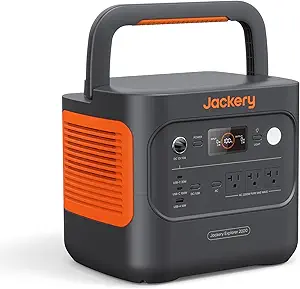
Jackery Explorer 1000 v2 Portable Power Station
This model offers 1500W continuous power and a 1070Wh LiFePO4 battery, making it well-suited for camping, small emergencies, and off-grid use. It compares favorably to the Explorer 2000 v2 in portability and price, but provides less capacity and power output. The 1-hour emergency charging via app is a major advantage for quick top-ups, and the durable LiFePO4 cells promise over 4,000 cycles, ensuring a decade of reliable service. Its lightweight design at just under 24 pounds and foldable handle make it easy to carry for outdoor activities. However, its limited capacity means it cannot power larger appliances or multiple devices simultaneously for extended periods, and solar panels are sold separately. This pick makes the most sense for users seeking a portable, reliable backup for small appliances or electronics during power outages or outdoor trips.
Pros:- Lightweight and portable at under 24 lbs with foldable handle
- Fast 1-hour emergency recharge via app
- Long-lasting LiFePO4 battery with over 4,000 cycles
- Good for powering essential small appliances and electronics
Cons:- Limited capacity restricts runtime for larger appliances
- Solar panels are sold separately, increasing overall system cost
Best for: Campers, outdoor enthusiasts, and small household users needing reliable portable backup power.
Not ideal for: Large households or those requiring continuous power for heavy appliances or multiple devices over long outages.
- Battery Capacity:1070Wh
- Wattage:1500W continuous
- Weight:23.8 lbs
- Lifespan:Over 4,000 cycles
- Charging Time:1 hour via app
- Ports:2 USB-C, 1 USB-A, 3 AC
Bottom line: Ideal for outdoor and emergency use where portability and quick recharge are priorities over high capacity.
Jackery Explorer 2000 v2 Portable Power Station, 2042Wh LiFePO4 Home Backup Battery, 2200W Solar Generator, USB-C PD 100W Fast Charging for Emergencies, Power Outages, Camping(Solar Panel Optional)
This model combines high capacity with ultra-quiet operation, making it a prime choice for home backup and discreet outdoor use. It features a 2042Wh LiFePO4 battery capable of delivering 2200W continuously, surpassing the Explorer 1000 v2 in both power and runtime. Its silent charging mode at less than 30dB enables peaceful operation during power outages or outdoor activities, and the 10+ year lifespan with 4,000 cycles offers long-term dependability. Its 58-minute full charge via AC or solar makes it fast for its size, while the 20ms seamless UPS switch ensures critical devices stay powered during outages. The unit weighs around 39.5 pounds, striking a balance between capacity and portability. The main tradeoff is its higher cost and the need to purchase solar panels separately, which may be a hurdle for budget-conscious users. Still, for those seeking a quiet, reliable backup that can handle larger loads, this option makes excellent sense.
Pros:- Quiet operation at less than 30dB, perfect for home use
- Large 2042Wh capacity with 2200W continuous power
- Seamless UPS switching for critical devices
- Long lifespan of over 4,000 cycles
Cons:- Higher price point compared to smaller units
- Solar panels sold separately, adding to total cost
Best for: Homeowners and small businesses needing dependable, quiet backup power with long-term durability.
Not ideal for: Frequent travelers or outdoor adventurers who prioritize lightweight, portable units over large capacity and silent operation.
- Capacity:2042Wh
- Wattage:2200W
- Lifespan:Over 4,000 cycles
- Charging Time:58 minutes AC/solar
- Weight:39.5 lbs
- Ports:3 AC, USB-C PD 100W
Bottom line: This power station suits users seeking a long-lasting, silent backup solution for home or small business emergencies.
OUPES 2000W Solar Generator with LiFePO4 Battery and Panels
This generator excels with its 36-minute fast charging capability, making it an excellent choice for quick top-ups during outages or outdoor adventures. It offers a robust 2000W pure sine wave AC output with a surge capacity of 4500W, outperforming the Jackery Explorer 1000 v2 in surge power, ideal for heavy-duty appliances and tools. The 1024Wh LiFePO4 battery, expandable to 5120Wh, provides flexibility for long-term power needs, but the initial capacity is on the smaller side for extended outages. Its included 100W solar panel allows for rapid solar recharge, reducing dependency on grid power. Weighing only 27.8 lbs, it’s highly portable for camping or emergency kits, but the higher price and need for additional batteries for full expansion can be a barrier for some users. This makes it a compelling option for those who prioritize fast recharge and high surge capacity for demanding devices.
Pros:- Fast 36-minute recharge via AC or solar
- 4500W surge capacity for heavy appliances
- Expandable to 5120Wh with additional batteries
- Includes 100W solar panel for quick solar charging
Cons:- High initial cost for base unit
- Additional batteries needed for full capacity
Best for: Outdoor workers, campers, and emergency preparedness enthusiasts needing rapid recharge and high surge power.
Not ideal for: Home users requiring extended backup durations without additional batteries or those on a tight budget.
- Wattage:2000W
- Surge Power:4500W
- Battery Capacity:1024Wh, expandable to 5120Wh
- Charging Time:36 minutes to 80%
- Port Selection:4 AC, USB-C PD, USB-A, DC
- Weight:27.8 lbs
Bottom line: This generator is well-suited for heavy-duty outdoor and emergency applications where fast recharge and surge power are critical.
Anker SOLIX C2000 Gen 2 Portable Power Station
This station provides 2400W of continuous power with a 4000W peak, making it suitable for simultaneous operation of multiple appliances during outages or outdoor events. It significantly outperforms the Explorer 1000 v2 in peak power, which is essential for heavy-duty devices. Its 2048Wh LiFePO4 battery ensures long-lasting use, and the rapid 58-minute full charge via AC or solar makes it attractive for quick turnaround times. The unit’s compact size and weight of 41.7 pounds make it more portable than larger models, though this still might be heavy for some users. The absence of an included solar panel means additional investment for solar charging capabilities, adding to the total expense. This pick makes sense for those who want high power and fast recharge in a portable form factor for home backup or outdoor use.
Pros:- Ultra-fast 58-minute full charge via AC or solar
- High peak power of 4000W for multiple appliances
- Compact and lightweight for its capacity
- Expandable capacity up to 4000Wh
Cons:- Solar panel sold separately, increasing overall cost
- Higher price point for comparable capacity units
Best for: Home users and outdoor enthusiasts needing quick recharge and high peak power in a portable form.
Not ideal for: Budget-conscious buyers or those requiring an all-in-one package with solar panel included.
- Battery Capacity:2048Wh
- Peak Power:4000W
- Charge Time:58 minutes
- Weight:41.7 lbs
- Ports:Multiple AC, USB-C PD, USB-A
Bottom line: This power station is best for users who prioritize rapid charging and high peak power in a portable package for home or outdoor use.
How We Picked
Products were evaluated based on a combination of capacity, charging speed, build quality, battery chemistry, port selection, and expandability. Performance under real-world backup scenarios was prioritized, alongside usability features such as ease of recharge and outdoor ruggedness. Devices with faster recharge times and longer-lasting batteries ranked higher, as these factors directly impact reliability during outages. Cost was considered but balanced against features to highlight the best value options. The ranking reflects a balance between power, speed, durability, and user versatility, ensuring a broad appeal for different backup needs.Factors to Consider When Choosing Solar Backup Power Stations
Choosing the right solar backup power station requires understanding your specific backup needs, whether for emergency home use, outdoor adventures, or off-grid living. Beyond initial specs, considering how the unit integrates with solar panels, its expandability, and ease of use can significantly impact satisfaction. This guide highlights key factors to consider to help you make a more informed decision and avoid common pitfalls.Capacity and Power Output
The primary factor is how much power you need. Larger capacities, such as over 3,000Wh, are suitable for whole-home backup, while smaller units are better for camping or emergency essentials. Pay attention to the continuous wattage output to ensure it can run your critical devices. A mismatch here can leave you with a unit that cannot handle your essential appliances during an outage.
Charging Speed and Solar Compatibility
Fast recharge times, ideally under an hour, minimize downtime during outages. Check if the unit supports rapid solar charging and whether it includes compatible solar panels. Some models charge quickly via AC but are slower with solar, which could limit off-grid use. Be aware of the maximum solar input capacity to avoid buying panels that are under or overpowered for the unit.
Battery Chemistry and Longevity
LiFePO4 batteries dominate this category because of their longer cycle life and safety advantages. Cheaper lithium-ion batteries may degrade faster, requiring replacements sooner. Investing in battery chemistry that offers better longevity can save money over the long term, especially if you plan to rely on the unit regularly or for extended backup periods.
Portability and Size
Consider how portable the unit is—smaller, lighter models suit outdoor use or frequent transport, but may lack the capacity of larger stations. Conversely, large, stationary units are better for permanent backup but less convenient to move. Think about where you’ll deploy the system most often and choose accordingly to avoid frustration or underperformance.
Expandability and Connectivity
Some models offer modular designs or multiple expansion options, allowing you to increase capacity as needed. This flexibility can be valuable if your backup needs grow or change over time. However, these systems often carry a higher initial cost and complexity, so assess whether the added features align with your long-term backup plans.
Frequently Asked Questions
Can I run my entire house on a solar backup power station?
Running an entire house depends on the station’s capacity and the total power draw of your appliances. Most portable units are designed for essential devices rather than full home systems. For full-house backup, a dedicated, high-capacity station like the Jackery HomePower 3600 Plus is more suitable, but it still requires careful planning. Additionally, integrating with your electrical system through a transfer switch can ensure safe operation during outages.
How long can a solar backup power station run my devices during an outage?
The runtime depends on your device’s power consumption and the station’s capacity. Smaller units may only last a few hours for essential devices, while larger stations with over 3,000Wh can support critical appliances for days. Always calculate your total wattage needs and compare it to the station’s output to estimate runtime accurately, avoiding surprises during extended outages.
Are LiFePO4 batteries worth the extra cost?
Yes, LiFePO4 batteries tend to last longer, typically over 2000 cycles, and are safer due to their thermal stability. While they come at a higher initial cost, their durability and longer lifespan often justify the investment, especially if you plan to rely on the system frequently. Cheaper alternatives might save money upfront but could require replacement sooner, adding to long-term expenses.
Can I expand my solar backup station later?
Many high-end models support expansion, allowing you to add more batteries or solar input capacity over time. This flexibility is ideal if your backup needs increase or if you want to spread out costs. However, not all units are expandable, so confirm compatibility before purchasing if future scaling is a priority. Be prepared for higher initial costs with expandable systems.
What should I look for in solar panels for backup power stations?
Choose panels that match the input capacity of your station to optimize charging efficiency. Monocrystalline panels generally offer higher efficiency in limited space, while polycrystalline options are often more affordable. Ensure the panels are durable and weather-resistant if you’ll use them outdoors. Proper matching of panel wattage and voltage ensures you get the most out of your solar investment and quicker recharges during outages.
Conclusion
For most users seeking a reliable, all-around backup solution, the Anker SOLIX C1000 Gen 2 offers a compelling balance of power, speed, and portability. If your priority is comprehensive home backup with room to grow, the Jackery HomePower 3600 Plus stands out despite its size and cost. Beginners or light users will find the Jackery Explorer 1000 to be straightforward and sufficient. For those with advanced needs and bigger budgets, the Anker SOLIX C2000 Gen 2 provides premium performance. Overall, matching your backup needs to the right capacity, expandability, and portability ensures you’ll stay powered when it matters most.