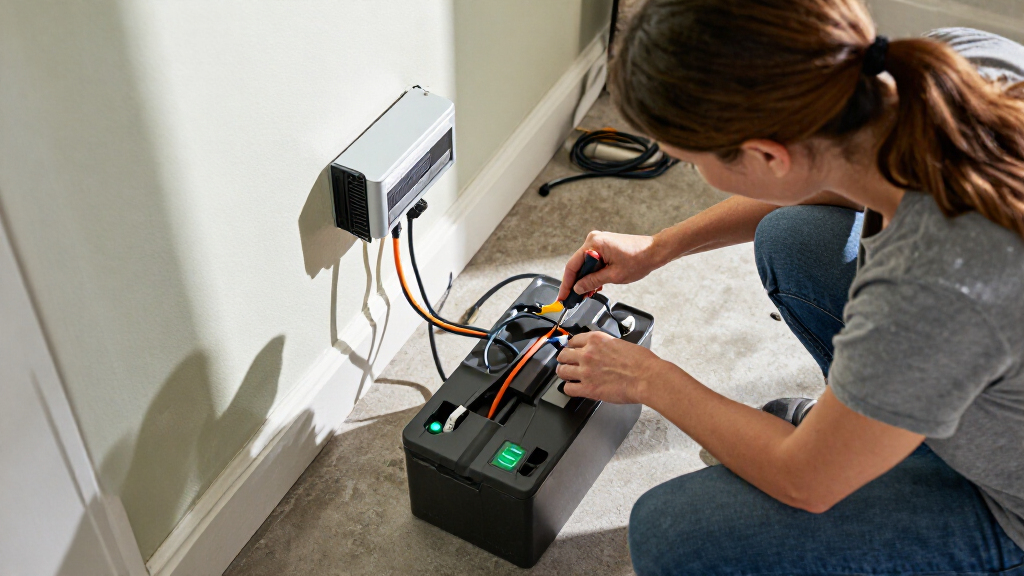

For buyers seeking a home battery backup system, my three picks serve distinctly different needs: the Jackery HomePower 3600 Plus is the strongest choice here for household-scale backup, the GOLDENMATE 1000VA/800W Lithium UPS suits computers and network gear, and the CyberPower CP1500PFCRM2U is a practical rackmount option for short interruptions. The central tradeoff is scale: Jackery supplies much more energy and can take solar or generator input, while the UPS models focus on keeping sensitive electronics running through brief outages or allowing a clean shutdown.

Get backup power and energy gear delivered free with Prime
- Fast, free delivery on millions of items
- Prime Video, Amazon Music and more included
- Member-only deals all year
These products are not interchangeable. A 3,584Wh power station can support selected household loads for far longer than a compact UPS, but it is heavier and requires a more deliberate setup. The CyberPower offers eight outlets and sine-wave output in a rack form, yet its listed runtime at full load is only about three minutes. GOLDENMATE adds a long-life LiFePO4 battery and a tower design, but its 800W output and roughly 30-minute full-load runtime are for electronics, not whole-home backup. I rank them by how well they match common home-backup needs, while making their limits clear.
Key Takeaways
- The Jackery is the only pick here with 3,584Wh of stated capacity and expansion up to 21kWh, making it the closest fit to extended backup for selected household loads.
- The Jackery’s 3,600W output and 120V/240V operation in parallel offer much more power flexibility than either UPS, but it weighs 77.2 pounds and lists only two outlets.
- The GOLDENMATE is the better small-system choice for computers and networking when long battery service life matters; its stated LiFePO4 lifespan exceeds 10 years and 5,000 cycles.
- The CyberPower‘s rackmount form, sine-wave output, AVR, and eight outlets favor a short-depth equipment rack, but its 1,000W rating does not mean long runtime at full load.
- Neither UPS should be treated as a household-scale battery: their power and runtime are intended for electronics, while the Jackery is the clear choice for larger, longer-duration loads.
| Jackery HomePower 3600 Plus Power Station, 3584Wh, 3600W AC Output |  | Best Overall for Selected Household Loads | Capacity: 3,584Wh | Continuous output: 3,600W | Voltage: 120V; 240V in parallel | VIEW LATEST PRICE | See Our Full Breakdown |
| GOLDENMATE 1000VA/800W Lithium UPS Battery Backup & Surge Protector, White |  | Best for Long-Life Electronics Backup | Capacity class: 1000VA | Maximum output: 800W | Voltage: 120V | VIEW LATEST PRICE | See Our Full Breakdown |
| CyberPower CP1500PFCRM2U PFC Sinewave UPS Battery Backup |  | Best Rackmount UPS for Brief Outages | Capacity class: 1500VA | Maximum power: 1,000W | Output voltage: 120V | VIEW LATEST PRICE | See Our Full Breakdown |
| home battery backup system | Voltage | Battery chemistry | Capacity class | Outlets |
|---|---|---|---|---|
| Jackery HomePower 3600 Plus Po | 120V; 240V in parallel | LFP (lithium iron phosphate) | — | — |
| GOLDENMATE 1000VA/800W Lithium | 120V | Lithium iron phosphate | 1000VA | 8 |
| CyberPower CP1500PFCRM2U PFC S | — | — | 1500VA | 8 |
More Details on Our Top Picks
Jackery HomePower 3600 Plus Power Station, 3584Wh, 3600W AC Output
The Jackery HomePower 3600 Plus earns the top spot because it is the only system in this lineup built around substantial stored energy rather than a short bridge for electronics. Its 3,584Wh capacity and 3,600W continuous output give it room to support a broader set of essential devices than either UPS. That makes it the strongest match for a homeowner who wants to keep chosen appliances or household circuits going during an outage, subject to their power draw and the way the system is connected. Its capacity can also expand up to 21kWh, an important distinction from the fixed, compact UPS units below.
Charging flexibility adds to its usefulness in an extended outage. The HomePower can charge through AC, solar, or a gas generator, so a buyer is not tied to one replenishment method. Solar input may help when grid service remains unavailable, while generator charging provides another route when weather or daylight is unhelpful. The CyberPower and GOLDENMATE are more straightforward for protecting equipment at a fixed location, but neither offers the same stated household-oriented capacity or charging mix. Jackery’s ability to operate at 120V and 240V in parallel may also serve more demanding configurations, though buyers should confirm what the parallel setup requires before planning around it.
Portability is a mixed benefit, not a reason to call this unit light. At 77.2 pounds, it is a substantial object to lift, even with the luggage-style rolling design. That form helps move it across suitable floors, but stairs, uneven ground, and loading it into a vehicle may still require help. The listed two outlets are another meaningful limitation: greater capacity does not automatically mean convenient access for many devices. Buyers may need a compatible distribution arrangement, and should check that their intended connections and loads are supported.
The LFP battery is rated for 6,000 cycles and a 10-year lifespan, which gives the Jackery a different ownership profile from the CyberPower’s lead-acid battery, listed with an average life of three years. GOLDENMATE also uses LiFePO4 and claims a lifespan exceeding 10 years, but it remains an 800W, electronics-focused UPS with much less stated output. My ranking favors Jackery for the broadest backup capability here, not for every household: it costs more upfront according to the product description, takes more space than a UPS, and needs careful load planning. Anyone seeking uninterrupted power for a router and desktop alone may find the GOLDENMATE or CyberPower more suitable and less cumbersome.
Pros:- 3,584Wh capacity and 3,600W continuous output suit substantially larger loads than either UPS in this lineup.
- Expandable capacity up to 21kWh offers more room for extended backup than the fixed-capacity options.
- AC, solar, and gas-generator charging give buyers several ways to replenish power.
- LFP battery is rated for 6,000 cycles and a 10-year lifespan.
Cons:- At 77.2 pounds, it is difficult to lift and move despite its rolling luggage-style design.
- The two listed outlets may be limiting for a home with many devices to connect.
- Its greater size and setup demands are unnecessary for buyers who only need a short bridge for computer equipment.
Best for: Households that want a high-capacity portable battery for selected essential loads, with solar or generator charging options and room to expand.
Not ideal for: Buyers who need a small desk- or rack-mounted UPS, many built-in outlets, or a system they can easily carry up stairs without assistance.
- Capacity:3,584Wh
- Continuous output:3,600W
- Voltage:120V; 240V in parallel
- Battery chemistry:LFP (lithium iron phosphate)
- Expandable capacity:Up to 21kWh
- Charging options:AC, solar, and gas generator
- Weight:77.2 pounds
Our verdict“I recommend the Jackery for buyers who need meaningful stored energy and flexible recharging, provided they can accommodate its weight, outlet limits, and setup needs.”
GOLDENMATE 1000VA/800W Lithium UPS Battery Backup & Surge Protector, White
The GOLDENMATE 1000VA/800W Lithium UPS is my pick for a buyer whose version of home backup means keeping a computer, router, or telecom equipment running long enough to ride out a brief outage or shut down safely. Its 800W output and eight outlets fit a concentrated collection of electronics better than the Jackery’s two listed outlets, while its tower form is designed to sit near a desk or equipment shelf rather than inside a rack. It does not compete with the Jackery for household-scale energy, but that is not its intended advantage.
The main differentiator is its LiFePO4 battery, which is described as lasting more than 10 years and more than 5,000 charge cycles. That makes it more appealing than the CyberPower for a buyer who wants to limit the frequency of battery replacement, especially since CyberPower specifies a lead-acid battery with an average life of three years. GOLDENMATE also supplies an LCD for status monitoring and offers surge and power protection. Those details matter at a desk or network station, where a clear view of operating status and multiple connected devices can simplify everyday use.
Runtime remains the boundary. The listed figure is about 30 minutes at full load, which is more than CyberPower’s stated three minutes at full load, but neither figure should be read as a promise for every configuration. A lighter load may last longer; a demanding one may use the reserve faster. Even with the longer stated runtime, this UPS is not a replacement for the Jackery when a buyer wants to support larger appliances or sustain selected household loads through a prolonged outage. Its 800W ceiling also makes load checks necessary before connecting equipment.
There are practical compromises to weigh. The stated battery charge time is 10 hours, and the unit’s voltage support should be checked against the buyer’s supply and connected equipment; the supplied product details flag a 90–140V range for verification. Its buzzer alarm may be disruptive unless muted, which could matter in a bedroom or quiet office. Compared with the CyberPower, GOLDENMATE makes a stronger case for longer battery service life and the listed full-load runtime; CyberPower is the more natural fit when rack mounting, sine-wave output, and automatic voltage regulation are priorities. I would choose GOLDENMATE for a tower-style electronics station, not as a whole-home battery.
Pros:- LiFePO4 battery is listed for more than 10 years and over 5,000 charge cycles.
- Eight outlets accommodate a cluster of electronics in a home office or network area.
- LCD monitoring provides a direct view of system status.
- The stated full-load runtime is about 30 minutes, compared with CyberPower’s three-minute figure.
Cons:- The 800W output and limited UPS runtime do not make it a household-scale backup system.
- The listed battery charge time is 10 hours.
- The buzzer can be disruptive unless muted, and buyers should verify voltage compatibility.
Best for: Home users who want a tower UPS for computers, routers, or telecom equipment and value LiFePO4 longevity and eight outlets.
Not ideal for: Anyone seeking backup for large household appliances, long-duration home power, or an 800W system with extensive rack integration.
- Capacity class:1000VA
- Maximum output:800W
- Voltage:120V
- Outlets:8
- Form factor:Tower
- Battery chemistry:Lithium iron phosphate
- Full-load runtime:About 30 minutes
- Battery charge time:10 hours
Our verdict“I favor GOLDENMATE for electronics owners who want a long-life LiFePO4 UPS, but not for buyers who need high-capacity or extended home backup.”
CyberPower CP1500PFCRM2U PFC Sinewave UPS Battery Backup
The CyberPower CP1500PFCRM2U is the best fit for a home with a short-depth rack and equipment that needs a UPS rather than a large portable power station. It supplies 1,000W maximum power, sine-wave output, surge protection, and automatic voltage regulation. Those features align with networking, security, and AV installations where maintaining stable power and avoiding an abrupt shutdown matters. Its rackmount design is a sharper match for that environment than GOLDENMATE’s tower enclosure, while its eight outlets give a rack owner several connection points in one unit.
The limits are easy to miss if a buyer focuses only on the 1500VA label. CyberPower lists about three minutes of runtime at full load, so this is a short-duration bridge, not a source of sustained household energy. It can help connected electronics ride through a momentary interruption or provide a window for an orderly shutdown, but it is far behind the Jackery’s 3,584Wh capacity for longer outages. GOLDENMATE lists roughly 30 minutes at full load and uses LiFePO4, so it is the stronger of these two compact UPS options when stated runtime and battery longevity are the main concerns.
Where CyberPower makes its case is in the details of rack use. Its short-depth 2U form is intended to fit installations where deeper equipment may not work, and the color LCD presents real-time status. Sine-wave output is relevant for compatible active-PFC power supplies, and automatic voltage regulation can respond to voltage fluctuations without relying on battery power every time. Together, these characteristics make it more purpose-built for rack equipment than a general portable station. A buyer without a rack, or without equipment that benefits from this arrangement, will get little value from that form factor.
The lead-acid battery brings a regular ownership task: the listed average battery life is three years, so replacement may be needed sooner than with GOLDENMATE’s long-life lithium design. The battery charge time is stated as eight hours. CyberPower also lacks built-in remote management; the product description says additional cards are required for that capability. Its listing has an inconsistency between the 1,000W maximum power figure and a separate 600W output-wattage entry, so buyers should confirm the applicable rating for their intended setup rather than assume every connected load is supported. My ranking places it third because it is the least suitable for extended household backup, though it remains a focused choice for rack-based equipment protection.
Pros:- Short-depth 2U rackmount form suits compact equipment installations.
- Sine-wave output is suitable for compatible active-PFC equipment.
- Automatic voltage regulation and surge protection support connected electronics.
- Eight outlets and a color LCD help manage and monitor rack equipment.
Cons:- Listed runtime is about three minutes at full load, limiting it to brief interruptions or shutdown time.
- The lead-acid battery has a stated average life of three years and may require replacement.
- Remote management requires additional cards, and listed wattage figures should be confirmed for the intended load.
Best for: Homeowners with a short-depth rack who need sine-wave UPS backup and voltage regulation for networking, security, or AV equipment.
Not ideal for: Buyers seeking long runtime, a portable household battery, a long-life lithium battery, or built-in remote management.
- Capacity class:1500VA
- Maximum power:1,000W
- Output voltage:120V
- Outlets:8
- Form factor:Short-depth 2U rackmount
- Output type:Sine wave
- Battery chemistry and average life:Lead acid; about 3 years
- Full-load runtime:About 3 minutes
- Battery charge time:8 hours
Our verdict“I recommend the CyberPower for rack owners who prioritize form, sine-wave output, and voltage regulation over extended runtime.”

How We Picked
I ranked these products around the job implied by home battery backup: keeping essential equipment powered when utility service fails, with enough capacity and output to suit the intended load. I gave the most weight to usable energy capacity, continuous output, charging options, and whether the product can plausibly support more than a brief shutdown. That puts the Jackery first for scale, even though its size and outlet count make it less convenient than a small UPS for a desk or rack.
I also separated household backup from electronics protection. UPS units can react quickly to a power interruption and are useful for networking, computers, and other sensitive equipment, but their wattage and runtime figures do not make them substitutes for a high-capacity power station. The CyberPower’s rack compatibility and sine-wave output give it a specific equipment-room role. GOLDENMATE places more emphasis on battery longevity and tower placement. Neither has the energy capacity listed for the Jackery, so I do not rank them as solutions for running larger household loads over an extended outage.
Finally, I considered battery chemistry, setup, and operating tradeoffs. LiFePO4 can support a longer cycle life than a conventional lead-acid UPS battery, but the total system still needs to fit the buyer’s equipment, space, and load. Product specifications can describe capacity, output, and runtime under particular conditions; actual runtime depends on the connected devices and their draw. I favor the option that best matches each use case, not one that looks strongest on a single headline number. I also account for portability, outlet count, charging paths, rack or tower form, and maintenance needs, since those factors determine whether a backup system is ready to help when an outage actually occurs.
| home battery backup system | Battery chemistry | Form factor | Full-load runtime |
|---|---|---|---|
| Jackery HomePower 3600 Plus Po | LFP (lithium iron phosphate) | — | — |
| GOLDENMATE 1000VA/800W Lithium | Lithium iron phosphate | Tower | About 30 minutes |
| CyberPower CP1500PFCRM2U PFC S | — | Short-depth 2U rackmount | About 3 minutes |
Factors to Consider When Choosing Best Home Battery Backup Systems
I would start by defining what must stay powered, for how long, and whether the backup needs to move with the load. The three products here span separate categories: the Jackery is a high-capacity portable power station, while GOLDENMATE and CyberPower are UPS units for electronics. Picking by the biggest wattage or a product’s “backup” label alone can lead to a mismatch.
Separate stored energy from power output
Watt-hours describe energy capacity, while watts describe the rate at which a system can supply power. The Jackery lists 3,584Wh and 3,600W continuous output, giving it both a larger energy reserve and a higher output ceiling than the two UPS models. The GOLDENMATE is rated at 800W and CyberPower at up to 1,000W, but their listed VA figures do not tell you how long they can run a particular load.
Make a list of the devices you intend to power and check their wattage, startup requirements, and total simultaneous draw. A system can have enough stored energy but still fail to run a device whose demand exceeds its output rating. Conversely, a high output number does not guarantee long runtime if the battery has little stored energy. For longer outages and larger loads, capacity matters alongside output; for sensitive electronics needing a quick bridge, UPS behavior and compatible output may matter more.
Match the system to the outage you expect
For selected household loads, the Jackery is the clear fit among these three because its capacity is measured in kilowatt-hours and can expand up to 21kWh. Its actual runtime will vary with connected equipment, and a buyer should confirm how appliances or circuits will connect before relying on it. It is not automatically a whole-home installation just because it is marketed for home backup.
For a router, computer, or network switch, a UPS can provide a simpler local backup and may help devices remain powered during a brief interruption. CyberPower’s three-minute full-load listing points to a shutdown window, not an extended outage plan. GOLDENMATE’s listed 30 minutes at full load is longer, but its 800W ceiling still confines it to smaller loads. Think of both UPS units as equipment protection, not substitutes for the Jackery’s larger energy store.
Choose battery chemistry with ownership in mind
Battery chemistry affects expected service life and upkeep, though actual lifespan depends on operating conditions and use. Jackery uses LFP and lists 6,000 cycles with a 10-year lifespan. GOLDENMATE uses LiFePO4, with a claimed lifespan exceeding 10 years and more than 5,000 cycles. CyberPower uses lead acid and lists an average battery life of three years, making future replacement a more immediate planning factor.
Those figures are useful for comparing stated product expectations, not guarantees of identical service in every home. Check the manufacturer’s care and replacement guidance, warranty terms, and conditions tied to cycle or lifespan claims. A UPS may be the right choice despite a shorter battery life if its rack form, output, and protection features suit the equipment. For a buyer who wants to reduce battery replacement frequency in a compact UPS, GOLDENMATE has the stronger stated profile.
Account for charging and recovery after an outage
Backup is only useful if the system can be ready for the next interruption. The Jackery accepts AC, solar, and gas-generator charging, which provides more ways to replenish its larger battery. That flexibility can matter when an outage lasts beyond the stored energy, though buyers should check charging rates, compatible panels or generators, and any required accessories before planning a recovery routine.
The UPS products are designed to recharge from household AC; the listed charge times are eight hours for CyberPower and 10 hours for GOLDENMATE. If outages occur in clusters, the time needed to recharge may affect readiness for the next one. A buyer should also consider the equipment’s power draw while the UPS is recovering and follow the manufacturer’s instructions for battery charging and use.
Check placement, outlets, and connection needs
Form factor changes where a system makes sense. CyberPower is a short-depth rackmount model, suited to an equipment rack; GOLDENMATE is a tower for a desk, shelf, or network area. Jackery is portable in concept and has a luggage-style design, but its 77.2-pound weight means moving it still takes planning. Think about access during an outage, ventilation, floor space, cable reach, and whether the unit can remain near the equipment it needs to serve.
Outlet count is another practical difference. Both UPS models list eight outlets; Jackery lists two, despite its much higher capacity. Do not assume outlet quantity alone settles compatibility: check which outlets provide battery backup, plug type, and whether your devices need dedicated circuits or a specific connection method. If you plan to power several items from a high-capacity station, confirm a safe, compatible way to distribute power rather than improvising adapters.
Set realistic expectations for backup behavior
UPS systems and power stations solve related but different problems. A UPS is generally intended to respond to a power interruption for attached electronics, while a portable station stores more energy for selected loads and may need a planned connection method. Neither listed UPS should be treated as a whole-house solution, and the Jackery should not be assumed to feed a home’s wiring without an appropriate, compliant installation.
Runtime figures are estimates tied to a load and operating conditions. A device drawing less than the stated full load may run longer, while a load that approaches the output limit may shorten runtime or exceed what the product can support. For critical medical devices, heating, refrigeration, or other essential equipment, verify the device’s requirements and seek qualified advice on connection and safe operation before choosing a system.
Frequently Asked Questions
Which of these is the best choice for extended home backup?
The Jackery HomePower 3600 Plus is the strongest fit in this group for extended backup of selected household loads because it lists 3,584Wh of capacity, 3,600W continuous output, and expansion up to 21kWh. It also supports AC, solar, and gas-generator charging. The CyberPower and GOLDENMATE are lower-output UPS units with much shorter stated full-load runtimes, so I would reserve them for computers, networking, and other electronics.
Can either UPS run a refrigerator or other large appliance?
Neither UPS is presented as a large-appliance backup system: GOLDENMATE is rated up to 800W and lists about 30 minutes at full load, while CyberPower is rated up to 1,000W and lists about three minutes at full load. A refrigerator or motor-driven appliance can have startup demands that differ from its normal running draw, so check the appliance specifications against the UPS’s limits before connecting it. The Jackery has substantially higher stated capacity and output, but its compatibility with any specific appliance still needs to be verified.
What is the main difference between GOLDENMATE and CyberPower?
GOLDENMATE is a tower-style, 800W LiFePO4 UPS with eight outlets, a stated full-load runtime of about 30 minutes, and a claimed battery life exceeding 10 years. CyberPower is a 1,000W short-depth rackmount UPS with sine-wave output, automatic voltage regulation, and eight outlets, but its stated full-load runtime is about three minutes and its lead-acid battery has an average life of three years. I would favor GOLDENMATE for battery longevity and desk-side electronics backup, and CyberPower for compatible rack equipment.
Does the Jackery connect directly to my home wiring?
The product details describe a portable power station with 120V output and 240V operation in parallel, but they do not establish that it can be connected directly to household wiring. A safe home connection may require compatible equipment and a qualified installation, and requirements vary by setup and location. I would confirm the manufacturer’s instructions and consult a qualified electrician before planning to power household circuits.
How should I estimate how long a backup battery will last?
Start by identifying the wattage of each device you plan to run, then add the loads that may operate at the same time and compare that total with the system’s output limit. Battery capacity, expressed in watt-hours, helps indicate the stored energy available, but real runtime varies with load, conversion losses, device behavior, and operating conditions. Treat the stated full-load runtimes for these UPS models as reference points rather than promises, and confirm critical equipment requirements with the manufacturer before relying on backup power.
Conclusion
Choose the Jackery HomePower 3600 Plus if your priority is a large portable energy reserve for selected household loads and you value solar or generator charging. Its capacity and output set it apart from the UPS units, but the 77.2-pound weight and two-outlet limit call for planning. I would choose GOLDENMATE for a home office or network station where LiFePO4 battery longevity, eight outlets, and a tower design matter more than household-scale power. Pick CyberPower if your equipment lives in a short-depth rack and sine-wave output, voltage regulation, and rack integration outweigh its short stated runtime and lead-acid replacement needs.
These rankings reflect different jobs, not three versions of the same product. For longer outages and bigger selected loads, Jackery is the clear leader. For electronics backup, GOLDENMATE offers the stronger stated battery-life profile, while CyberPower is the more specialized rack choice. Before purchasing, I would compare your devices’ startup and running wattage, verify outlet and voltage compatibility, and plan how the system will be recharged and connected safely.