For most solar battery banks, I’d start with the Renogy 500A Battery Monitor as the best overall pick for a high-current system, while the ECO-WORTHY ESM100 stands out for its large touchscreen and the FOXWELL BT630 for Bluetooth monitoring. The main tradeoff is between a monitor’s current capacity and how much detail or remote access it offers: a higher amp rating may suit a larger inverter, while a clear display or app can make routine checks easier. Voltage range matters too, since a monitor must match the battery bank and installation. Read on for the full breakdown of all 14 options and how I’d match each one to a solar setup.

Get backup power and energy gear delivered free with Prime
- Fast, free delivery on millions of items
- Prime Video, Amazon Music and more included
- Member-only deals all year
Key Takeaways
- Shunt capacity separates many of these choices: several models are rated for 500A, while the bayite and DROK options are rated for 100A and the RQG for 200A; match the rating to the maximum current your system can draw.
- Voltage coverage is not uniform: the CGELE is listed up to 200V, while the ECO-WORTHY is specified for 48V and several choices cover ranges up to 100V or 120V. Check the monitor’s supported voltage against your bank rather than assuming all solar batteries are alike.
- Display and connectivity serve different needs: the ECO-WORTHY offers a 4.3-inch touchscreen, BINTA has a 3.5-inch screen, and FOXWELL adds Bluetooth; a larger screen helps at the installation site, while Bluetooth can help when the display is less accessible.
- Wire length and environmental protection can shape installation: LNEX lists a 16-foot shielded wire, while the AILITRON TR24 is specified as IP68 waterproof. Those details matter when the shunt and display cannot sit close together or the monitor faces damp conditions.
- There is no single spec that makes a monitor best for every home: the strongest shortlist depends on bank voltage, peak current, preferred readout, and installation layout—not just the largest screen or shunt rating.
| ECO-WORTHY ESM100 48V Battery Monitor with 4.3-Inch Touchscreen |  | Best for ECO-WORTHY V3 Rack Batteries | Compatible batteries: ECO-WORTHY 48V 100Ah Server Rack Series V3 | Display: 4.3-inch full-color capacitive touchscreen | Connection: RS-232 | VIEW LATEST PRICE | See Our Full Breakdown |
| AILITRON Battery Monitor with Shunt, 8–80V, 500A |  | Best Compact LCD Value | Voltage range: 8–80V | Minimum operating voltage: 8V | Display: Backlit LCD | VIEW LATEST PRICE | See Our Full Breakdown |
| RQG Battery Monitor, 200A with Shunt, 8–100V 2-Inch Color Screen |  | Best for Data-Rich Local Readouts | Voltage range: 8–100V | Maximum current: 200A | Display: 2-inch TFT full-color dot-matrix LCD | VIEW LATEST PRICE | See Our Full Breakdown |
| DROK 8–100V 100A Digital Battery Monitor with 2.4-Inch Color LCD |  | Best for Clear Alarms | Voltage range: 8–100V | Current range: 0.05–100A | Power range: 0–50kW | VIEW LATEST PRICE | See Our Full Breakdown |
| LNEX 500A Shunt Battery Monitor with 2.4-Inch Color Screen and 16-Foot Shielded Wire | 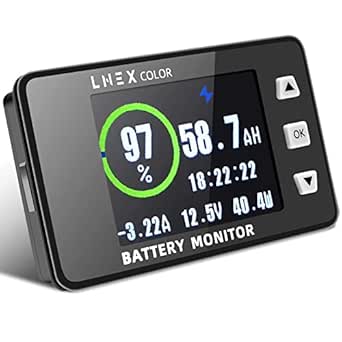 | Best for Remote Display Placement | Model: 500A | Compatible voltage range: 8–100V | Maximum operating voltage: 120V | VIEW LATEST PRICE | See Our Full Breakdown |
| LiTime 500A Battery Monitor with M8 Shunt, 8–120V LCD Display |  | Best for Straightforward, High-Capacity Monitoring | Voltage range: 8–120V DC | Maximum current: 500A | Battery bank capacity: Up to 9,999Ah | VIEW LATEST PRICE | See Our Full Breakdown |
| bayite DC 8–100V 0–100A Battery Monitor with 100A Shunt |  | Best Value for Small DC Solar Banks | Voltage range: DC 8–100V | Current range: 0–100A | Power range: 0–10kW | VIEW LATEST PRICE | See Our Full Breakdown |
| CGELE DC Multifunction Battery Monitor with Shunt, 0–200 V, 0–100 A |  | Best for Detailed DC Diagnostics | Voltage range: 0–200V | Current range: 0–100A | Power range: 0–60,000W | VIEW LATEST PRICE | See Our Full Breakdown |
| Renogy 500A Battery Monitor with Shunt |  | Best for Multi-Chemistry Solar Banks | Maximum current: 500A | Voltage range: 10–120V DC | Compatible system voltages: 12V, 24V, and 48V | VIEW LATEST PRICE | See Our Full Breakdown |
| BINTA 500A Battery Monitor with Shunt, 8–100V, 3.5-Inch Color Screen |  | Best Color Display for Quick At-a-Glance Checks | Current range: 0–500A | Voltage range: 8–100V | Display: 3.5-inch color LCD with adjustable backlight | VIEW LATEST PRICE | See Our Full Breakdown |
| AILITRON TR24 50A Battery Monitor with Shunt, 8V–100V TFT Display, IP68 Waterproof |  | Best for Compact, Exposed Solar Setups | Current capacity: 50A | Operating voltage: 8–100V DC | Accuracy: ±1.0% | VIEW LATEST PRICE | See Our Full Breakdown |
| FOXWELL BT630 Bluetooth Battery Monitor with 600A Smart Shunt |  | Best for Solar Data History | Current capacity: 600A | Operating voltage: 10–120V DC | Accuracy: ±0.4% | VIEW LATEST PRICE | See Our Full Breakdown |
| BINTA Battery Monitor with Shunt, 8–120V, 0–500A |  | Best for Simple Local Monitoring | Voltage range: 8–120V | Maximum current: 500A peak; 350A continuous | Maximum capacity: 999Ah | VIEW LATEST PRICE | See Our Full Breakdown |
| Redodo 500A Battery Monitor with M8 Shunt for 8–120V RV and Solar Systems |  | Best for Long Cable Runs | Maximum current: 500A | Operating voltage: 8–120V DC | Battery bank capacity: 0–9,999Ah | VIEW LATEST PRICE | See Our Full Breakdown |
| home battery monitors for solar system | Display | Voltage range |
|---|---|---|
| ECO-WORTHY ESM100 48V Battery | 4.3-inch full-color capacitive touchscreen | — |
| AILITRON Battery Monitor with | Backlit LCD | 8–80V |
| RQG Battery Monitor | 2-inch TFT full-color dot-matrix LCD | 8–100V |
| DROK 8–100V 100A Digital Batte | 2.4-inch color LCD | 8–100V |
| LNEX 500A Shunt Battery Monito | 2.4-inch backlit color screen | — |
| LiTime 500A Battery Monitor wi | Backlit LCD | 8–120V DC |
| bayite DC 8–100V 0–100A Batter | LCD with manually switchable blue backlight | DC 8–100V |
| CGELE DC Multifunction Battery | — | 0–200V |
| Renogy 500A Battery Monitor wi | — | 10–120V DC |
| BINTA 500A Battery Monitor wit | 3.5-inch color LCD with adjustable backlight | 8–100V |
| AILITRON TR24 50A Battery Moni | Color TFT screen | — |
| FOXWELL BT630 Bluetooth Batter | — | — |
| BINTA Battery Monitor with Shu | Backlit circular display | 8–120V |
| Redodo 500A Battery Monitor wi | — | — |
More Details on Our Top Picks
ECO-WORTHY ESM100 48V Battery Monitor with 4.3-Inch Touchscreen
For a solar system built around ECO-WORTHY 48V 100Ah Server Rack Series V3 batteries, the ESM100 offers a more battery-specific view than general-purpose shunt monitors such as the DROK 8–100V 100A. Its 4.3-inch touchscreen reports voltage, current, state of charge, temperature, and cell status, helping owners check battery health without relying only on inverter estimates. Four temperature sensors add useful coverage, while low operating power and a magnetic mounting strip suit a permanent battery-room installation. The tradeoff is compatibility: it is not compatible with V2 batteries and is not a flexible choice for mixed-brand banks. Customizing inverter parameters also requires a secure login. I’d rank it ahead of universal monitors only for owners whose battery model matches exactly; most other solar setups are better served by a shunt monitor with broader compatibility.
Pros:- Shows voltage, current, state of charge, temperature, and cell status in real time
- Four temperature sensors provide multiple points of battery temperature monitoring
- Low power use, with automatic sleep after 30 seconds of inactivity
- Magnetic mounting strip supports straightforward placement near the battery
Cons:- Works only with ECO-WORTHY 48V 100Ah Server Rack Series V3 batteries and is incompatible with V2
- Inverter-related parameter customization requires a secure login
- Less suitable than a universal shunt monitor for systems using other battery brands
Best for: Owners of ECO-WORTHY 48V 100Ah Server Rack Series V3 batteries who want a large local display with cell and temperature information.
Not ideal for: Owners of ECO-WORTHY V2 batteries, mixed-brand battery banks, or solar systems that need a broadly compatible shunt monitor.
- Compatible batteries:ECO-WORTHY 48V 100Ah Server Rack Series V3
- Display:4.3-inch full-color capacitive touchscreen
- Connection:RS-232
- Temperature sensors:4
- Operating temperature:-4°F to 167°F
- Power consumption:<1W operating; <0.1W standby
- Dimensions:5.49 × 0.84 × 3.84 in
- Warranty:1 year
Our verdict“Choose the ESM100 for a compatible ECO-WORTHY V3 bank when battery-specific status matters more than broad system compatibility.”
AILITRON Battery Monitor with Shunt, 8–80V, 500A
The AILITRON pairs a compact backlit LCD with an included shunt, giving solar owners a basic local readout of voltage, current, and battery capacity without a large screen installation. Its stated 8–80V range covers many common battery banks, and its lithium and lead-acid support makes it more adaptable than the battery-specific ECO-WORTHY ESM100. It also records readings for later reference, a practical aid when checking how a system behaves between visits. The main concern is a specification mismatch: the title claims 500A, while the listed model is 0–100A. That uncertainty makes it harder to recommend for a high-current inverter or a large bank. I’d favor the DROK for clearer measurement details and alarms; this AILITRON makes more sense for buyers who prioritize a small display and can verify the current rating before installation.
Pros:- Includes a shunt for current measurement
- Displays voltage, current, and battery capacity
- Supports lithium and lead-acid systems
- Backlit LCD and stored readings support basic monitoring
Cons:- Title lists 500A, but the model description lists 0–100A
- Maximum voltage is 80V, below the 100V range of the DROK and RQG monitors
- The supplied information does not specify display dimensions or measurement accuracy
Best for: Solar and off-grid owners with a modest battery system who want a small shunt-based display and can confirm the monitor’s current rating.
Not ideal for: Owners of high-current solar banks who need a verified 500A rating or precise, clearly documented measurement limits.
- Voltage range:8–80V
- Minimum operating voltage:8V
- Display:Backlit LCD
- Compatible battery types:Lithium and lead-acid
- Included component:Battery shunt
- Weight:20 g
- Dimensions:2.32 × 2.32 × 0.79 in
Our verdict“Consider it for a compact, basic solar monitor only after confirming that its actual current rating fits your system.”
RQG Battery Monitor, 200A with Shunt, 8–100V 2-Inch Color Screen
The RQG stands out for packing up to twelve data points onto a 2-inch color screen, including voltage, current, power, capacity, and temperature. For solar owners who want more than a basic battery percentage, this can make local checks more informative than the AILITRON’s simpler listed readout. Its 8–100V range also fits a wider variety of systems than that monitor’s 8–80V range, while the stated 200A limit is suited to many smaller and mid-sized banks. The display uses embedded installation, so planning a panel cutout matters; it is not as flexible to place as a standalone screen. The product also describes protective shutdown behavior and relay connections, but the supplied information gives limited detail about setup and accuracy. I’d choose the DROK instead when its explicit measurement ranges and alarm behavior matter more than the RQG’s broader on-screen data.
Pros:- Displays up to twelve readings, including voltage, current, power, capacity, and temperature
- 8–100V operating range suits a broad range of battery systems
- Supports multiple battery chemistries, including lead-acid and lithium iron phosphate
- Can connect to an external temperature probe and relays
Cons:- 200A maximum current is below the stated 500A capacity of the LNEX monitor
- Embedded installation requires planning a suitable mounting opening
- Supplied product data gives limited detail on accuracy and configuration
Best for: Solar owners with a system within 200A who want a compact, embedded display showing several battery readings at once.
Not ideal for: Owners of higher-current battery banks or anyone who wants a simple surface-mounted screen with clearly documented setup details.
- Voltage range:8–100V
- Maximum current:200A
- Display:2-inch TFT full-color dot-matrix LCD
- Displayed information:Up to 12 parameters, including voltage, current, power, capacity, and temperature
- Battery compatibility:Lead-acid, ternary lithium, and lithium iron phosphate
- Temperature monitoring:External temperature probe supported
- Mounting:Embedded installation
Our verdict“Pick the RQG for a data-dense built-in display on a solar bank that stays within its 200A limit.”
DROK 8–100V 100A Digital Battery Monitor with 2.4-Inch Color LCD
The DROK earns its place for solar owners who want readable local measurements and visible alerts rather than a battery-specific interface. Its 2.4-inch color LCD reports voltage, current, power, and capacity, while flashing alarms can flag low capacity, low voltage, or charging-current conditions. Compared with the RQG, DROK specifies measurement ranges and accuracy more clearly; compared with the ECO-WORTHY ESM100, it is not tied to one battery model. The tradeoff is a 100A current ceiling, which rules it out for some larger inverter setups, and it needs at least 8V to operate. A low-voltage alarm setting can also clear capacity, so owners should understand that behavior before relying on stored readings. I’d put it ahead of the AILITRON when documented ranges and alarm functions matter, but below higher-current monitors for large solar banks.
Pros:- Measures voltage, current, power, and capacity
- Flashing alarms cover low capacity, low voltage, and charging-current conditions
- Specifies voltage and current accuracy
- Adjustable backlight and a mounting base support practical installation
Cons:- 100A maximum current may not suit larger inverter and battery systems
- Requires at least 8V to operate
- Low-voltage alarm settings can automatically clear capacity
Best for: Owners of smaller solar or RV battery systems who want a color screen with local low-voltage and capacity alerts.
Not ideal for: High-current solar banks above 100A, or buyers who need capacity data to remain unaffected by low-voltage alarm settings.
- Voltage range:8–100V
- Current range:0.05–100A
- Power range:0–50kW
- Capacity range:0.1–99,999Ah
- Voltage accuracy:±1% + 2 digits
- Current accuracy:±0.5% + 2 digits
- Display:2.4-inch color LCD
- Measurement speed:20 times per second
Our verdict“Choose the DROK for a sub-100A solar setup where clear local readings and alarm alerts matter more than high-current capacity.”
LNEX 500A Shunt Battery Monitor with 2.4-Inch Color Screen and 16-Foot Shielded Wire
For a solar battery bank tucked into a cabinet or utility area, the LNEX’s 16-foot shielded wire gives the display more placement flexibility than the compact AILITRON or the embedded RQG. Its 2.4-inch color screen shows voltage and current, and programmable high and low alarms can help flag conditions that need attention. The stated 500A capacity is also a better fit for larger systems than the DROK’s 100A limit, with support listed for several battery chemistries. There is a notable specification conflict: the compatible range is listed as 8–100V, but maximum operating voltage is separately stated as 120V. I would not plan a system near that upper figure without confirmation. The supplied data also does not spell out capacity measurement or accuracy, so the LNEX is less informative on paper than the DROK for detailed diagnostic use.
Pros:- 16-foot shielded wire allows the screen to be placed away from the battery bank
- Stated 500A rating suits higher-current systems than the DROK’s 100A limit
- Programmable high and low alarms
- Supports lead-acid, LiFePO4, lithium-ion, and nickel-metal hydride batteries
Cons:- Voltage compatibility is listed as 8–100V while maximum operating voltage is stated as 120V
- Supplied specifications do not state measurement accuracy
- Product data describes voltage and current readings but does not clearly specify capacity measurement
Best for: Solar and RV owners with a battery bank set apart from the viewing area who need a long display lead and a stated 500A rating.
Not ideal for: Buyers needing clearly reconciled voltage limits, detailed accuracy figures, or a monitor whose product data explicitly confirms capacity tracking.
- Model:500A
- Compatible voltage range:8–100V
- Maximum operating voltage:120V
- Display:2.4-inch backlit color screen
- Wire length:16 ft shielded wire
- Compatible batteries:Lead-acid, LiFePO4, lithium-ion, and nickel-metal hydride
- Included components:Monitor, shield wire, shunt, B+ wire, hand wrench, and battery terminals
- Dimensions:6.69 × 6.69 × 2.17 in
Our verdict“Choose the LNEX when remote screen placement and its stated 500A rating fit your system, after verifying the applicable voltage limit.”
LiTime 500A Battery Monitor with M8 Shunt, 8–120V LCD Display
The LiTime earns this spot for solar owners who want a clear readout at the battery bank rather than app-based monitoring. Its backlit LCD shows current, power, capacity, and estimated charge or discharge time, while the 500A shunt and 8–120V range suit many residential off-grid and backup setups. Compared with the Renogy 500A Battery Monitor, it also supports banks up to 9,999Ah and includes audible low-voltage and low-capacity alerts, but its listed features do not include Renogy’s degradation measurement. The alarms can help catch a low state of charge before loads become a problem; the tradeoff is that setup requires manual configuration. I would skip it for exposed installations: the unit is not waterproof and is unsuitable for marine environments.
Pros:- Displays voltage, current, power, capacity, and estimated charge or discharge time on the LCD.
- Supports battery banks up to 9,999Ah and a wide 8–120V DC range.
- Works with lithium-ion, LiFePO4, gel, AGM, and lead-acid batteries.
- Low-voltage and low-capacity alerts use both a flashing display and buzzer.
Cons:- Not waterproof and unsuitable for marine environments.
- Requires manual setup after the display is connected.
- Provides no phone or app-based monitoring.
Best for: Solar owners with a large DC battery bank who want charge, capacity, and time-remaining information on a dedicated screen, plus audible low-battery alerts.
Not ideal for: Buyers needing a monitor for an outdoor or marine location, or anyone who wants app connectivity and minimal manual setup.
- Voltage range:8–120V DC
- Maximum current:500A
- Battery bank capacity:Up to 9,999Ah
- Compatible batteries:Lithium-ion, LiFePO4, gel, AGM, and lead-acid
- Display:Backlit LCD
- Alarms:Flashing display and buzzer for low voltage or capacity
- Operating temperature:14–140 °F
- Dimensions:5.91 × 4.72 × 1.57 in
Our verdict“Choose the LiTime if you want detailed, on-screen readings and audible alerts for a high-capacity solar battery bank in a protected indoor location.”
bayite DC 8–100V 0–100A Battery Monitor with 100A Shunt
The bayite is a practical pick for a modest solar setup where energy tracking matters more than high-current capacity. Its display combines voltage, current, active power, and accumulated energy, and the stored energy reading remains available after power is off. That persistence can help owners keep an eye on energy use without relying on continuous power to the meter. Compared with the CGELE DC Multifunction Battery Monitor, bayite has a narrower 100A current limit and fewer displayed measurements, but its stated energy range reaches 9,999kWh and it includes an overload alarm. The compact meter is less suited to a larger home bank than the 500A LiTime or Renogy models. Also, the package includes the display and shunt, not the wiring, so installation planning and accessory sourcing fall to the buyer.
Pros:- Shows voltage, current, active power, and energy on one LCD.
- Retains energy data when power is off.
- Includes an overload alarm and manually switchable blue backlight.
- Compact display with a stated measurement range up to 100V DC.
Cons:- The 100A current limit is lower than the 500A LiTime, Renogy, and BINTA monitors.
- Wires and other installation accessories are not included.
- Does not list battery capacity or state-of-charge measurement.
Best for: DIY solar owners monitoring a small DC battery bank or individual circuit who can source their own wiring and want persistent energy readings.
Not ideal for: Owners of high-current or larger home battery banks, or buyers who expect a complete wiring kit and detailed state-of-charge estimates.
- Voltage range:DC 8–100V
- Current range:0–100A
- Power range:0–10kW
- Energy range:0–9,999kWh
- Minimum operating voltage:6.5V
- Display:LCD with manually switchable blue backlight
- Included components:Display and 100A shunt
- Model:PZEM-051
Our verdict“Pick bayite for a smaller solar DC circuit when stored energy readings and a simple display matter more than high current capacity or battery-state estimates.”
CGELE DC Multifunction Battery Monitor with Shunt, 0–200 V, 0–100 A
CGELE stands apart for buyers who want more than a state-of-charge estimate: it reports nine measurement types, including impedance, internal resistance, energy, and running time. That breadth can help a solar owner examine battery behavior alongside everyday voltage and current readings, though it does not replace a dedicated battery-management system. Its stated 0–200V range is broader than the bayite’s 8–100V range, while both are limited to 100A—well below the 500A capacity of the Renogy 500A Battery Monitor. Screwless press terminals make wiring changes easier, but the minimum operating voltage is listed as 9.99V, which limits its usefulness for monitoring a deeply discharged low-voltage bank. It is a specialist choice for DC systems, not a universal monitor for AC solar output or high-current whole-bank monitoring.
Pros:- Reports voltage, current, power, impedance, internal resistance, capacity, state of charge, energy, and running time.
- Stated voltage range extends to 200V DC.
- Screwless press terminals simplify wire installation and removal.
- Backlit LCD supports viewing in both day and night conditions.
Cons:- Current measurement is limited to 100A, unlike the 500A Renogy and LiTime monitors.
- Minimum operating voltage is 9.99V, restricting monitoring of deeply discharged low-voltage banks.
- Measures DC only.
Best for: Technically minded solar, RV, or industrial DC system owners who want battery diagnostics such as resistance and running-time readings alongside basic power measurements.
Not ideal for: Owners of high-current battery banks above 100A, or users who need readings below 9.99V or AC-side solar production monitoring.
- Voltage range:0–200V
- Current range:0–100A
- Power range:0–60,000W
- Capacity range:0–1,000Ah
- Energy range:0–9,999kWh
- Running time range:0–999h
- Measurement accuracy:1%
- Installation and display:Screwless press terminals; backlit LCD
Our verdict“Choose CGELE when detailed DC battery diagnostics matter more than a high-current rating or monitoring below 9.99V.”
Renogy 500A Battery Monitor with Shunt
Renogy is a strong fit for solar owners who want 500A capacity monitoring and programmable battery alarms in one established shunt-based setup. It tracks voltage, current, power consumption, capacity, and degradation, making it more informative about battery condition than the bayite, which focuses on voltage, current, power, and energy. Its 20-foot shielded cable offers useful flexibility when the battery bank and display are separated, and compatibility includes several lithium, lead-acid, and nickel-metal hydride chemistries. The tradeoff is its 10–120V operating range: it cannot monitor systems above 120V, and the listed minimum voltage may exclude a severely discharged bank. Compared with the LiTime, Renogy adds degradation tracking but lists a lower maximum battery-bank capacity. This makes Renogy a balanced choice for common 12V, 24V, and 48V solar banks rather than the widest-range option.
Pros:- Measures voltage, current, consumed power, capacity, and battery degradation.
- Supports 12V, 24V, and 48V systems with a 500A maximum current.
- Programmable high- and low-capacity alarms help flag battery limits.
- Includes a 20-foot shielded cable and shunt holder.
Cons:- Maximum operating voltage is 120V DC.
- Listed minimum operating voltage of 10V may limit monitoring of deeply discharged batteries.
- The supplied specifications do not state a maximum battery-bank capacity.
Best for: Solar owners with a 12V, 24V, or 48V bank who want 500A monitoring, programmable capacity alarms, and a long cable for flexible display placement.
Not ideal for: Owners of systems above 120V DC, banks that may fall below 10V, or buyers prioritizing a stated capacity ceiling as high as LiTime’s 9,999Ah.
- Maximum current:500A
- Voltage range:10–120V DC
- Compatible system voltages:12V, 24V, and 48V
- Compatible battery types:Lead-acid, LiFePO4, lithium-ion, and nickel-metal hydride
- Measurement accuracy:1%
- Cable length:20 ft
- Operating temperature:14–140 °F
- Model:RBM500-G1
Our verdict“Choose Renogy for a common-voltage solar bank when programmable alarms, degradation tracking, and long cable reach outweigh the 120V ceiling.”
BINTA 500A Battery Monitor with Shunt, 8–100V, 3.5-Inch Color Screen
BINTA is the display-focused pick in this group: its 3.5-inch color screen offers simple, full-data, curve, and historical views, so owners can choose between a quick status check and a more detailed look at battery behavior. It also covers voltage, current, power, remaining capacity, runtime, and ambient temperature, giving it a broader readout than bayite’s simpler four-measurement display. Its 500A range suits larger banks better than bayite or CGELE, though its 8–100V ceiling is narrower than the Renogy and LiTime monitors, both of which reach 120V. BINTA stores the latest test data during a power loss, but that is not the same as continuous remote monitoring. The sizeable screen also needs a suitable mounting spot, and the listed minimum operating voltage is 8V.
Pros:- Displays voltage, current, power, remaining capacity, runtime, and ambient temperature.
- Four screen modes include curve and historical-data views.
- Adjustable backlight and stored latest test data support convenient local checks.
- Includes a 500A sampler, 10-foot shielded cable, ground loop wire, and installation wrench.
Cons:- The 100V maximum is lower than the 120V limit of the Renogy and LiTime monitors.
- The larger color screen and housing require a suitable mounting location.
- Requires at least 8V to operate and does not list app-based monitoring.
Best for: Solar owners with a battery bank up to 500A who want a large, configurable color display showing runtime, capacity, and historical data at the installation site.
Not ideal for: Owners of systems above 100V DC, buyers who need remote app access, or anyone without room to mount a larger screen.
- Current range:0–500A
- Voltage range:8–100V
- Display:3.5-inch color LCD with adjustable backlight
- Display modes:Simple, full data, curve, and historical data
- Current accuracy:±0.5%
- Voltage accuracy:±1%
- Compatible battery types:LiFePO4, lithium-ion, gel, sealed, and flooded
- Included cable:10 ft shielded cable
Our verdict“Choose BINTA if a large, versatile local display matters more than the higher voltage ceiling offered by Renogy or LiTime.”
AILITRON TR24 50A Battery Monitor with Shunt, 8V–100V TFT Display, IP68 Waterproof
For a small off-grid battery bank installed somewhere damp or exposed, the AILITRON TR24 pairs a local color screen with an IP68 waterproof rating and support for several battery chemistries. Its display reports state of charge, amp-hours, voltage, and power, while customizable alarms can flag low capacity or out-of-range voltage without relying on a phone. Compared with the FOXWELL BT630, it offers a direct screen rather than app-based monitoring, but gives up the FOXWELL’s much higher current capacity, runtime estimates, and historical data. The main constraint is its 50A limit, which suits modest systems rather than larger solar banks with heavy inverters. The supplied shunt and wiring components help get a basic installation started, though display dimensions and cable length are not specified.
Pros:- IP68 rating suits damp or exposed marine and outdoor installations.
- TFT screen shows state of charge, amp-hours, voltage, and watts.
- Supports lithium, LiFePO4, lead-acid, and NI-MH batteries.
- Customizable voltage and low-capacity alarms, with a 50A shunt included.
Cons:- 50A current capacity limits it to lighter-duty battery systems.
- Display dimensions and included wiring length are not specified.
Best for: Owners of small off-grid solar, boat, or RV battery systems who want local readings and a monitor suited to wet installation areas.
Not ideal for: Solar users with high-current inverters or larger battery banks who need more than 50A capacity or longer-term data tracking.
- Current capacity:50A
- Operating voltage:8–100V DC
- Accuracy:±1.0%
- Display:Color TFT screen
- Battery compatibility:Lithium, LiFePO4, lead-acid, and NI-MH
- Measurements:State of charge, amp-hours, voltage, and watts
- Alarms:Customizable high/low voltage and low capacity
- Included components:Meter, shunt, positive electrode wire, and two copper terminals
Our verdict“Choose the TR24 for a small, exposed solar battery setup where a waterproof local display matters more than high current capacity or data history.”
FOXWELL BT630 Bluetooth Battery Monitor with 600A Smart Shunt
The FOXWELL BT630 suits solar owners who want to check more than a battery’s current charge: its app reports voltage, current, power, capacity, estimated runtime, and up to 30 days of history. That record can help track how a bank behaves through changing solar production and household loads. Its 600A shunt and 10–120V operating range also give it more headroom than the AILITRON TR24, whose 50A limit targets much smaller systems. The tradeoff is that Bluetooth readings depend on a smartphone, so there is no listed standalone display for a quick glance at the battery. Installation also involves wiring at the battery’s negative terminal. At 0.4W power consumption, it is designed to keep its own draw modest, though buyers should still account for that load in systems kept in storage.
Pros:- App combines voltage, current, power, capacity, state of charge, and estimated runtime.
- Stores up to 30 days of historical data.
- 600A shunt supports higher-current systems than the AILITRON TR24.
- Eight protection alarms and 0.4W power consumption.
Cons:- Bluetooth monitoring requires a compatible smartphone and app.
- Installation requires wiring connections at the battery negative terminal.
- Its 10V minimum operating voltage excludes lower-voltage systems.
Best for: Solar and off-grid owners who want app-based readings, runtime estimates, alarm coverage, and a record of recent battery behavior.
Not ideal for: Buyers who prefer a dedicated on-device screen, do not want app-dependent monitoring, or need a monitor with no battery-side wiring.
- Current capacity:600A
- Operating voltage:10–120V DC
- Accuracy:±0.4%
- Connectivity:Bluetooth app
- Historical data:Up to 30 days
- Protection alarms:8
- Power consumption:0.4W
- Battery compatibility:LiFePO4, lithium, AGM, gel, and flooded lead-acid
Our verdict“Pick the BT630 if smartphone access and battery history matter more than having a built-in display.”
BINTA Battery Monitor with Shunt, 8–120V, 0–500A
The BINTA TR16H is a straightforward fit for solar users who want charge, remaining capacity, voltage, and current on a physical backlit display. Its 8–120V range spans more system voltages than the AILITRON TR24, and its capacity reading reaches 999Ah, making it a more flexible match for larger battery banks. Two-way current detection helps account for power moving both into and out of the bank, while memory retains settings and the last recorded data after shutdown. Compared with the FOXWELL BT630, the BINTA avoids app dependence but does not list Bluetooth history, estimated runtime, or the FOXWELL’s higher 600A rating. Its 350A continuous limit is the practical ceiling; the 500A figure is peak capacity, not a continuous operating rating. Installation also requires connecting the shunt cables and positive wire.
Pros:- Backlit display reports charge state, remaining capacity, voltage, and current.
- 8–120V range accommodates a broad range of DC battery systems.
- Two-way current detection captures charging and discharging flow.
- Memory retains settings and the last recorded data after shutdown.
Cons:- 350A continuous capacity is below the 500A peak rating.
- Installation requires connecting shunt cables and a positive wire.
- No app-based history or estimated runtime is listed.
Best for: RV and off-grid solar owners who want a local display, broad voltage compatibility, and remaining-capacity readings without app monitoring.
Not ideal for: Users whose solar system can draw more than 350A continuously or who want Bluetooth access, historical charts, or runtime estimates.
- Voltage range:8–120V
- Maximum current:500A peak; 350A continuous
- Maximum capacity:999Ah
- Battery compatibility:Lead-acid, LiFePO4, and lithium-ion
- Display:Backlit circular display
- Auto-sleep current:<50mA
- Included cables:3m shielded cables and 1m positive wire
- Dimensions:2.31 × 0.78 × 2.31 inches
Our verdict“Choose the BINTA TR16H for broad-voltage solar systems needing clear local readings, provided their continuous current stays within 350A.”
Redodo 500A Battery Monitor with M8 Shunt for 8–120V RV and Solar Systems
The Redodo 500A stands out for installations where the battery and display cannot sit close together: its kit includes a 20 ft shielded cable, giving more placement flexibility than the BINTA TR16H’s included 3m cables. It monitors voltage, current, power, capacity, charge status, and estimated runtime across 8–120V systems, with a battery-bank capacity setting up to 9,999Ah. A flashing display and audible alert can call attention to low voltage or capacity, offering a more immediate warning than the AILITRON TR24’s customizable alarms alone. The tradeoff is that the Redodo is a wired monitor, not an app-connected system, and its 500A rating is paired with ±1% accuracy. It also requires battery, load, and shunt wiring, so it is better suited to buyers comfortable with a DC installation than those seeking a plug-and-play setup.
Pros:- 20 ft shielded cable allows flexible display placement.
- Reports voltage, current, power, capacity, charge status, and estimated runtime.
- Audible and flashing alerts warn of low voltage or capacity.
- Supports battery banks up to 9,999Ah and common lithium and lead-acid types.
Cons:- Wiring between the battery, load, and shunt is required.
- ±1% accuracy is less precise than the FOXWELL BT630’s stated ±0.4%.
- Limited to DC battery systems operating from 8–120V.
Best for: RV and solar owners placing a monitor away from the battery who want runtime estimates, audible warnings, and a long shielded cable.
Not ideal for: Buyers seeking wireless app access, a simple no-wiring installation, or a system outside the 8–120V DC range.
- Maximum current:500A
- Operating voltage:8–120V DC
- Battery bank capacity:0–9,999Ah
- Accuracy:±1%
- Battery compatibility:Li-ion, LiFePO4, AGM, and gel
- Cable length:20 ft (6m)
- Dimensions:3.94 × 0.71 × 2.4 inches
- Included components:Monitor, shunt, shielded wire, and power wire
Our verdict“The Redodo is a strong choice when long cable reach and audible warnings matter more than app connectivity or finer stated accuracy.”
How We Picked
I compared these monitors around the requirements that affect day-to-day use in a solar battery system: supported voltage, shunt current capacity, display readability, and installation flexibility. I also looked for distinct practical benefits, such as Bluetooth access, a longer shielded lead, waterproofing, or a screen large enough to read at a glance. Since the listed products do not all share the same voltage or current limits, I treated compatibility as a first-step filter rather than assuming one model suits every battery bank.
The order reflects how broadly useful each option appears for the stated solar use, balanced against its tradeoffs and the information provided. A 500A shunt can suit higher-current systems, but it is not automatically a better buy for a modest setup; likewise, a large display does not replace checking voltage compatibility. I gave stronger positions to options with a clear use case and useful specifications, while models with narrower capacity, fewer stated installation details, or a more specialized fit rank lower for general home-solar use. Confirm the full manufacturer specifications and wiring instructions before installation.
Factors to Consider When Choosing Home Battery Monitors For Solar Systems
Before choosing a monitor, I’d work backward from the battery bank and installation rather than starting with screen size. A monitor reports what its shunt and settings can measure; it does not increase battery capacity or fix a poorly configured charging system. These checks help avoid buying a unit that looks suitable but cannot fit the electrical limits or layout of your setup.
Match Voltage Range to the Whole Battery Bank
Check the monitor’s supported voltage against the battery bank’s nominal voltage and the manufacturer’s stated operating range. A product described for 48V, such as the ECO-WORTHY ESM100, is a different fit from units listing ranges that extend to 100V or 120V. Do not treat a higher maximum rating as proof that every battery configuration is supported; confirm the exact wiring arrangement and permitted voltage in the manual. Also distinguish battery-bank voltage from the voltage of a solar array, which may be handled by a charge controller rather than the battery monitor. A common mistake is buying based on the solar panel’s advertised voltage instead of the battery system the monitor will measure. If you plan to change bank voltage later, select based on the documented range for that future configuration, not an assumption that the monitor will adapt.
Size the Shunt for Real Peak Current
The shunt rating should cover the highest current expected to pass through it, including heavy inverter use, not merely the current seen during ordinary charging. The lineup ranges from 50A and 100A models through 200A units to several 500A and 600A options, so capacity is a meaningful point of separation. An oversized rating is not a substitute for checking accuracy and operating limits at the currents your system actually uses. An undersized shunt can restrict the system or produce an unsuitable installation, depending on its design and instructions. Add up likely simultaneous loads and charging sources, then compare the result with the shunt’s stated rating and the manufacturer’s wiring guidance. Leave room for realistic peaks, but avoid choosing the largest number just because it appears more capable.
Check What the Monitor Can Actually Tell You
A battery monitor’s value depends on the measurements and settings it supports, not only on a percentage-of-charge display. Look for the information you need to manage your system, such as current flow, voltage, consumed capacity, or configurable battery parameters, and verify those functions in the product documentation. Battery chemistry and capacity settings affect how useful the readings are, so confirm that the monitor can be configured for your battery type. A screen that shows several figures may still leave out a feature you expect, while a simpler display can be enough if you only need a quick local check. Avoid treating a state-of-charge estimate as a replacement for the battery maker’s charging guidance. For a system with changing loads, prioritize clear, relevant measurements over decorative screen size.
Plan the Shunt and Display Locations Before Buying
The shunt must be installed in the correct part of the battery circuit for the monitor to account for the current it is meant to measure. Follow the product’s wiring diagram and battery manufacturer guidance; a load or charging source connected around the shunt can make readings incomplete. Then measure the route from the shunt to the display, including the path through cabinets or conduit. LNEX lists a 16-foot shielded wire, a detail that could help with a more spread-out layout, while other models may call for a shorter or separately planned run. Think about whether the display will be easy to see without opening a battery enclosure, and keep the unit accessible for configuration and service. Do not assume a longer lead or a compact display solves every installation constraint; connector type and mounting space matter too.
Choose Between Local Readout and Remote Access
A built-in display is useful when you want to check the system at the battery location, while Bluetooth can make status checks easier when that location is inconvenient. The FOXWELL BT630 is the lineup’s clear Bluetooth-focused choice, whereas large-screen options such as ECO-WORTHY and BINTA emphasize at-device viewing. Before paying extra for wireless access, check the app’s supported functions, device compatibility, connection range, and whether the monitor retains useful readings if a phone is not nearby. Bluetooth is not the same as internet-connected remote monitoring, so it may not let you check the system from outside the home. A local screen can be the simpler choice for a fixed installation, but it must be placed where you can read it safely. Choose the access method you will actually use rather than treating connectivity as a universal upgrade.
Account for Environment, Maintenance, and Future Changes
Battery locations can be warm, dusty, damp, or cramped, and the monitor’s stated environmental protection should fit the actual placement. The AILITRON TR24 is specified as IP68 waterproof, but that rating should not be read as permission to ignore its installation instructions or expose every connection to water. Check temperature limits, mounting guidance, cable protection, and whether the display itself shares the shunt’s protection rating. Also consider how easy it will be to inspect connections and update battery settings if you change batteries later. A monitor with enough current and voltage headroom may be useful if you expect a larger inverter or a revised bank, but future-proofing only helps when the new system remains within documented limits. Pay more for a feature that solves a real placement or monitoring need, not for specifications your system will never use.
Frequently Asked Questions
Do I need a 500A shunt for a home solar battery system?
Not automatically. The right rating depends on the greatest current expected to pass through the shunt, especially when an inverter and other loads operate together. The lineup includes 100A, 200A, 500A, and 600A choices, so there are options for different system sizes. Compare the shunt rating with your inverter’s expected battery-side current and the manufacturer’s limits, then allow for realistic peaks. A larger rating is useful only if it matches your system’s requirements and the monitor provides suitable readings for your use.
Can I use a battery monitor with a 48V solar battery bank?
Only if the monitor’s stated voltage range supports your bank and its wiring instructions match your configuration. The ECO-WORTHY ESM100 is specifically described as a 48V monitor, while several other products list broader ranges such as 8–100V or 8–120V. A broad range can offer more flexibility, but it does not replace checking the manual for supported battery types and setup limits. Do not confuse battery-bank voltage with solar-array voltage, since the array is commonly managed through a charge controller. If the bank may change later, check the supported range for both the current and planned configuration.
Will a battery monitor work accurately if some loads bypass the shunt?
A shunt-based monitor can only account for current that passes through the shunt as installed. If a load or charging source connects directly to the battery on the wrong side, the monitor may not include that current in its calculations. Follow the supplied wiring diagram and confirm where the battery, inverter, charger, and other connections belong. Do not add new battery connections without checking whether they preserve the intended measurement path. If readings seem inconsistent after installation, inspect wiring and configuration before assuming the battery itself is at fault.
Is Bluetooth better than a large built-in screen for solar monitoring?
Neither is better for every installation. Bluetooth, as offered by the FOXWELL BT630, can make it easier to check status when the monitor is not mounted at eye level, but its usefulness depends on app functions, phone compatibility, and connection range. A large local screen, such as the ECO-WORTHY’s 4.3-inch display, is easier to check at the installation point without opening an app. Bluetooth should not be mistaken for internet access from anywhere. Choose based on where you will view readings and whether you need a local readout, phone access, or both.
Can one of these monitors work with lithium batteries?
Possibly, but the product name alone does not confirm compatibility with a particular lithium battery or its settings. Check the manual for supported chemistry, capacity configuration, and any limits on voltage or charging behavior. A monitor measures system data; it does not replace the battery’s management system or charging controls. Confirm that the monitor can be configured for the battery bank you own, and follow the battery maker’s installation guidance. If the documentation does not clearly support your chemistry and configuration, contact the manufacturer before wiring it in.
Conclusion
For a broad shortlist, I’d choose the Renogy 500A Battery Monitor as the best overall option for buyers who need a high-capacity shunt, then verify its voltage range and functions against the system before ordering. The bayite 100A monitor is my value-oriented pick for a smaller setup where its lower current rating is sufficient; it is not the choice for a high-current inverter system. For beginners who prefer a clear local readout, the ECO-WORTHY ESM100 is the easiest standout to shortlist, provided the 48V specification suits the bank. For a premium-style feature set, I’d look at the FOXWELL BT630 for Bluetooth access, while buyers needing a larger screen can compare ECO-WORTHY with BINTA’s 3.5-inch model. For specific installation needs, consider the LNEX for its listed 16-foot shielded wire or the AILITRON TR24 for its stated IP68 rating. My final choice would come down to verified voltage compatibility, sufficient shunt capacity, and the display or access method that fits the actual installation.