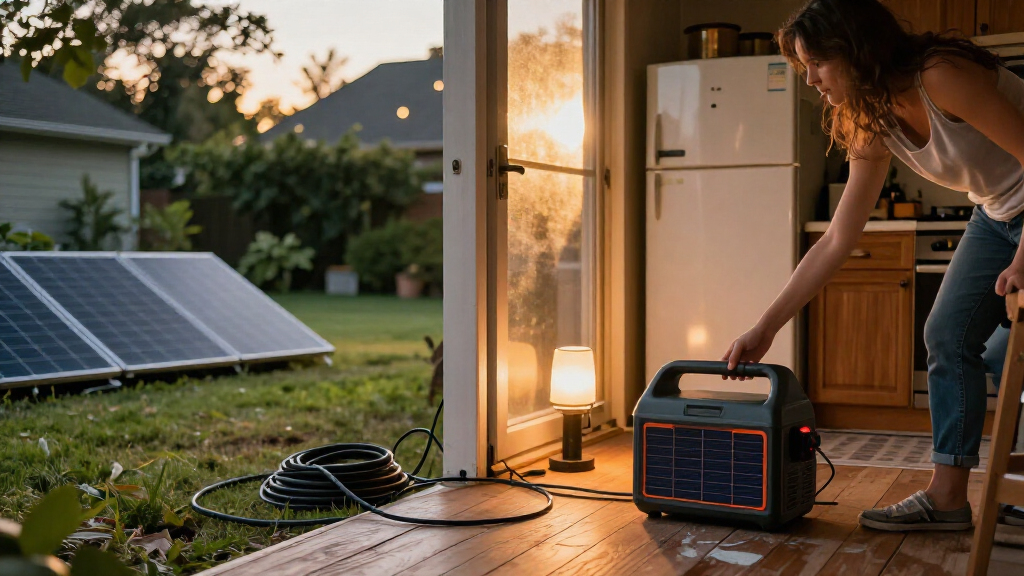
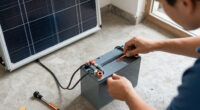
When the power goes out at home, the right solar generator kit keeps your fridge running, your phones charged, and your lights on without gas, fumes, or engine maintenance. For most households, the Jackery HomePower 3600 Plus with two 200W panels is the best overall pick because it combines enough wattage to run large appliances with a genuinely expandable battery. If you want whole-home coverage and don’t mind a permanent installation, the ECO-WORTHY 10kW off-grid system with 20.48kWh of storage plays in a completely different league than any portable unit. On a tighter budget, the UDPOWER S1200 kit and Jackery Solar Generator 1000 v2 deliver honest emergency coverage at a lower capacity. The core tradeoff in this category is capacity versus cost and portability: small kits are cheap and easy to store but can’t run a refrigerator overnight, while big kits handle real outages but cost more and take up space. Keep reading for the full breakdown of all 13 kits.

Get backup power and energy gear delivered free with Prime
- Fast, free delivery on millions of items
- Prime Video, Amazon Music and more included
- Member-only deals all year
Complete the kit


Key Takeaways
- Watt-hour capacity was the single biggest divider in this lineup: kits under 300Wh (BLAVOR, Jackery Explorer 300, EnginStar, ZeroKor) are emergency lighting and phone chargers, not true home backup, while the 2000Wh-plus kits could actually run a refrigerator through an overnight outage.
- Included solar panel wattage often lags far behind battery size — the ABOK Ark3600 ships with 600W of panels while the identical station sold alone (without panels) tempts buyers who then have no way to recharge during a multi-day outage. Always check what recharging the kit, not just what it powers.
- The ECO-WORTHY 10kW system is the only option here that can realistically back up an entire house, but it demands professional installation and a permanent mounting location — it’s a category apart from the twelve portable kits.
- Jackery dominated the mid and upper range with four entries (HomePower 3600 Plus, HomePower 3000, Explorer 2000 v2, Explorer 1000 v2), and their consistency in charge speed and app controls is why they took the top spots despite the ABOK Ark3600 matching raw capacity at a lower effective panel bundle.
- Bargain 300W-class kits repeatedly cut the same corners: pure sine wave inverters were sometimes swapped for modified sine wave (ZeroKor), and built-in panels (BLAVOR’s 40W) recharge so slowly that a multi-day outage drains them faster than the sun can refill them.
| Jackery HomePower 3600 Plus Portable Power Station with Two 200W Solar Panels |  | Best Overall | Capacity: 3,584Wh | AC output: 3,600W (7,200W parallel) | Expandable capacity: Up to 21kWh per unit; 43kWh with multiple units | VIEW LATEST PRICE | See Our Full Breakdown |
| UDPOWER S1200 1190Wh Solar Generator Kit with 120W Solar Panel |  | Best Value | Battery capacity: 1190Wh | Battery type: LiFePO4, 4,000+ cycles | AC output: 1800W pure sine wave | VIEW LATEST PRICE | See Our Full Breakdown |
| BLAVOR 1600W Solar Generator with Built-In 40W Solar Panel |  | Best for Beginners | VIEW LATEST PRICE | See Our Full Breakdown | |||
| BLUETTI Elite 200 V2 Solar Generator with Two 200W Solar Panels |  | Best Mid-Size Powerhouse | Battery capacity: 2073.6Wh | Battery type: LiFePO4, 6,000+ cycles | Continuous AC power: 2600W (3900W power lifting) | VIEW LATEST PRICE | See Our Full Breakdown |
| ABOK Ark3600 Portable Power Station with 3 × 200W Solar Panels |  | Best Solar-Charging Setup | VIEW LATEST PRICE | See Our Full Breakdown | |||
| Jackery Explorer 300 Portable Power Station with 40W Solar Panel |  | Best Budget Kit for Device Backup | Capacity: 292Wh | Battery chemistry: LiFePO4 | Charge cycles: Over 4,000 cycles to 70% capacity | VIEW LATEST PRICE | See Our Full Breakdown |
| ECO-WORTHY 10kW Off-Grid Solar System Kit with 5,310W Panels and 20.48kWh Battery Storage |  | Best Whole-Home Off-Grid System | Inverter continuous output: 10,000W (20,000W peak) | Output voltage: 120V/240V split-phase | Solar array: 9 × 590W panels (5,310W total) | VIEW LATEST PRICE | See Our Full Breakdown |
| ABOK Ark3600 Portable Power Station |  | Best Expandable Capacity | Capacity: 3,840Wh, expandable to 11,520Wh | Battery type: LiFePO4, over 4,000 cycles | Solar input: 2,000W | VIEW LATEST PRICE | See Our Full Breakdown |
| Jackery Explorer 2000 v2 Portable Power Station with Two 200W Solar Panels |  | Best Mid-Size Home Backup | Battery capacity: 2,042Wh LiFePO4 | AC output: 2,200W across 3 AC ports | USB-C PD output: 100W | VIEW LATEST PRICE | See Our Full Breakdown |
| EnginStar 300W Portable Power Station with 60W Foldable Solar Panel |  | Best Starter Kit for Beginners | Battery capacity: 296Wh (80,000mAh) | AC output: 300W, 2 × 110V pure sine wave | Ports: 8 total, including 18W USB-C | VIEW LATEST PRICE | See Our Full Breakdown |
| Jackery HomePower 3000 Portable Power Station with Two 200W Solar Panels |  | Best Whole-Home Backup Pick | Capacity: 3,072Wh | AC output: 3,600W | Surge output: 7,200W | VIEW LATEST PRICE | See Our Full Breakdown |
| ZeroKor 300W Portable Power Station with 60W Solar Panel | 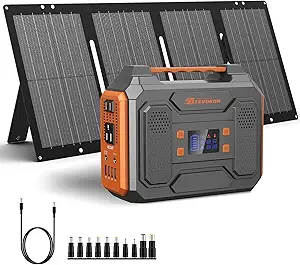 | Best Budget Starter Kit | Maximum power output: 300W | Solar panel: 60W monocrystalline, 20.5% conversion efficiency | AC outlets: 2, 300W maximum | VIEW LATEST PRICE | See Our Full Breakdown |
| Jackery Solar Generator 1000 v2 with 200W Solar Panel |  | Best Mid-Size Balance | Battery capacity: 1,070Wh | Battery type: LFP, 4,000+ charge cycles | AC output: 1,500W (3,000W surge peak) | VIEW LATEST PRICE | See Our Full Breakdown |
More Details on Our Top Picks
Jackery HomePower 3600 Plus Portable Power Station with Two 200W Solar Panels
For genuine whole-home backup potential, this option stands out as the most complete package in the lineup. With 3,600W of AC output and 3,584Wh of capacity, it can run refrigerators, well pumps, and HVAC startups that smaller kits like the BLAVOR 1600W simply cannot touch. What separates it from the similarly sized ABOK Ark3600 is headroom: capacity expands to 21kWh per unit (43kWh in parallel), and the 6,000-cycle LFP battery is rated for a decade of service. The wheeled design and telescopic handle offset the weight that comes with this class.
The tradeoffs are logistical. The station and panels ship separately, and hitting the advertised multi-unit capacity means buying additional batteries, which is a real budget consideration. Compared with the BLUETTI Elite 200 V2, it costs more upfront but offers roughly 70% more capacity and higher sustained output.
Pros:- 3,600W output with 7,200W parallel capability runs whole-home loads
- Expandable up to 21kWh per unit for multi-day outages
- 6,000-cycle LFP battery with a stated 10-year lifespan
- Wheels and telescopic handle make repositioning manageable
Cons:- Power station and solar panels may arrive in separate shipments
- Reaching the advertised maximum capacity requires purchasing additional expansion units
Best for: Homeowners who want to run major appliances through extended outages and may expand capacity over time
Not ideal for: Buyers on a tight budget or those who only need to keep phones, lights, and a laptop running during brief outages
- Capacity:3,584Wh
- AC output:3,600W (7,200W parallel)
- Expandable capacity:Up to 21kWh per unit; 43kWh with multiple units
- Battery cycle life:6,000 cycles
- Charging options:Hybrid AC+DC, AC, solar, or gas generator
- Hybrid charging time:2 hours
- Included solar panels:Two 200W panels
Our verdict“If a blackout means keeping your fridge, furnace, and medical devices alive rather than just charging phones, this is the kit built for that job.”
UDPOWER S1200 1190Wh Solar Generator Kit with 120W Solar Panel
This kit makes the list because it delivers 1800W of pure sine wave output at a capacity tier where most competitors cap out around 1,000W. That means a microwave, a space heater, or a power tool is realistically in play — something the BLAVOR 1600W can handle only with care and the EnginStar 300W cannot approach. The UPS switch time under 0.01 seconds is the hidden gem here: plugged in as a pass-through, it flips to battery so fast that computers and routers won’t reboot during an outage.
With 14 ports, including five AC outlets and 100W USB-C, it covers a surprising number of devices at once. The compromise is solar: a single 120W panel is slow to refill 1190Wh, and the 4,000+ cycle rating trails the 6,000 cycles offered by the Jackery HomePower 3600 Plus and BLUETTI Elite 200 V2, so long-term ownership costs are a bit higher.
Pros:- 1800W pure sine wave output rivals larger, pricier stations
- Sub-0.01-second UPS switch protects sensitive electronics
- 14 ports including five AC outlets and 100W USB-C
- LiFePO4 battery rated for 4,000+ cycles
Cons:- Single 120W panel recharges the 1190Wh battery slowly
- Station and solar panel ship in separate boxes
Best for: Budget-conscious buyers who want real appliance power and UPS-style pass-through protection for electronics
Not ideal for: Households needing fast solar recharge or more than a day of heavy appliance runtime — the single 120W panel and 1190Wh capacity limit both
- Battery capacity:1190Wh
- Battery type:LiFePO4, 4,000+ cycles
- AC output:1800W pure sine wave
- Solar panel:120W foldable, IP65 waterproof
- Charging ports:14 total, including 5 AC outlets
- UPS switch time:Under 0.01 seconds
Our verdict“The smart pick if you want appliance-grade output and UPS protection without paying for a 2kWh-plus system.”
BLAVOR 1600W Solar Generator with Built-In 40W Solar Panel
The built-in 40W solar panel is what gives this kit its role: there is nothing to set up, connect, or store separately, which makes it the easiest entry point into solar backup in the roundup. Compared with the UDPOWER S1200, you give up a third of the capacity and five AC outlets, but you also skip the hassle of deploying a separate panel every time you want to trickle-charge. The 100W bidirectional USB-C port is a genuinely useful touch, letting you refill the station from a laptop charger or car charger most people already own.
The honest tradeoff is that the integrated panel is a convenience, not a charging strategy — 40W against a 1024Wh battery means days of sunlight for a full refill, and the external panel that would actually help is sold separately (up to 200W input is supported). For short outages and camping weekends, that is a fair bargain.
Pros:- Built-in solar panel eliminates setup and separate storage
- LiFePO4 battery rated for 4,000+ cycles
- 100W bidirectional USB-C charges with common cables
- 10 adapter connectors and carrying case included
Cons:- Built-in panel is limited to 40W — effectively a trickle charger
- Meaningfully faster external solar panel sold separately
Best for: First-time buyers and campers who want one self-contained unit with zero setup and no separate panels to manage
Not ideal for: Anyone planning multi-day home backup — 1024Wh and a 40W built-in panel cannot sustain a refrigerator-heavy load
Our verdict“A low-friction first step into solar backup, best paired with an add-on panel if outages at your home last more than a few hours.”
BLUETTI Elite 200 V2 Solar Generator with Two 200W Solar Panels
This model occupies the sweet spot between the entry-level kits and the big Jackery HomePower 3600 Plus: a 2073.6Wh battery with 2600W of continuous AC power — enough to run most refrigerators alongside a washer or a window AC unit. The 6,000+ cycle LFP battery matches Jackery’s durability claim at a smaller capacity, and the ability to power nine devices at once makes it a genuine mini home hub rather than a campsite accessory. Charging flexibility is a standout, with AC, solar, and even alternator charging for RV owners who want to refill while driving.
Two caveats deserve attention. The headline 0–80% in 50 minutes applies to AC/DC wall charging, not the included 400W of panels — solar full-charge times assume 1,000W of panels you would need to buy separately, and the fastest alternator route requires BLUETTI’s Charger 2 accessory. The panels also ship separately, so expect staggered deliveries.
Pros:- 2600W continuous output (3900W power lifting) handles appliance combos
- LiFePO4 battery rated for 6,000+ cycles
- Alternator charging option suits RV and van setups
- Runs up to nine devices simultaneously
Cons:- Fastest charging requires accessories or solar panels beyond what is included
- No battery expansion path if needs grow
Best for: Households that want multi-appliance backup for a day or more without paying for a 3.5kWh-plus flagship system
Not ideal for: Whole-house ambitions or long outages — capacity is not expandable, unlike the Jackery HomePower 3600 Plus or ABOK Ark3600
- Battery capacity:2073.6Wh
- Battery type:LiFePO4, 6,000+ cycles
- Continuous AC power:2600W (3900W power lifting)
- AC/DC charging:0–80% in 50 minutes
- Alternator charging:Full charge in 2 hours with BLUETTI Charger 2
- Included solar panels:Two 200W panels
Our verdict“The best balance of output, durability, and size in the middle of the lineup — buy it if two kilowatt-hours covers your outage plan.”
ABOK Ark3600 Portable Power Station with 3 × 200W Solar Panels
Where this kit pulls ahead of the crowd is solar input. Three included 200W panels and a 2,000W maximum PV input mean the sun can refill the 3,840Wh battery far faster than the UDPOWER S1200’s single 120W panel or even the BLUETTI Elite 200 V2’s included array. Combine AC and solar and the stated recharge time drops to about 1.3 hours — genuinely useful when storm windows between outages are short. Capacity expands to 11,520Wh, and 15 output ports plus Bluetooth app control round out a spec sheet that competes directly with the Jackery HomePower 3600 Plus.
The tradeoffs versus Jackery are durability and reputation: the 4,000+ cycle rating trails Jackery’s 6,000 cycles, meaning a shorter effective lifespan under heavy cycling. The fastest recharge figure also depends on ideal solar conditions, and the 1,500W AC input alone means wall-only recharges take longer than the hybrid route.
Pros:- Three 200W panels included — the most solar wattage in this batch
- 2,000W PV input enables fast sunlight recharges
- Expandable from 3,840Wh to 11,520Wh
- 15 ports plus Bluetooth app control
Cons:- 4,000+ cycle rating trails the 6,000-cycle leaders
- Fastest recharge time requires combined AC and solar under good conditions
Best for: Off-grid and rural buyers who recharge primarily from sunlight and want maximum included panel wattage out of the box
Not ideal for: Buyers who prioritize the longest battery lifespan or a long-established service track record — the cycle rating and brand history trail Jackery
Our verdict“The pick for sun-powered households: more included panels and higher solar input than anything else at this capacity.”
Jackery Explorer 300 Portable Power Station with 40W Solar Panel
Not everyone needs to run a refrigerator during an outage — sometimes the job is keeping phones, a router, and a CPAP alive. That’s where the Explorer 300 earns its spot. At 7.5 lbs, it’s the most portable option in this lineup by a wide margin, and its LiFePO4 battery rated for over 4,000 cycles means it will survive a decade of occasional use, something the EnginStar 300W — with roughly 1,000 cycles on a lithium-ion cell — can’t match. The tradeoff is honest, though: the included 40W panel needs about 7.5 hours to reach 80%, and 292Wh simply won’t run large appliances. Compared with the Jackery Explorer 2000 v2, this is a device-level lifeline, not a home backup system, and buyers should treat it that way.
Pros:- Featherweight at 7.5 lbs with an integrated carry handle — genuinely grab-and-go
- LiFePO4 chemistry rated for over 4,000 cycles, far beyond typical budget kits
- Charges up to six devices at once across AC, USB-C PD (100W), USB-A, and car ports
- 600W surge rating handles brief startup spikes from small devices
Cons:- The 40W panel takes roughly 7.5 hours to reach 80% — slow recovery for extended outages
- 292Wh capacity is device-level only; it won’t meaningfully back up kitchen or HVAC loads
- Power station and solar panel may arrive in separate shipments
Best for: Apartment dwellers and minimalists who need to keep phones, laptops, a router, or medical devices running through short outages
Not ideal for: Homeowners who want to power a fridge, microwave, or any large appliance — the 300W output and 292Wh capacity can’t handle it
- Capacity:292Wh
- Battery chemistry:LiFePO4
- Charge cycles:Over 4,000 cycles to 70% capacity
- Ports:2 AC, 100W USB-C PD, 2 USB-A, 120W car port
- Included solar panel:40W
- Solar charging time:Approx. 7.5 hours to 80%
- Weight:7.5 lbs
Our verdict“A smart, durable pick for keeping essentials charged — not for powering your house.”
ECO-WORTHY 10kW Off-Grid Solar System Kit with 5,310W Panels and 20.48kWh Battery Storage
This kit plays in a completely different league than everything else here. While the ABOK Ark3600 and Jackery Explorer 2000 v2 are portable power stations with panels bolted on, the ECO-WORTHY 10kW system is a permanent installation: a 10,000W split-phase inverter that feeds 120V/240V circuits, nine 590W panels totaling 5,310W, and 20.48kWh of 48V LiFePO₄ storage — enough to run well pumps, HVAC equipment, and kitchen loads that no portable unit in this roundup can touch. The 20,000W surge rating covers motor startup, and parallel support for up to six inverters leaves room to grow. The flip side: nine truck-shipped panels, professional installation, and none of the plug-and-play simplicity portable kits offer. This is a lifestyle commitment, not an emergency gadget.
Pros:- 10kW continuous output with 120V/240V split-phase support for real household loads
- 20.48kWh of LiFePO₄ storage — roughly five times the capacity of the largest portable kit here
- Dual MPPT controllers, WiFi inverter monitoring, and Bluetooth-enabled battery monitoring
- Expandable via parallel connection of up to six inverters
Cons:- Professional installation is recommended, adding meaningful cost and lead time
- Nine large panels ship by freight and require an accessible delivery location
- Far more system than a typical suburban homeowner needs for occasional outages
Best for: Rural homeowners or off-grid builders who want a permanent, whole-house system capable of running 240V appliances
Not ideal for: Renters, apartment dwellers, or anyone wanting quick setup — this requires roof or ground mounting and professional installation
- Inverter continuous output:10,000W (20,000W peak)
- Output voltage:120V/240V split-phase
- Solar array:9 × 590W panels (5,310W total)
- Battery storage:4 × 48V 100Ah LiFePO₄ (20.48kWh total)
- Battery BMS:100A with CAN/RS485 communication
- Monitoring:WiFi inverter monitoring, Bluetooth battery monitoring
- Expandability:Up to 6 inverters in parallel
- Installation:Professional installation recommended
Our verdict“If you’re backing up an entire home — not just essentials — this is the only kit in the roundup built for that job.”
ABOK Ark3600 Portable Power Station
The Ark3600’s defining feature is headroom. Its 3,840Wh capacity can grow to 11,520Wh, which no other portable option in this roundup can claim — the Jackery Explorer 2000 v2 tops out at roughly half the base capacity with no expansion path. A 3,600W rated output runs most household appliances simultaneously, and 2,000W of solar input recharges far faster than smaller kits like the Explorer 300 when paired with enough panels. The wheels and telescoping handle are necessary concessions at 92 lbs — this is portable only in the sense that one person can wheel it to another room. One caution worth flagging: the product title references a solar panel, but the details don’t confirm one is included, so verify what’s in the box before counting on it as a complete kit.
Pros:- Expandable from 3,840Wh to 11,520Wh — the only scalable portable option in this lineup
- 3,600W rated output with 4,500W peak runs multiple large appliances at once
- 15 output ports plus AC, solar, and car charging with a Bluetooth monitoring app
- 2,000W solar input enables fast recharging with a sufficiently large panel array
Cons:- Heavy at 92 lbs despite wheels and a telescoping handle
- Solar panel inclusion is listed in the title but not confirmed in product details
- 1,500W AC charging, while good, means wall recharging still takes hours at full depth of discharge
Best for: Homeowners who want to start with serious backup capacity and expand later rather than replacing the unit as needs grow
Not ideal for: Campers and anyone who needs to lift their power station into a vehicle — at 92 lbs, this stays home
- Capacity:3,840Wh, expandable to 11,520Wh
- Battery type:LiFePO4, over 4,000 cycles
- Solar input:2,000W
- AC charging:1,500W
- Output ports:15
- Weight:92 lbs with wheels and telescoping handle
- Monitoring:Bluetooth app
Our verdict“The pick for buyers who’d rather buy capacity once and expand it than upgrade units every few years.”
Jackery Explorer 2000 v2 Portable Power Station with Two 200W Solar Panels
This is the sweet spot for most households. With 2,042Wh of capacity and a 2,200W AC output, the Explorer 2000 v2 can keep a refrigerator, some lights, and a few devices running for a realistic stretch of an outage — enough for the scenario most buyers actually face. Where it beats the smaller Explorer 300 is obvious; where it beats the ABOK Ark3600 is practicality: at 39.5 lbs, it’s liftable by one person, and its 20ms UPS switching means a plugged-in computer or router won’t even blink when the grid drops. The included two 200W panels recharge it in about 6 hours of good sun, which is respectable, and an 80% wall recharge in 66 minutes makes post-outage recovery painless. It’s simply not expandable — plan your capacity needs up front.
Pros:- 2,042Wh capacity with 2,200W output covers real essential circuits, not just phones
- 20ms UPS switchover keeps computers and networking gear running seamlessly through an outage
- Two included 200W panels recharge the unit in about 6 hours of sun
- 80% wall recharge in 66 minutes is among the fastest recovery in this roundup
Cons:- No capacity expansion — you’ll need a bigger unit or a second system if 2kWh proves too little
- Solar charging at 400W still assumes good sunlight conditions
- Power station and panels may ship separately, complicating delivery
Best for: Suburban homeowners who want fridge-and-essentials backup with true UPS protection for sensitive electronics
Not ideal for: Households with heavy 240V loads like well pumps or electric dryers — this tops out at 120V and 2,200W
- Battery capacity:2,042Wh LiFePO4
- AC output:2,200W across 3 AC ports
- USB-C PD output:100W
- Included solar panels:2 × 200W
- Solar charging time:Approx. 6 hours with 400W of panels
- AC charging time:80% in 66 minutes
- UPS switching time:20ms
- Weight:39.5 lbs (power station)
Our verdict“The most balanced kit here for homeowners who want meaningful backup without a permanent installation.”
EnginStar 300W Portable Power Station with 60W Foldable Solar Panel
For a first dip into solar backup, the EnginStar bundle makes the entry cost and complexity as low as possible. The foldable 60W panel actually out-punches the 40W panel bundled with the Jackery Explorer 300, helping this kit refill its 296Wh battery faster despite similar capacity, and the full wall recharge in about 3 hours is quicker than most small units. Eight ports and a 10-in-1 connector cable cover the basics for phones, tablets, lights, and a small fan. The compromises are real: the battery is standard lithium-ion rated for about 1,000 cycles versus the Jackery’s 4,000-plus on LiFePO4, and 300W output rules out anything beyond small devices. There’s also inconsistent product copy about whether the panel is included — confirm before ordering.
Pros:- Bigger 60W foldable panel than similarly sized kits typically include
- Eight output ports plus a 10-in-1 connector cover most small-device charging needs
- Charges via solar, wall outlet, or car socket with a full wall recharge in about 3 hours
- BMS protection against short circuits, overcharge, and overload
Cons:- Lithium-ion battery rated for roughly 1,000 cycles — a fraction of LiFePO4 rivals’ lifespan
- 300W output can’t run kitchen appliances or power tools
- Product listing is inconsistent about whether the solar panel is actually included
Best for: First-time buyers and budget-conscious users who want a complete, low-cost solar kit to learn on before committing to bigger systems
Not ideal for: Anyone backing up a refrigerator or expecting long-term durability — 300W output and ~1,000-cycle battery life are entry-level
- Battery capacity:296Wh (80,000mAh)
- AC output:300W, 2 × 110V pure sine wave
- Ports:8 total, including 18W USB-C
- Charging methods:Solar, wall outlet, or 12V car socket (65W max)
- Full recharge time:Approx. 3 hours from wall
- Solar panel:60W monocrystalline, 23% efficiency, folds to 10.2 × 9.4 in
- Battery cycle life:More than 1,000 cycles
- Weight:6.5 lbs (station) + 4 lbs (panel)
Our verdict“A cheap, complete on-ramp to solar backup — ideal for learning, not for long-haul reliance.”
Jackery HomePower 3000 Portable Power Station with Two 200W Solar Panels
When the goal is keeping a refrigerator, a furnace blower, or a home office alive through an extended outage, capacity and output are what separate real backup from a camping toy. This unit delivers 3,072Wh of storage and 3,600W of AC output, which puts it in a different category than mid-size options like the Jackery Explorer 2000 v2 — roughly 50% more stored energy and far more headroom for running multiple appliances at once. The 20ms UPS switchover is the standout feature for home backup: plug a sump pump or medical device into it and it transitions to battery so fast most electronics never notice the grid went down. Compared with the ABOK Ark3600, it gives up some raw wattage but pairs it with a more polished fast-charging system — 1.7 hours via hybrid AC and DC is genuinely quick for this capacity class. The LiFePO4 chemistry rated for 4,000 cycles means this is a decade-scale purchase, not a two-year stopgap.
Pros:- 3,600W output runs multiple large appliances simultaneously
- 20ms UPS switchover keeps sensitive and critical devices running uninterrupted
- Hybrid AC and DC charging refills the battery in about 1.7 hours
- LiFePO4 cells rated for 4,000 cycles provide long-term reliability
Cons:- Solar recharge to 80% takes roughly nine hours, so panels are a trickle rather than a fast-recovery solution
- Power station and solar panels ship separately, which complicates delivery and setup
Best for: Homeowners who want automatic, UPS-level backup for essentials like refrigerators, sump pumps, and heating systems during multi-hour outages
Not ideal for: Apartment dwellers or occasional campers — at this capacity and output, most of the capability goes unused and the footprint is substantial
- Capacity:3,072Wh
- AC output:3,600W
- Surge output:7,200W
- UPS switchover:≤20ms
- Battery chemistry:LiFePO4, 4,000 cycles to 70% capacity
- Solar panels:Two 200W SolarSaga panels
- Recharge time:1.7 hours hybrid AC and DC; 2.2 hours AC only
- Ports:AC, USB-C, USB-A, DC, and TT-30 RV
Our verdict“If a grid outage at your house means spoiled food and a wet basement, this is the kit that addresses those risks directly.”
ZeroKor 300W Portable Power Station with 60W Solar Panel
Not everyone backing up their home needs to run a refrigerator — sometimes the job is keeping phones charged, a router online, and a lamp lit through a short outage. That narrower mission is where this kit earns its place, and it costs a fraction of full-size systems like the Jackery HomePower 3000. The included 60W monocrystalline panel means you get a complete, functional solar setup out of the box rather than just a battery, which is more than some entry-level kits offer. Compared with the similar EnginStar 300W kit, the standout here is charging flexibility — AC outlet, car outlet, and solar are all options, so you can top it up from a vehicle during a road trip or extended blackout. The built-in protections (short-circuit, over-current, over-voltage, overload, overheating) cover the safety basics. The hard limit is the 300W output ceiling: no microwaves, no refrigerators, no hair dryers.
Pros:- Complete kit includes a 60W monocrystalline solar panel, not just the battery
- Three recharge methods: AC outlet, 12V car outlet, and solar panel
- Full suite of built-in electrical protections
- Integrated flashlight with reading and SOS modes adds utility in emergencies
Cons:- 300W maximum output cannot run refrigerators or most kitchen appliances
- Solar panel junction box is not waterproof, limiting durable outdoor deployment
Best for: Budget-conscious buyers or first-time solar users who want to keep phones, lights, fans, and a router running during brief outages
Not ideal for: Anyone expecting refrigeration or appliance backup — the 300W limit rules out nearly everything with a compressor or heating element
- Maximum power output:300W
- Solar panel:60W monocrystalline, 20.5% conversion efficiency
- AC outlets:2, 300W maximum
- DC output:9V–12.6V, 10A maximum
- USB ports:3 USB-A plus 1 quick-charge port
- Solar panel outputs:USB-A, USB-C, and 18V/3.3A DC
- Recharge methods:AC outlet, 12V car outlet, 13V–23V solar panel
- Safety features:Short-circuit, over-current, over-voltage, overload, and overheating protection
Our verdict“A sensible, low-commitment entry point for small-device backup — as long as you understand its job ends well before refrigerators enter the picture.”
Jackery Solar Generator 1000 v2 with 200W Solar Panel
This kit occupies the sweet spot between underpowered entry kits and expensive whole-home systems. With 1,070Wh of storage and 1,500W of AC output, it can genuinely run a mini-fridge overnight or power a work-from-home setup through a daylong outage — capabilities the ZeroKor 300W simply cannot touch — while staying at 23.8 lbs, light enough to move between rooms or load into a car, unlike the HomePower 3000. The app-controlled charging modes are the differentiator here: the optional one-hour emergency charge lets you top up from the grid fast when storm warnings hit, while quiet and efficiency modes trade speed for lower noise and battery wear. The 200W panel refills to 80% in about six hours, nearly three hours faster than the HomePower 3000’s solar recharge — a real advantage when sunshine is your only source. The five-year warranty adds confidence for a purchase in this price band.
Pros:- 1,500W output handles most small appliances, including mini-fridges and microwaves briefly
- Optional one-hour emergency charging when speed matters most
- Solar recharge to 80% in about six hours is quick for this capacity
- LFP battery rated for 4,000 cycles with a five-year warranty
Cons:- Fastest charging requires enabling emergency mode in the app rather than working out of the box
- Generator and solar panel ship separately, adding setup friction
Best for: Renters, small households, and remote workers who want meaningful appliance backup with a unit that’s still portable enough to carry
Not ideal for: Households targeting whole-home coverage — 1,070Wh won’t sustain multiple large appliances through a long outage
- Battery capacity:1,070Wh
- Battery type:LFP, 4,000+ charge cycles
- AC output:1,500W (3,000W surge peak)
- Weight:23.8 lbs
- Solar panel:200W, 80% charge in about 6 hours
- Full charge time:1 hour emergency mode; 1.7 hours default
- Ports:3 AC, 2 USB-C, 1 USB-A, 1 DC car port
- Warranty:5 years
Our verdict“The most sensible middle path in this lineup — real backup capability, real portability, and fast recharging for buyers who need both sides of that tradeoff.”
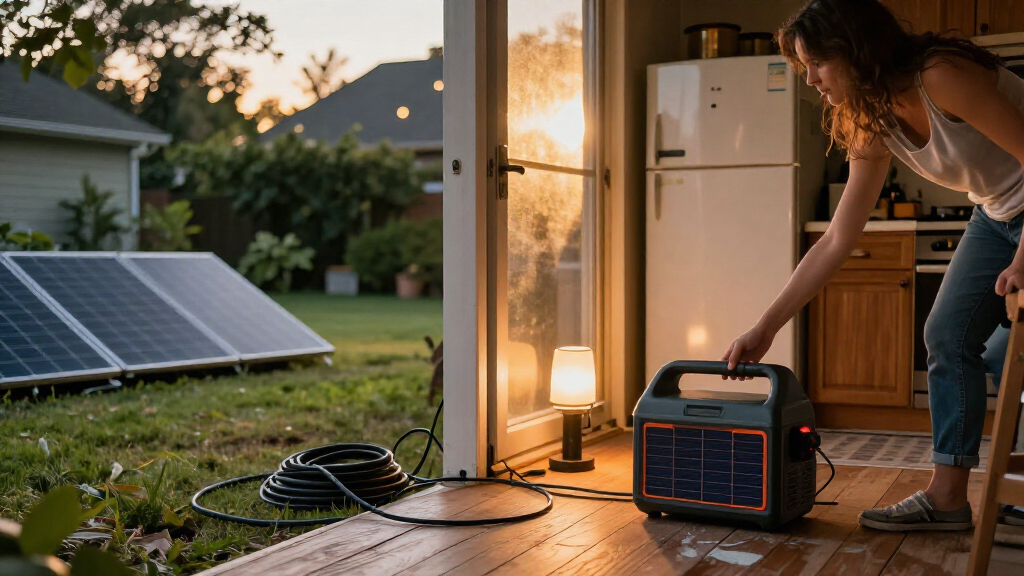
How We Picked
I evaluated every kit against the realities of a home power outage rather than spec-sheet bragging rights. Usable capacity came first: a kit needs enough watt-hours to run a refrigerator (roughly 800Wh per day) plus lights and communications for at least one night before solar recharge. Inverter output mattered next, because a 300W inverter cannot start a fridge compressor no matter how big the battery is. Recharge capability — the wattage of included panels and whether the kit supports fast AC recharge — separated kits that survive multi-day outages from ones that fade after day one.
Beyond the numbers, I weighed build quality, expandability, and total kit value. Kits that bundle appropriately sized panels ranked above power stations sold bare, and expandable systems like the Jackery HomePower series earned credit for growing with a buyer’s needs. Finally, I considered who each kit is actually for: a beginner keeping a fridge alive needs something very different from an off-grid homeowner, so the ranking reflects fit-for-purpose at each tier, not raw capacity alone.
Factors to Consider When Choosing Solar Generator Kits For Home Backup
Choosing a solar generator kit for home backup is mostly an exercise in honest math: what you need to power, for how long, and how fast you can refill the battery with sunlight. These are the factors that most often trip buyers up.Start With Your Watt-Hour Budget, Not the Product
Before comparing kits, list what you actually need during an outage. A refrigerator draws roughly 800Wh per day, a CPAP machine 300–400Wh per night, and phone or laptop charging is almost negligible. Add those numbers up, multiply by the number of days you want coverage, and you have your minimum capacity target — most households land between 1,000Wh and 3,000Wh for a realistic two-day outage. The most common mistake in this category is buying a 300Wh kit because it’s cheap, then discovering it can’t run a refrigerator for a single night. Also remember that lithium batteries shouldn’t be drained to zero regularly, so treat about 80% of rated capacity as your working number. And factor in panel output: a 200W panel might only deliver 600–800Wh on a good day, so a 2,000Wh battery paired with one small panel takes days to refill.
Inverter Wattage Decides What You Can Run at All
Battery capacity tells you how long you can run something; inverter wattage tells you whether you can run it in the first place. Refrigerator compressors, well pumps, and microwaves have surge requirements that can briefly hit two to three times their running wattage. A 300W station simply cannot start a fridge, and even a 1,000W unit may struggle with a surge-heavy appliance. For genuine home backup, I’d treat 1,500W of continuous output as the practical floor and 3,000W as comfortable headroom for running multiple appliances simultaneously. Another detail that separates kits: pure sine wave versus modified sine wave inverters. Modified sine wave output can cause motors, compressors, and sensitive electronics to run hot or behave erratically, which is a real problem when the device in question is your refrigerator. Every top-tier kit in this roundup uses pure sine wave, but several budget 300W options cut that corner.
Solar Panel Bundles Are Where Cheap Kits Cut Corners
A “solar generator kit” is only as good as its recharge loop, and this is where budget bundles most often disappoint. Watch for three tricks: panels measured in optimistic lab conditions rather than real-world output, kits that bundle one small panel with a big battery (guaranteeing a multi-day recharge), and stations with built-in panels that produce so little power they’re essentially decorative. As a rule of thumb, you want at least 400W of panel capacity for every 2,000Wh of battery if you expect daily solar recharge during an extended outage. Panel quality matters too — monocrystalline panels with decent efficiency ratings will outperform thin, flexible, or amorphous options in anything less than full sun. Also check the charge controller’s input limit on the station itself, because some units can’t accept all the panel wattage you might want to add later.
Portability Versus Permanence: Know Which Buyer You Are
Portable kits and fixed off-grid systems solve overlapping but distinct problems, and confusing them wastes money. A portable kit like the Jackery or BLUETTI options can move from closet to kitchen during an outage, double as campsite or job-site power the rest of the year, and require zero installation — that versatility is part of what you’re paying for. A hardwired system like the ECO-WORTHY 10kW kit lives on your roof permanently, integrates with your electrical panel, and can back up heating and well pumps that portables can’t touch, but it needs professional installation, permitting in many areas, and a multi-thousand-dollar commitment. A reasonable middle path many buyers take: start with one strong portable kit covering the essentials, and only move to a fixed system if outages in your area are long or frequent. What I’d advise against is buying two small portables when one properly sized kit would have done the job better for similar money.
Battery Chemistry, Lifespan, and Expandability
Nearly every kit in this range uses LiFePO4 (LFP) chemistry, and for good reason: it tolerates thousands of charge cycles versus the hundreds of older lithium-ion cells, which matters for something you’ll own for a decade and hopefully rarely use. Check the rated cycle life and what capacity the manufacturer guarantees at the end of it — some budget brands are vague on this, which is itself a signal. Expandability is the other long-term factor: systems like the Jackery HomePower series accept add-on battery packs, letting you start with 3–4kWh and grow later, while sealed budget units are stuck at whatever capacity you bought. If you expect your backup needs to grow (an EV, a medical device, a chest freezer), paying more upfront for an expandable platform usually beats replacing the whole kit. Finally, look at pass-through charging, which lets the station run appliances while it recharges from panels — genuinely useful during multi-day outages.
The Hidden Costs and Features That Matter in an Outage
Small details loom large when you’re fumbling in the dark. Uninterruptible power supply (UPS) functionality — switching to battery in under 20 milliseconds — keeps computers and network gear alive through blinks and brownouts, not just long outages. A clear display or app showing real-time input and output helps you ration power intelligently instead of guessing. Multiple charging inputs (AC, solar, car port) give you redundancy when the sun doesn’t cooperate. And think about where you’ll store and run the kit: batteries should live in a temperature-controlled space, since extreme cold reduces capacity and extreme heat accelerates degradation. Budget for extension cords and a transfer switch if you want to power hardwired circuits, because none of that is included in any kit. The cheapest kits often become the most expensive once you add the accessories they quietly assume you already own.
Frequently Asked Questions
Can a solar generator kit actually run my refrigerator during an outage?
Yes, but only if two conditions are met: the inverter must handle the fridge’s surge draw (typically 1,200–1,800W for a moment when the compressor starts), and the battery must hold roughly 800–1,200Wh per day of fridge runtime. In this lineup, that rules out the entire 300W class — the BLAVOR, Jackery Explorer 300, EnginStar, and ZeroKor kits lack the inverter wattage to start a compressor, regardless of their batteries. The 1,000Wh-and-up kits like the UDPOWER S1200 and Jackery 1000 v2 can run a fridge for roughly a day, while the Jackery HomePower 3600 Plus, ABOK Ark3600, and ECO-WORTHY systems can stretch that to multiple days, especially with panels recharging during daylight. The practical takeaway: if fridge coverage is your main goal, treat 1,000Wh of capacity and 1,500W of inverter output as your entry point.
Is it better to buy one large kit or two smaller kits for the same money?
One properly sized kit wins for home backup in almost every scenario, and the main reason is appliance starting power. Two 1,000Wh stations still can’t run a refrigerator if each has a 1,000W inverter that trips on compressor surge, while a single 2,000Wh unit with a 2,200W inverter handles it easily. Splitting capacity also doubles your monitoring burden during an outage and halves your solar recharge per unit unless you buy extra panels. Where two kits make sense is when you want power in two places at once — say, a fridge downstairs and medical equipment upstairs — or when you value redundancy against a single unit failing. The only other argument for multiples is incremental buying: starting with one mid-size kit like the Jackery Explorer 2000 v2 and adding a second later spreads the cost out.
How much solar panel capacity do I need to keep a kit charged during a multi-day outage?
Real-world panel output is usually 50–70% of the rated wattage, depending on sun angle, weather, and how often you reposition the panels. A 200W panel realistically delivers 600–1,000Wh on a clear day, so if your household burns 1,500Wh daily, you’d want at least 400W of panels just to break even. This is why the ABOK Ark3600’s bundle of three 200W panels impressed me more than kits pairing big batteries with a single 200W panel — during a three-day outage, recharge speed matters as much as initial capacity. Fixed mounting helps consistency but portable panels you can angle toward the sun (and move if a neighbor’s house shades you) typically outperform permanently mounted ones by a surprising margin. Also verify the station’s maximum solar input, because exceeding it wastes panel wattage you paid for.
Should I choose a portable solar generator kit or a fixed off-grid system like the ECO-WORTHY 10kW?
It comes down to outage profile and how you’ll use the equipment between outages. If your power interruptions are occasional and measured in hours to a couple of days, a portable kit in the Jackery HomePower class covers your essentials, stores in a closet, and earns its keep as camping or workshop power the rest of the year. If you face frequent or multi-day outages, want to back up heating, well pumps, or whole circuits, or intend to offset daily grid usage, a fixed system like the ECO-WORTHY 10kW with 20.48kWh of storage is the only option here that genuinely fits — but it requires professional installation, roof or ground mounting space, possible permitting, and a permanent commitment. A common mistake is buying the fixed system for rare outages and rarely recouping the investment. The reverse mistake — expecting a portable kit to run a whole house — is even more common and more disappointing.
Are the budget 300W kits worth buying at all for home backup?
They’re worth it for a narrowly defined job: keeping phones, headlamps, a radio, a fan, or a Wi-Fi router alive, and doing it affordably. The EnginStar and Jackery Explorer 300 handle that role capably, and the Jackery in particular brings the polished app and build quality of its bigger siblings. What they can’t do is run anything with a motor or heating element — no fridge, no microwave, no space heater, no hair dryer. If your definition of home backup stops at “lights and communication,” these kits are honest value. But if there’s any chance you’ll want refrigerator coverage during an extended outage, the money spent on a 300W kit is better put toward a 1,000Wh-class option like the UDPOWER S1200 or Jackery 1000 v2, because you won’t be able to upgrade your way there later.
Conclusion
The right pick depends entirely on what “backup” means in your house. For best overall, the Jackery HomePower 3600 Plus with two 200W panels delivers the combination of capacity, inverter headroom, and expandability that covers nearly every home backup scenario short of whole-house coverage. For best value, the UDPOWER S1200 kit and Jackery Solar Generator 1000 v2 hit the sweet spot of fridge-capable performance without the premium price of the big stations. For best premium buyers who want genuine whole-home resilience, the ECO-WORTHY 10kW off-grid system is the only option here that can run a house — provided you’re ready for permanent installation. For beginners, the Jackery Explorer 2000 v2 bundle offers forgiving, straightforward operation with enough capacity to be genuinely useful, while the EnginStar 300W kit suits first-timers who just want lights and charged phones. For capacity on a budget, the ABOK Ark3600 with three panels is the strongest raw-wattage deal in the lineup. Whatever you choose, buy for the outage you actually expect — the most expensive kit is the one that can’t do the job when the lights go out.
Halloween Picks
halloween
As an affiliate, we earn on qualifying purchases.