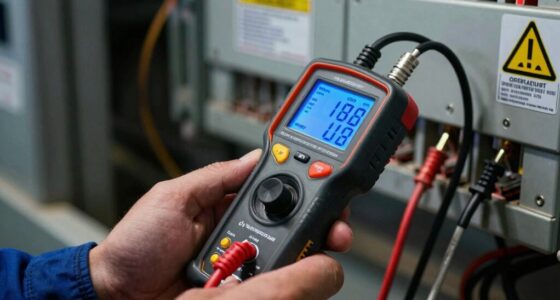
To master a carbon pile tester, start by understanding how it applies a controlled load and watch the voltage and current readings carefully. Gradually increase the load using the large dial while observing the meter to see how voltage drops across the battery or circuit. A stable, low voltage drop means good contact and health, while a rising or irregular drop signals issues. Keep practicing these steps, and you’ll find yourself evaluating contact resistance like a pro in no time.

Get backup power and energy gear delivered free with Prime
- Fast, free delivery on millions of items
- Prime Video, Amazon Music and more included
- Member-only deals all year
Key Takeaways
- Familiarize yourself with the load control dial and meter display before starting tests.
- Connect test leads securely and ensure good contact for accurate readings.
- Gradually increase the load while monitoring voltage and current, observing for voltage drops.
- Interpret low, stable readings as healthy contact, while rising voltage drops indicate resistance issues.
- Use manufacturer guidelines to compare readings and determine if contact resistance is within acceptable limits.

Understanding how to read a carbon pile tester is essential for accurately measuring electrical contact resistance. When it comes to battery maintenance, this skill becomes even more critical because your battery’s performance hinges on proper testing procedures. Whether you’re troubleshooting a car battery or checking a large industrial power source, knowing how to interpret the readings ensures you’re making informed decisions about repairs or replacements.
To begin, familiarize yourself with the device’s controls and display. Most carbon pile testers feature a large dial or knob to adjust the load and a meter to display voltage or current readings. Before testing, make sure your setup is correct—connect the test leads securely to the battery or circuit terminals, ensuring good contact. Proper preparation helps avoid inaccurate readings that could lead to unnecessary maintenance or misdiagnoses.
When performing testing procedures, the goal is to simulate operational conditions by applying a calculated load. You’ll typically start by setting a low resistance or load on the device, then gradually increase it while observing the meter. As you do this, pay close attention to the voltage readings across the circuit or battery terminals. The key measurement is the contact resistance, which is inferred by the voltage drop at a specific load. A high voltage drop indicates poor contact or internal resistance issues, signaling potential problems that might require maintenance or further inspection.
As you increase the load, note the steady‑state current and voltage. Consistent readings suggest stable connections, while fluctuations may suggest loose connections, corrosion, or internal deterioration. When reading the meter, focus on the voltage drop across the contact points at the applied load. If the voltage remains low and stable, it indicates good contact and a healthy battery or circuit. Conversely, a rising voltage drop signals resistance issues that could hamper performance.
While interpreting results, keep in mind that different batteries and circuits have acceptable resistance ranges. Consult manufacturer guidelines or standard testing procedures to determine whether your readings fall within acceptable limits. If the resistance is too high, consider cleaning contacts, tightening connections, or replacing faulty components. Regular testing, including circuit resistance testing, as part of your battery maintenance routine helps prevent unexpected failures and prolongs the life of your equipment.
As an affiliate, we earn on qualifying purchases.
Frequently Asked Questions
Can I Use a Carbon Pile Tester on All Types of Batteries?
You can’t use a carbon pile tester on all types of batteries. It’s mainly suitable for large, high-capacity batteries like those in vehicles or industrial settings. Battery compatibility is limited because some batteries, like small or sealed types, may not handle the testing process safely or accurately. Be aware of testing limitations to avoid damaging the battery or getting false readings. Always check the manufacturer’s guidelines before testing different battery types.
What Safety Precautions Should I Take When Operating the Tester?
When operating a carbon pile tester, you should always wear personal protective equipment like gloves and safety goggles for proper handling. Make certain your workspace is clear of hazards, and keep the tester’s leads properly insulated. Never touch the testing terminals during operation, and follow manufacturer instructions closely. Taking these safety precautions helps prevent electrical shocks and injuries, making your testing process safer and more effective.
How Often Should I Calibrate My Carbon Pile Tester?
You should calibrate your carbon pile tester every 6 to 12 months for peak accuracy. Did you know that 85% of testing errors stem from improper calibration? To guarantee consistent results, check your calibration frequency regularly, especially if you’re testing different battery types. Also, verify your tester’s compatibility with various batteries, as using incompatible ones can skew your readings. Stay proactive to maintain precise and reliable testing.
What Do I Do if the Needle Fluctuates During Testing?
If the needle fluctuates during testing, first check for needle stability issues or loose connections. Fluctuations often occur due to unstable contact or external vibrations. make certain the tester is properly calibrated and the test setup is steady. You might also need to wait for the needle to stabilize before recording readings. Addressing these fluctuation causes helps you get accurate, reliable measurements with your carbon pile tester.
Are There Any Common Mistakes to Avoid When Reading the Tester?
Watch out for common mistakes during testing—these can trip you up and skew your results. When doing battery maintenance and testing procedures, avoid rushing or misreading the needle, which can lead to inaccurate conclusions. Verify the connections are clean and secure, and don’t ignore fluctuating needle movements. Staying attentive and methodical helps you interpret the tester correctly, preventing costly errors and ensuring your battery’s health is accurately assessed.
Conclusion
Now that you know how to read a carbon pile tester like a pro, remember that practice makes perfect. The more you work with it, the more confident you’ll become. Don’t forget, Rome wasn’t built in a day—so stay patient and keep honing your skills. With time, you’ll master this tool and handle battery tests with ease. Keep learning, stay curious, and trust that every expert started just like you—by taking the first step.
Halloween Picks
halloween
As an affiliate, we earn on qualifying purchases.