

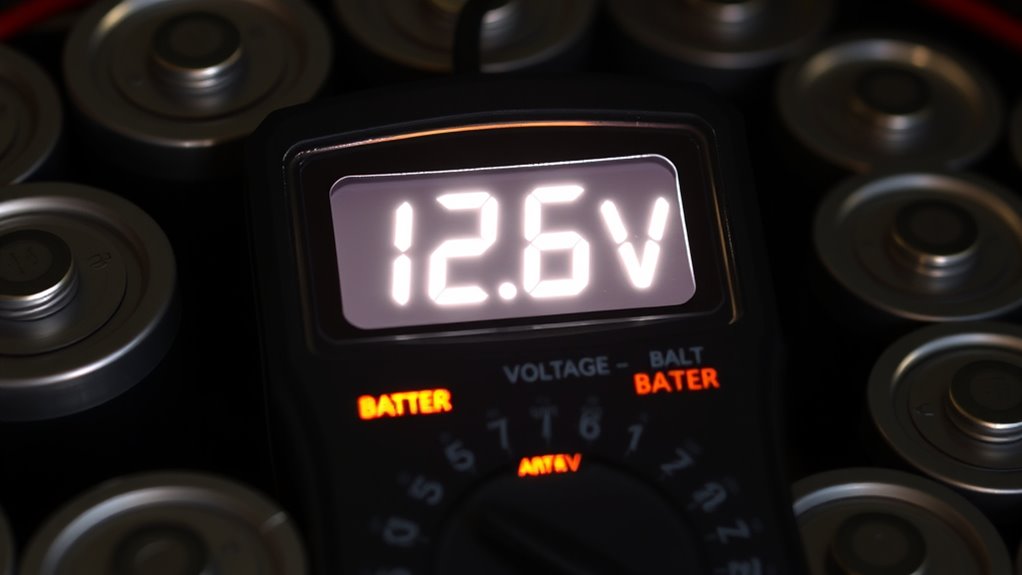
Understanding your battery’s voltage helps you determine its charge and health. A fully charged lead-acid battery shows around 12.6 volts or higher, while below 12 volts suggests it’s discharged or failing. Fluctuations can happen due to recent use, temperature, or aging, but consistent low levels may indicate the need for recharging or replacing. By monitoring these signs regularly, you can prevent unexpected failures. Keep reading to learn more about what these numbers reveal and how to interpret them correctly.
Key Takeaways
- Battery voltage indicates charge level, with around 12.6V signaling a full charge and below 12V indicating discharge.
- Fluctuations in voltage can result from recent usage, temperature, or aging, and do not always signify problems.
- Persistent low or unpredictable voltage readings may point to battery deterioration or internal faults.
- A sudden drop after engine start is normal, but ongoing low voltage suggests the need for recharging or servicing.
- Regular voltage checks help monitor battery health, prevent failures, and ensure reliable power.
Knowing how to read your battery’s voltage is vital for understanding its health and performance. When you check the voltage, you’re fundamentally gauging the battery’s current state of charge, which indicates how much energy it has stored and how ready it is to power your device or vehicle. A proper understanding of voltage readings helps you identify whether your battery is functioning at its best or if it’s showing signs of wear or potential failure. Voltage levels can fluctuate based on various factors, including recent usage, temperature, and age, so recognizing what these fluctuations mean is essential to maintaining battery health.
A fully charged lead-acid battery, for example, typically measures around 12.6 volts or higher when at rest. If your reading falls noticeably below this, it suggests the battery isn’t holding a full charge, which could be due to aging, sulfation, or a fault within the cells. On the other hand, a reading close to 12.4 volts indicates a partial charge, while anything below 12 volts often points to a discharged or failing battery. These measurements give you a quick snapshot of the current state of charge, but they aren’t foolproof indicators of overall health. Voltage fluctuations can occur for many reasons—like temperature changes or recent heavy usage—that temporarily affect the reading without necessarily indicating a serious issue.
When you observe consistent voltage fluctuations, it’s a sign that you should dig deeper into your battery’s condition. For instance, a sudden drop in voltage after starting your engine might be normal, but if the voltage remains low or dips unpredictably over time, it could mean the battery is nearing the end of its life. Similarly, if you notice the voltage rising and falling during rest periods, it might be due to internal resistance or an aging cell struggling to hold a charge. Keeping an eye on these fluctuations helps you determine if your battery needs recharging, servicing, or replacement. Recognizing signs of battery deterioration can help prevent unexpected failures and extend your battery’s lifespan.
Learning to interpret voltage readings isn’t just about knowing the numbers—it’s about understanding what they signify in real-world terms. Pay attention to how the voltage changes under different conditions and over time. A healthy battery generally maintains a steady voltage with minimal fluctuations, whereas irregular or declining voltage patterns can warn you of impending failure. Regularly checking your battery’s voltage enables you to catch problems early, prevent unexpected breakdowns, and ensure your power source remains reliable. In essence, mastering how to read and interpret voltage readings empowers you to manage your battery proactively, extending its lifespan and maintaining top performance.
Frequently Asked Questions
How Do Temperature Changes Affect Battery Voltage Readings?
Temperature changes cause thermal effects that impact battery voltage readings. When it’s cold, your battery’s voltage tends to drop due to increased internal resistance, leading to voltage fluctuation. Conversely, higher temperatures can temporarily boost voltage but may harm the battery over time. You should observe these voltage changes carefully, especially in extreme weather, to make certain of accurate readings and prevent misinterpreting your battery’s health.
Can a Low Voltage Indicate a Dead Battery?
Yes, a low voltage can indicate a dead battery, but it also depends on battery chemistry and voltage stability. If your battery’s voltage drops markedly below its normal range, it’s likely dead or nearly so. Keep in mind that different battery chemistries have different voltage thresholds. Regularly check voltage stability to prevent unexpected failure, and consider testing with a multimeter to accurately assess your battery’s health.
What’s the Difference Between Voltage and Capacity?
Voltage measures the electrical potential difference between two points, indicating the battery’s current energy level, while capacity shows how much charge the battery can hold overall. As you use your battery through charge cycles, it experiences aging, which reduces its capacity over time. This means a battery with high voltage might still have diminished capacity due to aging, so both readings help you understand its health better.
How Often Should I Check My Battery’s Voltage?
You should check your battery’s voltage regularly, especially after a few charging cycles, to catch potential issues early. Skipping these checks can lead to unexpected failures, risking your device’s performance. Regular voltage monitoring is a crucial part of battery maintenance, helping you spot problems before they escalate. Don’t wait for a complete failure—stay proactive, check often, and keep your battery in top shape.
Do All Batteries Behave the Same at Similar Voltages?
No, all batteries don’t behave the same at similar voltages because battery chemistry affects their voltage stability. For instance, lead-acid and lithium-ion batteries may show similar voltages but handle charge and discharge differently. You should know that voltage readings alone can’t tell the full story of a battery’s health. Always consider the type of battery and its specific chemistry to interpret voltage levels accurately.
Conclusion
By understanding what your battery voltage readings mean, you’re fundamentally holding the key to its health in your hands. Think of voltage as the heartbeat of your battery—when it’s strong, everything runs smoothly; when it’s weak, issues arise. Keep an eye on those numbers, and you’ll catch problems before they become emergencies. Remember, a healthy battery is the silent engine behind your daily routines, quietly powering your world like a dependable friend.