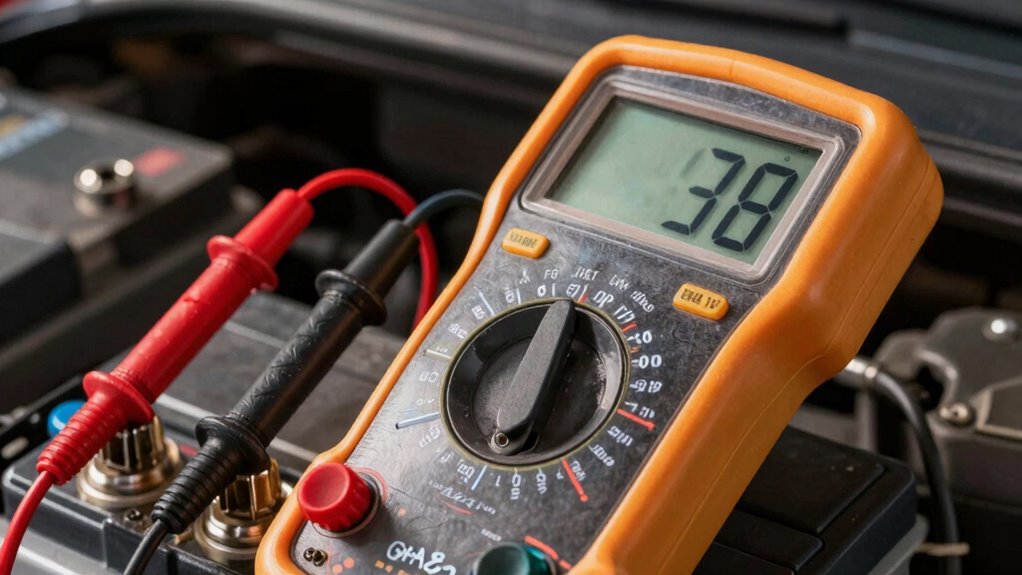

Many people skip testing their car battery under load, even though it’s vital for accurately evaluating its health. Static voltage checks can hide problems like internal faults or diminished capacity, leading to unexpected breakdowns. By measuring voltage while the battery is under a real load—like headlights or engine start—you’ll get a clearer picture of its true condition. Keep going, and you’ll discover how this simple test can save you from surprises on the road.
Key Takeaways
- Many vehicle owners skip load testing, missing signs of capacity loss not visible in static voltage checks.
- Voltage drop under load reveals true battery health by testing power delivery during engine start and accessory use.
- A healthy battery maintains above 9.6 volts during load; drops below indicate internal faults or reduced capacity.
- Load testing requires a multimeter and a load like headlights to assess performance under real operating conditions.
- Regular load testing helps prevent unexpected breakdowns by identifying issues that static voltage measurements may conceal.
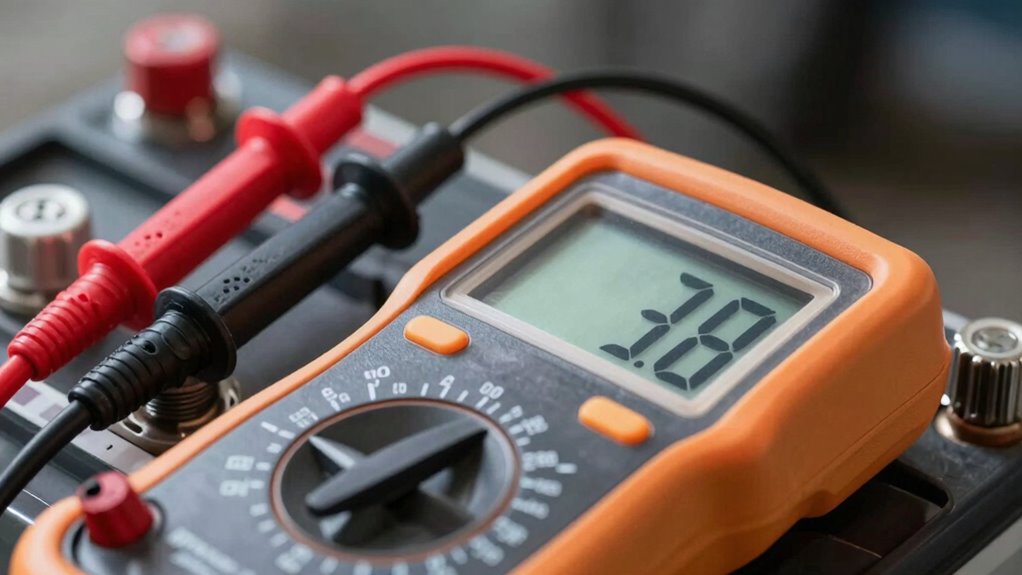
Many people overlook the importance of testing their car battery regularly, but neglecting this simple step can leave you stranded unexpectedly. One essential test that often gets ignored is measuring voltage drop under load. This test provides insight into your battery’s true health, revealing issues that aren’t always obvious just by checking the voltage when the car is off. When you perform this test, you’re fundamentally assessing the battery’s capacity to deliver power under real-world conditions, which is crucial for reliable vehicle operation.
The battery capacity isn’t just about how much power it can hold when fully charged; it also depends on how well it handles repeated charging cycles. Every time you start your car, the battery endures a charge cycle, and over time, these cycles cause wear and tear. A battery with diminished capacity will struggle to maintain voltage during load, especially when the engine is cranking or accessories are on. This is why voltage drop under load becomes a valuable indicator. If your battery can’t sustain a steady voltage when tested under load, it’s a sign that its capacity has substantially diminished, regardless of how new it appears.
Performing this test is straightforward but often overlooked. You need a multimeter to measure voltage, and a load—such as turning on the headlights or the car’s accessories—to simulate typical usage. First, check the battery’s voltage when the engine is off. Then, start the engine and turn on the headlights or other electrical loads. Observe how the voltage drops during this load. A healthy battery should maintain a voltage above 9.6 volts under load in most cases. If the voltage dips below this threshold, it indicates the battery is struggling to deliver sufficient power, which could be due to reduced battery capacity or an internal fault. This kind of testing is more revealing than just checking the static voltage, which can sometimes mask underlying issues. Additionally, understanding the contrast ratio of your vehicle’s electrical system can help you interpret how well components are functioning under load conditions.
Frequently Asked Questions
How Often Should I Perform a Voltage Drop Test?
You should perform a voltage drop test at least once every six months or after completing about 50 charging cycles, especially if your battery’s lifespan is nearing its end. Regular testing helps identify issues early, preventing unexpected failures. If you notice slow starts or dim headlights, it’s a good idea to check the voltage drop more frequently. Staying proactive ensures your battery stays reliable longer and maintains peak performance.
Can a Battery Pass a Load Test but Still Be Faulty?
In the blink of an eye, a battery can pass a load test yet still be faulty. You might think it’s performing well, but its voltage drop under load reveals hidden issues. This means the battery’s performance and load capacity are compromised, even if it initially appears fine. Always check under load, because a passing test doesn’t guarantee the battery’s long-term health or reliability.
What Tools Are Needed for Accurate Voltage Drop Testing?
To accurately perform voltage drop testing, you’ll need a digital multimeter and test leads. The digital multimeter measures voltage differences, while the test leads connect the meter to the battery terminals and cable ends. Make sure the multimeter is set to the appropriate voltage range. Using quality test leads guarantees reliable readings. With these tools, you can identify voltage drops that indicate potential wiring or connection issues.
How Does Temperature Affect Voltage Drop Readings?
Don’t let the cat out of the bag—temperature substantially impacts voltage drop readings. Thermal effects cause internal resistance to fluctuate, making readings unreliable if temperature isn’t stable. Cold temperatures increase resistance, leading to higher voltage drops, while heat decreases it. To get accurate results, you need consistent, temperature-stable conditions, ensuring your measurements reflect the true health of your battery without being skewed by external thermal influences.
Is Voltage Drop Testing Suitable for All Types of Batteries?
Voltage drop testing isn’t suitable for all battery types because different battery chemistries respond uniquely under load. For example, lead-acid batteries show clear results, but lithium-ion batteries may need specific testing environments to obtain accurate readings. You should consider the battery chemistry and testing environment to make certain of reliable results. Always verify compatibility before performing voltage drop tests, especially on specialized or newer battery technologies.
Conclusion
Don’t ignore the voltage drop under load—it’s like checking the heartbeat of your battery. Skipping this test is like trying to read a map in the fog; you might miss the hidden pitfalls. By paying attention to this simple step, you’re shining a flashlight on potential problems before they turn into roadside breakdowns. Remember, a healthy battery keeps your journey smooth, so don’t let a small test become a big surprise. Stay vigilant, and keep your engine humming.