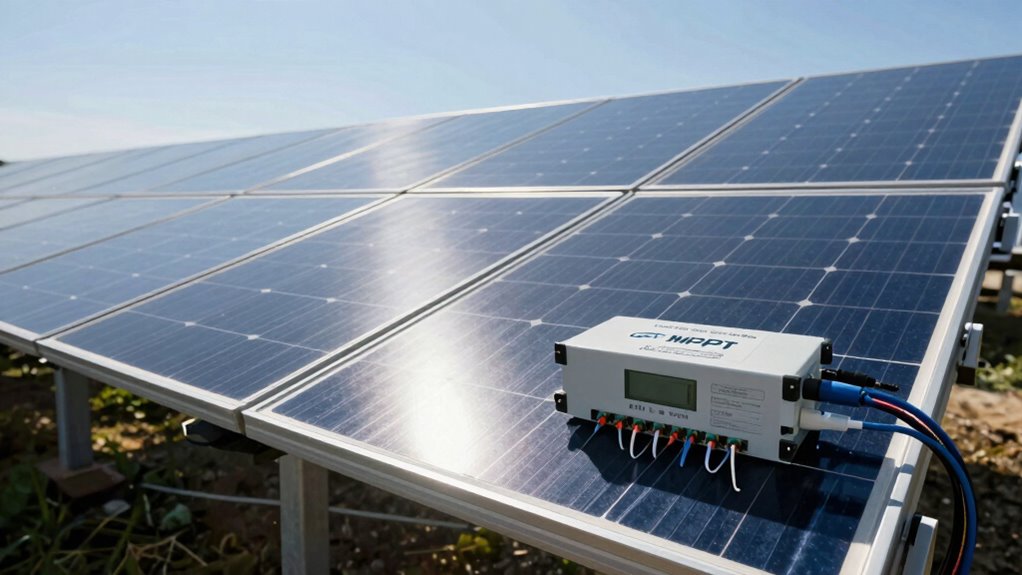
During midday, your MPPT controller clips power to prevent overloads when solar input exceeds its maximum capacity. This isn’t a flaw but a safety feature to protect your system’s components. When sunlight is at its peak, the controller limits the energy it transfers, ensuring everything stays within safe limits. If you want to understand why this happens and how to optimize your system, there’s more to explore.
Key Takeaways
- Power clipping occurs when solar output exceeds the MPPT controller’s maximum input limit during peak sunlight.
- During midday, solar panels generate maximum energy, which can surpass the controller’s capacity, causing clipping.
- Clipping is a safety feature that prevents system overload and potential damage by capping incoming power.
- If batteries are nearly full, excess midday energy is clipped to avoid overcharging and protect battery health.
- Adjusting system components, like increasing battery capacity, can reduce clipping and improve energy utilization.
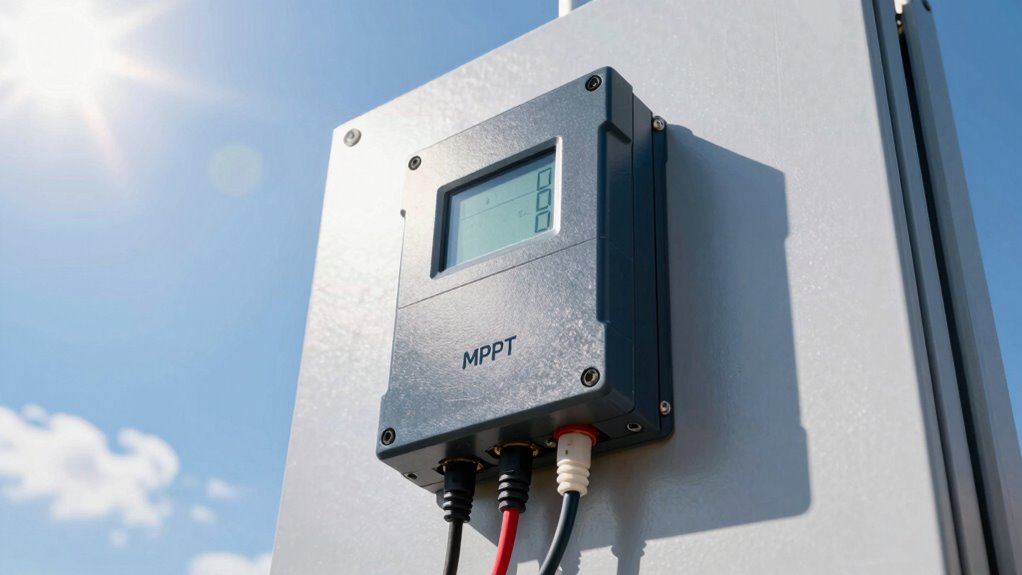
During midday, MPPT (Maximum Power Point Tracking) controllers often experience power clipping, which occurs when the system reaches its maximum input limit. This is a common scenario in solar power systems, especially when the sun is at its peak. At this time, your solar panels generate the highest amount of power, but the MPPT controller can only handle a certain maximum input. As a result, any excess energy that exceeds this limit gets clipped, meaning it’s not transferred to the batteries or used for power. This isn’t necessarily a flaw in your system, but rather a natural consequence of the controller’s design and the inherent limits of your panels.
Midday power clipping occurs when solar input exceeds MPPT controller limits, a natural system safeguard during peak sunlight.
One of the key factors influencing this power clipping is solar panel efficiency. During midday, solar panels operate at or near their maximum efficiency, converting sunlight into electrical energy as effectively as possible. However, even at peak efficiency, there’s a limit to how much power they can produce due to their design and environmental factors like temperature and shading. When the panels hit their *optimum* conversion point, the power output peaks, and if your MPPT controller is set to a maximum input threshold, it can’t process beyond that point. This means your system is working at its capacity, but the controller’s limit caps the amount of energy flowing into your batteries.
Battery charging rates also play a *vital* role here. If your batteries are already close to full capacity, the system’s ability to accept more charge diminishes. During midday, when solar production is high, the system might try to push more energy into the batteries, but if they’re nearly full, the charging rate slows down. In this case, the power that exceeds the charging capacity gets clipped, even if the panels are still producing high levels of power. This prevents overcharging your batteries, protecting their lifespan, but it also means not all the generated energy gets stored.
Understanding the relationship between solar panel efficiency, battery charging rates, and the maximum input limits of your MPPT controller helps you *maximize* your system. While clipping might seem like a limitation, it’s actually a safeguard that prevents damage to your batteries and ensures system longevity. Recognizing that power management strategies can help optimize energy capture, you might consider adjusting your system’s settings or expanding your battery bank capacity so that it can accept more charge during peak sunlight hours. Recognizing these factors allows you to better manage midday power clipping and improve your overall solar energy efficiency.
Frequently Asked Questions
Can MPPT Controllers Prevent Power Clipping During Peak Sunlight Hours?
Yes, MPPT controllers can help prevent power clipping during peak sunlight hours. They optimize the power output by matching the solar panel’s voltage and current to the inverter’s capacity, which minimizes issues caused by solar panel degradation over time. Ensuring inverter compatibility also allows the MPPT controller to operate efficiently, reducing clipping and maximizing energy harvest during peak sunlight. Proper system setup is key to avoiding power loss at midday.
Does Increasing Panel Wattage Always Lead to More Energy Output?
Adding more panel wattage doesn’t always mean more energy output. In fact, studies show panel degradation can reduce efficiency over time, and inverter efficiency limits how much power gets converted. If your panels produce more power than your inverter can handle, it causes clipping, wasting potential energy. So, increasing panel wattage without considering these factors may not boost overall energy, and could even reduce your system’s effectiveness.
How Does Temperature Affect MPPT Clipping Behavior?
Temperature effects markedly influence MPPT clipping behavior. When temperatures rise, panels and controllers heat up, prompting thermal regulation that can reduce current output to prevent damage. This cooling mechanism causes the MPPT controller to clip power more aggressively at midday, especially on hot days. Conversely, cooler temperatures improve efficiency, allowing the controller to maximize power without clipping. Always consider temperature impacts when evaluating your system’s midday performance.
Are Certain Brands of MPPT Controllers Less Prone to Clipping?
Think of your MPPT controller as a finely tuned race car; some brands, with better manufacturing quality and solid reputation, perform smoother and are less prone to clipping. Less reputable brands might cut corners, causing power clipping during peak sunlight. When choosing, prioritize trusted brands known for durability and quality, ensuring your system runs efficiently at midday. A well-made controller keeps your energy flowing seamlessly, avoiding the sharp dips that ruin your solar output.
Can Software Updates Reduce or Eliminate Power Clipping Issues?
Yes, software patches and firmware updates can mitigate or eliminate power clipping issues in your MPPT controller. Manufacturers often release updates that optimize control algorithms, improve voltage regulation, and enhance overall efficiency. By regularly updating your controller’s firmware, you ensure it operates at peak performance, minimizing clipping during midday. Check for updates from your brand, and follow instructions to install them safely for the best results.
Conclusion
As the sun reaches its peak, your MPPT controller gently tames the relentless surge of energy, like a skilled conductor guiding a storm. It clips the excess, balancing the flow like a calm river after a wild rush. In this midday lull, your system finds harmony, preventing overload and ensuring longevity. Trust this steady rhythm, where energy dances within safe bounds, allowing your solar setup to thrive smoothly under the bright midday sky.