
TL;DR
IdeaClyst is a local-first, AI-powered platform that acts as a war room for your ideas. It combines structured debate, real research, and a collaborative workspace to accelerate validation and decision-making, reducing costly missteps. If you’re interested in how innovative workspaces operate, check out A War Room for Your Next Idea: Inside IdeaClyst.
Imagine having a dedicated war room for your ideas — a space where your team can sharpen, challenge, and prioritize with laser focus. Now, picture doing this entirely on your own machine, with no data leaving your laptop. That’s what IdeaClyst promises: a personal, AI-powered war room that turns the chaos of multiple ideas into a clear, actionable plan.
This isn’t just another brainstorming tool. It’s a structured environment designed to cut through the noise, force disagreement, and build conviction. If you’ve ever wrestled with which idea to pursue or watched your best plans falter from lack of rigorous critique, you’re about to see how a dedicated war room can change the game.
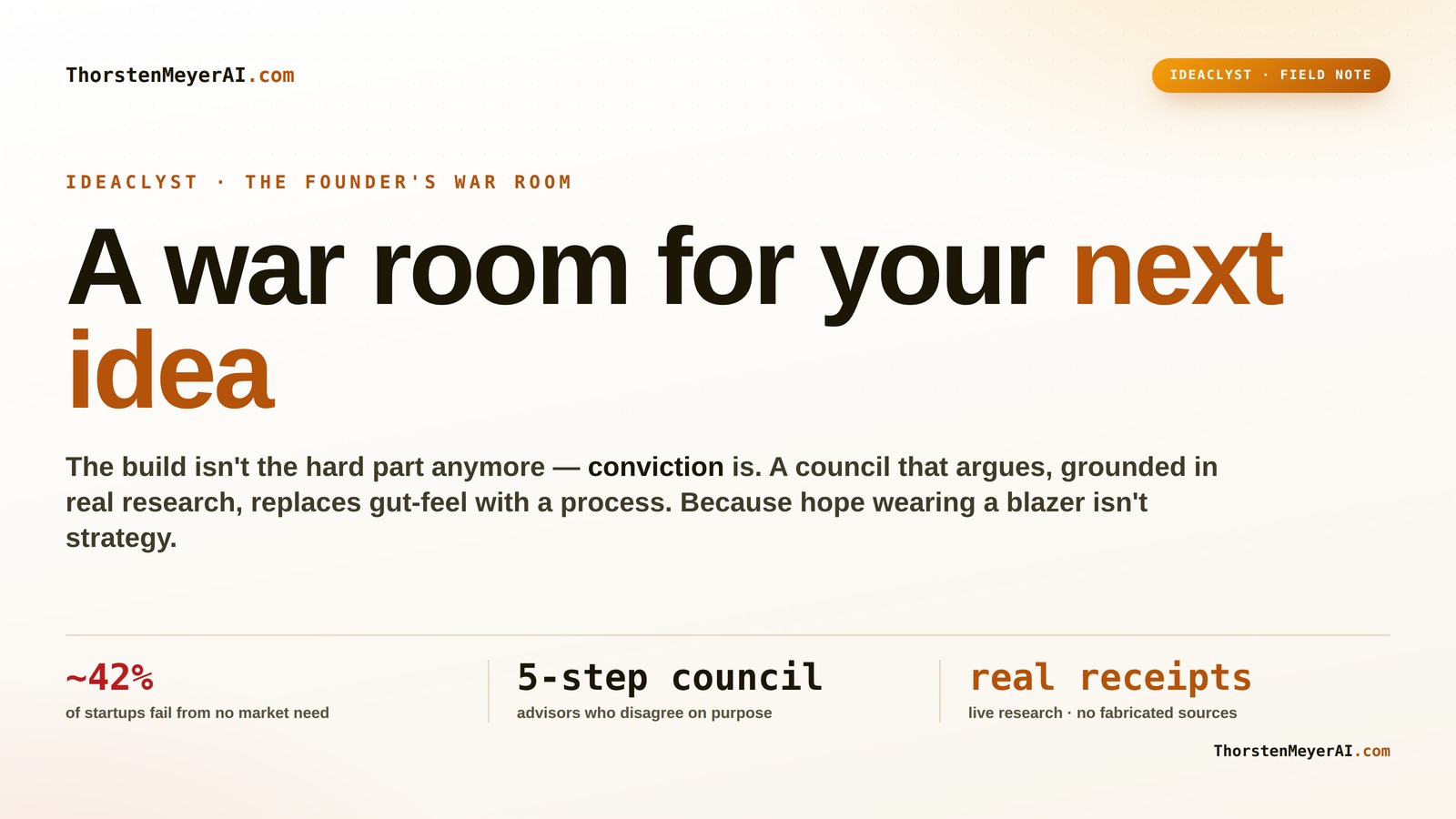
A war room for your next idea
The build isn’t the hard part anymore — conviction is. Knowing which idea deserves the next six months, and being able to defend it. Most founders answer with gut feel and optimistic math. That’s hope wearing a blazer. IdeaClyst replaces it with a process.
The most expensive decision is what to build
The single most valuable thing a tool can do is talk you out of the wrong six months. The numbers make the case better than any pitch.
Three tools in one — on your own machine
Strip away the framing and IdeaClyst is three things at once, all running locally with nothing leaving your laptop.
An AI council
Pressure-tests an idea you bring it — advisors who argue on purpose.
A discovery engine
Finds ideas you didn’t know to look for by hunting real demand signals.
A founder’s workspace
Carries winners from “interesting” all the way to “ready to build.”
Advisors who disagree on purpose
Not one confident, agreeable answer — a structured five-step deliberation where models play different roles and turn on their own work. The disagreement is the feature.
The five-step deliberation
A council that leads with the bad news surfaces the objections you’d otherwise find the expensive way, on month five.
Product strategy
Who’s it for, what’s the wedge, why now, what’s the business model.
Technical architecture
What would it actually take to build — and where’s the risk.
Critique pass
The council turns on its own work. Where’s the hand-waving? What kills this?
Second, independent critique
A different voice, a different angle — so blind spots don’t survive.
Final synthesis
Everything into one coherent founder packet: strategy, architecture, validation, plan.
When IdeaClyst cites a source, it actually fetched it
The hard departure from “ask an AI what it thinks of my startup.” It runs in a strict, real-data-only mode — if it can’t gather genuine evidence, it says so plainly rather than inventing a plausible paragraph.
Confidence with receipts
No fabricated statistics, no imaginary competitors, no made-up citations. The packet survives a skeptical co-founder or a sharp investor because the reasoning has receipts.
Market research first
Scouts the landscape before the council reasons about anything.
Competitor read
Real positioning, pricing signals, feature claims — differentiation vs. reality.
Validation with links
Not “talk to customers” — concrete signals & sources you can click.
From the blank page to build-ready
Evaluation is half the problem; the blank page is the other half. And a plan is worthless if it dies in a tab you never reopen.
Bring a space, not an idea
“AI for accountants,” “tools for indie game studios” — plus your goal and real capacity. It hunts demand signals across HN, Reddit, Product Hunt, GitHub, pricing pages.
- An honest market read — leads with the bad news when a space is hard
- An opportunity map — high pain, thin competition
- Ranked candidates — wedge, who pays, effort, risk, confidence
- each with KILL CRITERIA — when to walk away
A home and a forward path
Every promising idea gets carried forward, with every artifact in plain files on your disk.
- Validation tooling — sprint board, interview list, evidence browser
- Founder profile — a personal-fit lens; same discovery, different advice
- Build workspaces — funnel, personas, landing draft, version history
- “Build this idea” → a PRD + task queue, ready for a coding agent
Key Takeaways
- IdeaClyst transforms idea validation by combining AI critique, research, and local storage — making decision-making faster and more confident.
- The structured debate between models exposes weaknesses early, saving time and money compared to traditional brainstorming.
- Grounding critique in real web research prevents overconfidence based on model vibes alone.
- Running your own idea war room involves clear steps: define, critique, discover, refine, and save.
- Best suited for founders, product teams, and innovators who value rigorous, fast decision cycles.

ChatGPT for Business 101: AI-Driven Strategies to Cut Costs, Skyrocket Productivity and Boost Your Bottom Line
As an affiliate, we earn on qualifying purchases.
As an affiliate, we earn on qualifying purchases.
Why a War Room Changes the Idea Game — Fast
Think of a war room as your mental battlefield — a space where ideas are tested against real-world challenges, not just your gut. Traditional brainstorming often feels like tossing ideas into the wind, hoping they stick. A war room, however, forces you into a disciplined, strategic environment.
For example, a startup founder might bring a new product idea to the table. Instead of vague enthusiasm, the war room’s structured debate pinpoints weak points — like whether the target market is large enough or if the tech risks are manageable. This clarity saves months of wasted effort and thousands of dollars.
Research shows that teams with structured critique outperform unstructured groups. IdeaClyst’s war room approach embodies this: it’s about rapid, honest debate, and making smarter decisions faster. The deeper value lies in its ability to surface hidden assumptions and biases that often go unnoticed in casual discussions. By systematically challenging ideas, teams can identify potential failures early, saving resources and reducing risk. The tradeoff, however, is that this process requires discipline and openness to critique, which can be uncomfortable but ultimately more rewarding.
Inside IdeaClyst: The Three Core Parts You’ll Use
IdeaClyst is a toolkit built to mimic a real war room — but inside your laptop. It’s made of three main components:
- The AI Council: A panel of models that debate your idea from different angles, intentionally disagreeing to surface flaws.
- The Discovery Engine: Finds ideas you might not have considered, based on your inputs and live web research.
- The Founder’s Workspace: Your personal hub where ideas evolve into plans, with everything saved locally in Markdown files.
For instance, you might start with a half-formed idea like launching a new SaaS tool. The council critiques its market fit, technical risks, and business model. Meanwhile, the discovery engine suggests related niches or emerging trends. All of this stays on your own machine, private and secure. This layered approach allows you to explore your idea comprehensively, considering both internal critiques and external opportunities, without reliance on cloud services. Learn more about innovative tech environments at Wilderness Sense. The implication is that you retain full control over sensitive data, which is critical for competitive or confidential projects. The tradeoff is that it requires some initial setup and familiarity with local tools, but the payoff is a secure, customizable environment tailored to your thinking process.
How the AI Council Finds Flaws Most Tools Miss
The AI council in IdeaClyst isn’t just cheerleading. It’s designed to challenge your assumptions fiercely. For insights into how AI is transforming strategic thinking, see A War Room for Your Next Idea. Instead of one AI giving a thumbs-up, five models play different roles: one critiques strategy, another assesses tech risks, a third identifies market gaps.
Imagine you propose a social platform aimed at remote workers. The council might highlight overlooked legal hurdles, or point out that competitors already dominate that space. Its disagreement isn’t a bug — it’s the feature, forcing you to confront weaknesses early. This diversity of perspective pushes you beyond confirmation bias, which often leads to overconfidence and overlooked flaws. The tradeoff, however, is that managing multiple models requires careful interpretation of conflicting opinions. Recognizing when models disagree productively versus when to dig deeper is key. This process encourages critical thinking, reduces the risk of blind spots, and ultimately leads to more robust ideas. According to research from [1], teams that intentionally introduce honest disagreement make better, more confident decisions.
Real Research, Not Just Model Vibes — How IdeaClyst Stays Grounded
One common mistake with AI tools? Taking their word as gospel. IdeaClyst avoids this trap by grounding all its critique and suggestions in live web research. It pulls in real data, current market trends, and verified facts.
Suppose you’re exploring an eco-friendly packaging startup. Instead of generic praise, IdeaClyst’s research engine pulls recent stats on consumer trends, regulations, and competitors. Find out more about research-driven innovation at A War Room for Your Next Idea. This ensures your ideas are evaluated against real-world conditions, not just theoretical models. The implication is that your decisions are more likely to succeed because they’re based on up-to-date, verified information. The tradeoff is that this process depends on the quality and relevance of the data pulled, which can vary. However, by anchoring critique in current data, IdeaClyst helps you avoid the common pitfall of overconfidence based on outdated or superficial insights, making your validation process more rigorous and reliable.
From Idea to Action: How to Run Your Own IdeaClyst War Room
Setting up your idea war room is simpler than you think. Here’s a step-by-step process: For more on effective innovation strategies, visit A War Room for Your Next Idea.
- Define your idea: Write a clear, concise description or problem statement.
- Launch the council: Input it into IdeaClyst and let the models debate from different angles.
- Review critiques and suggestions: Pay attention to the objections and ideas for expansion.
- Use the discovery engine: Let it find related opportunities or risks you hadn’t considered.
- Refine your plan: Incorporate the insights into your strategy document.
- Save and iterate: All outputs are Markdown files on your disk, ready for versioning or sharing.
For example, a solo founder considering a niche social app would go through these steps, ending with a clear plan and a list of potential risks and opportunities.
Who Benefits Most from a Dedicated Idea War Room?
While anyone with ideas can use IdeaClyst, it shines brightest for founders, product teams, and innovation groups facing tough choices. It’s especially useful when rapid iteration and honest critique matter.
Picture a small startup debating whether to pivot or double down. The war room helps surface hidden risks, align team thinking, and build confidence in the decision — all in hours, not weeks.
Nonprofit leaders or community organizers can also use it to vet new initiatives, making sure every dollar and effort counts before launch.
Limitations to Keep in Mind Before Jumping In
IdeaClyst is powerful, but it’s not magic. While it accelerates research and critique, it still depends on your input quality and strategic thinking. It’s best suited for teams comfortable with structured debate and honest critique.
Also, it’s designed for remote, local-first use. If you prefer in-person whiteboard sessions or complex multi-day workshops, it might not fit perfectly. And, while it’s open source, the technical setup requires some familiarity with local environments.
Finally, it’s a tool for validation, not a substitute for customer conversations or real-world testing. Think of it as a turbocharged thinking partner, not the final arbiter.
Frequently Asked Questions
Is IdeaClyst a software tool or a methodology?
IdeaClyst is a local-first software platform that combines AI models, research, and a structured workflow into a personal war room for ideas. It’s designed to be both a tool and a process you control.Can I use IdeaClyst for team collaboration?
Yes, although it’s built for your local environment, you can share the Markdown outputs and collaborate asynchronously. It’s particularly useful for remote teams that want structured critiques without cloud dependencies.Does it require technical skills to set up?
Some familiarity with local environments and command-line tools helps, but detailed documentation and open-source licensing mean you can tailor it to your needs. It’s not a plug-and-play SaaS, but it’s accessible for motivated founders.How does IdeaClyst compare to traditional brainstorming?
Unlike freeform brainstorming, IdeaClyst enforces structure, disagreement, and real research. It turns vague ideas into validated plans faster, reducing the risk of building something nobody needs.What kind of ideas should I bring to IdeaClyst?
Any early-stage idea, concept, or hypothesis. Whether you’re exploring a new product, campaign, or social initiative, the war room helps you challenge assumptions and refine your approach.Conclusion
In a world flooded with ideas, having a dedicated war room inside your laptop can be a game-changer. It’s not just about generating ideas — it’s about slicing through the noise, testing assumptions, and building unwavering conviction.
Think of IdeaClyst as your personal battleground for smarter decisions. With it, you’ll spend less time second-guessing and more time building what truly matters. So, what’s your next idea, and how will you fight for it?