
TL;DR
A GreenBuildingAdvisor reader in Northwest Arkansas asked whether to use leftover closed-cell spray foam to insulate an unconditioned garage wall in a 1975 home. The source is a homeowner’s question, not a published expert answer: whether the foam is appropriate, and the wall’s moisture risk, remain unresolved.
A Northwest Arkansas homeowner is weighing whether to use leftover closed-cell spray foam in an unconditioned garage wall, raising questions about moisture in a south-facing, brick-clad wall in climate zone 4A. The GreenBuildingAdvisor report presents the homeowner’s question, but the supplied material does not include an expert answer or establish whether the proposed installation is safe for this assembly.

Get backup power and energy gear delivered free with Prime
- Fast, free delivery on millions of items
- Prime Video, Amazon Music and more included
- Member-only deals all year
The homeowner describes a wall in a 1975 house, arranged from outside to inside as brick cladding, a one-inch airspace, original black-colored exterior sheathing, a 2-by-4 stud wall with studs 16 inches on center, and half-inch painted drywall. The garage is unconditioned, and the homeowner is considering insulating the wall as part of a broader garage project.
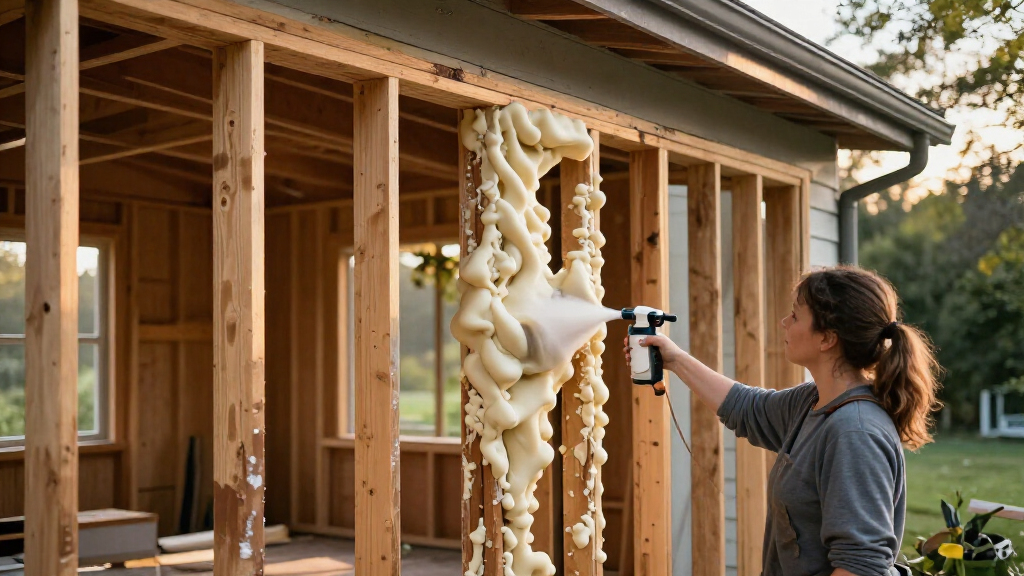
The proposed material is a leftover DAP 600FR dual-tank kit. The homeowner says they would apply it to at least two inches, but the source does not say that any foam has been installed. The homeowner is also considering unfaced batt insulation as an alternative.
The question centers on whether closed-cell foam could restrict drying through the wall, potentially creating what the homeowner calls a “double vapor barrier.” The owner also flags the wall’s south-facing exposure and concerns about heat and moisture associated with sun-warmed brick. These are concerns raised in the question, not findings about the wall’s actual condition.
Moisture Risk in a Brick Wall
The choice of insulation can affect how moisture moves and dries in an exterior wall. If an assembly has limited drying paths, moisture that enters through leaks or other sources may be harder to remove. Whether that risk applies here depends on the existing materials, their condition, and how the wall is built; the source provides no inspection or measured moisture data.
That makes this a practical decision for the homeowner rather than a general endorsement or warning about spray foam. Applying a product simply because it is already available could be costly if the wall later develops moisture damage, while choosing another insulation also requires attention to air leakage, fit, and the wall’s drying potential. The report does not quantify either option’s performance or establish that one is safer in this specific house.
Products Worth Considering

Apple Watch SE (2nd Generation) GPS 40mm Smartwatch with Starlight Aluminum Case and Starlight Sport Band (S/M)

Bose Smart Ultra Dolby Atmos Soundbar with Voice Control, HDMI eARC, Black

Bose Portable Smart Speaker with Alexa and Google Assistant, Black
As an affiliate, we earn on qualifying purchases.
The Existing Wall and Climate
The homeowner identifies the location as Northwest Arkansas, climate zone 4A, described in the question as mixed-humid. They say they have consulted a guide to mixed-humid climates and are aware that drying in both directions can matter in their region. The question does not include a full wall analysis, local code review, or an assessment by a building-science professional.
The wall’s reported layers are relevant because the proposed foam would be installed on the interior side of a brick-clad assembly with existing sheathing and painted drywall. But the description alone does not establish the sheathing’s vapor properties, whether the airspace drains as intended, whether the brick or wall has existing moisture problems, or how the layers perform together. The homeowner notes that the wall receives strong sun during the day, adding a concern about solar heating of the brick, but no temperature or moisture measurements are supplied.
The garage is unconditioned, which the homeowner believes may reduce the temperature difference across the wall and, in turn, condensation risk. That is the homeowner’s reasoning, not a verified conclusion about this assembly. The source gives no indoor humidity readings, ventilation details, or seasonal operating conditions.
“I just don’t want to shoot myself in the foot by creating a moisture trap that destroys the wall in a few years.”
— The homeowner, in the GreenBuildingAdvisor question
Key Details Still Missing
The source material does not provide an expert response, a final decision, or evidence that work has begun. It is therefore unclear whether closed-cell foam at the proposed thickness would be suitable for this particular wall or whether unfaced batts would offer a better outcome.
Several details needed to evaluate the concern are not established: the exact sheathing type and condition, the wall’s moisture history, the state of the brick airspace and drainage, local code requirements, and how the garage is ventilated and used. The question also does not document existing leaks, measured humidity, or an on-site inspection. No conclusion about condensation, brick-related moisture, or future durability can be drawn from the description alone.
Before Insulation Work Begins
The homeowner’s next step is to obtain an assessment of the specific wall assembly before applying the leftover foam. That review can address the existing layers, the brick cavity and drainage, moisture conditions, and applicable local requirements. The source does not report whether the homeowner has sought that assessment or what advice they received.
Until those details are checked, the proposed spray-foam installation remains undecided. The homeowner may compare it with unfaced batts, but the report does not say which approach will be chosen. Any recommendation would need to apply to this wall and its actual condition, rather than relying only on the climate-zone label or the fact that the garage is unconditioned.
Key Questions
Has the homeowner installed the spray foam?
The source does not say that the foam has been installed. The homeowner describes a proposed project and asks whether it is a good idea.
What wall is being discussed?
The reported wall is in an unconditioned garage in Northwest Arkansas. It has brick cladding, a one-inch airspace, original sheathing, a 2-by-4 stud wall, and painted half-inch drywall, according to the homeowner.
Does the report conclude that closed-cell foam will trap moisture?
No. The homeowner raises that as a concern, but the supplied material contains no expert conclusion and no inspection or moisture measurements confirming a problem.
What alternative is the homeowner considering?
The homeowner says unfaced batt insulation may be an alternative. The source does not provide a comparison or recommend either option.
What information is still needed to judge the proposal?
The wall’s exact materials and condition, drainage and moisture history, garage conditions, and applicable local requirements are not established in the report. An assessment of the specific assembly is needed before its suitability can be determined.
Source: rss