Whether you’re a homeowner looking to boost your energy independence or a DIY enthusiast eager to harness solar power, this comprehensive checklist is tailored for you. It covers the essential home energy tools and devices needed to create an efficient and reliable solar setup in 2026. From solar panels to monitoring systems, we’ve curated top picks to guide your purchase decisions.

Get backup power and energy gear delivered free — and shop member deals
- Fast, free delivery on millions of items
- Access to Prime Big Deal Days deals on October 6–7
- Prime Video, Amazon Music and more included
This article is organized into key categories, each highlighting a specific component of a home energy system. For each section, you’ll find an in-depth explanation of why the item matters, common pitfalls to avoid, and practical advice on sizing and compatibility. Use this as a roadmap to assemble your ideal solar energy system with confidence.
Navigate through the sections to identify the features that best match your energy goals and budget. Remember, selecting compatible components and understanding your power needs are crucial steps. This checklist aims to simplify your shopping experience while ensuring you get the most value for your investment.
Solar Panels
Solar panels are the heart of any solar power system, converting sunlight into usable electricity. Choosing the right panels involves considering your energy consumption, available space, and the efficiency of the technology. The ECO-Worthy 1.6KWH Complete Solar Panel Kit 400W 12V for RV Off Grid is a versatile choice, especially for those with limited space or specific off-grid needs. It provides a balanced combination of power output and portability, making it suitable for RVs and small homes. When selecting solar panels, ensure they are compatible with your battery storage and inverter systems, and pay attention to their durability and efficiency ratings.
Common mistakes include underestimating your energy needs or choosing panels that are incompatible with your existing setup. Proper sizing is critical: oversizing can lead to unnecessary costs, while undersizing may not meet your energy demands. Also, consider factors like mounting options, shading, and orientation to optimize performance. Look for panels with robust warranties and proven track records for reliability.
What to look for:
- High wattage and efficiency ratings
- Compatibility with existing battery and inverter systems
- Durability and weather resistance
- Warranty coverage and brand reputation
- Ease of installation and mounting options
ECO-Worthy 1.6KWH Complete Solar Panel Kit 400W 12V for RV Off Grid

This solar panel kit provides an ideal daily output of 1.6KWH, suitable for powering RVs, sheds, cabins, or homes with energy backup. It includes bifacial solar panels, a MPPT controller, a pure sine wave inverter, lithium batteries, and accessories, offering efficient and long-lasting energy production.
Pros:
- High energy output suitable for various off-grid applications
- Efficient with up to 99% tracking efficiency and 98% peak conversion
- Long-lasting lithium batteries with over 3000 cycles
Cons:
- Requires proper installation and setup for optimal performance
- Initial cost may be high for complete kit
- Dependent on sunlight conditions for maximum efficiency
Best for: Small to medium off-grid setups
Not ideal for: Large-scale residential solar arrays
Bottom line: Choose panels that match your energy needs and installation space.
Battery Storage
Battery storage is the backbone of a reliable solar energy system, allowing you to store excess power generated during the day for use at night or during outages. The ECO-WORTHY 48V Home Backup Power System with 30,720 Wh Battery and 10kW inverter is a robust option, offering ample capacity for most household needs. When selecting a battery system, consider the total capacity, discharge rates, and compatibility with your inverter. A high-quality battery ensures longevity and consistent performance, which are vital for maintaining your energy independence.
Many buyers make the mistake of oversizing or undersizing their storage, leading to wasted investment or insufficient power. Proper sizing depends on your household’s daily energy consumption and future expansion plans. Additionally, check for features like battery management systems (BMS), safety certifications, and warranty coverage. Compatibility with your inverter and charge controllers is crucial to avoid operational issues.
What to look for:
- High capacity (Wh or kWh)
- Compatibility with inverter and charge controller
- Long cycle life and warranty
- Safety features like BMS
- Ease of installation and scalability
ECO-WORTHY 48V Home Backup Power System with 30,720 Wh Battery and 10kW Inverter
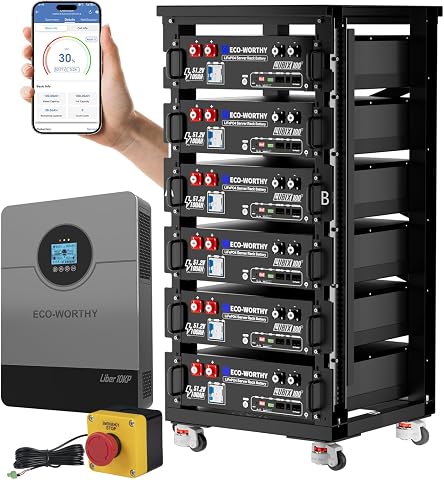
This off-grid home backup power system includes six 51.2V 100Ah LiFePO4 batteries and a 10,000W pure sine wave inverter, capable of supporting high-power appliances during outages. It features safety certifications, intelligent communication, Bluetooth/WiFi monitoring, and expandable capacity for larger energy needs.
Pros:
- High-capacity battery system suitable for whole-home backup
- Supports high-power appliances with 10kW inverter
- Expandable system for increased energy needs
- Safety certified with advanced communication features
Cons:
- Complex installation may require professional assistance
- Large physical size may require significant space
- Initial setup and configuration can be technical
Best for: Home backup and energy resilience
Not ideal for: Small-scale or temporary setups
Bottom line: Match battery capacity to your household energy consumption.
Inverters
The inverter is a critical component that converts stored DC power into usable AC electricity for your home appliances. The ECO-WORTHY Powermega 48V 314Ah LiFePO4 Energy Storage System with 10kW inverter offers a high capacity and reliable pure sine wave output, ensuring your devices operate smoothly and efficiently. When choosing an inverter, consider its continuous and surge power ratings, compatibility with your battery system, and features like multiple AC outlets and remote monitoring capabilities.
Many consumers overlook the importance of matching inverter capacity with their total load, which can lead to system inefficiencies or equipment damage. Oversizing can increase costs unnecessarily, while undersizing restricts your power availability. Look for inverters with good thermal management, safety certifications, and user-friendly interfaces. Compatibility with your battery chemistry and charge controllers is essential for optimal operation.
What to look for:
- Sufficient continuous and surge power ratings
- Compatibility with battery voltage and chemistry
- Pure sine wave output for sensitive electronics
- Built-in safety features and protections
- Remote monitoring and control options
ECO-WORTHY Powermega 48V 314Ah LiFePO4 Energy Storage System with 10kW Hybrid In

This high-capacity energy storage system combines a 48V 314Ah LiFePO4 battery with a 10kW hybrid inverter, providing over 16 kWh of usable energy suitable for home backup and off-grid applications. Features include WiFi and Bluetooth monitoring, a robust BMS with safety protections, and flexible installation options for reliable, long-term energy management.
Pros:
- High-capacity energy storage with long cycle life
- Advanced monitoring via WiFi and Bluetooth
- Flexible installation options with split-phase output
- Robust safety features including active BMS and fire suppression
Cons:
- Large and heavy, requiring truck delivery
- Battery shipped separately, may arrive in multiple packages
- Two inverter versions shipped randomly, no performance difference
Best for: Whole-house backup and high-demand appliances
Not ideal for: Small or portable power needs
Bottom line: Select an inverter that matches your total power requirements.
Charge Controllers
Charge controllers regulate the flow of energy from your solar panels to your batteries, preventing overcharging and prolonging battery life. The Victron Energy SmartSolar MPPT VE.Can Solar Charge Controller (Bluetooth) is a top-tier choice, offering advanced MPPT technology for maximum efficiency. An effective charge controller ensures your batteries are charged optimally, especially in variable sunlight conditions. When choosing, consider the maximum input voltage, current capacity, and compatibility with your solar array size.
Common mistakes include selecting controllers with insufficient capacity or ignoring Bluetooth and monitoring features. Proper sizing is essential to handle your solar array’s wattage. Look for models with clear displays, data logging, and easy connectivity options. Quality charge controllers also feature robust build quality and safety protections, ensuring long-term system stability.
What to look for:
- Adequate current and voltage capacity
- MPPT technology for efficiency
- Compatibility with battery voltage
- Connectivity features like Bluetooth
- Durability and safety certifications
Victron Energy SmartSolar MPPT VE.Can Solar Charge Controller (Bluetooth) 12/24/

The Victron Energy SmartSolar MPPT charge controller efficiently converts sunlight into usable energy while optimizing battery life. It features fast MPPT tracking, synchronized charging for multiple units, and Bluetooth connectivity for real-time system monitoring and configuration.
Pros:
- High efficiency with fast MPPT tracking
- Synchronized multiple controllers for system-wide optimization
- Bluetooth connectivity for easy monitoring and configuration
- Supports intelligent load management
Cons:
- Complex setup may require technical knowledge
- Bulky size might be challenging for limited spaces
Best for: Optimizing solar power input
Not ideal for: Small or low-capacity systems
Bottom line: Pick a charge controller matching your solar array size.
Power Inverters
The power inverter converts stored DC energy into usable AC power, making it essential for running household appliances. The GROWATT 10,000W Hybrid Solar Inverter with 3 MPPT, Pure Sine Wave, 120V is a versatile choice, supporting both grid-tied and off-grid applications. Its high wattage capacity and multiple MPPT inputs allow for efficient energy harvesting from several solar arrays. When selecting an inverter, consider your total load, surge capacity, and whether it supports hybrid operations for integrating grid power or generators.
A common mistake is choosing an inverter that doesn’t meet the peak power demands of your appliances, leading to system shutdowns or damage. Proper sizing ensures your inverter can handle startup surges and continuous loads. Features like multiple MPPT channels, user-friendly displays, and remote control enhance usability. Compatibility with your battery bank and system components is also vital for seamless operation.
What to look for:
- Sufficient wattage and surge capacity
- Multiple MPPT inputs for scalability
- Pure sine wave output for sensitive electronics
- Hybrid capabilities for grid or generator integration
- User-friendly interface and remote monitoring
GROWATT 10,000W Hybrid Solar Inverter with 3 MPPT, Pure Sine Wave, 120V/240V Spl

The GROWATT 10,000W hybrid solar inverter supports both grid-tied and off-grid applications, featuring three MPPT controllers for efficient solar energy collection. It offers flexible battery options, smart connectivity, and robust safety certifications, making it suitable for residential and commercial use.
Pros:
- Supports both grid-tied and off-grid applications with flexible configurations
- High efficiency of 97.5% ensures minimal energy loss
- Multiple smart modes and remote monitoring for ease of use
- Robust safety features and certifications for reliable operation
Cons:
- Complex setup may require professional installation
- Large size may not be suitable for small spaces
- Higher cost compared to basic inverters
Best for: Whole-house or high-demand applications
Not ideal for: Small-scale portable use
Bottom line: Ensure inverter capacity matches your household power needs.
Monitoring Systems
Monitoring systems provide real-time insights into your solar energy setup, helping you optimize performance and troubleshoot issues quickly. The Solar Pool Thermometer, Wireless Waterproof Digital Water Temperature isn’t a typical energy monitor but highlights the importance of reliable, waterproof sensors for outdoor setups or pools. For actual energy management, look for dedicated solar monitoring systems that track production, consumption, and system health.
Many users neglect the importance of monitoring, which can lead to missed opportunities for efficiency improvements or unnoticed faults. When choosing a system, consider features like wireless connectivity, data logging, and smartphone app compatibility. A good monitor should be easy to install, provide clear data visualization, and support alerts for system anomalies. This helps maintain peak performance and extend the lifespan of your components.
What to look for:
- Wireless connectivity and app support
- Real-time data on energy production and consumption
- Ease of installation and user interface
- Compatibility with your existing system
- Ability to send alerts or notifications
Solar Pool Thermometer, Wireless Waterproof Digital Water Temperature Monitor fo

This solar-powered digital pool thermometer provides accurate water temperature readings without batteries. It features IPX7 waterproof construction, a wireless range of 500 inches, and is suitable for pools, hot tubs, baths, and ponds.
Pros:
- No batteries required, solar-powered
- High accuracy with advanced chip technology
- Waterproof and suitable for various water environments
- Wireless range allows remote monitoring
Cons:
- Dependent on sunlight for charging
- Limited details on temperature display range
- No mention of app or digital interface
Best for: Monitoring overall system health
Not ideal for: Basic or no monitoring features
Bottom line: Choose a monitoring system that fits your technical comfort level and needs.
Starting your home energy upgrade with a clear, prioritized shopping list helps you make informed decisions and avoid unnecessary costs. Focus first on essential components like solar panels and batteries, then expand with inverters and monitoring systems as your budget allows. Remember, quality components and proper sizing are key to a reliable and efficient system.
Enjoy the process of building your sustainable energy setup—it’s an investment in your independence and the environment. With the right tools and a bit of planning, you’ll be well on your way to harnessing solar power effectively in 2026 and beyond.
Halloween Picks
halloween
As an affiliate, we earn on qualifying purchases.