A digital battery tester is a small tool that saves you from guessing whether a battery is dead, dying, or simply in the wrong device — but the right one depends entirely on what you’re testing. For automotive work, the TOPDON BT200 earned my best overall pick thanks to its 12V/24V coverage, 100–2000 CCA range, and clear charging/cranking analysis, which covers cars, trucks, boats, and RVs in one unit. If your batteries are mostly household AA, AAA, C, D, and 9V cells, the D-FantiX universal checker is the smarter buy, while the budget-friendly UMLIFE BT-168 two-pack makes sense for junk drawers and glove boxes. The main tradeoff in this category is versatility versus precision: automotive analyzers measure cranking health under load, while household testers just report remaining charge. Read on for the full breakdown of all twelve models, including who each one is for and who should skip it.

Get backup power and energy gear delivered free with Prime
- Fast, free delivery on millions of items
- Prime Video, Amazon Music and more included
- Member-only deals all year
Key Takeaways
- Automotive and household battery testers are not interchangeable — the TOPDON BT200 and ANCEL BA101 measure cranking amps and alternator health under load, while household units like the D-FantiX only report voltage-based charge level for small cells.
- The TOPDON BT200 ranks above the BT100 mainly for its added 24V support, making it the safer choice if you service trucks, boats, or RVs rather than just passenger cars.
- Two-pack household testers (UMLIFE BT-168 and the generic 2Pcs options) are cheap enough to keep in multiple locations, but their sliding contacts and thin leads feel noticeably flimsier than single-unit picks like the Dlyfull.
- The Dlyfull stood out among household testers for covering button cells in addition to standard sizes, which most one-size-fits-all checkers skip.
- The La Crosse 911-65557-INT is the most portable option in the lineup but trades away some size compatibility, so it suits travel kits rather than a primary workshop tool.
| TOPDON BT100 12V Car Battery Tester, Automotive Battery Load Tester |  | Best Overall Automotive Pick | Battery Voltage: 12V | CCA Range: 100–2000 CCA | Battery Types: Flooded, AGM flat plate/spiral, EFB, GEL | VIEW ON AMAZON | See Our Full Breakdown |
| D-FantiX Battery Tester for AAA AA C D 9V, Universal Battery Charge Checker (BT-168) | 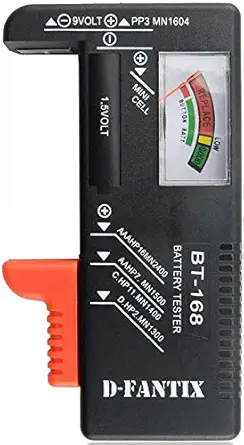 | Best Value Household Pick | Battery Sizes: AA, AAA, C, D, 9V, button cell | Voltage Range: 1.5V–9V | Display: Analog needle, color-coded scale | VIEW ON AMAZON | See Our Full Breakdown |
| ANCEL BA101 Car Battery Tester, 12V Digital Automotive Alternator Meter Diagnostic Tool |  | Best for Beginners | Battery Voltage: 12V | CCA Range: 100–2000 CCA | Minimum Battery Size: 30Ah | VIEW ON AMAZON | See Our Full Breakdown |
| TOPDON BT200 Car Battery Tester, 12V/24V, 100–2000 CCA Load Tester |  | Best Premium Pick | Battery Voltage: 12V and 24V | CCA Range: 100–2000 CCA | Battery Types: Flooded, AGM, GEL, deep-cycle | VIEW ON AMAZON | See Our Full Breakdown |
| 2Pcs Universal Battery Tester LCD Digital Battery Checker for AA AAA 9V 1.5V 3.7V 1.2-4.8V Batteries |  | Best Multi-Room Budget Pick | Battery Sizes: AA, AAA, C, D, 9V | Voltage Range: 1.2V–4.8V (incl. 1.5V, 3.7V, 9V) | Supported Chemistries: Alkaline, NiMH rechargeable, lithium | VIEW ON AMAZON | See Our Full Breakdown |
| UMLIFE 2 Pack BT-168 Digital Battery Tester for AA, AAA, C, D, 9V & Button Cell Batteries |  | Best Two-Pack Value | Model: BT-168 | Quantity: 2-pack | Compatible Batteries: AAA, AA, C, D, 18650, 9V, 1.5V button cell (alkaline, dry, rechargeable) | VIEW ON AMAZON | See Our Full Breakdown |
| 2Pcs Battery Tester for AA AAA C D 9V 1.5V Household Batteries |  | Cheapest Baseline Pick | Quantity: 2-pack | Compatible Batteries: AA, AAA, C, D, 1.5V, 9V, 1.5V button cells | Display: Analog needle with green/yellow/red zones | VIEW ON AMAZON | See Our Full Breakdown |
| KONNWEI KW208 12V Car Battery Tester, Digital Auto Battery Analyzer Charging Cranking System Tester |  | Best for Vehicle Diagnostics | Supported Systems: 12V only | Battery Range: 100–2000 CCA | Chemistries: Flooded, AGM flat plate, AGM spiral, gel | VIEW ON AMAZON | See Our Full Breakdown |
| Dlyfull Battery Tester for AA AAA C D 9V, Button Cell & Household Batteries |  | Best Battery Compatibility | Compatible Batteries: AA, AAA, C, D, 9V, N, CR123A, CR2, CRV3, 2CR5, CR-P2, button cells | Display: LCD bar graph (poor/weak/good) | Power Source: 1x AAA battery (included) | VIEW ON AMAZON | See Our Full Breakdown |
| ZUFECY Battery Tester Checker, Universal Battery Tester for AA AAA C D 9V 1.5V, Small Volt Checker – Orange |  | Best Budget Single Unit | Model: BT-189 | Compatible Batteries: AA, AAA, C, D, 9V, 1.5V button cells | Display: Analog-style gauge with color zones | VIEW ON AMAZON | See Our Full Breakdown |
| Battery Tester for AA AAA C D 9V & Household Batteries Battery Checker |  | Most Versatile Household Pick | Battery Types: AA, AAA, AAAA, C, D, N, 9V, CR2, CR123A, and button cells (CR/LR series) | Testing Method: Real-load testing with calibrated discharge resistors per chemistry | Display: LCD with voltage reading and Good/Weak/Poor bar (not backlit) | VIEW ON AMAZON | See Our Full Breakdown |
| La Crosse 911-65557-INT Portable Digital Battery Tester, Black |  | Easiest to Use | Battery Types: AA, AAA, C, D, N, 9V, and lithium ion button cells | Voltage Settings: 1.5V (alkaline), 1.2V (rechargeable), 3.0V (lithium button cell) | Display: LED readout of voltage and strength level | VIEW ON AMAZON | See Our Full Breakdown |
| digital battery tester | Display | Power Source |
|---|---|---|
| TOPDON BT100 12V Car Battery T | — | Powered by battery under test (passive) |
| D-FantiX Battery Tester for AA | Analog needle, color-coded scale | Powered by battery under test |
| ANCEL BA101 Car Battery Tester | Monochrome with backlight and adjustable contrast | — |
| TOPDON BT200 Car Battery Teste | 2.4-inch color LCD | — |
| 2Pcs Universal Battery Tester | Digital LCD level readout | Powered by battery under test |
| UMLIFE 2 Pack BT-168 Digital B | LCD with color-coded good/low/replace scale | None required (powered by tested battery) |
| 2Pcs Battery Tester for AA AAA | Analog needle with green/yellow/red zones | None (activated by tested battery) |
| KONNWEI KW208 12V Car Battery | — | — |
| Dlyfull Battery Tester for AA | LCD bar graph (poor/weak/good) | 1x AAA battery (included) |
| ZUFECY Battery Tester Checker | Analog-style gauge with color zones | None (powered by tested battery) |
| Battery Tester for AA AAA C D | LCD with voltage reading and Good/Weak/Poor bar (not backlit) | 1x AAA battery (not included) |
| La Crosse 911-65557-INT Portab | LED readout of voltage and strength level | — |
More Details on Our Top Picks
TOPDON BT100 12V Car Battery Tester, Automotive Battery Load Tester
The TOPDON BT100 earns the top automotive slot because it balances diagnostic depth with everyday usability. It reports SOH, SOC, voltage, and CCA in plain language, then goes further with dedicated cranking and charging system tests — the two checks that actually tell you whether the starter or alternator is the culprit, not just the battery. Coverage from 100–2000 CCA means it handles everything from a motorcycle to a heavy truck battery, and the spark-proof, reverse-polarity copper clamps make it forgiving for first-timers. Compared with the ANCEL BA101, the BT100 trades screen sophistication for a simpler three-color LED verdict system that’s faster to interpret in a driveway. The real tradeoff: it’s 12V only, so RV owners and semi-truck operators with 24V systems will need the TOPDON BT200 instead, and there’s no battery-memory function between tests.
Pros:- Full 3-in-1 testing: battery health, cranking, and charging system in one device
- Wide 100–2000 CCA range covers motorcycles through large truck batteries
- Spark-proof, reverse-polarity-protected copper clamps for safer connections
- Compact enough to live in a glove box between uses
- Menu-driven interface with three-color LED verdict for quick interpretation
Cons:- 12V-only — no support for 24V commercial or RV electrical systems
- No test-memory function, so comparing readings over time requires manual notes
- Display is basic compared with the color LCD on the BT200
Best for: DIY car owners and small-shop mechanics who want full battery, cranking, and charging diagnostics in one pocket-size tool
Not ideal for: Owners of 24V trucks or RVs — this unit is strictly 12V, so the BT200 is the better fit
- Battery Voltage:12V
- CCA Range:100–2000 CCA
- Battery Types:Flooded, AGM flat plate/spiral, EFB, GEL
- Tests Offered:Battery health, cranking, charging system
- Clamps:Copper, spark-proof, reverse-polarity protection
- Power Source:Powered by battery under test (passive)
- Portability:Compact, glove-box size
Our verdict“If you want one tool that diagnoses the battery, starter, and alternator without professional-tool complexity, this is the pick.”
D-FantiX Battery Tester for AAA AA C D 9V, Universal Battery Charge Checker (BT-168)
For the junk-drawer problem — a pile of loose AA and 9V cells with no idea which are dead — the D-FantiX BT-168 solves it with almost no cost or complexity. The analog needle sweeps a color-coded good/low/replace scale, and because the tested battery powers the tester itself, there’s nothing to keep charged. Compared with the LCD-based 2Pcs Universal LCD tester, this analog approach is cruder — you get a zone, not a number — but zones are genuinely all most households need, and there’s no digital display to misread or break. It covers AA, AAA, C, D, 9V, and button cells, which is the full range of household sizes. The honest limitation: it measures voltage under a light load, not true capacity, so a battery that reads ‘good’ can still die quickly under heavy draw in a camera or toy.
Pros:- Works with every common household size including button cells
- No internal battery required — powered by the cell being tested
- Color-coded analog needle gives an instant good/low/replace verdict
- Extremely light and small enough for a kitchen drawer
Cons:- Analog needle gives zones, not precise readings or percentages
- Does not measure true capacity, so weak cells can falsely read ‘good’
- Needle can stick or drift over time compared with digital displays
Best for: Households sorting drawers full of mixed AA, AAA, C, D, 9V, and button cells before tossing them
Not ideal for: Anyone who wants precise state-of-charge percentages — this is a triage tool, not a meter, and can’t judge capacity under real load
- Battery Sizes:AA, AAA, C, D, 9V, button cell
- Voltage Range:1.5V–9V
- Display:Analog needle, color-coded scale
- Power Source:Powered by battery under test
- Compatible Types:Standard and rechargeable household batteries
- Weight:0.05 kg (about 1.8 oz)
- Dimensions:6.69 x 3.94 x 1.38 inches
Our verdict“The cheapest sane way to stop throwing away good batteries — as long as you accept good-enough rather than precise results.”
ANCEL BA101 Car Battery Tester, 12V Digital Automotive Alternator Meter Diagnostic Tool
The ANCEL BA101 stands out as the easiest entry point into real automotive battery diagnostics. Its one-handed operation, backlit monochrome screen, and plain SOH/SOC readouts mean a first-time user can go from clamp-on to verdict in under a minute, and the 4-in-1 protection (reverse polarity, short circuit, overcurrent, overvoltage) forgives the mistakes novices make in tight engine bays. Against the TOPDON BT100, the BA101 supports a longer list of rating standards — JIS, DIN, SAE, IEC, EN, and more — which matters if your battery label uses a non-US rating. The catch is accuracy depends on entering battery type, rating, and temperature correctly; skip that step and results drift. It also excludes batteries under 30Ah and all lithium packs, so small motorcycle batteries and modern LiFePO4 setups are off the table without stepping up to a different tool entirely.
Pros:- One-handed operation with backlit screen readable in sun or darkness
- Supports a wide range of rating standards (JIS, DIN, SAE, IEC, EN, and more)
- 4-in-1 electrical protection against reverse polarity, shorts, overcurrent, overvoltage
- Powered directly by the vehicle battery — nothing to charge
Cons:- Accuracy depends on manually entering battery type, rating, and temperature correctly
- Excludes batteries under 30Ah, lithium packs, and 6V/24V systems
- Monochrome screen is less informative than the BT200’s color display
Best for: First-time DIYers who want guided, one-handed battery and alternator checks without a learning curve
Not ideal for: Owners of lithium or sub-30Ah batteries, or anyone needing 6V/24V support — this unit covers none of those
- Battery Voltage:12V
- CCA Range:100–2000 CCA
- Minimum Battery Size:30Ah
- Battery Types:Flooded, AGM, GEL, EFB (no lithium)
- Display:Monochrome with backlight and adjustable contrast
- Protection:Reverse polarity, short circuit, overcurrent, overvoltage
- Weight:5 ounces
Our verdict“The friendliest introduction to automotive battery testing — just enter your battery’s label data carefully and check its 30Ah minimum against your vehicle.”
TOPDON BT200 Car Battery Tester, 12V/24V, 100–2000 CCA Load Tester
For buyers who outgrow the basics, the TOPDON BT200 is the most capable tester in this lineup. It’s a direct upgrade from the BT100: dual 12V and 24V support covers semi-trucks and RVs the BT100 can’t touch, the 2.4-inch color LCD stays legible in direct sun, and a memory function recalls your last test so you can track a fading battery across weeks. The -4°F to 140°F operating range is the quiet differentiator — cheap testers give unreliable readings on freezing mornings, which is exactly when you need them. Compared with the ANCEL BA101, you get a richer display and test memory, but the same 100–2000 CCA window. The tradeoffs are real: it’s the priciest route to a battery verdict here, and the added menu depth means slightly more button-pressing than the BT100’s simpler flow — overkill for someone testing one family car twice a year.
Pros:- Tests both 12V and 24V systems, covering trucks, RVs, and boats
- Sunlight-readable 2.4-inch color LCD with plain Good/Replace prompts
- Wide -4°F to 140°F operating range for reliable winter testing
- Memory function recalls the previous test for trend tracking
- 1-year warranty with lifetime technical support
Cons:- More expensive than the BT100 and BA101 for similar CCA coverage
- Deeper menus add button presses compared with simpler testers
- Overkill in capability and size for single-vehicle households
Best for: Fleet owners, RV and semi-truck operators, and serious DIYers who need 24V support and want to track battery health over time
Not ideal for: Single-car owners doing occasional checks — the 24V capability and memory features go unused, and a simpler tester costs less
- Battery Voltage:12V and 24V
- CCA Range:100–2000 CCA
- Battery Types:Flooded, AGM, GEL, deep-cycle
- Tests Offered:Battery health, cranking, charging system
- Display:2.4-inch color LCD
- Operating Temperature:-4°F to 140°F (-20°C to 60°C)
- Extra Features:Last-test memory function
- Warranty:1 year, with lifetime technical support
Our verdict“The tool to buy once your battery testing expands beyond one car — the 24V support and cold-weather accuracy justify the premium.”
2Pcs Universal Battery Tester LCD Digital Battery Checker for AA AAA 9V 1.5V 3.7V 1.2-4.8V Batteries
Sometimes the right answer is two cheap testers instead of one good one. This two-pack of LCD battery checkers makes sense for households where batteries die in three different rooms — one lives in the kitchen drawer, one in the workshop. The digital readout is the step up from the analog D-FantiX BT-168: instead of judging a needle position, you see a level indicator directly, which matters for anyone with aging eyes or borderline batteries. Voltage coverage from 1.2V through 4.8V also means it handles 1.2V NiMH rechargeables and 3.7V lithium cells the BT-168 can’t properly classify. Like all household testers in this price class, it reports a voltage-derived level rather than true capacity, and build quality is lightweight — treat the slider contacts gently or they’ll loosen. There’s also no printed percentage of remaining life, just a bar-style status.
Pros:- Two units included, so one can stay in a drawer and one in a toolbox
- Digital LCD readout is easier to interpret than an analog needle
- Covers 1.2V NiMH, 1.5V alkaline, 3.7V lithium, and 9V cells
- No internal battery needed to operate
Cons:- Shows a level indicator rather than a precise state-of-charge percentage
- Lightweight plastic build — contacts can loosen with rough handling
- Cannot measure true capacity under load, only voltage-derived status
Best for: Families and home-office setups who want a tester in more than one location and need to check NiMH and 3.7V lithium cells too
Not ideal for: Anyone who needs precise capacity percentages or a durable shop-grade tool — this is light-duty household triage only
- Battery Sizes:AA, AAA, C, D, 9V
- Voltage Range:1.2V–4.8V (incl. 1.5V, 3.7V, 9V)
- Supported Chemistries:Alkaline, NiMH rechargeable, lithium
- Display:Digital LCD level readout
- Power Source:Powered by battery under test
- Quantity:2 testers per pack
- Form Factor:Compact, pocket and drawer friendly
Our verdict“The practical pick if your household argues over where the battery tester went — two digital checkers covering more chemistry types than analog rivals.”
UMLIFE 2 Pack BT-168 Digital Battery Tester for AA, AAA, C, D, 9V & Button Cell Batteries
The selling point here is simple: you get two testers for the price of one, which makes sense for households where batteries live in multiple drawers, or for anyone who wants a backup in the car. Each BT-168 unit covers nearly every household chemistry, including 18650 cells that the Dlyfull can’t handle, and the color-coded LCD (good/low/replace) keeps results readable at a glance. Like the D-FantiX and ZUFECY checkers, it draws power from the battery under test, so there’s no internal cell to replace. The tradeoff is precision: the display behaves more like an analog-style needle gauge than a true digital readout, so borderline batteries land in a gray zone. Build quality is basic ABS plastic throughout.
Pros:- Two testers included, ideal for keeping one in a kitchen drawer and one in a toolbox
- Handles 18650 lithium cells in addition to standard household sizes
- No internal battery needed — powered by the battery being tested
- Lightweight and compact enough for a pocket or glovebox
Cons:- Analog-style needle display is less precise than true digital readouts
- Basic plastic construction won’t survive rough handling
Best for: Households and small workshops that want a tester in two locations without buying twice
Not ideal for: Buyers who need precise voltage numbers for borderline cells — the stepped needle display is only approximate
- Model:BT-168
- Quantity:2-pack
- Compatible Batteries:AAA, AA, C, D, 18650, 9V, 1.5V button cell (alkaline, dry, rechargeable)
- Material:ABS plastic
- Display:LCD with color-coded good/low/replace scale
- Power Source:None required (powered by tested battery)
Our verdict“A practical pick for anyone who wants household battery coverage in two places at once, as long as approximate readings are good enough.”
2Pcs Battery Tester for AA AAA C D 9V 1.5V Household Batteries
This generic two-pack is about as bare-bones as a battery checker gets: a needle, three color zones, and slots for the common sizes. Where the UMLIFE BT-168 pair at least adds an LCD strip, this model relies on a traditional analog needle sweep — fine for a quick ‘keep or toss’ decision, but you’re interpreting needle position rather than reading a display. The honest limitation, which the listing itself admits, is that it measures voltage, not true capacity, so a battery that reads ‘good’ may still die quickly under load. Because testing draws current from the battery, the manufacturer recommends keeping test sessions brief. Compared with the Dlyfull, you give up button-cell versatility and screen clarity in exchange for a lower entry cost and a spare unit.
Pros:- Very low-cost entry point with two units included
- Covers AA, AAA, C, D, 9V and 1.5V button cells
- No battery required to operate
- Small and light enough to store anywhere
Cons:- Voltage-only readings can’t gauge real capacity under load
- Analog needle is harder to interpret than the LCD on the UMLIFE or Dlyfull
- Testing drains the battery slightly, so sessions should be brief
Best for: Buyers who just want a zero-friction toss-or-keep checker in the junk drawer, with a spare included
Not ideal for: Anyone sorting rechargeable batteries by condition — voltage alone won’t tell you remaining capacity
- Quantity:2-pack
- Compatible Batteries:AA, AAA, C, D, 1.5V, 9V, 1.5V button cells
- Display:Analog needle with green/yellow/red zones
- Power Source:None (activated by tested battery)
- Measurement Type:Voltage check
- Form Factor:Compact handheld
Our verdict“A functional budget pair for quick sorting, provided you accept its voltage-only limitations.”
KONNWEI KW208 12V Car Battery Tester, Digital Auto Battery Analyzer Charging Cranking System Tester
The KW208 plays in a completely different league from the household checkers above — it’s a true automotive analyzer that measures internal resistance, CCA, and capacity rather than just voltage. It handles 12V batteries from 100–2000 CCA across flooded, AGM, and gel chemistries, and goes beyond the TOPDON BT100 by also running cranking and charging system tests, so you can diagnose a weak alternator or starter rather than guessing. The updated galvanized alloy clips improve contact and claimed accuracy to 99.7%, and the whole unit is plug-and-play off the battery itself — it will even analyze a dead battery. The catches: it’s useless for AA and button cells, its readings are only as consistent as your clip connection, and 12V-only means 24V truck owners should look at the TOPDON BT200 instead.
Pros:- Full battery analysis including CCA, internal resistance, and health percentage
- Tests cranking system and alternator charging, not just the battery
- Works on flooded, AGM flat plate, AGM spiral, and gel batteries
- Powered by the battery under test, including fully drained ones
Cons:- Limited to 12V systems — no support for 24V commercial vehicles
- No household battery testing at all
- Results depend on clean clip contact on terminals
Best for: Car, motorcycle, marine, and boat owners who want to monitor battery health and test the charging system before winter or a road trip
Not ideal for: Household battery sorting — it only works on 12V automotive batteries, and 24V systems are out of range
- Supported Systems:12V only
- Battery Range:100–2000 CCA
- Chemistries:Flooded, AGM flat plate, AGM spiral, gel
- Test Modes:Battery, cranking, charging/alternator
- Claimed Accuracy:99.7%
- Weight:230 g
- Dimensions:0.79 x 3.07 x 5 inches
- Languages:Up to 8 selectable
Our verdict“The right tool if your batteries live under a hood rather than in a remote control.”
Dlyfull Battery Tester for AA AAA C D 9V, Button Cell & Household Batteries
Where most household testers stop at AA through 9V, the Dlyfull covers an unusually broad chemistry list, including CR123A, CR2, CRV3, 2CR5, CR-P2, and N cells — formats common in cameras, alarms, and flashlights that the ZUFECY and the generic two-packs simply can’t slot in. The bar-graph LCD is easier to interpret than the needle sweeps on cheaper models, and the pocket-sized chassis with anti-slip finish feels more considered than the bare ABS of the UMLIFE. Two real catches shape the buying decision: it will not test rechargeable batteries (a limitation the UMLIFE doesn’t share), and it runs on an internal AAA battery, so the tester itself is one more thing that can be dead when you need it — though one AAA is included, along with an 18-month warranty.
Pros:- Broadest household compatibility in this batch, including CR123A, CR2, CRV3, 2CR5 and CR-P2
- Clear bar-graph LCD showing good/weak/poor condition
- Compact pocketable design with anti-slip grip
- Includes starter AAA battery and 18-month warranty
Cons:- Cannot test rechargeable batteries
- Requires its own internal AAA battery to operate
- No 18650 or automotive battery support
Best for: Photographers, gadget owners, and households with lots of specialty lithium cells like CR123A and CR2
Not ideal for: Rechargeable battery users — the unit explicitly won’t test NiMH or similar cells
- Compatible Batteries:AA, AAA, C, D, 9V, N, CR123A, CR2, CRV3, 2CR5, CR-P2, button cells
- Display:LCD bar graph (poor/weak/good)
- Power Source:1x AAA battery (included)
- Weight:115 g
- Dimensions:5.2 x 3.46 x 0.94 inches
- Rechargeable Support:No
- Warranty:18 months
Our verdict“The pick for households deep in specialty lithium cells, as long as all your batteries are single-use.”
ZUFECY Battery Tester Checker, Universal Battery Tester for AA AAA C D 9V 1.5V, Small Volt Checker – Orange
If the two-packs feel like overkill, the ZUFECY BT-189 offers the same core job in a single, easy-to-spot orange unit — a color choice that genuinely helps when the tester is buried in a drawer. Coverage matches the basics: AA, AAA, C, D, 9V, and 1.5V button cells, which is on par with the generic two-pack but short of the Dlyfull’s specialty lithium support and the UMLIFE’s 18650 slot. It’s a powered-by-the-tested-battery design, so there’s nothing to maintain, and the compact footprint makes it glovebox-friendly. The compromises are the familiar ones at this tier: a stepped gauge rather than a precise readout, plastic construction, and no way to test rechargeable or lithium-ion cells beyond basic button types. For a one-drawer household, that’s usually an acceptable trade.
Pros:- Bright orange color is easy to find in a cluttered drawer
- Covers all common household sizes plus button cells
- No internal battery to replace
- Very compact and inexpensive as a single unit
Cons:- No support for specialty lithium cells or 18650 batteries
- Stepped gauge readout is approximate, not a precise voltage figure
- Lightweight plastic build feels basic
Best for: Singles or small households that need one simple checker for common battery sizes
Not ideal for: Owners of 18650, CR123A, or rechargeable cells — this unit only covers standard household sizes
- Model:BT-189
- Compatible Batteries:AA, AAA, C, D, 9V, 1.5V button cells
- Display:Analog-style gauge with color zones
- Power Source:None (powered by tested battery)
- Color:Orange
- Form Factor:Compact portable handheld
Our verdict“A sensible no-frills single tester for standard household batteries when you don’t need a spare.”
Battery Tester for AA AAA C D 9V & Household Batteries Battery Checker
Where most household testers in this roundup stop at AA through 9V, this model stretches coverage into AAAA cells, CR2, CR123A, and a long list of button cells down to tiny LR41s. The real differentiator is its real-load testing: each battery type discharges through a calibrated resistor, so a nearly dead alkaline can’t fake a healthy voltage reading the way it can on simpler open-circuit checkers like the ZUFECY or the 2Pcs universal tester. Readings land in about 0.1 second, with a voltage number plus a Good/Weak/Poor bar. The tradeoffs are real: it needs its own AAA battery to operate, the screen isn’t backlit, and lithium chemistry isn’t supported at all. Compared with the La Crosse below, you give up some simplicity but gain far broader chemistry coverage.
Pros:- Real-load testing per battery type gives more trustworthy results than simple voltage-only checkers
- Broadest chemistry coverage in the household category, including AAAA, CR2, CR123A and many button cells
- Clear LCD shows exact voltage plus a color-coded Good/Weak/Poor indicator
- Fast 0.1-second readings with 3-second auto-shutoff to preserve battery life
Cons:- Requires its own AAA battery (not included) to operate
- No lithium battery support and no backlit screen
- Smart auto power-on only triggers above 0.7V, so fully drained batteries may not register
Best for: Gadget-heavy households juggling everything from hearing-aid button cells to CR123A camera batteries who want load-accurate readings in one device
Not ideal for: Anyone wanting a zero-setup tester — it requires a separate AAA battery to power on, which can be missing exactly when you need it
- Battery Types:AA, AAA, AAAA, C, D, N, 9V, CR2, CR123A, and button cells (CR/LR series)
- Testing Method:Real-load testing with calibrated discharge resistors per chemistry
- Display:LCD with voltage reading and Good/Weak/Poor bar (not backlit)
- Accuracy:±(1% of reading + 0.02V)
- Power Source:1x AAA battery (not included)
- Reading Speed:0.1 seconds
- Auto Power:Auto-on above 0.7V; 3-second auto-shutoff
- Size:4.7 x 2.8 inches
- Operating Temperature:-10°C to 45°C
Our verdict“This is the pick for buyers whose battery drawer includes oddball sizes and button cells, provided they don’t mind keeping a spare AAA inside it.”
La Crosse 911-65557-INT Portable Digital Battery Tester, Black
The La Crosse takes a different philosophy from the spec-heavy tester above: three steps, one battery at a time, no ambiguity. You dial in the chemistry (1.5V alkaline, 1.2V rechargeable, or 3.0V lithium button cell), slide the orange tray closed, and the LED readout shows voltage and strength. That sliding-tray contact design is more forgiving than the fixed spring slots on the Dlyfull or UMLIFE BT-168 — there’s no wiggling a battery to get a connection, which is exactly the frustration that makes cheap testers feel unreliable. The dedicated voltage selector also means rechargeables are read on the correct scale rather than being falsely flagged as weak. On the downside, it covers a narrower range of formats than the AA/AAAA/CR123A household tester — no AAAA, CR2, or CR123A slots — and it doesn’t publish load-testing specs, so serious users may want more rigor.
Pros:- Sliding tray contact gives a consistent connection with no wiggling or misreads
- Dedicated 1.2V/1.5V/3.0V settings read rechargeables on the correct scale
- Simple three-step operation ideal for non-technical household members
- Compact pocket-friendly form from an established brand
Cons:- Limited format coverage compared with multi-slot household testers
- No published accuracy or load-testing specifications
- One-battery-at-a-time tray design is slower when sorting a whole drawer
Best for: Buyers who want the simplest possible go/no-go answer for standard AA, AAA, C, D, N and 9V batteries, especially homes full of rechargeables
Not ideal for: Users with CR123A, AAAA, or CR2 batteries — those formats simply have no slot here
- Battery Types:AA, AAA, C, D, N, 9V, and lithium ion button cells
- Voltage Settings:1.5V (alkaline), 1.2V (rechargeable), 3.0V (lithium button cell)
- Display:LED readout of voltage and strength level
- Testing Method:Slide-tray positive contact; touch contacts for 9V
- Operation:Three steps: select voltage, insert battery, slide tray closed
- Chemistry Support:Alkaline and rechargeable (NiMH)
- Form Factor:Portable handheld tester
Our verdict“Choose this if ease of use and correct rechargeable readings matter more than covering exotic battery formats.”

How We Picked
I evaluated each tester against four criteria: measurement capability (does it report true load health or just voltage?), range coverage (battery sizes and voltage classes supported), build and connection quality (clamps, contacts, and lead durability), and ease of reading results. Automotive models were judged on CCA range, 12V versus 24V support, and whether they include charging and cranking analysis, since those functions separate a diagnostic tool from a simple voltmeter. Household models were compared on how many battery formats they accept, whether button cells are covered, and how clearly the display communicates remaining life.
The ranking logic follows buyer intent rather than raw specs. A more capable tester ranks higher only when that capability serves a realistic use case — the BT200 outranks the BT100 because 24V support matters to truck and boat owners, not because bigger numbers look better on paper. Similarly, budget two-packs rank lower on build quality but earn their place on value for multi-location convenience. Every pick needed a clear owner profile; anything that overlapped almost entirely with a better-priced or better-built alternative was pushed down the list.
Factors to Consider When Choosing Digital Battery Tester
Before choosing a digital battery tester, it helps to understand what separates a genuinely useful diagnostic tool from a gadget that tells you what you already suspect. These are the factors that shaped my rankings and the mistakes I’d avoid as a buyer.Match the Tester to the Battery Type First
The single most common buying mistake is grabbing a universal household tester expecting it to diagnose a car battery. Household checkers measure open-circuit voltage on small cells, which is fine for AA and 9V batteries, but car batteries can read 12.4V at rest and still fail the moment the starter draws current. Automotive testers like the KONNWEI KW208 apply a load simulation and calculate internal resistance and CCA performance, which is the only reliable way to predict a no-start. If you own both cars and a drawer full of remotes, budget for two tools rather than forcing one to do both jobs.
Why Load Testing Beats a Voltage Reading
A battery’s resting voltage is a snapshot; its behavior under load is the story. Many cheap testers simply display a voltage number and leave the interpretation to you, which works when a cell is clearly full or clearly dead but fails in the gray zone where most batteries actually live. Better models translate the measurement into a charge percentage or health verdict on screen. For vehicles, cranking and charging analysis tells you whether the battery, the alternator, or the starter is the real culprit — a distinction that can save you from replacing a perfectly good battery.
CCA Range and Voltage Class for Automotive Buyers
If you’re testing anything beyond a passenger car, check the CCA (cold cranking amps) range and supported voltage class before buying. A 100–2000 CCA range covers most sedans through large diesel trucks, but if you maintain a boat, RV, or commercial vehicle, 24V support matters — which is exactly why the BT200 outranks the otherwise similar BT100 in my lineup. Underspending here usually means buying twice. Also confirm the tester handles the battery chemistry you actually own, since some automotive models are calibrated only for standard flooded lead-acid batteries and give unreliable readings on AGM or gel types.
Build Quality and Contact Design
With household testers, the failure point is almost always the contact: flimsy sliders, weak springs, or terminals that won’t reach recessed button cells. Inexpensive two-pack units accept this tradeoff deliberately — you’re paying for redundancy, not refinement. Automotive testers live or die by their clamps and cables; thin leads with weak spring tension produce inconsistent readings on side-post batteries and in cold weather. Heavier-gauge leads and insulated clamps cost a little more upfront and hold up far longer in a trunk-mounted toolkit.
Display Readability and Verdict Clarity
A good tester tells you what to do next, not just what it measured. Analog-style bars and bare voltage digits force you to remember thresholds (is 1.2V on a NiMH cell good or bad?). The best digital models show a charge percentage, a good/weak/replace verdict, or an alternating-state screen. This matters most if the tool will be used by multiple people in a household — a clear verdict eliminates arguments about whether the TV remote batteries are actually dead. Screen size and backlighting matter too if you’ll work in a garage or under a hood.
When to Buy Two Instead of One
There’s a strong case for owning a capable automotive analyzer and a cheap household checker simultaneously, and a weaker case for buying one premium do-it-all tool. Household testers are inexpensive enough that a two-pack lets you keep one in the kitchen drawer and one in the workshop, which dramatically increases the odds you’ll actually use it before tossing batteries. For vehicles, one solid analyzer is enough for most households. The mistake to avoid is buying three mediocre testers that each do part of the job — consolidate your automotive needs into one good unit and treat household checking as a low-stakes purchase.
Frequently Asked Questions
Can a household battery tester test my car battery?
No — household testers like the D-FantiX or UMLIFE BT-168 are designed for 1.2V to 9V cells and cannot measure a 12V lead-acid battery safely or meaningfully. Even if the voltage range overlapped, car batteries fail under the high current draw of a starter, and that failure is invisible to a simple charge checker. You need an automotive analyzer with load testing and CCA measurement, such as the TOPDON BT200, ANCEL BA101, or KONNWEI KW208. If you only suspect a car battery is weak and want a rough sanity check, a multimeter on the terminals can confirm resting voltage, but it won’t predict cranking performance the way a dedicated tester will.
Do I need 24V support if I only own a car?
Probably not. Standard passenger cars, motorcycles, and most boats run 12V systems, so a 12V-only tester like the TOPDON BT100 or KONNWEI KW208 covers you completely. 24V support becomes relevant for heavy trucks, large marine vessels, some RVs, and commercial equipment with dual-battery setups. The BT200’s 24V capability is the main reason it ranks above the BT100, but if that scenario doesn’t apply to you, the BT100 delivers nearly identical 12V diagnostics for less. My advice: buy for the vehicles you own today, unless a truck or boat purchase is genuinely on the horizon.
Are cheap two-pack household testers worth buying?
They can be, as long as you understand what you’re getting. Units like the UMLIFE BT-168 two-pack and the generic 2Pcs checkers trade away build refinement for convenience — you’re paying for the ability to keep a tester wherever batteries pile up. The contacts are lighter, the housings are thinner, and longevity is unpredictable compared with a single better-built unit like the Dlyfull. My suggestion is to treat them as disposable convenience tools: buy the two-pack if your household constantly hunts for dead batteries in different rooms, but buy one solid unit if the tester will live in a single workshop drawer and get regular use.
What do CCA ratings on a tester’s spec sheet actually mean for me?
CCA stands for cold cranking amps, and the range listed on a tester tells you the size of batteries it can evaluate. A 100–2000 CCA range — standard on the ANCEL BA101, TOPDON BT100, and BT200 — covers everything from small motorcycle batteries to large diesel truck batteries. If your battery falls outside the tester’s range, readings become unreliable or the tool may refuse to test at all. Before buying, check the CCA rating printed on your vehicle’s battery label and confirm the tester comfortably exceeds it; leaving headroom matters if you might test a second vehicle or a boat battery later.
Will a battery tester also tell me if my alternator is bad?
The automotive models in this lineup will, within limits. Testers like the ANCEL BA101, KONNWEI KW208, and TOPDON BT200 include a charging system test that measures alternator output voltage while the engine runs, flagging undercharging or overcharging conditions. That covers the most common alternator failure modes and often prevents replacing a good battery when the charging system is the real problem. What they won’t do is diagnose intermittent electrical faults or a failing starter motor beyond a basic cranking voltage check — for those, you’d step up to a full scan tool. For a typical no-start investigation, though, battery-plus-charging analysis answers the question the majority of the time.
Conclusion
The right pick here depends less on specs and more on what you’re actually testing. For best overall, the TOPDON BT200 wins on range and versatility — its 12V/24V support and full charging/cranking analysis cover nearly every vehicle a household could own. The ANCEL BA101 is the best value for automotive buyers who stay within 12V systems, while the TOPDON BT100 is the better beginner choice thanks to its simpler workflow and guided testing. On the household side, the D-FantiX is my best household pick for its size coverage and clear readings, the Dlyfull is the premium option for anyone who also tests button cells, and the UMLIFE BT-168 two-pack is the budget play for multi-room convenience. If portability is the priority — a travel kit or glovebox tool — the La Crosse portable tester earns its spot despite its limited format support. Whatever you choose, buy for the batteries you own today, not the ones you might own someday, and skip any tester whose display can’t give you a clear verdict.
Halloween Picks

Panefright Halloween Window Projector

Vexalify 11-Inch Halloween Pumpkin Fog Machine with Bluetooth Speaker and 12-Color LED Lights

10 ft Halloween Inflatable Archway – Pumpkin, Skeleton & Candy Yard Décor
As an affiliate, we earn on qualifying purchases.