Solar-powered outdoor security lights provide motion-triggered illumination without a wired power connection, but brightness, coverage, and charging needs vary widely. My best overall pick is the Philips 3600-Lumen Solar Outdoor Security Floodlight for buyers who want a clear focus on high-output security lighting. The Adiding 2-Pack stands out for its cable-linked panel placement, while the Omibee 6000-Lumen 2-Pack is aimed at buyers who want broad, adjustable coverage and remote control. The main tradeoffs are how much area a light covers, whether the solar panel can reach a sunny spot, and how reliably it can recharge in cloudy or shaded conditions. Read on for the full comparison and recommendations by buyer type.

Get backup power and energy gear delivered free with Prime
- Fast, free delivery on millions of items
- Prime Video, Amazon Music and more included
- Member-only deals all year
Key Takeaways
- The Philips is the clearest high-output security pick in this lineup, while its single-light format may suit a smaller number of mounting points better than a multi-light bundle.
- Panel placement can matter more than an extra head. The Adiding lights’ 16.4-foot cable gives buyers more freedom to put the panel in sunlight while aiming the light at a shaded entry.
- Adjustable-head designs solve different coverage problems. The LYWALT offers four heads, while the Omibee combines six adjustable heads with dual motion sensors and a remote for a wider, more configurable setup.
- Multi-packs shift the value equation toward coverage. The Bell+Howell, WdtPro, Tuffenough, Daphino, and ShineSeed options provide two units, while the six-light 800-lumen set is better suited to spreading modest illumination across several spots.
- Headline lumen counts do not settle the choice. Buyers still need to weigh sensor coverage, panel exposure, weather protection, and how each light’s beam can be aimed at the target area.






| solar powered outdoor security light | Brightness | Lighting modes |
|---|---|---|
| Bell+Howell Bionic Floodlight | 500 lumens per light | — |
| Philips 3600-Lumen Solar Outdo | 1800 or 3600 lumens | Test mode and security mode |
| WdtPro 3-Head Solar Motion Sen | — | 3 |
| Intelamp Solar Outdoor Motion | 1,200 lumens | 3 |
| Adiding Solar Outdoor Flood Li | Up to 2800 lumens | 3 |
| 6-Pack Solar Motion Sensor Out | Up to 800 lumens per light | 3 |
| LEPOWER Solar LED Security Lig | Up to 1600 lumens | — |
| Tuffenough Solar Outdoor Secur | Up to 2500 lumens | 3 |
| LYWALT Solar Outdoor Motion Se | Up to 3000 lumens | 3 |
| Solar Motion Sensor Outdoor Fl | Up to 2000 lumens | — |
| Omibee Solar Outdoor Flood Lig | — | — |
| TECKNET 416-LED Solar Motion S | — | — |
| Solar Motion Sensor Outdoor Li | 3000 lumens | 3 |
| Daphino 2500-Lumen Solar Motio | — | — |
| ShineSeed Solar Motion Sensor | 3500 lumens | — |
More Details on Our Top Picks
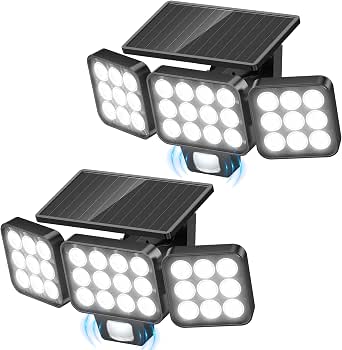
Bell+Howell Bionic Floodlight Elite Solar Flood Lights, 2-Pack
The Bell+Howell pair is a practical choice when I want security lighting that can go on a wall or nearer ground level. Each light has three adjustable panels, so I can aim coverage toward a path, doorway, or garden rather than rely on one fixed beam. The two operating options serve different needs: motion mode activates for 30 seconds when movement is detected up to about 25 feet away, while Eco mode provides a soft all-night glow.
Compared with the Philips 3600-Lumen Floodlight, this set gives up brightness and detection reach, but its wall-mount or ground-stake installation suits more locations and includes two lights. The tradeoff is a shorter motion range and a brief activation window; buyers seeking stronger coverage for a large driveway should look to Philips instead. Solar charging also depends on a sunny installation spot.
Pros:- Two lights let buyers cover separate areas.
- Three adjustable panels help direct light where it is needed.
- Wall mounting and included ground stakes offer flexible placement.
- Motion and all-night Eco modes suit different lighting needs.
Cons:- About 25 feet of motion detection is shorter than the Philips model’s adjustable range of up to 59 feet.
- Motion activation lasts only 30 seconds.
- Solar charging performance depends on access to sunlight.
Best for: Homeowners who want two modest-output lights for paths, garden edges, or entry areas and value both wall and ground-stake placement.
Not ideal for: Buyers covering a wide driveway or seeking long-range detection, since the motion range is about 25 feet and output is 500 lumens per light.
- Pack size:2 lights
- Brightness:500 lumens per light
- LEDs:89 per light
- Light panels:3 adjustable panels per light
- Motion detection range:Up to approximately 25 ft
- Modes:Motion and Eco
- Motion mode duration:30 seconds
- Mounting:Wall mount or ground stake
Our verdict“Choose this pair for flexible, smaller-area lighting with two mounting options, but pick the Philips for brighter, longer-range security coverage.”
Philips 3600-Lumen Solar Outdoor Security Floodlight with Motion Sensor
The Philips is the strongest fit here for buyers who need a single wall-mounted light to cover a broad approach. Its selectable 1800- or 3600-lumen output lets me choose between a less intense setting and a brighter burst, while the PIR sensor spans 180 degrees and reaches up to 59 feet. I can also set activation from 30 to 120 seconds, giving more control over how long the area stays lit than the Bell+Howell’s fixed 30-second motion cycle.
A separate solar panel on a 16-foot cable can sit where sunlight is better, even if the light itself needs a different wall position. That flexibility comes with extra installation planning, and the light is limited to cool-white 5000K output. Unlike the WdtPro two-pack, Philips provides one fixture rather than coverage from two locations, but its adjustable range and higher listed output make it the better single-light security pick.
Pros:- Selectable brightness reaches up to 3600 lumens.
- 180-degree sensor has an adjustable range up to 59 feet.
- Lighting duration can be set from 30 to 120 seconds.
- A 16-foot solar-panel cable allows separate placement for better sun exposure.
Cons:- Only cool-white 5000K lighting is specified.
- Wall mounting and separate panel positioning take more planning than the Bell+Howell ground-stake option.
- One fixture does not provide the multi-location coverage of the WdtPro or Adiding two-packs.
Best for: Buyers securing a driveway, yard approach, or large entry area who need long motion-sensor reach and adjustable high output.
Not ideal for: Shoppers who need multiple fixtures, warm-toned light, or a simple setup without separate solar-panel positioning.
- Brightness:1800 or 3600 lumens
- Color temperature:5000 K
- Motion detection angle:180°
- Motion detection range:Adjustable, up to 59 ft
- Lighting duration:30–120 seconds
- Battery capacity:4000 mAh total
- Solar panel cable:16 ft
- Lighting modes:Test mode and security mode
Our verdict“Pick the Philips when one bright, long-range wall light matters more than having a multi-light set or a simpler installation.”
WdtPro 3-Head Solar Motion Sensor Flood Lights, 2-Pack
The WdtPro set stands out for buyers who want two wall-mounted fixtures with a substantial stated output and broad motion sensing. Each light has three adjustable heads and up to 3,500 lumens, making it easier to spread illumination across separate approaches than with the single Philips floodlight. Its sensor is specified for up to 60 feet across 180 degrees, a reach suited to larger areas, though actual solar performance will depend on sun exposure.
WdtPro lists three lighting modes and up to 15 hours of runtime after three hours of sun exposure. That runtime claim is useful for comparing options, but it does not remove the need for a well-positioned panel and favorable charging conditions. Compared with Intelamp, this pair lists much higher maximum brightness and longer sensor reach; Intelamp counters with dual sensors and flexible mounting hardware. The WdtPro’s main compromise is that both lights require wall mounting.
Pros:- Two fixtures can cover separate locations.
- Three adjustable heads help spread and aim each light’s output.
- Motion detection is specified up to 60 feet across 180 degrees.
- Three modes and a stated runtime of up to 15 hours offer operating flexibility.
Cons:- Wall mounting is required, unlike the Bell+Howell option with ground stakes.
- The stated runtime and charging depend on available sunlight.
- The specified 7000K color temperature may feel very cool compared with Philips 5000K lighting.
Best for: Homeowners who need two bright, wall-mounted motion lights to cover separate sides of a house, garage, or yard.
Not ideal for: Buyers who cannot wall-mount fixtures or need ground-stake placement, or who prefer a lower color temperature than the specified 7000K.
- Pack size:2 lights
- Maximum brightness:3,500 lumens
- Light source:150 COB LED chips
- Motion detection range:Up to 60 ft
- Motion detection angle:180 degrees
- Lighting modes:3
- Stated runtime:Up to 15 hours after 3 hours of sun exposure
- Color temperature:7,000 K
Our verdict“Choose WdtPro for two high-output wall fixtures with long stated detection reach, but skip it if mounting flexibility or less-cool light is a priority.”
Intelamp Solar Outdoor Motion Sensor Flood Lights, 3 Heads, 270° Wide Angle
Intelamp is the most distinctive choice for a corner, post, or approach where movement may come from the sides as well as the front. Its dual motion sensors and stated detection coverage over 180 degrees are paired with three adjustable heads that spread light across a 270-degree area. That wider layout can reduce dark gaps around a mounting point, while the 1,200-lumen output is more modest than the Philips and WdtPro options.
The claimed ability to run for up to three consecutive nights in motion-sensing mode after a full day of charging may appeal to buyers who want reserve capacity, though solar exposure remains a condition of that claim. Compared with the Adiding two-pack, Intelamp offers side-oriented sensing and hardware for posts or trees, while Adiding brings two lights, remote control, and a separate panel cable. Intelamp is a better fit for one awkwardly positioned area than for broad multi-location coverage.
Pros:- Dual sensors help detect movement from the front and sides.
- Three adjustable heads spread light across a stated 270-degree angle.
- Three lighting modes give buyers different operating choices.
- Included screws and tie straps support mounting on hard surfaces, trees, or posts.
Cons:- At 1,200 lumens, it is less bright on paper than Philips or WdtPro.
- The listed runtime of up to three nights depends on a full day of charging and use conditions.
- It is designed for outdoor use only.
Best for: Homeowners lighting a corner, fence line, or post-mounted location where side approaches need to trigger the light.
Not ideal for: Buyers who need the highest brightness or two fixtures to cover separate areas; its listed output is 1,200 lumens and it is a single light.
- Brightness:1,200 lumens
- Light sources:108 LEDs
- Lighting angle:270°
- Motion detection:Dual sensors; over 180°
- Lighting modes:3
- Stated runtime:Up to 3 consecutive nights in motion-sensing mode after a full day of charging
- Color temperature:6500 K
- Mounting:Wall mount; screws and tie straps included
Our verdict“Choose Intelamp for side-angle sensing and flexible post or wall mounting, not for maximum brightness or coverage from multiple lights.”
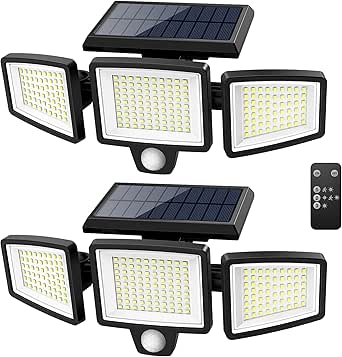
Adiding Solar Outdoor Flood Lights, 2-Pack, 202 LEDs with 16.4 ft Cable
Adiding makes the most sense when I want two fixtures and need the solar panels positioned away from the lights. Each unit has a 16.4-foot cable, giving more placement freedom than the Bell+Howell lights, whose panels are built into the fixture. That separation can help when a wall or eave is shaded but a nearby roofline or open area gets sun. The pair is rated up to 2800 lumens per light, with a 180-degree lighting angle and remote control for its three modes.
Compared with WdtPro, Adiding offers remote operation and a longer stated cable, while WdtPro lists a longer motion-detection range and a higher maximum output. Adiding’s description does not specify a motion range, so buyers focused on sensor reach should favor Philips or WdtPro instead. Its water resistance is listed without a specific rating, another reason to choose a model with a stated waterproof specification if exposure is a primary concern.
Pros:- Two lights can cover separate areas.
- The 16.4-foot cable lets the solar panel sit away from the light fixture.
- Remote control provides access to three lighting modes.
- Up to 2800 lumens and a 180-degree angle suit broad area lighting.
Cons:- The supplied data does not specify motion detection range or angle.
- Water resistance is listed without a specific rating, unlike the waterproof WdtPro and Intelamp products.
- The solar panel still needs a suitably sunny position for charging.
Best for: Buyers who want two solar floodlights with remote mode control and need to place panels separately from fixtures in partly shaded locations.
Not ideal for: Shoppers who need a specified long-range motion sensor or a stated waterproof rating for especially exposed installation sites.
- Quantity:2 lights
- LEDs:202 per light
- Brightness:Up to 2800 lumens
- Color temperature:6500 K
- Lighting angle:180°
- Solar panel cable:16.4 ft
- Lighting modes:3
- Control:Remote control
- Water resistance:Water resistant
Our verdict“Pick Adiding for two remote-controlled lights with separate-panel placement, but choose Philips or WdtPro if documented motion-sensor reach is your main priority.”
6-Pack Solar Motion Sensor Outdoor Lights, 800 Lumens, 3 Modes
I’d choose this six-light set when the goal is to add motion lighting at several entry points rather than flood one large area with a single powerful fixture. Each light offers up to 800 lumens, three modes, and a sensor rated for 120 degrees and up to 26 feet, making the set useful for paths, side doors, and smaller exterior zones. Compared with the LEPOWER light, it has less output and shorter stated detection distance, but six separate fixtures can spread coverage across more locations without electrical wiring. The tradeoff is the need to mount and position multiple units, and their charging depends on available sunlight. The strongest motion mode also switches off after 20 seconds, which may be brief for longer tasks.
Pros:- Six lights allow coverage across multiple locations.
- Three modes provide flexibility for motion-activated use.
- IP65 rating suits outdoor wall-mounted installation.
- Screws, tape, and rope are listed as installation options.
Cons:- At 800 lumens per light, each unit is less powerful than the LEPOWER 1600-lumen model.
- Charging and runtime depend on sunlight exposure.
- The strong motion-sensor mode turns off after 20 seconds.
Best for: Homeowners who want separate solar motion lights at several doors, paths, or outbuildings without running power cables.
Not ideal for: Buyers seeking a single high-output floodlight for a large driveway or a long illumination period after each motion trigger.
- Pack size:6 lights
- Brightness:Up to 800 lumens per light
- Light source:149 LED beads
- Motion detection:120° angle; up to 26 ft
- Lighting modes:3
- Water resistance:IP65
- Mounting:Wall mount
- Coverage area:Up to 322 sq. ft.
Our verdict“Choose this set to place modest-output motion lighting at several outdoor spots, but pick the LEPOWER if one fixture needs greater reach and brightness.”
LEPOWER Solar LED Security Light with PIR Motion Sensor, 1600 Lumens
The LEPOWER is the stronger fit when a security light needs to spot movement farther from the wall: its sensor reaches up to 72 feet, well beyond the 26-foot detection distance listed for the Tuffenough and six-pack lights. Three adjustable heads and up to 1600 lumens let me direct light across a wider area than a fixed-head fixture, while the 15-foot cable gives more freedom to place the solar panel where it can receive sun. Its three modes include motion-activated and continuous lighting, though continuous mode lasts about 50 minutes after a full charge, not all night. The stated range and output make it a more focused choice for driveways and larger approaches, but shaded panel placement or poor weather can limit charging.
Pros:- Motion sensor detection is rated up to 72 feet.
- Three adjustable heads help direct light across a broad area.
- 15-foot cable allows more flexible solar-panel placement.
- Offers motion-activated, normally-on, and test modes.
Cons:- Normally-on operation lasts about 50 minutes after a full charge.
- Solar charging can be limited by shade and poor weather.
- Its 1600-lumen output is lower than the LYWALT’s stated 3000 lumens.
Best for: Homeowners with a long driveway or broad approach who need adjustable heads and motion detection at a greater distance.
Not ideal for: Buyers who need dependable long-duration continuous lighting or cannot place the solar panel where it receives adequate sun.
- Brightness:Up to 1600 lumens
- Color temperature:5500 K
- Motion sensor range:Up to 72 ft
- Sensor angle:180°
- Adjustable heads:3
- Operating modes:Auto, normally on, test
- Solar panel cable:15 ft
- Water resistance:IP65
Our verdict“Pick the LEPOWER for longer-range motion detection and adjustable coverage, but choose the LYWALT if higher stated brightness matters more than sensor distance.”
Tuffenough Solar Outdoor Security Lights with Remote, 3 Heads, 210 LEDs, 2-Pack
The Tuffenough stands apart for pairing remote control with three adjustable heads, so I can change its operating mode without reaching the wall-mounted fixture. Its two lights provide up to 2500 lumens each and a 270-degree motion-detection angle, but the sensor distance is rated at 26 feet—much shorter than the LEPOWER’s 72-foot reach. That makes this a better match for nearby doors, patios, and garage sides than for detecting movement far down a driveway. The listed installation height of 6.5 to 8 feet gives a useful placement target, though mounting too high or low can affect sensor performance. Like the other solar options here, it depends on sunlight, and charging may take two to three days in cloudy or rainy conditions.
Pros:- Remote control makes mode changes easier after installation.
- Three adjustable heads can direct light toward separate nearby zones.
- Up to 2500 lumens per light provides higher stated output than the LEPOWER.
- 270° motion-detection angle covers a wide approach area.
Cons:- Motion detection is rated for up to 26 feet, much less than the LEPOWER’s 72 feet.
- Cloudy or rainy conditions may require two to three days of charging.
- Sensor performance can suffer if installed outside the recommended height range.
Best for: People mounting lights near a patio or entry who want to adjust modes by remote rather than access the fixture directly.
Not ideal for: Buyers covering long driveways or shaded locations where solar charging may be slow or inconsistent.
- Pack size:2 lights
- Brightness:Up to 2500 lumens
- Light source:210 LEDs
- Motion detection angle:270°
- Motion sensing distance:Up to 26 ft
- Lighting modes:3
- Battery capacity:1800 mAh
- Recommended installation height:6.5–8 ft
- Water resistance:IP65
Our verdict“Choose the Tuffenough for nearby coverage and convenient remote mode control, not for detecting movement far from the house.”
LYWALT Solar Outdoor Motion Sensor Light, 3000 Lumens, 188 LEDs, 4 Adjustable Heads
With four adjustable heads and a stated output of up to 3000 lumens, the LYWALT is the most powerful single fixture in this group by listed brightness. Its dual PIR sensors detect movement up to 40 feet across a 180-degree range, giving it more reach than the Tuffenough while falling short of the LEPOWER’s 72-foot rating. The stated illumination angle reaches 270 degrees, useful for aiming light around a corner or across multiple nearby zones. Three nighttime modes include low-level always-on settings, but those stay at just 10% or 3% brightness; this is not a substitute for full-output continuous lighting. The tempered-glass solar panel is a distinct feature, though actual charging and operation still rely on sunlight and the built-in battery.
Pros:- Four adjustable heads offer flexible beam placement.
- Stated output of up to 3000 lumens exceeds the other listed lights in this batch.
- Dual PIR sensors detect motion up to 40 feet.
- Three nighttime modes include low-level lighting with motion-triggered full output.
Cons:- Always-on modes provide only 10% or 3% brightness.
- The LEPOWER has a longer stated motion range of up to 72 feet.
- Charging and operation depend on sunlight and the built-in battery.
Best for: Homeowners who want one high-output fixture with several adjustable beams for a broad porch, yard, or building entrance.
Not ideal for: Buyers who need long-range detection beyond 40 feet or bright, full-output illumination throughout the night.
- Brightness:Up to 3000 lumens
- Light source:188 LEDs
- Adjustable heads:4
- Motion detection:Up to 40 ft; 180° range
- Illumination angle:Up to 270°
- Motion sensors:Dual PIR
- Battery capacity:2500 mAh
- Solar panel:Tempered glass; stated 35% conversion rate
- Lighting modes:3
Our verdict“Choose the LYWALT for high stated brightness and four-way beam adjustment, but favor the LEPOWER for longer-range motion detection.”
Solar Motion Sensor Outdoor Flood Light, 2000 Lumens, IP67 Waterproof
This single-head light is the weather-focused pick: its IP67 rating is higher than the IP65 rating listed for the LEPOWER, Tuffenough, and six-light set. It delivers up to 2000 lumens, detects motion up to 26 feet, and can be installed on a wall or in the ground. That mounting flexibility is useful when a wall is unavailable, while its 360-degree horizontal and 90-degree vertical adjustment helps aim the beam after placement. Compared with the four-head LYWALT, it offers fewer ways to split light across separate zones and a shorter stated detection distance. Its 3600mAh battery is the largest capacity specified in this batch, but solar charging still depends on sunlight. The 6500K cool-white color may also feel stark beside warmer exterior lighting.
Pros:- IP67 rating is higher than the IP65 ratings listed for several alternatives.
- Wall or in-ground mounting suits different installation locations.
- 360° horizontal and 90° vertical adjustment help direct the light.
- 3600mAh battery capacity is the largest specified among these five products.
Cons:- Motion detection reaches up to 26 feet, shorter than the LEPOWER’s 72-foot range.
- A single fixture offers less multi-directional aiming than the LYWALT’s four heads.
- 6500K cool-white light may not suit buyers who prefer warmer outdoor illumination.
Best for: Homeowners needing one adjustable light for a weather-exposed spot where wall or in-ground mounting is useful.
Not ideal for: Buyers who need wide multi-directional coverage, a long sensor range, or warm-toned outdoor light.
- Brightness:Up to 2000 lumens
- Color temperature:6500 K
- Motion sensing range:Up to 26 ft
- Motion shutoff:30 seconds
- Battery capacity:3600 mAh
- Water resistance:IP67
- Mounting:Wall mount or in-ground
- Adjustment:360° horizontal; 90° vertical
- Dimensions:4.5 × 3.7 × 10 in
Our verdict“Pick this model for weather-exposed installation flexibility and an IP67 rating, but choose a multi-head or longer-range option for broader security coverage.”
Omibee Solar Outdoor Flood Lights, 6000 Lumens, 284 LEDs, 6 Adjustable Heads, Dual Motion Sensors, Remote Control, 2-Pack
For buyers who want to aim light across several parts of a yard, the Omibee’s six adjustable heads offer more control than the three-head ShineSeed or Daphino. Its listed output of up to 6000 lumens and coverage of up to 2,000 square feet suit larger approaches, while dual sensors detect motion across a 180° angle at up to 40 feet. The remote control adds three modes and brightness settings, letting you tune the light without adjusting the fixture itself. The tradeoff is a relatively small 2200mAh battery for a high-output light: sustained performance depends on strong sun and the selected setting. I’d choose it for broad, adjustable illumination, but not for a shaded mounting spot or anyone seeking a simple, low-output path light.
Pros:- Six adjustable heads make it easier to direct light toward separate areas.
- Up to 6000 lumens and stated coverage up to 2,000 square feet suit larger spaces.
- Dual motion sensors cover a 180° angle and detect movement up to 40 feet away.
- Remote offers three modes and 30%, 60%, and 100% brightness settings.
Cons:- The 2200mAh battery and solar charging make output dependent on sunlight and chosen settings.
- Wall mounting requires screws and a position with direct sun.
- The high-output, multi-head setup may be excessive for a small entryway.
Best for: Homeowners covering a wide driveway, yard, or multiple approach angles who have a sunny wall-mount location.
Not ideal for: Buyers with shaded installation spots or those who want a compact light with minimal setup and controls.
- Pack quantity:2 lights
- Maximum brightness:6000 lumens
- Light heads:6 adjustable heads
- Motion detection:180° angle; up to 40 ft
- Stated lighting coverage:Up to 2,000 sq ft
- Battery capacity:2200mAh
- Lighting control:Remote; 3 modes; 30%, 60%, and 100% brightness
- Weather resistance:IP65
Our verdict“Choose the Omibee for configurable, high-output coverage across a large sunny area; pick the three-head ShineSeed if a simpler wide-angle layout suits your space.”
TECKNET 416-LED Solar Motion Sensor Outdoor Lights, 2-Pack
The TECKNET’s defining strength is its three-sided 300° lighting design, which can spread illumination around a corner or across a broad wall rather than concentrating it in one forward-facing beam. Its 4,200-lumen maximum is below the Omibee’s stated 6,000 lumens, but TECKNET offers a more panoramic layout and an IP66 rating. Three modes include all-night lighting as well as motion-triggered options, giving it more flexibility for routine nighttime visibility. The listed sensor range, however, is only 13–20 feet, well short of the 40-foot detection stated for the Omibee and Daphino. It also needs 6–8 hours of direct sun for a full charge. I’d favor it for nearby entrances and corners, not for detecting movement far down a driveway.
Pros:- Three-sided design spreads light across a 300° angle.
- Three modes include all-night illumination and motion-activated options.
- IP66 weather-resistance rating is higher than the IP65 rating listed for the Omibee and ShineSeed.
- Two-light solar setup avoids the need for wired power.
Cons:- Motion detection is specified at only 13–20 feet and a 120° angle.
- A full charge requires 6–8 hours of direct sunlight.
- Adhesive mounting is unsuitable for rough or uneven surfaces.
Best for: Buyers lighting a nearby entrance, corner, or wall who value broad side-to-side illumination and an all-night mode.
Not ideal for: Homeowners who need long-range motion detection, or whose mounting location gets limited direct sunlight.
- Pack quantity:2 lights
- LED count:416
- Maximum brightness:4,200 lumens
- Lighting angle:300°
- Motion detection:120° angle; 13–20 ft
- Runtime:10–12 hours after a full charge
- Charging requirement:6–8 hours of direct sunlight
- Weather resistance:IP66
Our verdict“Pick TECKNET for broad lighting around a nearby wall or corner, but choose the Omibee or Daphino if you need a stated 40-foot detection range.”
Solar Motion Sensor Outdoor Lights, 3 Modes, 270° Adjustable, 2-Pack
This two-pack is a practical middle ground for buyers who want adjustable heads and more than one nighttime behavior without stepping up to the Omibee’s six-head, 6000-lumen setup. Each light provides 3000 lumens from three heads that adjust up to 270°, with modes for motion activation or lower-level all-night lighting. That makes it easier to balance security bursts with routine visibility around a fence or entry. Its stated 26-foot motion range is shorter than the 40 feet listed for Daphino and Omibee, so it suits closer approaches better than a long driveway. The 5–6-hour charging claim and over-10-hour lighting duration depend on sun exposure and mode. I’d shortlist it for straightforward, adjustable coverage, but skip it if longer sensor reach is the priority.
Pros:- Three adjustable heads can be aimed across different parts of an entry or fence.
- Three lighting modes include motion-activated and low-level all-night options.
- Remote control allows adjustments from up to 5 m away.
- IP65-rated ABS+PC housing is designed for outdoor exposure.
Cons:- The stated motion detection range is limited to 26 feet.
- At 3000 lumens, it has less listed output than the Omibee and TECKNET.
- Solar charging and runtime can fall short in shade or poor sunlight.
Best for: Homeowners seeking two adjustable solar lights for a fence, porch, or nearby approach, with both motion and low-level lighting modes.
Not ideal for: Buyers monitoring a long driveway or large open area who need motion detection beyond 26 feet or higher stated output.
- Pack quantity:2 lights
- Brightness:3000 lumens
- Light heads:3; adjustable up to 270°
- Motion detection range:Up to 26 ft
- Lighting modes:3
- Solar charging time:5–6 hours
- Lighting duration:Over 10 hours
- Weather resistance:IP65
Our verdict“Choose this pair for flexible, moderate-output lighting near a home, but favor the longer-range Daphino or Omibee for detecting movement farther away.”
Daphino 2500-Lumen Solar Motion Sensor Lights, 3 Heads, 2-Pack
Daphino makes a case for itself through 40-foot motion detection and three adjustable heads, rather than sheer brightness. Its 2500-lumen output is lower than the 3000-lumen adjustable-head model in this lineup and well below the Omibee, but the stated 130° sensor arc and 270° coverage are useful for a typical home approach. Three modes include dim and motion-boost options, with up to 12 hours of runtime claimed in dim mode. That mode-specific figure matters: the light’s runtime will vary with sunlight and how often it triggers at full output. Its 7–8-hour charging time is also longer than the 5–6 hours listed for the 3000-lumen model. I’d pick Daphino when sensor reach matters more than maximum brightness, and look elsewhere for faster charging or larger-area coverage.
Pros:- Motion detection is specified up to 40 feet across a 130° arc.
- Three adjustable heads provide up to 270° coverage.
- Three modes include dim and motion-boost options.
- IP65-rated ABS and PC construction is intended for outdoor use.
Cons:- The 2500-lumen output is lower than the Omibee, TECKNET, and 3000-lumen model in this group.
- Charging is listed at 7–8 hours, longer than the 5–6 hours stated for the 3000-lumen model.
- The up-to-12-hour runtime applies to dim mode and depends on solar conditions.
Best for: Homeowners who want a two-light set for a driveway edge or yard approach where a stated 40-foot sensor range matters more than maximum brightness.
Not ideal for: Buyers who need high-output floodlighting, faster stated charging, or dependable performance in a shaded location.
- Pack size:2 lights
- Maximum light output:2500 lumens
- LED count:156
- Motion detection:Up to 40 ft; 130° arc
- Coverage:270°
- Runtime:Up to 12 hours in dim mode
- Charging time:7–8 hours
- Weather resistance:IP65
Our verdict“Choose Daphino when 40-foot motion detection matters more than brightness; select the Omibee for a much brighter, more adjustable floodlight.”
ShineSeed Solar Motion Sensor Flood Lights, 3500 Lumens, 168 LEDs, 3 Heads, 300° Wide Angle, 3 Modes, IP65, 2-Pack
The ShineSeed pairs three adjustable heads with a 300° illumination angle, giving it a wider stated spread than Daphino’s 270° coverage. Its 3500-lumen output also sits between Daphino’s 2500 lumens and TECKNET’s 4200, making this the more balanced choice for buyers who want broad illumination without the Omibee’s six-head format. A 3000mAh battery and claimed up to 18 hours of continuous lighting stand out on paper, though actual runtime will depend on sunlight and mode. The motion sensor is listed at up to 60 feet across a 180° angle, but that longer reach does not change the fact that mounting still needs a sunny wall. I’d choose it for broad outdoor coverage and flexible modes; skip it if wall mounting is impractical.
Pros:- Three heads and a 300° illumination angle spread light across a broad area.
- 3500-lumen output exceeds the Daphino’s 2500 lumens.
- 3000mAh battery and up to 18 hours of stated continuous lighting.
- Three lighting modes and IP65 weather resistance.
Cons:- Solar charging depends on sunlight, with 4–6 hours listed for charging.
- Wall mounting is required, limiting placement options.
- The stated continuous-lighting duration may not match performance in motion-heavy or low-sun conditions.
Best for: Homeowners with a sunny wall and a broad area to cover who want three modes, wide illumination, and a longer stated lighting duration.
Not ideal for: Renters or buyers unable to wall-mount, and anyone whose installation spot receives little direct sun.
- Pack size:2 lights
- Brightness:3500 lumens
- LED count:168
- Illumination angle:300°
- Motion detection:180° angle; up to 60 ft
- Battery capacity:3000mAh
- Charging time:4–6 hours
- Continuous lighting time:Up to 18 hours
Our verdict“Choose ShineSeed for wide, wall-mounted coverage and a long stated runtime; choose TECKNET for a higher listed output and IP66 rating.”
How We Picked
I compared these 15 solar-powered outdoor security lights around the questions that affect a real installation: how much area the light can cover, how motion sensing and adjustment are presented, how easily the panel can reach sun, and what the listed build or weather features suggest about outdoor use. I also looked at practical extras such as multiple operating modes, remote controls, cable-connected panels, and the number of lights supplied. A high lumen claim was not treated as a stand-alone measure of usefulness; a broad, aimable beam and a workable charging position can matter just as much.
The ranking gives priority to balanced security use and setup flexibility, then separates picks by their strongest buyer fit. Products with more coverage options or clearer placement advantages rank ahead of lights whose main appeal is a large bundle or a headline specification. Since the supplied product details do not establish runtime, charging time, battery capacity, or independent brightness testing, I do not make claims about those points. Buyers should check those specifications and confirm installation requirements before choosing.
Factors to Consider When Choosing Solar Powered Outdoor Security Lights
Choosing among these lights is less about finding the largest number on a package and more about matching the hardware to the site. I would start with the spot that needs coverage, then work backward through sunlight, sensor placement, mounting, and upkeep.
Match the beam to the area you need to cover
First decide whether the job is to light a doorway, a side path, a driveway, or several angles around a building. Multiple adjustable heads can direct light toward separate zones, but they do not guarantee that every zone receives strong illumination at once. A single floodlight may make more sense when one broad approach is the priority. Avoid choosing only by a lumen figure: beam direction, mounting height, and distance from the target all affect what the light accomplishes. If you need coverage around a corner, look for adjustable heads or a wide-angle layout rather than assuming a brighter fixed beam will solve it. Sketching the target area before buying can prevent both blind spots and unnecessary overlap.
Plan for sunlight before choosing a mounting point
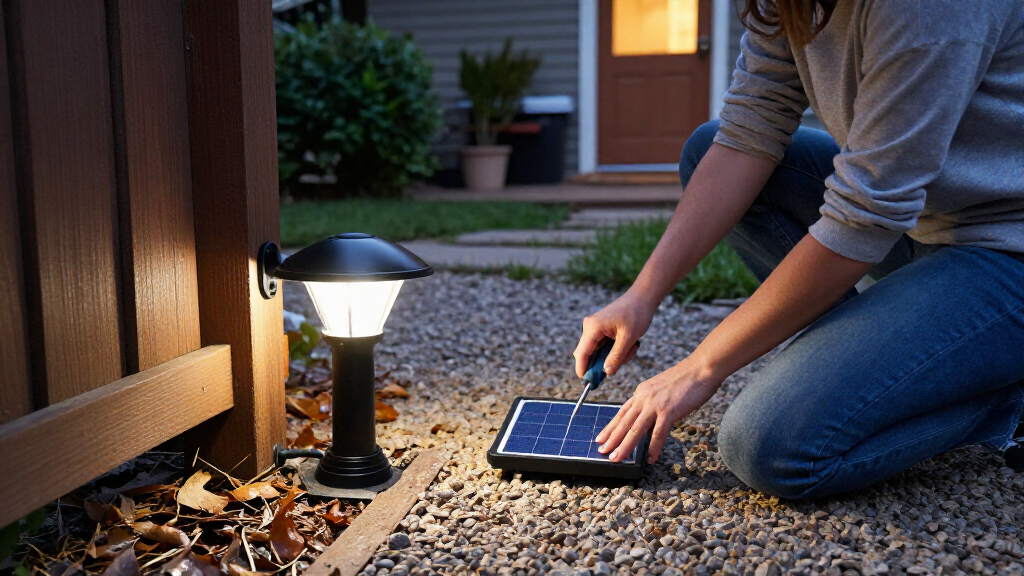
A security light often needs to face the area you want to illuminate, while its panel needs access to daylight; those goals may not line up on the same wall. Shaded eaves, north-facing walls, trees, and seasonal shadows can all limit charging. A separate panel connected by a cable can help when the best sun exposure is away from the best light position, but the cable route adds installation work and needs protection from damage. Do not assume that a motion-triggered light will perform the same in winter or after several cloudy days as it does in bright conditions. Check whether the panel is detachable or remotely mounted, and choose a position with as much unobstructed sky as the site allows.
Treat sensor placement as part of the lighting plan
A bright light can still be disappointing if its sensor misses the approach or triggers too often. Mounting height, the direction people walk, nearby foliage, and traffic beyond the property can all affect detection. A wide sensor angle may help cover a side approach, but it can also pick up movement you did not intend to illuminate. Before drilling, temporarily mark a likely position and check whether the sensor can face the route people actually use. Compare the available modes and controls as well: adjustable settings can help balance security coverage with unwanted activation. If the product information does not specify detection range, avoid assuming a particular distance from the head count or lumen claim.
Read weather and construction details for your location
Outdoor ratings provide a useful clue about protection from water and dust, but the mounting location still matters. A light under a roof overhang faces different exposure from one placed on an open fence or wall that catches wind-driven rain. Look for a stated ingress-protection rating when the product details provide one, and check that seams, connectors, and any separate panel are suitable for the intended exposure. For coastal, dusty, or freeze-prone areas, pay attention to the maker’s care and temperature guidance rather than treating all outdoor-rated products as interchangeable. A higher rating may be worth choosing for a fully exposed location, while placement under shelter can reduce wear. Keep the panel and sensor accessible enough for occasional cleaning and inspection.
Compare the full setup, not just the number of lights
A multi-pack can cover more entry points, but only if each light has a useful mounting position and enough sun for its panel. A remote control or several operating modes may make adjustment easier after installation, while a cable-linked panel can solve a difficult sunlight problem at the cost of more routing. Check what is included, how the lights mount, and whether the package calls for separate hardware or tools. Also verify battery capacity, stated runtime, charging time, and replacement or service information when available; these details are not established by the product names alone. Spending more is easier to justify when an added feature addresses a real site constraint, not simply because the product has more LEDs or heads.
Frequently Asked Questions
Should I choose a higher-lumen light or one with more adjustable heads?
Choose based on the shape of the area, not the headline figure alone. A higher-output light can suit a focused driveway or entrance, while adjustable heads can aim coverage toward separate approaches or reduce shadows around a corner. More heads do not automatically mean brighter light in every direction, and a high lumen claim does not describe beam spread or real-world output at a distance. Check how the heads move and where the sensor points, then compare those details with your mounting location. If only one doorway needs light, a simpler beam may be easier to aim and maintain.
What if the best place for the light is shaded?
Look for a model with a separately positioned or cable-connected solar panel, then place the panel where it can receive stronger daylight. The Adiding set is one option in this roundup with a listed 16.4-foot cable, which can help separate panel placement from light placement. Measure the route before buying and plan how to secure the cable against abrasion, water pooling, and accidental pulling. If no sunny panel position is available, solar charging may not meet your expectations regardless of the light’s listed brightness. Review the maker’s charging guidance for the season and exposure at your site.
Are multi-light packs a better choice than one powerful floodlight?
A pack can be a better fit when you need separate lights at a garage, gate, and side path, since each unit can address a distinct approach. One stronger floodlight may be simpler when a single area is the priority and a suitable mounting point covers it. Multi-packs also mean more panels to place in sunlight and more installations to maintain. Compare the included quantity with the locations you actually need to secure, rather than treating extra units as automatic value. For a large or irregular property, several well-placed lights may reduce blind spots more effectively than one central fixture.
How can I avoid motion lights turning on for the wrong reasons?
Point the sensor toward the route you want to monitor and away from busy streets, moving branches, or neighboring areas where possible. Mounting height and angle affect which movement crosses the sensor’s field, so follow the maker’s placement guidance and test the setup before finalizing the position. Adjustable sensitivity or operating modes can help if the model offers them, but not every product listing confirms those controls. A wider detection angle may catch a side approach while also increasing unwanted triggers. If the light has a remote, use it to change settings only when its documented controls support that adjustment.
What specifications should I verify before installing a solar security light?
Check the stated battery capacity, charging time, runtime, sensor range, operating modes, and weather rating where the manufacturer provides them. Confirm whether the solar panel is built in or separate, how long any connecting cable is, and whether the mounting hardware suits your wall or eave. Also look for temperature and installation guidance, since a product’s outdoor label does not answer every question about prolonged exposure. Product names in this roundup provide some headline features, but they do not establish all of these specifications. If an important figure is missing, consult the full listing or manufacturer rather than estimating it from lumens or LED count.
Conclusion
For a balanced security-focused choice, I would start with the Philips 3600-Lumen Solar Outdoor Security Floodlight as the best overall pick in this comparison. The Adiding 2-Pack is my best value fit for buyers who need more freedom to place the panel, while the Omibee 6000-Lumen 2-Pack is the premium-style choice for buyers prioritizing multiple adjustable heads, dual sensors, and remote control. Beginners who want a straightforward multi-light setup may prefer the Bell+Howell Bionic Floodlight Elite 2-Pack, with two units to position at separate spots. For specific needs, choose the six-light 800-lumen set to spread coverage across several locations, or the LYWALT when four adjustable heads suit a more complex area. Before deciding, match the light and sensor layout to your target and confirm that the panel can receive enough sunlight.