Choosing the best home solar energy systems requires balancing power output, battery capacity, and installation complexity. My analysis identifies the ECO-WORTHY 10000W Output Complete Off-Grid Solar Panel Kit as the best overall choice for whole-home coverage due to its split-phase inverter and high-capacity LiFePO4 storage. For smaller applications or beginners, the 3000W 24V Off-Grid Solar Power Kit offers a manageable entry point with solid component integration. The primary tradeoff in this market is between raw power capacity and system modularity; larger kits deliver independence but demand significant roof space and electrical expertise. Continue reading to see how these eleven options stack up against specific household energy needs.

Get backup power and energy gear delivered free with Prime
- Fast, free delivery on millions of items
- Prime Video, Amazon Music and more included
- Member-only deals all year
Key Takeaways
- Split-phase inverters in high-wattage kits like the ECO-WORTHY 10000W model are necessary for running standard 240V appliances, unlike single-phase units.
- LiFePO4 battery chemistry appears in nearly all mid-to-high tier picks, offering longer lifespans and safer thermal profiles compared to older lithium-ion variants.
- Standalone generators like the Jackery Solar Generator 1000 v2 serve a different niche than complete home kits, focusing on portability rather than permanent residential integration.
- Entry-level kits under 1000W often lack sufficient battery storage for overnight use, making them suitable for daytime off-grid tasks rather than whole-home backup.
- System voltage consistency matters; matching panel, controller, and battery voltages (e.g., 24V or 48V) prevents efficiency losses and simplifies future expansion.
| Giosolar 1120W 24V Off-Grid Solar and Wind Power Kit with 2 Lithium Batteries |  | Best for Wind-and-Solar Supplementation | Solar panel output: 720W (6 × 120W) | Wind turbine power: 400W | System voltage: 24V | VIEW LATEST PRICE | See Our Full Breakdown |
| ECO-WORTHY 10000W Output Complete Off-Grid Solar Panel Kit for Home, 10kW Split-Phase Inverter, 32.2kWh Storage, 10,620W PV |  | Best for High-Consumption Off-Grid Homes | Solar panel array: 10,620W (18 × 590W) | Battery storage: 32.2kWh total | Battery configuration: 2 × 48V 314Ah LiFePO4 batteries | VIEW LATEST PRICE | See Our Full Breakdown |
| 3000W 24V Off-Grid Solar Power Kit with 1440W Panels, 5.12kWh Battery, MPPT Controller and Pure Sine Wave Inverter |  | Best Balanced Kit for Essential Loads | Solar panel output: 1,440W (12 × 120W) | Panel type: Rigid monocrystalline | Battery capacity: 5.12kWh | VIEW LATEST PRICE | See Our Full Breakdown |
| ECO WORTHY 10000W Output Complete Off-Grid Solar Panel Kit for Home |  | Best for Split-Phase Output with Moderate Solar Input | Solar panel array: 2,950W (5 × 590W) | Panel type: N-type monocrystalline bifacial | Panel conversion efficiency: 23.23% | VIEW LATEST PRICE | See Our Full Breakdown |
| ECO-WORTHY 5KW Off Grid Solar System Complete Kit 2340W |  | Best for a Straightforward 48V Starter System | Solar panel output: 2,340W (12 × 195W) | Panel type: N-type monocrystalline | Battery: 51.2V 100Ah Cubix LiFePO4 | VIEW LATEST PRICE | See Our Full Breakdown |
| ECO-WORTHY Solar Panel Kit LiFePO4 Energy Storage System for Home Backup |  | Best Whole-Home Backup Capacity | Total Power Output: 3540 Watts (Solar Panels) | Battery Capacity: 2 x 48V 314Ah LiFePO4 | Inverter Power: 10kW Hybrid | VIEW LATEST PRICE | See Our Full Breakdown |
| ECO-WORTHY 1170W Solar Panel Kit with 48V 50Ah Battery and 3500W Off-Grid Inverter |  | Best Balanced Off-Grid System | Total Solar Power: 1170 Watts | Battery Type: 48V 50Ah LiFePO4 | Usable Energy: 2560Wh | VIEW LATEST PRICE | See Our Full Breakdown |
| ECO-WORTHY 1200W 24V Off-Grid Solar System with 4.68kWh Daily Output |  | Best for RVs and Mobile Applications | System Voltage: 24V | Battery Capacity: 7.168kWh Total | Inverter Power: 3000 Watts | VIEW LATEST PRICE | See Our Full Breakdown |
| Jackery Solar Generator 1000 v2 with 200W Solar Panel, 1024Wh LiFePO4 Battery |  | Best Portable Power Station | Battery Capacity: 1024Wh | AC Output: 1500W | Surge Power: 3000W | VIEW LATEST PRICE | See Our Full Breakdown |
| ECO-WORTHY 400W 12V Solar Panel Kit with Lithium Batteries and 2000W Inverter | 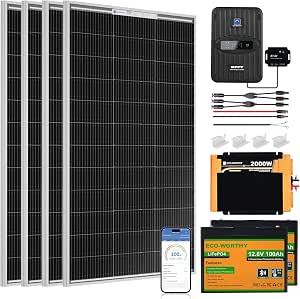 | Best Entry-Level Starter Kit | System Voltage: 12V | Solar Power: 400 Watts | Battery Capacity: 2 x 12V 100Ah | VIEW LATEST PRICE | See Our Full Breakdown |
| ECO-WORTHY 10KW Output 9.36KWH Off Grid Solar System Complete Kit for Home |  | Best for Whole-Home Off-Grid Independence | Maximum Power: 10000 watts | Daily Output: 9.36KWH (under 4 hours full sunshine) | Output Voltage: 120V / 240V Split Phase | VIEW LATEST PRICE | See Our Full Breakdown |
| home solar energy system | Battery capacity |
|---|---|
| Giosolar 1120W 24V Off-Grid So | — |
| ECO-WORTHY 10000W Output Compl | — |
| 3000W 24V Off-Grid Solar Power | 5.12kWh |
| ECO WORTHY 10000W Output Compl | — |
| ECO-WORTHY 5KW Off Grid Solar | — |
| ECO-WORTHY Solar Panel Kit LiF | 2 x 48V 314Ah LiFePO4 |
| ECO-WORTHY 1170W Solar Panel K | — |
| ECO-WORTHY 1200W 24V Off-Grid | 7.168kWh Total |
| Jackery Solar Generator 1000 v | 1024Wh |
| ECO-WORTHY 400W 12V Solar Pane | 2 x 12V 100Ah |
| ECO-WORTHY 10KW Output 9.36KWH | 10.24kWh (2x 48V 100Ah LiFePO4) |
More Details on Our Top Picks
Giosolar 1120W 24V Off-Grid Solar and Wind Power Kit with 2 Lithium Batteries
I’d shortlist this kit for a site where wind can contribute when sunlight is limited. Its 720W of solar panels is less panel capacity than the 1,440W kit from B0G8KQQKM1, but the added 400W wind turbine gives it a second generation source that the other options here lack. Two LiFePO4 batteries and a 3,000W pure sine wave inverter make it a more complete package than a panel-only setup, while the corrosion-resistant frames suit outdoor installation.
The tradeoff is that wind power depends heavily on local conditions and a suitable, elevated tower; the suggested tower height is 4.5–10 m. Its 24V architecture also calls for careful system planning, and battery charging is specified only from 0°C to 45°C. I’d choose it over the B0G8KQQKM1 kit only when the wind resource justifies the added installation work.
Pros:- Combines 720W of solar generation with a 400W wind turbine.
- Includes two 12.8V 100Ah LiFePO4 batteries with BMS protection.
- 3,000W pure sine wave inverter supplies 120V AC power.
- Kit includes solar and wind charge controllers, cables, connectors, and panel brackets.
Cons:- Wind turbine installation calls for a tower 4.5–10 m high and over 48 mm in diameter.
- Battery charging is specified for temperatures from 0°C to 45°C.
- Solar capacity is lower than the 1,440W B0G8KQQKM1 kit.
Best for: Cabin owners or off-grid households in windy locations who want both solar generation and battery storage in one kit.
Not ideal for: Buyers without space or permission for a tall turbine tower, or those seeking a straightforward solar-only installation.
- Solar panel output:720W (6 × 120W)
- Wind turbine power:400W
- System voltage:24V
- Battery bank:2 × 12.8V 100Ah LiFePO4
- Battery energy:1,280Wh per battery
- Inverter:3,000W pure sine wave, 24V DC to 120V AC
- Solar charge controller:60A
- Wind turbine cut-in speed:2.5 m/s
Our verdict“Choose this kit if your site has dependable wind and you can accommodate the turbine tower; otherwise, the B0G8KQQKM1 offers more solar capacity with less wind-installation complexity.”
ECO-WORTHY 10000W Output Complete Off-Grid Solar Panel Kit for Home, 10kW Split-Phase Inverter, 32.2kWh Storage, 10,620W PV
This is the most expansive option in this batch for households that need substantial generation, storage, and split-phase output. Its 10,620W PV array and 32.2kWh battery storage far exceed the B0GWJ5MWLQ kit’s 2,950W of panels and 16.1kWh battery, giving this version more capacity for sustained household use when conditions and system design support it. The 10kW inverter provides 120V/240V split-phase output, while dual MPPT controllers and battery communications support monitoring and system management.
That scale also raises the bar for installation: the product recommends a professional, and the 18-panel array needs substantial space and electrical planning. The listed daily generation figure assumes optimal conditions, so it should not be treated as a guaranteed household supply. I’d favor this over the smaller ECO-WORTHY kit when energy demand warrants the larger array and storage, not simply for the inverter’s headline output.
Pros:- Large 10,620W solar array paired with 32.2kWh of battery storage.
- 10kW inverter supports 120V and 120V/240V split-phase output.
- Dual MPPT controllers, Wi-Fi monitoring, and battery communication support system oversight.
- Battery includes a display, connectivity options, wheels, and handles.
Cons:- Professional installation is recommended, making this a poor fit for inexperienced DIY installers.
- Eighteen large panels require considerable mounting area and installation planning.
- Stated daily energy generation is based on optimal conditions, not a guaranteed output.
Best for: Owners of large off-grid homes who need 120V/240V split-phase power, substantial battery reserve, and room for a large PV array.
Not ideal for: DIY beginners, homes with limited panel space, or buyers whose daily energy needs do not justify an 18-panel, professionally installed system.
- Solar panel array:10,620W (18 × 590W)
- Battery storage:32.2kWh total
- Battery configuration:2 × 48V 314Ah LiFePO4 batteries
- Inverter output:10,000W continuous; 120V/240V split-phase
- Peak inverter output:20,000W
- MPPT controllers:Dual MPPT
- Maximum battery charging:200A
- Panel dimensions:89.68 × 44.65 × 1.18 in each
Our verdict“Pick this system for a large off-grid home with the space and professional support for its 10,620W array; choose the B0GWJ5MWLQ instead if a smaller array and lower storage capacity fit your needs.”
3000W 24V Off-Grid Solar Power Kit with 1440W Panels, 5.12kWh Battery, MPPT Controller and Pure Sine Wave Inverter
I’d rank this as a balanced choice for cabins and backup setups that need more than a small portable system but not a whole-home-scale array. The kit pairs 1,440W of rigid panels with a 5.12kWh LiFePO4 battery bank and a 3,000W pure sine wave inverter, so its included components cover generation, storage, and 120V AC output. Compared with the Giosolar B0CH7SHNT9, it has twice the stated solar panel capacity and avoids the need to site a wind turbine, though it gives up the option of wind generation.
The 60A MPPT controller, app control, LCD, and protected combiner box help organize a multi-panel installation, but this is still a 24V system with several components to wire. The inverter’s 6,000W peak rating lasts only one second, so I wouldn’t choose it for loads that need a longer surge. It makes more sense for planned essential loads than for high-demand whole-house use.
Pros:- Includes 1,440W of rigid monocrystalline panels and 5.12kWh of LiFePO4 storage.
- 3,000W continuous pure sine wave inverter provides 120V AC output.
- 60A MPPT controller includes app control, an LCD, and protection features.
- Combiner box includes DC surge protection.
Cons:- The 6,000W peak rating is specified for only one second.
- 24V configuration and multiple components require careful installation.
- Does not offer the 120V/240V split-phase output of the larger ECO-WORTHY systems.
Best for: Cabin owners and backup-power planners who want a modular solar-and-battery system for essential 120V appliances and electronics.
Not ideal for: Households seeking 120V/240V split-phase service, high surge loads, or a simpler portable power station.
- Solar panel output:1,440W (12 × 120W)
- Panel type:Rigid monocrystalline
- Battery capacity:5.12kWh
- Battery configuration:4 × 100Ah, 12.8V LiFePO4 batteries
- Inverter output:3,000W continuous; 6,000W peak for 1 second
- Inverter output voltage:120V AC
- Charge controller:60A MPPT
- PV combiner box:4-to-1 with DC surge protection
Our verdict“Choose this kit for a planned set of essential 120V loads and more solar capacity than the Giosolar B0CH7SHNT9; skip it if you need split-phase power or sustained surge capacity.”
ECO WORTHY 10000W Output Complete Off-Grid Solar Panel Kit for Home
This kit pairs a large inverter with a comparatively modest panel array, a useful distinction from the 10,620W ECO-WORTHY system B0GJ5LKS99. It provides 10kW of 120V/240V split-phase output and a 16.1kWh LiFePO4 battery, but its five 590W panels total only 2,950W. That setup may suit buyers who value the inverter’s output format and battery reserve more than rapid solar replenishment; the advertised generation figure is based on optimal conditions.
The bifacial panels may gain energy from reflected light when installed in a suitable layout, but that benefit depends on the mounting surface and surroundings. The system ships by freight and recommends professional installation, so it is not a casual DIY project. Compared with the larger B0GJ5LKS99, this version uses fewer panels and one battery, reducing system scale while also limiting solar input. I’d match it to a carefully planned load profile rather than assume 10kW output means 10kW of solar generation.
Pros:- 10kW continuous inverter supports 120V/240V split-phase output.
- Includes a 16.1kWh LiFePO4 battery with monitoring and battery-management features.
- Bifacial 590W panels can collect reflected light in suitable installations.
- Dual MPPT controllers and inverter monitoring support system management.
Cons:- The 2,950W array is much smaller than the 10,620W array in B0GJ5LKS99 despite the same inverter output.
- Professional installation is recommended, and delivery is by freight truck.
- Bifacial gains depend on the installation surface and available reflected light.
Best for: Households needing 120V/240V split-phase inverter output and substantial stored energy, but with lower solar-array needs than a larger off-grid installation.
Not ideal for: Buyers who need fast battery replenishment from solar, lack space or access for freight delivery, or plan an inexperienced DIY installation.
- Solar panel array:2,950W (5 × 590W)
- Panel type:N-type monocrystalline bifacial
- Panel conversion efficiency:23.23%
- Battery storage:16.076kWh
- Battery configuration:48V 314Ah LiFePO4
- Inverter output:10,000W continuous; 120V/240V split-phase
- Peak inverter output:20,000W
- Maximum battery charging:200A
Our verdict“Choose this system when split-phase inverter output and 16.1kWh of storage matter more than a large PV array; choose B0GJ5LKS99 if you need far more solar generation and battery capacity.”
ECO-WORTHY 5KW Off Grid Solar System Complete Kit 2340W
This ECO-WORTHY kit is the more approachable 48V bundle in this group: it combines 2,340W of panels, a 5kW inverter, and a 5.12kWh LiFePO4 battery with cables and brackets. Compared with the B0G8KQQKM1, it offers a higher stated inverter rating and a 48V setup rather than a 24V system, while the B0G8KQQKM1 lists a 60A MPPT controller and a larger 5.12kWh battery bank as four separate batteries. The product describes this set as suitable for DIY installation, which may appeal to owners of cabins, sheds, or backup systems who want a bundled starting point.
Its limits are just as important: the included battery is modest beside either ECO-WORTHY 10kW system, and the provided details do not specify a split-phase output or a charge-controller rating. I’d treat it as a system for selected loads, not assume it can carry an entire home. Buyers should confirm inverter output details and system compatibility before planning their wiring.
Pros:- Combines 2,340W of panels, a 5kW inverter, and a LiFePO4 battery in one kit.
- 48V system architecture suits a bundled off-grid setup.
- Includes cables and mounting brackets.
- Product materials describe the kit as suitable for DIY installation.
Cons:- The 5.12kWh battery offers less storage than the 16.1kWh and 32.2kWh ECO-WORTHY systems.
- Provided details do not specify a charge-controller rating.
- Split-phase output is not specified, limiting confidence for whole-home 240V planning.
Best for: Cabin owners or hands-on homeowners seeking a bundled 48V off-grid system for lights, refrigeration, electronics, and other selected loads.
Not ideal for: Large households needing long-duration storage, 120V/240V split-phase output, or clearly documented controller and inverter output details before purchase.
- Solar panel output:2,340W (12 × 195W)
- Panel type:N-type monocrystalline
- Battery:51.2V 100Ah Cubix LiFePO4
- Battery energy:5.12kWh
- Output voltage:120V
- Panel dimensions:58.86 × 26.18 × 1.18 in each
- Included accessories:Cables and mounting brackets
Our verdict“Choose this kit as a bundled 48V starting point for selected off-grid loads, but favor one of the ECO-WORTHY 10kW systems for split-phase service or substantially more storage.”
ECO-WORTHY Solar Panel Kit LiFePO4 Energy Storage System for Home Backup
This system stands out for its massive 32kWh usable energy storage, making it a serious contender for whole-home backup needs. Unlike smaller kits, it includes six 590W N-type panels and a 10kW hybrid inverter, providing enough power to run major household appliances during outages. The LiFePO4 batteries offer over 9,000 cycles, ensuring long-term reliability that cheaper lead-acid systems cannot match. Compared to the ECO-WORTHY 1170W Solar Panel Kit, this model is vastly more powerful but also requires significantly more installation space and structural support. While the plug-and-play design simplifies setup, the sheer weight of the components means professional assistance is often wise. It is an industrial-grade solution for those who need to keep a standard home running without grid power.
Pros:- Delivers over 30kWh of usable energy for extensive home backup
- Includes a high-capacity 10kW hybrid inverter capable of handling split-phase loads
- LiFePO4 batteries offer over 9,000 cycles for extended lifespan
- Integrated smart BMS with fire suppression enhances safety protocols
Cons:- Extremely heavy and bulky, complicating delivery and installation
- Requires significant roof or ground space for the six large panels
- Higher complexity may necessitate professional electrician services
Best for: Homeowners seeking comprehensive backup power for entire houses with significant energy demands and adequate installation space.
Not ideal for: Renters or those with limited roof space, as the six large panels and heavy battery units require substantial structural support and mounting areas.
- Total Power Output:3540 Watts (Solar Panels)
- Battery Capacity:2 x 48V 314Ah LiFePO4
- Inverter Power:10kW Hybrid
- Panel Quantity:6 x 590W N-Type
- Cycle Life:9000+ cycles
- System Voltage:48V
- Output Voltage:120V / 240V Split Phase
Our verdict“Choose this if you need robust, whole-home energy independence and have the space and budget for a high-capacity system.”
ECO-WORTHY 1170W Solar Panel Kit with 48V 50Ah Battery and 3500W Off-Grid Inverter
This kit hits a sweet spot between capacity and manageability, making it ideal for small cabins or workshops. The 48V system architecture offers better efficiency than 12V or 24V setups, reducing energy loss over longer cable runs. With six bifacial panels and a 3500W inverter, it can handle typical off-grid loads like lights, small appliances, and tools. Compared to the ECO-WORTHY 1200W 24V Off-Grid Solar System, this 48V option provides higher voltage efficiency, though the battery capacity is smaller. The built-in MPPT controller simplifies wiring, and the 20ms UPS switching ensures connected devices stay online during brief grid fluctuations. It is a versatile choice for users who want reliable power without the bulk of larger home systems.
Pros:- Efficient 48V system architecture reduces energy loss
- Built-in 80A MPPT controller simplifies installation
- Fast 20ms UPS switching protects sensitive electronics
- Bifacial panels generate extra power from reflected light
Cons:- Battery capacity is limited to 2560Wh, restricting runtime
- Daily output depends heavily on four hours of direct sunlight
- Components may arrive in separate shipments, complicating setup
Best for: Owners of small cabins, workshops, or boats who need a balanced, efficient 48V system for moderate energy loads.
Not ideal for: Users needing to run high-power appliances like electric ovens or central air conditioning, as the 3500W inverter and small battery may struggle.
- Total Solar Power:1170 Watts
- Battery Type:48V 50Ah LiFePO4
- Usable Energy:2560Wh
- Controller:80A MPPT Built-in
- UPS Switching:20ms
- Panel Efficiency:25%
Our verdict“This is the right pick for small off-grid setups where efficiency and compact design outweigh the need for massive storage.”
ECO-WORTHY 1200W 24V Off-Grid Solar System with 4.68kWh Daily Output
Designed with mobility in mind, this system is well-suited for RVs, trailers, and portable cabins. The 24V architecture is a common standard in mobile applications, making it easier to integrate with existing vehicle electrical systems. The seven-kilowatt-hour battery capacity provides ample runtime for camping trips or remote work setups. Unlike the Jackery Solar Generator 1000 v2, which is a sealed unit, this kit offers modular flexibility, allowing you to expand or replace individual components like batteries or panels. The Bluetooth monitoring feature lets you track battery health from a distance, which is convenient for managing power consumption on the go. It is a practical solution for travelers who need reliable, expandable power without the complexity of a fixed home installation.
Pros:- High battery capacity of 7.168kWh supports extended off-grid use
- Bluetooth monitoring allows remote tracking of system status
- Modular design permits easy upgrades to panels or batteries
- Bifacial panels include anti-shade technology for varied environments
Cons:- Requires more complex installation than all-in-one power stations
- Daily output estimates assume ideal sunlight conditions
- 24V system may require converters for certain 12V or 120V devices
Best for: RV owners, campers, and small cabin dwellers who need a flexible, expandable 24V system for mobile or semi-permanent use.
Not ideal for: Users looking for a plug-and-play, all-in-one solution, as this kit requires separate wiring and mounting of components.
- System Voltage:24V
- Battery Capacity:7.168kWh Total
- Inverter Power:3000 Watts
- Solar Input:1170 Watts
- Controller:60A MPPT
- Monitoring:Bluetooth
- Battery Cycles:6000+
Our verdict“Select this system if you need a robust, expandable power source for RVs or remote cabins with moderate energy needs.”
Jackery Solar Generator 1000 v2 with 200W Solar Panel, 1024Wh LiFePO4 Battery
This unit is the ultimate choice for portability and ease of use, requiring zero installation. The all-in-one design integrates the battery, inverter, and controller into a single, compact case, making it perfect for emergency backup or camping trips. While the 1,024Wh capacity is smaller than the ECO-WORTHY 1200W 24V Off-Grid Solar System, its 10ms UPS switchover ensures seamless power continuity for computers and routers. The fast charging capability, taking just 50 minutes via AC, is a significant advantage over traditional solar kits that rely on slower solar input. However, the 200W solar panel is limited in recharging speed compared to larger arrays. It is best for users who prioritize convenience and mobility over high-capacity energy storage.
Pros:- Zero installation required; just plug in and use
- Compact and lightweight design for easy transport
- Fast AC charging in under an hour
- Quiet operation with no moving parts
Cons:- Small battery capacity limits runtime for heavy loads
- Included solar panel recharges the unit slowly
- Higher cost per watt compared to DIY solar kits
Best for: Campers, renters, and homeowners needing a plug-and-play emergency backup for small electronics and essential devices.
Not ideal for: Users with high energy demands or those needing to power large appliances, as the 1500W output and small battery are insufficient.
- Battery Capacity:1024Wh
- AC Output:1500W
- Surge Power:3000W
- Solar Panel:200W
- Weight:23.4 lbs
- UPS Switchover:10ms
- Charging Time:1.25 Hours (AC)
Our verdict“This is the best option for those who value convenience and portability over maximum energy capacity.”
ECO-WORTHY 400W 12V Solar Panel Kit with Lithium Batteries and 2000W Inverter
This kit is an affordable entry point into solar energy, suitable for small sheds, boats, or basic backup needs. The 12V system is the simplest voltage architecture to work with, compatible with many existing automotive and marine components. With two 100Ah batteries and a 2000W inverter, it can run lights, fans, and small electronics effectively. Compared to the ECO-WORTHY 1170W Solar Panel Kit, this system is less efficient due to its lower voltage, but it is far easier to install and less expensive. The bifacial panels help maximize output even in less-than-perfect conditions. It is a practical starter system for those who want to experiment with solar power without a large financial commitment or complex setup.
Pros:- Lowest barrier to entry with simple 12V wiring
- Compact panels are easy to mount on small roofs or boats
- Includes all necessary components for a complete setup
- Bluetooth monitoring provides basic system insights
Cons:- 12V system is less efficient for longer cable runs
- Limited power output restricts appliance compatibility
- Battery capacity is suitable only for light loads
Best for: Beginners, boat owners, or shed users needing a simple, low-cost solar setup for basic lighting and small electronics.
Not ideal for: Users planning to expand the system significantly or run high-power appliances, as the 12V limit and small capacity will be restrictive.
- System Voltage:12V
- Solar Power:400 Watts
- Battery Capacity:2 x 12V 100Ah
- Controller:40A MPPT
- Panel Efficiency:23%
- Monitoring:Bluetooth 5.0
Our verdict“Choose this kit if you are new to solar and need a simple, cost-effective solution for small-scale power needs.”
ECO-WORTHY 10KW Output 9.36KWH Off Grid Solar System Complete Kit for Home
This system stands out for its robust 10KW continuous output and UL 1741 certification, offering a level of safety and reliability that smaller kits lack. Unlike the Giosolar 1120W kit, which suits only minimal loads, this unit powers high-draw appliances like air conditioners and microwaves simultaneously. The inclusion of N-Type bifacial panels with 25% efficiency maximizes energy harvest in limited sunlight conditions. However, the requirement for professional installation adds hidden costs and complexity, making it less accessible for DIY enthusiasts compared to plug-and-play units. While the parallel capability allows scaling to 60KW, the initial footprint of 12 panels demands significant roof or ground space. This is a serious infrastructure investment, not a casual backup solution.
Pros:- High 10KW continuous output supports heavy AC loads
- UL 1741 safety certification ensures grid-compatibility and rigorous testing
- N-Type bifacial panels offer high 25% efficiency and durability
- Scalable design allows paralleling up to 6 units for 60KW systems
Cons:- Professional installation is strongly recommended, adding to total cost
- Large physical footprint with 12 panels requires significant space
- Complex setup process unsuitable for novice DIY installers
Best for: Homeowners building or retrofitting an off-grid residence who need to run heavy AC appliances like central air conditioning or electric ranges.
Not ideal for: Renters or owners with limited roof space, as the 12-panel array requires substantial area and professional electrical work is mandatory.
- Maximum Power:10000 watts
- Daily Output:9.36KWH (under 4 hours full sunshine)
- Output Voltage:120V / 240V Split Phase
- Panel Efficiency:25%
- Battery Capacity:10.24kWh (2x 48V 100Ah LiFePO4)
- Certifications:UL 1741, UL1973, UL9540A
- Panel Type:N-Type 18BB Bifacial Monocrystalline
Our verdict“This kit is the definitive choice for serious off-grid living where high-power reliability and safety certifications are non-negotiable.”
How We Picked
I evaluated these systems based on three primary criteria: total usable energy capacity, inverter reliability, and component compatibility. A system is only as strong as its weakest link, so I prioritized kits where the solar array, charge controller, and battery bank were designed to work together without requiring third-party adjustments. I also examined the chemistry of the energy storage units, favoring LiFePO4 (lithium iron phosphate) over older lead-acid or generic lithium-ion options due to their superior cycle life and safety record.
Ranking logic focused on the ratio of daily energy production to storage capacity. Systems that generate more power than they can store during peak sunlight hours were penalized for potential waste, while those with balanced ratios ranked higher for efficiency. I also considered the ease of installation for DIY users, noting that kits with pre-configured wiring and clear manuals scored higher than those requiring complex custom assembly.
Factors to Consider When Choosing Best Home Solar Energy Systems
Selecting a solar system involves more than just picking the highest wattage number. You need to match the hardware to your actual consumption patterns and local climate conditions. Here are the critical factors that should drive your decision.Assessing Daily Energy Consumption vs. System Capacity
Before buying, calculate your household’s average daily kilowatt-hour (kWh) usage. A 10kW system sounds impressive, but if you only consume 5kWh per day, you are overspending on capacity you will never use. Conversely, a 1000W kit might seem sufficient until a cloudy week drains your batteries completely. Match the system’s daily production estimate to your peak usage, adding a 20% buffer for efficiency losses. This prevents both under-sizing, which leads to blackouts, and over-sizing, which wastes money on unused panels.
Understanding Battery Chemistry and Lifespan
The battery bank is the most expensive and perishable component of any solar setup. LiFePO4 batteries dominate the current market because they offer 3,000-6,000 charge cycles compared to 500-1,000 for lead-acid. While the upfront cost is higher, the long-term value is superior because you won’t need to replace the batteries every few years. Look for integrated Battery Management Systems (BMS) that protect against overcharging and extreme temperatures. Skipping this feature can lead to premature failure and safety hazards.
Inverter Types: Pure Sine Wave vs. Modified Sine Wave
Your inverter converts DC battery power into AC power for your home appliances. Always choose a pure sine wave inverter for home use, as modified sine wave units can damage sensitive electronics like refrigerators, microwaves, and medical devices. Pure sine wave inverters are more efficient and produce cleaner power, which extends the life of your appliances. Check if the inverter is split-phase (for 240V appliances) or single-phase (for 120V only). If you plan to run well pumps or dryers, split-phase is non-negotiable.
Scalability and Future Expansion
Energy needs often grow as you add electric vehicles or expand living spaces. Choose a system architecture that allows you to add more panels or batteries without replacing the core inverter or controller. Modular kits with standard voltages (24V or 48V) are easier to expand than custom low-voltage 12V setups. Check the maximum input ratings of the charge controller; if it is maxed out by the included panels, you cannot add more solar without buying a new controller. This hidden cost can double your expansion budget.
Frequently Asked Questions
Can I install these off-grid solar kits myself, or do I need a professional?
Many of these kits are designed for DIY installation, especially the smaller 1000W-3000W models which often come with pre-wired components and clear diagrams. However, larger systems like the 10kW units involve high-voltage DC electricity and complex battery bank configurations that pose serious safety risks if handled incorrectly. If you are not comfortable working with high amperage connections or mounting panels on a roof, hiring a certified electrician is the safer route. Professional installation also helps ensure compliance with local building codes, which can be tricky for off-grid setups.
How do cloudy days or winter months affect the performance of these systems?
Solar output drops significantly in low-light conditions, often by 50-70% during heavy cloud cover or winter. This is why battery capacity is more important than panel wattage in regions with variable weather. A system sized for sunny summer days will fail during a week of winter storms unless it has sufficient stored energy to last through the deficit. In northern climates, consider tilting panels steeper to catch the lower sun angle and investing in larger battery banks to bridge the gap during prolonged overcast periods.
What is the difference between a solar generator and a home solar system kit?
A solar generator, like the Jackery Solar Generator 1000 v2, is a portable, all-in-one unit ideal for camping or emergency backup for a few critical devices. Home solar system kits are stationary, scalable installations designed to power entire households or specific circuits permanently. Generators are limited by their fixed battery capacity and smaller panel size, making them unsuitable for running high-draw appliances like air conditioners continuously. Home kits offer higher total energy throughput and can be expanded over time, whereas generators are static products with little room for growth.
Do I need a permit to install an off-grid solar system on my property?
Regulations vary widely by municipality, so you must check with your local building department before purchasing. Some areas require permits for structural changes (roof mounting) and electrical work, even for off-grid systems, while others have exemptions for low-voltage or non-grid-tied setups. Failing to obtain necessary permits can result in fines or issues when selling your home later. It is also wise to check Homeowners Association (HOA) rules if you live in a managed community, as they often restrict visible solar installations.
How long do the components in these kits typically last?
Solar panels generally last 25-30 years with minimal degradation, losing only about 0.5% efficiency per year. The inverters and charge controllers typically have a lifespan of 10-15 years, depending on the quality of components and operating temperatures. LiFePO4 batteries are rated for 3,000-6,000 cycles, which translates to roughly 10-15 years of daily use. Budget for replacing the inverter and batteries every decade, as they are the wear items in the system, whereas the panels are essentially long-term infrastructure.
Conclusion
For those seeking whole-home independence, the ECO-WORTHY 10000W Output Complete Off-Grid Solar Panel Kit stands out as the best overall pick, offering the power and storage needed for modern household demands. If you are new to solar and want a beginner-friendly option with manageable complexity, the 3000W 24V Off-Grid Solar Power Kit provides a solid foundation without overwhelming technical hurdles. For premium portability and emergency backup that doesn’t require permanent installation, the Jackery Solar Generator 1000 v2 is the superior choice. Finally, the ECO-WORTHY 1200W 24V Off-Grid Solar System represents the best value for small cabins or essential-load backup, balancing cost and capability effectively. Choose based on your specific energy consumption and installation comfort level to avoid overpaying for unused capacity.