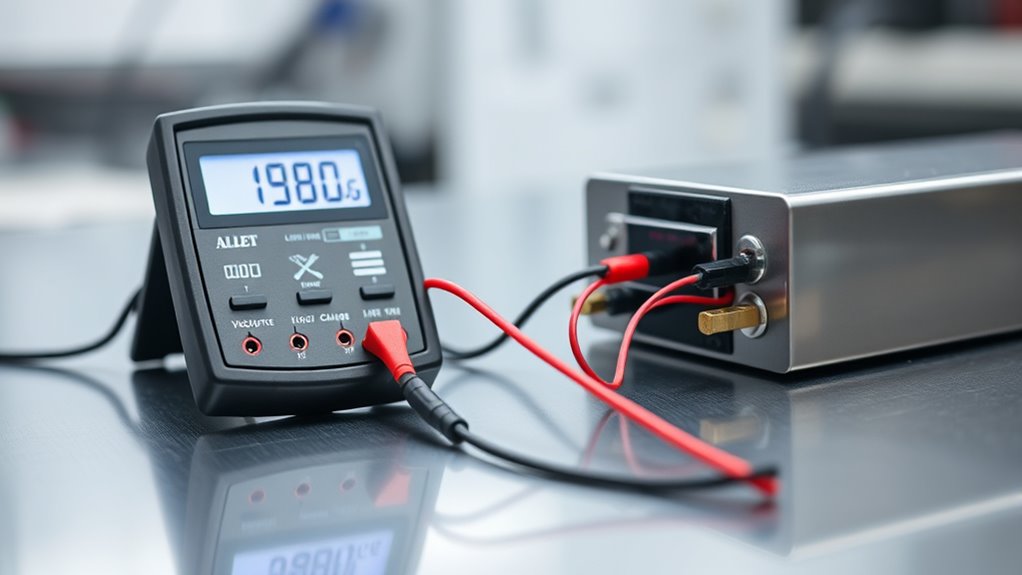

To accurately determine your battery’s state of charge, you need to comprehend its open-circuit voltage (OCV). Measure OCV after the battery has been at rest, allowing transient effects to fade. Keep in mind that different chemistries have unique voltage profiles, so consult specific voltage-to-SOC charts for your type. Recognizing factors like temperature and internal resistance helps ensure your readings reflect true capacity. The more you understand these details, the better you’ll interpret your battery’s energy status.

Get backup power and energy gear delivered free with Prime
- Fast, free delivery on millions of items
- Prime Video, Amazon Music and more included
- Member-only deals all year
Key Takeaways
- OCV indicates battery’s state of charge by measuring potential difference without load.
- Allow the battery to rest to ensure voltage stabilization before measuring OCV.
- Different chemistries have unique voltage-to-SOC profiles, requiring specific charts for accurate interpretation.
- External factors like temperature and internal resistance can affect voltage stability, impacting OCV accuracy.
- Understanding the non-linear relationship between OCV and SOC is essential for precise capacity estimation.

Open-circuit voltage (OCV) is a fundamental concept in understanding how batteries and electrical circuits work. When you measure a battery’s OCV, you’re gauging the potential difference between its terminals without any load connected. This measurement provides critical insights into the battery’s state of charge (SOC), which is essential for accurately evaluating how much energy remains. To interpret OCV effectively, you need to understand the underlying battery chemistry, as it influences the voltage behavior and stability over various charge levels. Different chemistries, like lithium-ion, lead-acid, or nickel-metal hydride, have unique voltage profiles. Recognizing these profiles allows you to correlate specific OCV values with particular SOC levels, making your readings more precise.
Voltage stability is another key factor that impacts how reliably OCV indicates the battery’s charge state. In a stable voltage environment, small changes in load or temperature won’t substantially skew your measurements, ensuring that the OCV accurately reflects the battery’s true charge. However, in unstable conditions—such as rapid temperature fluctuations or the presence of internal resistance—voltage readings may vary even if the battery’s actual SOC remains unchanged. That’s why understanding how factors like temperature, aging, and internal chemistry affect voltage stability can help you interpret OCV measurements more accurately. When the voltage remains stable across different conditions, you can be more confident that your OCV readings truly mirror the battery’s charge level.
In practical terms, measuring OCV involves allowing the battery to rest for a period after use, ensuring the voltage stabilizes before taking a reading. This resting phase helps eliminate transient effects caused by recent activity, giving you a more accurate snapshot of the battery’s potential difference. The relationship between OCV and SOC isn’t always linear, especially with certain chemistries, so consulting specific voltage-to-SOC charts for your battery type is often necessary. By understanding the influence of battery chemistry on voltage stability, you can better interpret your measurements, avoiding misjudging the battery’s actual remaining capacity.
Frequently Asked Questions
How Does Temperature Affect Open-Circuit Voltage Measurements?
Temperature influence considerably affects open-circuit voltage measurements, causing voltage variation that can lead to inaccurate state of charge readings. When temperature drops, the voltage tends to decrease, and when it rises, the voltage increases. You need to account for this temperature dependence because it impacts your battery’s voltage readings. By understanding how temperature influences voltage, you can improve the accuracy of your state of charge assessments and avoid potential misinterpretations.
Can Open-Circuit Voltage Be Used for Real-Time State of Charge?
You can’t rely on open-circuit voltage for real-time state of charge because it requires the battery to rest for accurate readings, which isn’t practical during operation. Battery chemistry influences voltage stability, making it less reliable for instant measurements. To track charge in real-time, you should use other methods like current-based algorithms or coulomb counting, as open-circuit voltage only reflects the state after a rest period.
What Are Common Errors in Measuring Open-Circuit Voltage?
You might face measurement inaccuracies when measuring open-circuit voltage, often caused by not waiting long enough after charging or discharging. Calibration challenges also arise if your equipment isn’t properly calibrated, leading to inconsistent readings. Additionally, temperature fluctuations and internal battery resistance can skew voltage measurements. To improve accuracy, verify proper calibration, allow sufficient rest time before measurement, and monitor environmental conditions.
How Long Should a Battery Rest Before Measuring OCV?
You should allow a rest period of at least 3 to 4 hours before measuring the open-circuit voltage (OCV). This rest period helps guarantee voltage stabilization, giving your battery enough time to settle after use or charging. Rushing the measurement can lead to inaccurate readings, so patience is key. During this time, avoid any loads or charging to get the most precise OCV reading for an accurate state of charge.
Is OCV Reliable for All Types of Batteries?
You might wonder if OCV is reliable for all battery types. It depends on the battery chemistry because measurement accuracy varies. For example, lead-acid batteries give consistent OCV readings when rested properly, but lithium-ion batteries can be less predictable due to temperature and usage. So, while OCV is useful, it’s not universally reliable across all batteries. Always consider the specific chemistry and conditions for accurate state of charge assessments.
Conclusion
By understanding open-circuit voltage, you uncover a clear window into your battery’s true state of charge. Think of it as a compass guiding you through the fog of guesswork, helping you make smarter decisions about when to charge or use your device. Remember, just like a lighthouse signals safe passage, accurate voltage readings lead you to reliable energy management—keeping your battery healthy and your device running smoothly.
Halloween Picks
halloween
As an affiliate, we earn on qualifying purchases.