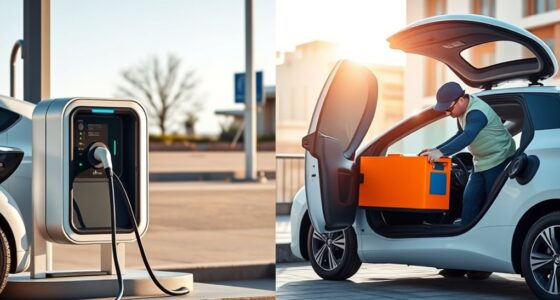

Battery swap stations let you exchange your depleted battery for a fully charged one in minutes, offering quick convenience, but they require standardized batteries and significant infrastructure investments. Fast chargers are more flexible and easier to install, providing 15-30 minute recharge times but may reduce your battery’s lifespan with frequent use. Both options involve costs and infrastructure considerations. To learn which option best fits your needs and long-term goals, explore the detailed differences ahead.
Key Takeaways
- Battery swap stations enable rapid exchanges within minutes, reducing downtime, whereas fast chargers take 15-30 minutes for a top-up.
- Swapping requires standardized batteries and significant infrastructure investment; fast chargers depend on existing electrical grids and are easier to deploy.
- Frequent swapping can impact battery health if not managed properly; fast charging may accelerate battery degradation due to heat.
- Building swap stations involves higher initial costs for infrastructure and batteries, while fast chargers have ongoing energy and cooling expenses.
- EV owners choose based on convenience needs, infrastructure availability, and long-term battery health considerations.
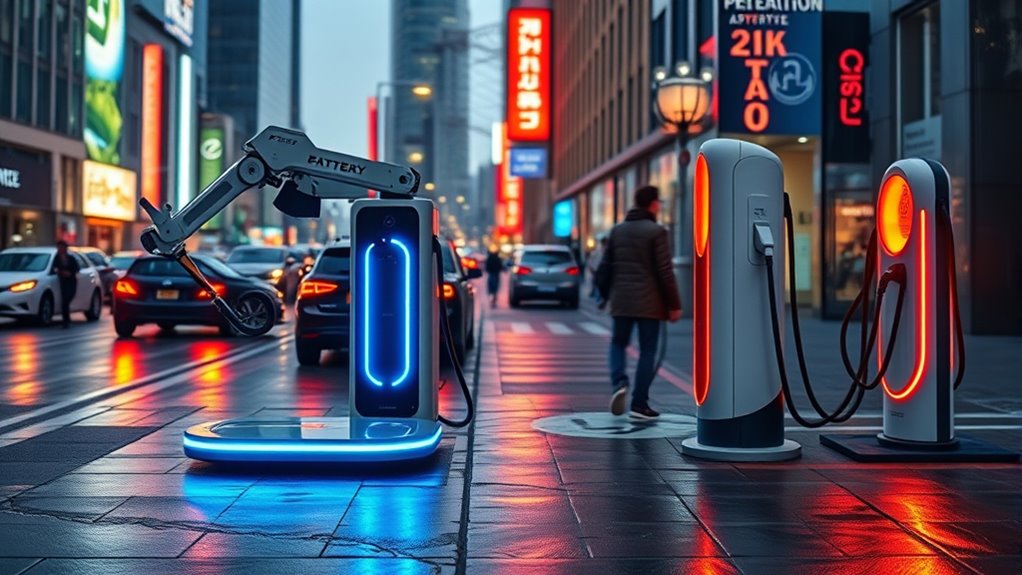
As electric vehicle adoption accelerates, choosing between battery swap and fast charging stations becomes a key decision for drivers. Both options aim to reduce downtime and make EV ownership more convenient, but they differ markedly in how they impact your vehicle’s battery longevity and the broader infrastructure investment needed. Battery swap stations involve exchanging your depleted battery for a fully charged one in a matter of minutes. This approach minimizes your wait time and ensures you’re always on the move, but it requires a network of standardized batteries and substantial infrastructure investment. Manufacturers must produce compatible batteries that can be swapped quickly, and service centers need specialized equipment, which can be costly to implement. Over time, frequent swapping might affect your battery’s health, especially if the swapping process isn’t carefully managed, potentially leading to decreased battery longevity. However, if managed well, swapping can help keep your vehicle’s battery in ideal condition by avoiding deep discharges and high charging temperatures associated with fast charging. Additionally, some tuning modifications to the vehicle’s battery management system can further optimize battery health during swapping processes.
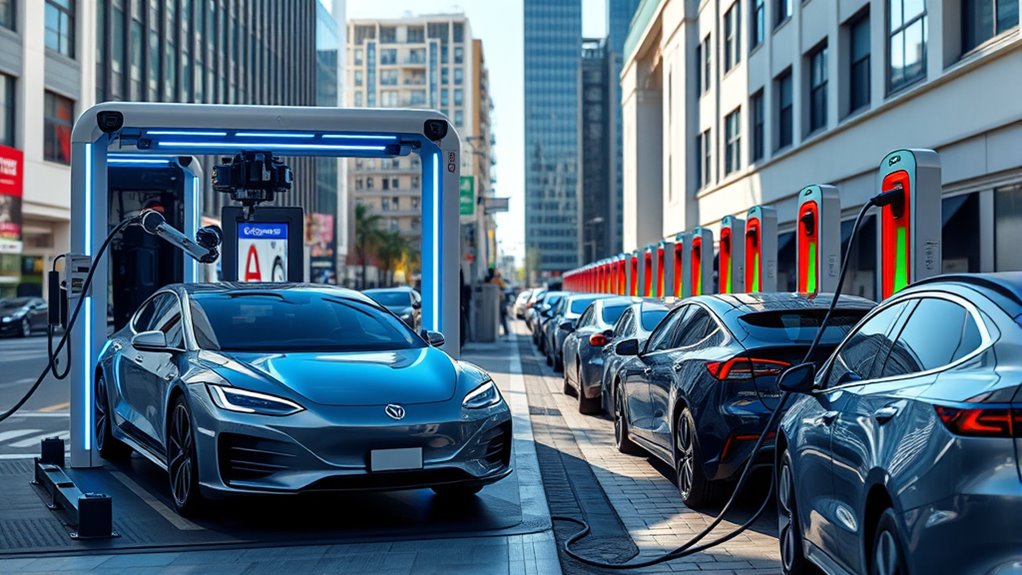
Fast charging stations, on the other hand, allow you to top off your battery in roughly 15 to 30 minutes, depending on the charger’s power level. This method relies on high-powered chargers and existing electrical infrastructure, which requires substantial investment from charging station providers and utility companies. While fast charging is more versatile and widely accessible in the near term, it can have negative effects on your battery’s longevity. Rapid charging generates heat, which can accelerate battery degradation if used frequently, leading to reduced overall lifespan. Manufacturers are continually improving battery chemistry to mitigate these effects, but the trade-off between fast charging convenience and long-term battery health remains a concern. From an infrastructure perspective, fast chargers are easier to deploy on a larger scale because they don’t need specialized batteries, making them more adaptable to current electrical grids. Still, the increased energy demands and cooling systems necessary for fast chargers add to the overall investment costs.
In your choice between the two, consider how often you’ll need quick turnaround times versus the long-term health of your battery. Fast charging stations offer immediate convenience but may impact battery longevity over time. Battery swap stations promise fast service with potentially less stress on your battery if properly managed, but they demand a more complex infrastructure setup and standardization across different vehicle models. Both options require substantial infrastructure investment to be effective, but their impact on your EV’s performance and lifespan varies. Your decision should balance your driving habits, access to infrastructure, and your priorities around convenience versus vehicle longevity.
Frequently Asked Questions
How Do Battery Swaps Affect Vehicle Resale Value?
Battery swaps can positively impact your vehicle’s resale value by maintaining better battery life, as they often involve replacing or servicing the battery regularly. Potential buyers see this as a sign of lower future repair costs and reliability, boosting resale value. However, if the battery swap infrastructure isn’t widespread or trusted, it might raise concerns. Overall, a well-maintained battery through swaps can make your vehicle more appealing and retain its value better.
What Are the Environmental Impacts of Battery Swapping?
Imagine a cleaner future where your EV’s battery swapping minimizes environmental impact. This process can reduce waste by encouraging battery recycling, extending their lifespan, and limiting resource extraction. However, it still involves manufacturing emissions and material use. While it’s a step toward sustainability, ongoing improvements in recycling technologies and sourcing practices are essential to lessen environmental footprints, making battery swapping a more eco-friendly option over time.
Can Existing Charging Stations Be Converted for Battery Swapping?
Yes, existing charging stations can be converted for battery station conversion by adapting their charging infrastructure. You’ll need to upgrade equipment to handle rapid battery swaps and ensure proper storage and handling of batteries. This adaptation involves installing specialized robotic systems or manual swapping stations, which can be integrated into current setups. With the right investment, you can efficiently transform your charging infrastructure to support battery swapping, enhancing flexibility and service options.
How Do Costs Compare Over the Vehicle’s Lifetime?
Ironically, over a vehicle’s lifetime, battery swaps often end up costing more than fast charging—who knew convenience could be so pricey? You’ll find that battery swap stations typically have higher initial setup costs, but lower maintenance expenses, while fast chargers offer better cost efficiency long-term. So, if you’re counting pennies, fast charging might be your smarter choice. Still, the convenience of swapping can sometimes outweigh the costs.
Are Battery Swap Stations Compatible With All Electric Vehicle Models?
Battery swap stations aren’t compatible with all electric vehicle models due to varying battery compatibility and swap station standards. Many stations are designed for specific brands or models, limiting universal access. If your vehicle doesn’t meet the required standards, you won’t be able to use the swap station. It’s essential to check your EV’s compatibility and whether the station follows industry standards before relying on this quick charging method.
Conclusion
Ultimately, choosing between battery swaps and fast charging stations depends on your lifestyle and priorities. Battery swaps offer lightning-fast convenience that feels like magic, while fast chargers provide flexibility and widespread availability. Think of it like picking between a rocket and a jet – both get you where you need to go, but one might suit your travel style better. Whichever you choose, remember: your decision could shape the future of electric mobility more than you realize.