Battery digital twins are more vital for large systems because they enable real-time monitoring, helping you spot issues early and prevent failures. They support predictive maintenance, extending system life and optimizing performance across grids, EVs, or industrial setups. By simulating various scenarios, they help you make informed decisions and manage complexity effectively. If you want to understand how these advanced tools can transform large-scale energy management, you’ll find useful insights ahead.
Open a free Amazon Business account
Business pricing, bulk buying and tax-exempt orders.
As an affiliate, we earn on qualifying purchases.
Key Takeaways
- Large systems require comprehensive monitoring and simulation to manage complexity effectively.
- Digital twins enable real-time oversight, crucial for preventing failures in extensive battery networks.
- Predictive analytics in digital twins help anticipate issues before they escalate in large-scale systems.
- Virtual testing of different scenarios optimizes performance and safety across interconnected components.
- Accurate data integration ensures reliable decision-making, vital for the safety and efficiency of large battery systems.
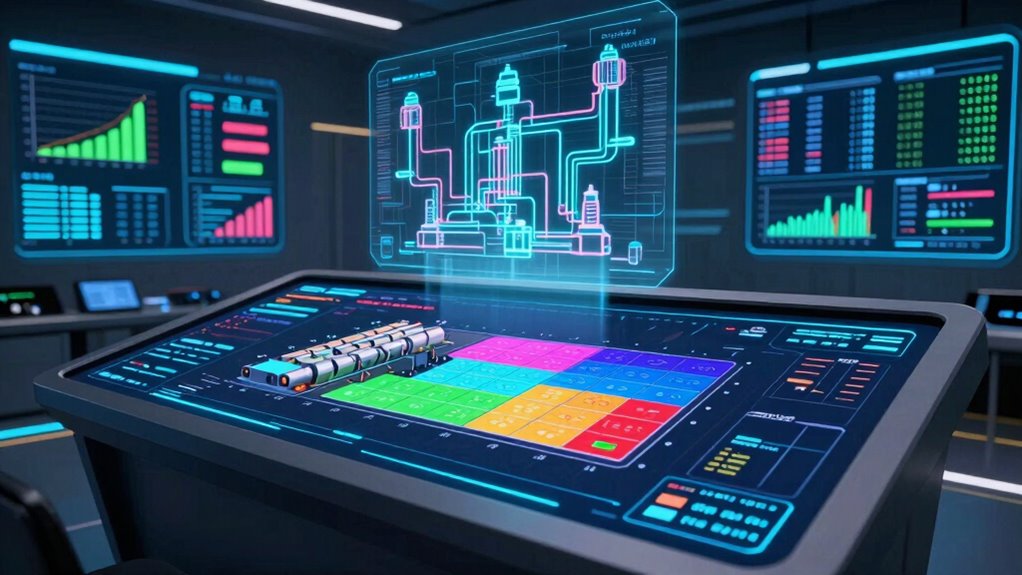
Have you ever wondered how companies can predict and improve battery performance before issues even arise? That’s where Battery Digital Twins come into play, especially for large systems like grids, electric vehicles, and industrial setups. These digital replicas of physical batteries allow you to simulate, analyze, and optimize performance without risking the actual hardware. For large systems, the stakes are higher—more components, complex interactions, and greater costs mean that early detection and prevention are essential. This is where real time monitoring becomes critical. By continuously gathering data on temperature, voltage, current, and other parameters, Battery Digital Twins provide a live view of how the system is functioning. This constant stream of information guarantees you’re never in the dark about potential issues, allowing you to catch anomalies as they happen, rather than after they cause damage or failure.
Battery Digital Twins enable real-time monitoring for early issue detection and performance optimization in large systems.
Predictive analytics takes this a step further by analyzing the data collected through real time monitoring. It identifies patterns and trends that might signal future problems, such as capacity fade, thermal runaway, or degradation of individual cells. For large systems, this proactive approach is indispensable. Instead of reactive maintenance—fixing issues after they occur—you can schedule interventions at the right times, minimizing downtime and extending the lifespan of your batteries. The ability to forecast potential failures also assists in planning for replacements and upgrades, which is especially important when dealing with expensive infrastructure. Incorporating advanced modeling techniques can further enhance the precision of these predictions, ensuring more reliable maintenance schedules. Understanding system complexity is key to effectively managing and optimizing these large-scale systems.
Moreover, Battery Digital Twins empower you to simulate various scenarios. Want to see how a system will respond to different load conditions, environmental factors, or aging processes? You can do that in a virtual environment. This helps in making smarter decisions about energy management, safety protocols, and capacity planning. Since large systems often involve multiple interconnected batteries, understanding how each component interacts allows you to optimize overall performance and reliability. Without a digital twin, managing such complexity becomes a guessing game, risking costly errors or overlooked issues. Additionally, integrating real time monitoring data with predictive analytics enhances the accuracy of the digital twin, making it an even more powerful tool for managing large-scale systems. Recognizing the importance of accurate data collection is fundamental to improving the effectiveness of digital twins and preventing failures before they happen.
In essence, for large battery systems, the combination of real time monitoring and predictive analytics within a Battery Digital Twin isn’t just a technological upgrade—it’s a necessity. It provides the insights needed to keep systems running smoothly, safely, and efficiently. By predicting failures before they happen, you save money, reduce risks, and guarantee continuous operation. As these systems grow bigger and more complex, the value of a digital twin becomes even more apparent, making it an essential tool in modern energy management.
As an affiliate, we earn on qualifying purchases.
Frequently Asked Questions
How Do Digital Twins Improve Battery Lifespan Predictions?
Digital twins improve battery lifespan predictions through advanced battery modeling, allowing you to simulate real-world conditions accurately. By continuously monitoring and analyzing data, these twins provide precise lifespan estimation, helping you identify potential issues early. This proactive approach enables you to optimize maintenance schedules, extend battery life, and enhance reliability. Fundamentally, digital twins give you a detailed, dynamic view, ensuring your batteries perform better over their entire lifespan.
What Are the Main Challenges in Implementing Battery Digital Twins?
Did you know that only 30% of digital twin implementations succeed due to integration issues? You’ll face challenges like data integration, where combining diverse data sources is complex, and model accuracy, which depends on high-quality, real-time data. Overcoming these hurdles requires robust systems and precise calibration. If you neglect these aspects, your digital twin may offer unreliable insights, hampering effective battery management and prediction accuracy.
Can Digital Twins Be Used for Real-Time Battery Monitoring?
Yes, digital twins can be used for real-time battery monitoring. They track battery health continuously by analyzing data streams and ensuring data synchronization between the physical battery and its digital counterpart. This real-time insight helps you identify issues early, optimize performance, and extend battery life. By maintaining accurate, up-to-date information, digital twins enable proactive maintenance and better management of your battery systems.
How Do Digital Twins Impact Overall System Safety and Reliability?
Digital twins enhance your system’s safety and reliability by providing highly accurate simulations through improved data integration. You can identify potential issues early, reducing risks of failures, and optimize performance in real-time. As a result, you gain better decision-making capabilities, prevent costly downtime, and extend your system’s lifespan. The combination of simulation accuracy and seamless data integration makes digital twins essential for maintaining safe and reliable large-scale battery systems.
What Industries Benefit Most From Large-Scale Battery Digital Twins?
Think of large-scale battery digital twins as the brain behind industry applications, guiding smarter decisions. You’ll find industries like renewable energy, electric vehicles, and grid management benefit most, as they rely on precise monitoring and predictive maintenance. Technological advancements make these systems more accurate and efficient, helping you optimize performance, extend battery life, and reduce costs. Embracing these innovations guarantees your operations stay reliable and future-ready in a rapidly evolving landscape.
Conclusion
You see, in large systems, digital twins aren’t just a fancy tool—they’re essential. They let you predict problems before they happen, optimize performance, and extend battery life. By constantly mirroring real-world conditions, digital twins reveal truths that might otherwise stay hidden. So, as you rely more on complex batteries, embracing digital twins isn’t just smart; it’s necessary. They turn data into insights, making your systems safer, smarter, and more reliable every day.
Fall yard work Picks
leaf blowers
As an affiliate, we earn on qualifying purchases.