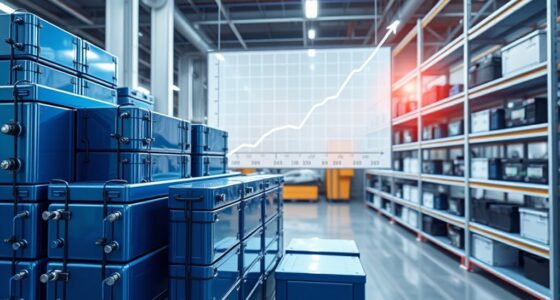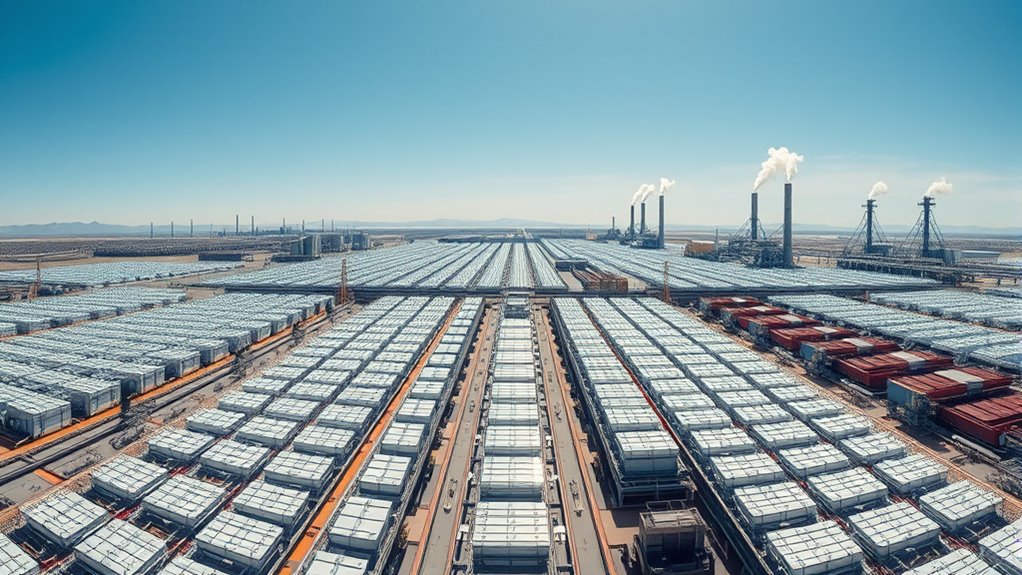

Battery gigafactories are expanding across continents, boosting production capacity, cutting costs, and strengthening supply chains worldwide. By establishing manufacturing hubs in diverse regions, you can reduce risks from political tensions or natural disasters, ensuring steady supply. Recycling and sustainable practices play a key role in stabilizing resources and costs. If you want to understand how this global growth impacts energy storage and industry resilience, keep exploring what’s happening across the continents.
Key Takeaways
- Gigafactories across multiple continents diversify supply chains, reducing risks from geopolitical tensions and natural disasters.
- Geographic expansion boosts local sourcing, lowers transportation costs, and accelerates regional battery production capacity.
- Scaling production globally supports increased demand for raw materials and enhances recycling efforts for sustainability.
- Distributed manufacturing promotes resilience, enabling industry to adapt quickly to market shifts and material shortages.
- Incorporating advanced recycling and circular economy practices in various regions ensures sustainable, cost-effective battery supply.
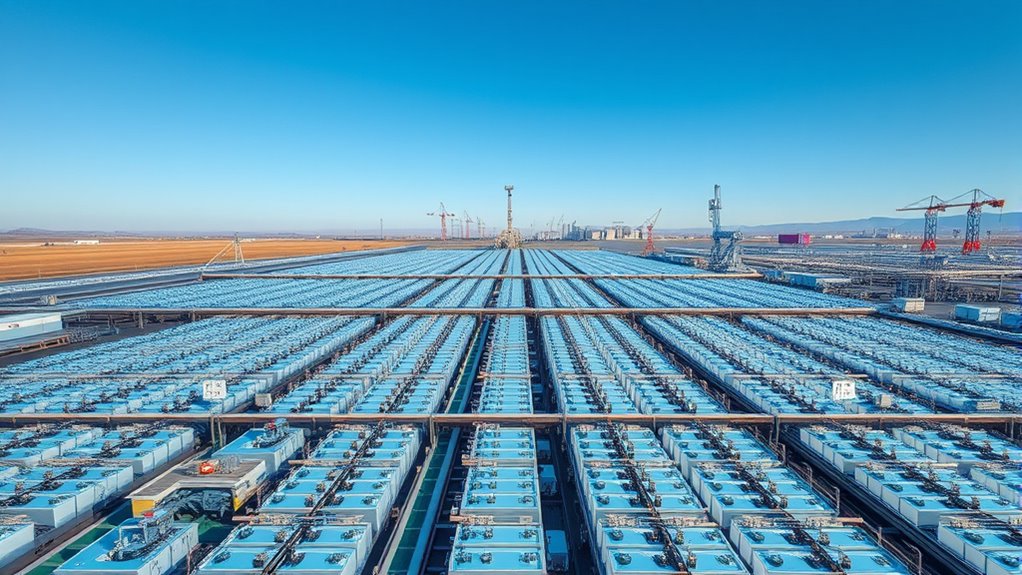
Battery gigafactories are revolutionizing how we produce and supply energy storage for electric vehicles and renewable power systems. As these massive facilities ramp up production, they’re not just increasing battery availability; they’re also reshaping the entire industry’s approach to sustainability and resilience. One key aspect gaining prominence is battery recycling. With the surge in battery manufacturing, the demand for raw materials like lithium, cobalt, and nickel skyrockets. Recycling batteries allows you to recover valuable materials and reduce dependency on mining, which is often environmentally damaging and geopolitically complex. Incorporating effective battery recycling processes into gigafactory operations guarantees a more sustainable supply chain, helping to buffer against raw material shortages and price fluctuations. This shift toward circularity isn’t just environmentally responsible; it’s essential for maintaining consistent production levels and avoiding supply disruptions.
As gigafactories expand across continents, your supply chain resilience becomes more critical than ever. Building multiple manufacturing hubs in different regions reduces reliance on a single source, mitigating risks from geopolitical tensions, natural disasters, or trade restrictions. You can distribute production geographically, ensuring that if one region faces delays or shortages, others can pick up the slack. This diversification also allows for local sourcing of materials and components, lowering transportation costs and lead times. By establishing a global network of gigafactories, you’re creating a more robust and flexible supply chain that can adapt to rapid changes in demand and market conditions. This resilience not only secures your production pipeline but also enhances your ability to meet growing consumer and industry needs swiftly.
Furthermore, integrating battery recycling into your supply chain strengthens your capacity to scale sustainably. As production volume increases, so does the volume of end-of-life batteries needing proper disposal or refurbishment. Creating efficient recycling channels ensures that valuable materials are reclaimed and reintroduced into the manufacturing cycle, reducing the pressure on raw material extraction. This closed-loop approach helps to stabilize costs and supply, making your operations more predictable and less vulnerable to external shocks. Plus, emphasizing recycling and sustainability aligns your brand with eco-conscious consumers and regulatory standards, giving you a competitive edge. Additionally, leveraging AI-driven insights can optimize your recycling processes and supply chain management for even greater efficiency.
Frequently Asked Questions
How Do Gigafactories Impact Local Job Markets and Economies?
Gigafactories boost local employment by creating numerous job opportunities, from construction to manufacturing and administration. You’ll see economic growth as these facilities attract suppliers and service providers, increasing revenue and investment in the area. This growth can lead to improved infrastructure, higher wages, and a stronger community. Overall, gigafactories positively impact local markets by fostering job creation and stimulating economic development.
What Are the Environmental Concerns Associated With Large-Scale Battery Production?
You should be aware that large-scale battery production raises environmental concerns like recycling challenges, making it hard to reuse materials efficiently. Chemical emissions from manufacturing processes can also harm air and water quality. These factories might also generate hazardous waste, so it’s essential to implement strict regulations and sustainable practices to minimize their ecological impact and protect local environments.
How Is Supply Chain Management Optimized Across Multiple Continents?
You optimize supply chain management across continents by leveraging international logistics strategies and supplier diversification. Did you know that companies with diversified suppliers see a 25% decrease in disruptions? You streamline operations by coordinating shipping routes, using real-time tracking, and building strong relationships with multiple suppliers. This approach minimizes risks, guarantees consistent raw material flow, and adapts quickly to geopolitical or logistical challenges, keeping your production on track worldwide.
What Innovations Are Driving Next-Generation Battery Gigafactories?
You’re driving innovation in next-generation battery gigafactories by utilizing advanced electrode materials, which improve energy density and lifespan. Automated manufacturing plays a vital role, streamlining production processes and reducing costs. These innovations enable faster scaling, higher quality, and more sustainable batteries, positioning your gigafactory at the forefront of the industry. By embracing these technologies, you guarantee your facilities stay competitive and meet rising global demand effectively.
How Do Geopolitical Factors Influence International Gigafactory Collaborations?
You’re directly impacted by geopolitical factors like trade policies and diplomatic relations, which can either facilitate or hinder international gigafactory collaborations. When trade policies are favorable, you benefit from smoother cross-border investments and technology transfers. Conversely, strained diplomatic ties can lead to tariffs, restrictions, or even project cancellations, making it harder to scale production globally. Staying informed on these factors helps you navigate and capitalize on international opportunities effectively.
Conclusion
As you watch battery gigafactories expand across continents, remember that Rome wasn’t built in a day. By scaling production and embracing innovation, you’re helping power a cleaner, greener future. It’s clear that collaboration and persistence will turn these vast projects into sustainable success stories. So, stay committed and keep pushing forward—because when it comes to building a better world, every small step counts. The journey may be long, but the destination is worth it.