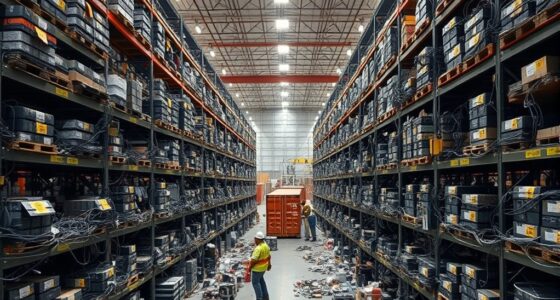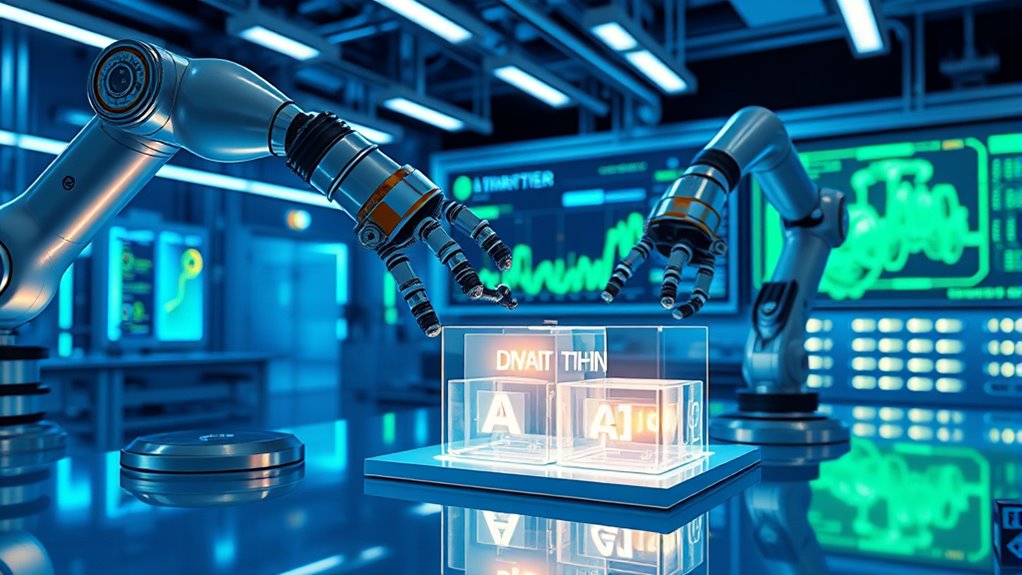

AI and digital twins are transforming battery manufacturing by offering real-time monitoring, predictive maintenance, and process optimization. These technologies let you simulate and analyze performance data, catching issues early and extending battery lifespans. They help improve product quality, speed up innovation, and reduce costs. By leveraging smarter decision-making tools, you’ll enhance safety and efficiency throughout the battery’s lifecycle. Keep exploring to discover how these advancements can give you a competitive edge.
Key Takeaways
- Digital twins enable real-time simulation and monitoring of battery manufacturing processes, enhancing efficiency and quality control.
- AI-driven analysis of data from digital twins predicts battery degradation and optimizes maintenance schedules.
- Virtual testing with digital twins accelerates battery development, reducing reliance on physical prototypes.
- Continuous data feedback improves manufacturing parameters, leading to more consistent and higher-quality batteries.
- Ensuring AI security protects digital twin models and sensitive manufacturing data, supporting safer and more reliable battery production.

As battery manufacturing becomes increasingly complex, AI and digital twins are transforming the industry by enabling real-time monitoring and optimization. These technologies give you the power to track every stage of the battery lifecycle with unmatched precision. Instead of relying solely on traditional testing methods, you can simulate and analyze performance data continuously, allowing you to anticipate issues before they happen. This proactive approach is especially crucial for maintaining battery health and extending lifespan, which directly impacts product reliability and customer satisfaction.
Digital twins create a virtual replica of your manufacturing process and the batteries themselves. By feeding real-time data into these digital models, you gain a dynamic view of how each battery performs under different conditions. This insight helps you identify inefficiencies, optimize manufacturing parameters, and improve overall quality. When it comes to the battery lifecycle, digital twins let you simulate various usage scenarios, predict degradation patterns, and plan maintenance schedules accordingly. As a result, you can reduce unexpected failures and ensure batteries reach their full potential.
Predictive maintenance becomes more accurate and cost-effective with AI-driven insights derived from digital twins. Instead of waiting for batteries to show signs of failure, you can forecast issues well in advance. For example, AI algorithms analyze data trends related to temperature fluctuations, internal resistance, and charge cycles to detect early signs of wear or potential faults. This allows you to schedule maintenance precisely when needed, minimizing downtime and avoiding costly repairs. In addition, predictive maintenance helps you extend the life of your batteries by addressing problems before they escalate, enhancing overall efficiency and reducing waste.
The combination of AI and digital twins also accelerates innovation in battery design. By simulating different materials, configurations, and manufacturing processes virtually, you can test countless variables without physical prototypes. This speeds up development cycles and helps you bring advanced, longer-lasting batteries to market faster. Moreover, continuous monitoring ensures your production processes stay consistent and high-quality, aligning with industry standards and customer expectations.
Furthermore, understanding the importance of AI Security is essential to protect your digital assets and ensure the integrity of your digital twin models. In essence, embracing AI and digital twins in battery manufacturing equips you with powerful tools to optimize the entire lifecycle of your products. From initial design to end-of-life management, these technologies enable smarter decision-making, reduce costs, and improve performance. As the industry evolves, you’ll find that staying ahead means leveraging these digital innovations to deliver safer, more reliable, and more efficient batteries that meet the demands of a rapidly changing world.
Frequently Asked Questions
How Cost-Effective Are Digital Twins for Small Battery Manufacturers?
Digital twins can be quite cost-effective for small battery manufacturers by providing significant cost savings through optimized processes and predictive maintenance. While the initial investment might seem high, the long-term benefits often outweigh costs, making it a feasible investment. You’ll see improved efficiency, fewer downtimes, and better product quality, which all contribute to a stronger bottom line. Overall, digital twins are a smart choice for enhancing competitiveness and operational excellence.
What Are the Potential Security Risks of Implementing AI in Manufacturing?
Sure, deploying AI in manufacturing might seem like inviting a friendly robot into your home, but beware of cybersecurity vulnerabilities and data privacy issues. Hackers could exploit weaknesses, causing disruptions or stealing sensitive info. While AI promises efficiency, it also opens doors to cyberattacks. You need solid security measures and strict data controls to keep your operations safe, or risk turning your smart factory into a hacker’s playground.
How Do AI and Digital Twins Impact Battery Recycling Processes?
You see AI and digital twins improve battery recycling processes by enhancing recycling efficiency and reducing environmental impact. They analyze data to identify ideal recycling methods, streamline sorting and material recovery, and predict potential failures. This technology helps you minimize waste, lower energy consumption, and guarantee safer, more sustainable recycling. By leveraging these tools, you can make your recycling operations more effective, environmentally friendly, and aligned with future sustainability goals.
Can Digital Twins Predict Long-Term Battery Performance Accurately?
Digital twins can predict long-term battery performance with a good level of predictive accuracy, but their accuracy depends on extensive data integration. You need to feed the digital twin detailed, real-time data from various sources to improve reliability. While they offer valuable insights, remember that predictions aren’t perfect, and factors like aging and environmental conditions can affect outcomes. Overall, digital twins are powerful tools, but their predictions should be continuously validated and refined.
What Skills Are Needed for Workers to Operate Ai-Driven Manufacturing Systems?
Think of yourself as a conductor leading a symphony; to do so, you need sharp automation skills and keen data analysis. You must understand how systems work together and interpret complex data streams. Quick decision-making, adaptability, and technical know-how are essential. Mastering these skills ensures you can smoothly operate AI-driven manufacturing systems, turning intricate digital harmony into real-world success.
Conclusion
As you embrace AI and digital twins, you’re opening a new dawn in battery manufacturing—like awakening a powerful guardian watching over every process. These technologies act as your lighthouse, guiding you through complex challenges with clarity and precision. By harnessing their potential, you’re not just building better batteries; you’re shaping a future where innovation shines brightly, illuminating the path toward sustainability and progress. The true power lies within your hands, ready to transform the industry forever.