TL;DR
Solar-powered portable chargers use photovoltaic panels to turn sunlight into electricity, then either store it in a battery or send it to a device. A compact solar power bank is convenient for emergency top-ups, but its small panel often charges slowly; a larger foldable panel paired with a battery is better for sustained off-grid use.
A solar power bank can sit in full sun all afternoon and still leave your phone nearly empty. The reason is simple: a small built-in panel may collect energy far more slowly than its marketing suggests.

Get backup power and energy gear delivered free with Prime
- Fast, free delivery on millions of items
- Prime Video, Amazon Music and more included
- Member-only deals all year
Solar-powered portable chargers use small photovoltaic panels to convert sunlight into electricity. Some store that energy for later; others send it straight to your device. This guide explains what they are, how charging speed works in real conditions, and how to choose between a compact power bank and a larger foldable panel. You’ll also get key facts for avoiding common buying mistakes, from confusing battery capacity with solar output to trusting vague claims like “water-resistant.”
A compact solar power bank is mainly a convenient backup; its small panel may take many hours or sunny days to recharge the battery meaningfully.
Panel size and output affect how quickly a charger collects energy; battery capacity affects how much energy it stores.
Use watt-hours, when available, to compare stored energy, and treat advertised phone-charge counts as estimates.
For steadier off-grid charging, charge a battery from a panel and connect your phone to the battery.
Check USB output standards, exact water and dust ratings, heat instructions, and battery safety protections before buying.
Know which kind of solar charger fits your trip
Solar-powered portable chargers come in two main forms: solar power banks store energy in a built-in battery, while foldable solar panels collect more sunlight and usually work with a separate power bank. The first favors convenience; the second favors useful output in steady sun.
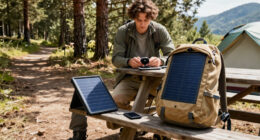
A power bank with a little panel is easy to toss into a daypack. On a weekend hike, it might provide a helpful emergency top-up after you have charged it at home. Its panel, though, may be too small to refill its battery quickly. A foldable panel takes more room and needs to be aimed toward the sun, but it offers more surface area to collect energy.
Think of the difference like a rain barrel and a rain gutter. The battery is the barrel that stores energy; the panel is the surface that gathers it. A tiny panel feeding a large battery is like a narrow gutter filling a big barrel during a short shower. That setup can still help, but it will not fill fast.
Choose based on your routine: a compact bank suits occasional backup, while a panel and separate battery suit multi-day trips or regular off-grid use. If you mainly need predictable daily charging, a conventional power bank charged from a wall outlet may serve you better. That choice becomes clearer once you separate stored energy from collection speed.
Products Worth Considering

Sonos Era 100 SL Compact Microphone-Free Speaker, Black

Logitech MX Master 4 for Mac

DJI Mini 3 Drone with DJI RC and 3-Axis Gimbal
As an affiliate, we earn on qualifying purchases.
Separate stored battery power from solar charging speed
A solar charger’s battery capacity describes how much energy it can store, while its panel output describes how quickly it may collect energy in specified conditions. Milliamp-hours (mAh) are common on power banks, but watt-hours (Wh), when provided, make energy comparisons easier.
Those numbers do not promise an exact number of phone charges. Conversion electronics and cable losses reduce usable energy, and your phone uses power while it charges. Battery age and temperature also affect performance. If a power bank advertises enough capacity for several charges, treat that count as an estimate rather than a guarantee.
For example, imagine you leave a compact bank on a sunny campsite table while using your phone for maps and photos. The bank may collect some energy, but your phone may consume much of it as you navigate. The panel’s rated wattage also comes from specified test conditions; shade, angle, clouds, and heat can push actual output lower or make it fluctuate.
When you compare products, check the battery’s Wh if available, the panel’s wattage and area, and the device output. One large battery number cannot tell you how quickly sunlight will replenish it. One impressive panel number cannot tell you how much energy the battery can hold. You need both to judge whether a setup fits your day.
Set realistic expectations for a full day in the sun
A small panel on a solar power bank usually works best as a slow emergency top-up, not as a reliable way to refill the whole battery in one sunny afternoon. Larger foldable panels can produce useful power in direct sunlight, but their output changes as the sun moves or clouds pass.
Picture a hiker who starts with a full phone and bank. By late afternoon, a compact panel may have added some reserve, but a cloud rolling over the ridge or a shadow from a tree can slow collection. A foldable panel positioned in open sun can gather more energy, though you may need to adjust its angle during the day. Neither setup has one fixed charging time that applies to every trip.
| Setup | Best use | Main tradeoff |
|---|---|---|
| Small solar power bank | Backup and occasional outdoor use | Convenient size, limited solar collection |
| Foldable panel with separate battery | Extended off-grid charging | More output, more gear and positioning |
| Wall-charged power bank | Predictable everyday backup | Needs an outlet before the trip |
For dependable travel, charge the battery from a wall outlet before you leave, then treat sunlight as extra energy. That approach works well unless your trip rules out outlets for an extended stretch; in that case, a larger panel and compatible battery make more sense.
Use this simple setup for steadier off-grid charging
For steadier off-grid charging, connect a solar panel to a battery first, then charge your phone from that battery. The battery buffers the panel’s changing output, so a passing cloud is less likely to interrupt your phone’s charge.
- Charge your power bank before the trip. Start with stored energy instead of relying on the first few hours of sunshine.
- Place the panel in open, direct sun. Point it toward the light and move it when a branch or tent casts shade.
- Keep the battery cool and follow its instructions. Some makers recommend placing the panel in sunlight while keeping the battery section shaded.
- Connect devices to the battery. Use direct panel-to-phone charging only if the panel supports it and you can tolerate output changes.
- Check charging status as conditions change. A shaded campsite or cloudy afternoon may call for conserving phone battery instead.
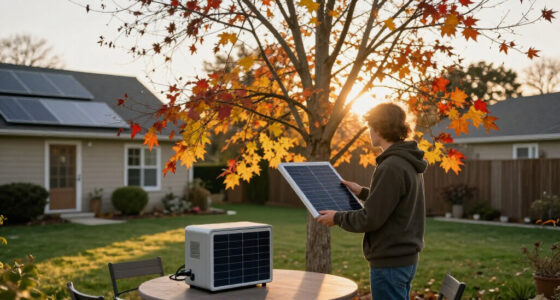
For instance, at a campsite you might unfold a panel on a clear patch of ground, connect it to a compatible power bank, and keep the bank under a shaded table. Your phone can then charge from the bank while the panel collects energy. A sudden cloud may slow the refill, but the stored reserve helps keep charging steadier.
Some panels support direct charging, but a phone connected straight to a panel can pause when sunlight drops. A battery between them adds a practical buffer. For laptops or tablets, check required wattage, voltage, connector, and charging standard first; small solar power banks generally do not have the output those devices need.
Check ports, weather protection, and heat before buying
Before buying, check the charger’s output standards, protection rating, and heat instructions, because a big capacity figure does not guarantee compatibility or durability. USB-C Power Delivery and USB-A outputs support different charging needs; the device and charger must match well enough to deliver the speed you expect.
Suppose you want to top up a tablet on a trail. A bank may have plenty of stored energy yet charge the tablet slowly if its USB output cannot meet the tablet’s requirements. For a laptop, look for a panel and battery system built for the required power, not a compact bank with a few extra ports.
Weather claims also need a close read. Water-resistant does not mean waterproof in every situation, and ports may need their covers shut to meet the stated rating. Check the exact water- and dust-resistance rating, drop guidance, warranty, and safety certifications relevant to your market. Choose a reputable maker that clearly describes overcurrent, overtemperature, and short-circuit protection.
Finally, follow the manufacturer’s sun and temperature guidance. Direct sunlight helps the panel, but a hot battery can affect performance and longevity. A shaded battery connected to a sunlit panel may be the sensible setup for a long afternoon. Features like built-in lights, wireless charging, and rugged shells can help, but they do not make a tiny panel collect more energy.
Buy for the way you’ll actually use solar power
Solar-powered portable chargers are worth buying when sunlight can meaningfully support your plans, such as emergency backup or repeated outdoor use. For ordinary daily charging, a wall-charged bank is usually more predictable; for extended off-grid stays, a foldable panel with a separate battery is often more capable.
Imagine a commuter who wants a backup for the train. A compact solar bank may sound appealing, but most weekdays the panel could spend hours under a coat or indoors, where light is too weak for practical charging. A standard power bank charged at home would give that commuter a more dependable reserve. By contrast, a camper with long sunny days and no outlet can put a larger panel to work.
- For emergencies: choose a portable bank with clear safety information and useful wired outputs; treat its panel as backup.
- For weekend trips: look at weight, folded size, usable battery capacity, and whether the panel can be positioned securely.
- For regular off-grid use: compare larger panel output and compatibility with a separate battery or power station.
- For lower-impact use: consider product lifespan, repairability, and battery recycling alongside solar charging.
Solar use can reduce reliance on wall power during a trip, but manufacturing, battery life, and end-of-life recycling also shape environmental impact. A small solar power bank is a useful tool, not a substitute for household electricity. Your best purchase is the smallest setup that can reliably meet your real charging needs.
Frequently Asked Questions
Can a solar power bank charge a phone in one day?
It depends on the panel size and sunlight. Many compact solar banks charge slowly, so their built-in panels are more useful for emergency top-ups than for fully recharging the bank in a day.
Can I charge my phone directly from a solar panel?
Some panels support direct phone charging, but clouds or shade can make output fluctuate and interrupt charging. A compatible power bank between the panel and phone can provide a steadier source.
Do solar chargers work on cloudy days or indoors?
Panels may still produce some power under clouds, but usually much less than in strong direct sun. Indoor light is generally too weak for practical charging, so charge your battery before leaving home.
Can a solar-powered portable charger charge a laptop?
Some larger panels and compatible battery systems can charge laptops. Check the laptop’s required wattage, voltage, connector, and charging standard; a small solar power bank is generally not suited to laptop charging.
Are solar power banks waterproof?
Only a specific model with an appropriate water-resistance rating offers defined protection, and that rating has limits. Check the rating, port-cover instructions, and care guidance rather than relying on a broad “water-resistant” claim.
What should I look for when buying a solar charger?
Compare usable battery energy, panel wattage and area, USB-C or USB-A outputs, charging standards, weight, protection ratings, warranty, and safety information. Decide first whether you need a compact emergency bank or a larger panel for extended off-grid use.
Conclusion
Choose a solar charger by matching the panel to the sunlight you can use and the battery to the energy you need to store. A small solar power bank can add a little backup; a larger foldable panel and separate battery can support longer stays away from outlets.
Charge your gear before you leave, then let the sun add to your reserve. When the afternoon clouds roll in, you’ll be glad you packed a realistic plan instead of relying on a tiny panel to do a big job.