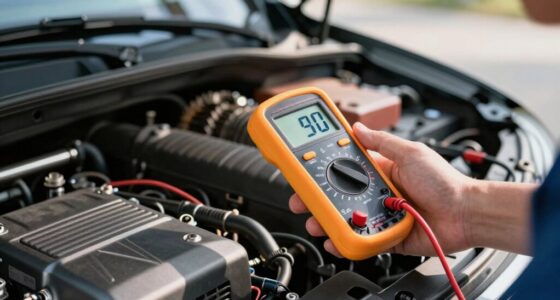
Frequent short trips prevent your vehicle’s battery from fully recharging, which speeds up its deterioration over time. When you don’t allow the battery to reach a full charge, it endures partial discharges that wear down internal components and reduce capacity. This ongoing cycle diminishes the battery’s lifespan and can lead to early failures. To understand how your driving habits impact your battery’s health and ways to protect it, keep exploring this topic further.
Key Takeaways
- Short trips prevent the battery from reaching full charge, accelerating capacity loss over time.
- Frequent incomplete charging cycles increase internal wear, reducing battery lifespan.
- Vehicle alternators may not fully recharge the battery during brief drives, causing semi-discharged states.
- Partial discharges and quick starts stress the battery, leading to faster degradation.
- Longer drives or maintenance chargers help restore full charge and extend battery life.

Short trips may seem convenient and cost-effective, but they often come with hidden expenses that can add up over time. One of the most overlooked consequences is how they impact your vehicle’s battery health. When you frequently take short trips, your car’s battery doesn’t get a chance to fully recharge. This leads to increased battery degradation, which means your battery’s capacity diminishes faster than it normally would. Over time, this degradation can cause your battery to hold less charge, forcing you to replace it sooner than expected.
Your charging habits play an essential role in this process. When you repeatedly start your car and drive only a few miles, the battery is constantly working to recover from a partial discharge. Because the battery isn’t reaching a full charge, it experiences more stress during each cycle. This partial charging puts more strain on the battery’s internal components, accelerating wear and tear. If you’re not mindful of your charging habits, you might unintentionally contribute to faster battery deterioration.
Repeated short drives cause partial discharges, stressing your battery and speeding up wear and tear.
Many drivers overlook the importance of allowing their batteries to fully charge. Instead of letting the battery reach a complete charge, they often shut off the engine early or rely on quick-starting routines. This habit creates a cycle of incomplete charging, which is harmful in the long run. Fully charging your battery, even during short trips, helps maintain its health, but it’s often overlooked because short trips don’t provide enough time for the battery to reach ideal charge levels.
Another factor to consider is how your vehicle’s charging system responds during short trips. If your car’s alternator isn’t able to fully recharge the battery, especially with frequent short drives, the battery remains in a semi-discharged state. This ongoing partial charge and discharge cycle gradually wears down the battery’s capacity. Over time, you might notice your vehicle’s performance declining or experience unexpected battery failures.
To mitigate this, you can adopt better charging habits. For instance, occasionally taking longer drives allows your battery to reach a full charge. Using a battery maintainer or trickle charger when your vehicle is parked for extended periods also helps keep the battery healthy. Recognizing that short trips are more taxing on your battery can motivate you to adjust your driving and charging habits, ultimately saving you money and hassle in the long run.
Frequently Asked Questions
Can Frequent Short Trips Affect My Car’s Overall Lifespan?
Frequent short trips can definitely impact your car’s lifespan. Short trips prevent your engine and battery from reaching ideal operating temperatures, leading to increased battery degradation over time. This also causes more engine wear because the engine doesn’t fully warm up, resulting in incomplete combustion. Over time, these issues can shorten your vehicle’s overall lifespan, requiring more maintenance and potentially costly repairs. So, longer drives are better for your car’s health.
How Does Short Trip Driving Impact Fuel Efficiency?
Fuel frugality suffers with frequent short trips, as your vehicle’s engine doesn’t reach ideal temperature. This causes increased fuel consumption and engine wear since your car runs less efficiently. You might notice more trips to the pump and quicker engine degradation. To save fuel and extend engine life, try combining errands and taking longer drives. Proper maintenance can also help mitigate the negative effects of short trip driving on your vehicle.
Are There Specific Battery Types More Prone to Issues From Short Trips?
You might notice that some batteries, like those with lithium-ion chemistry, are more sensitive to short trips. Their design requires regular full charges to maintain health, but short drives often prevent this. Batteries with simpler chemistry or different design, like lead-acid, may handle short trips better, but still suffer over time. So, understanding your battery’s chemistry and design helps you prevent premature wear caused by frequent short trips.
What Maintenance Tips Help Mitigate Battery Problems From Short Trips?
To prevent battery issues from short trips, focus on proper maintenance, including battery conditioning and following effective charging routines. Regularly check your battery’s health, keep terminals clean, and guarantee it’s fully charged after short drives. Avoid frequent shallow discharges and consider using a battery maintainer if your vehicle sits unused for a while. These steps help maintain ideal performance and prolong your battery’s lifespan, especially during short trips.
Do Electric Vehicles Experience Similar Charging Issues With Short-Distance Driving?
Electric vehicles can experience similar charging issues with short-distance driving. Frequent short trips increase your battery’s charging cycles, which accelerates battery degradation over time. Since the battery doesn’t fully cycle or reach ideal temperature, it doesn’t charge efficiently, leading to reduced range and performance. To minimize this, try to limit short trips when possible, and maintain your EV’s battery health with proper charging habits.
Conclusion
Next time you take frequent short trips, remember they can secretly drain your battery’s health. Imagine John, who thought quick errands wouldn’t matter, but over months, his EV’s range dropped considerably. Small trips might seem harmless, but they add up, preventing your battery from fully charging and lasting longer. To protect your investment, consider combining errands or making longer drives occasionally. Your battery will thank you, and you’ll save money in the long run.