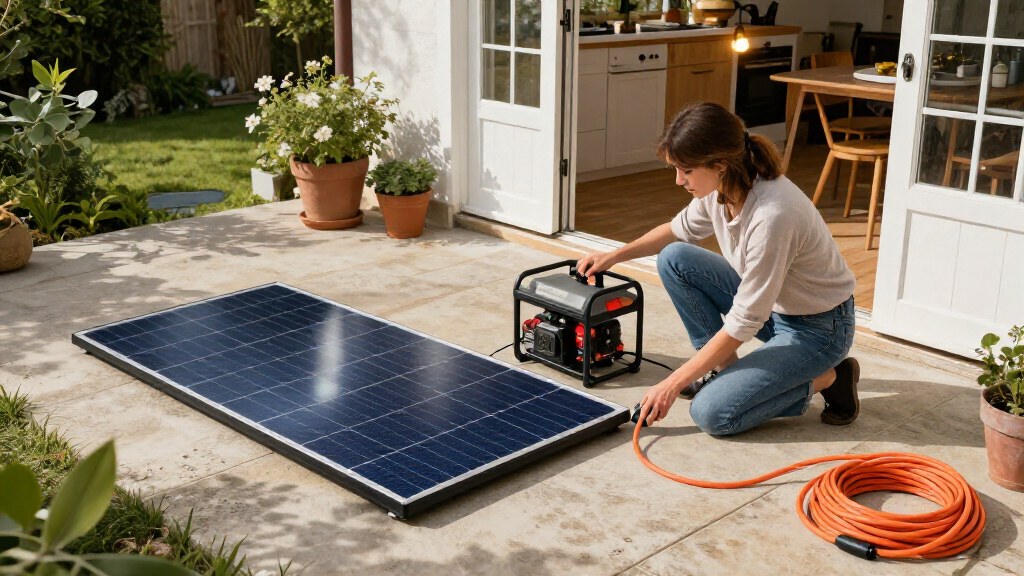

When people compare solar-powered backup generators, they are often weighing two different kinds of equipment: a portable solar generator, which combines a battery, inverter, and charging inputs in a movable unit, and a home solar-plus-battery system, which stores power for use through a household electrical setup. The portable option is easier to buy, move, and use for a few devices; the home system takes more planning and money but can cover more of daily household needs during an outage.

Get backup power and energy gear delivered free with Prime
- Fast, free delivery on millions of items
- Prime Video, Amazon Music and more included
- Member-only deals all year

Jackery Solar Generator 1000 V2 with 200W Solar Panel – 1024 Wh LiFePO₄ Battery
- ✔ Battery capacity: 1,024 Wh
- ✔ Battery chemistry: LiFePO₄
- ✔ Continuous AC output: 1,500 W

Portable Solar Generator 300W Power Station with 60W Solar Panel
- ✔ Maximum AC output: 300 W
- ✔ Solar panel: 60 W monocrystalline, included
- ✔ AC outlets: 2, rated up to 300 W max

Jackery Explorer 300 Portable Power Station, 292Wh
- ✔ Battery capacity: 292 Wh
- ✔ Battery chemistry: LiFePO₄
- ✔ Rated AC output: 300 W
The deciding question is how much of your life needs backup power. A portable unit can keep phones, lights, a router, or selected small appliances running, depending on its capacity and the devices connected. It usually cannot run an entire home for long. A home battery system can be sized and wired to power chosen circuits, and some designs can support broader household backup, but performance depends on battery capacity, solar production, equipment configuration, and installation. Choose the portable generator for modest, flexible backup or occasional trips. Choose the home system when reliable household coverage is worth a larger investment and a permanent installation.
At a Glance
| Criteria | Portable solar generator | Home solar-plus-battery backup system | Winner |
|---|---|---|---|
| Typical backup scope | Selected electronics and appliances; capacity varies by model | Selected household circuits or wider coverage, depending on design and size | B |
| Portability and use away from home | High; designed to move between rooms, vehicles, or campsites | Low; installed as part of the home electrical system | A |
| Setup and installation | Generally ready to use after charging; connect devices directly | Requires system design and qualified installation | A |
| Solar recharging | Can recharge from compatible panels, with speed limited by input and weather | Can charge from compatible rooftop or ground-mounted solar; output varies | Depends |
| Outage convenience | Manual; connect and manage devices within output limits | Can switch to backup automatically or through configured controls | B |
| Upfront cost and commitment | Lower entry cost; typically no permanent home work | Higher purchase and installation cost; long-term home commitment | A |
| Expansion and household integration | Some units accept extra batteries or panels, but integration is limited | Can be designed around household loads and integrated solar equipment | B |
Jackery Solar Generator 1000 V2 with 200W Solar Panel – 1024 Wh LiFePO₄ Battery
When a backup station needs to cover more than phones and laptops, the Jackery 1000 V2 has the strongest combination of storage and output in this group. Its 1,024 Wh LiFePO₄ battery and 1,500 W continuous AC rating give us considerably more room for selected household essentials than either 300 W model. The stated 3,000 W surge rating may also accommodate some brief startup loads, though we should check an appliance’s actual starting demand rather than assume compatibility.Its 10 ms UPS switchover is a useful differentiator for electronics that need a quick handoff during an outage, and the two 100 W USB-C ports support laptops and other USB-C devices directly. The listed 50-minute AC charging time is also notably faster than the small stations’ described solar replenishment, but that figure concerns wall charging and does not mean the unit can refill from the included 200 W solar panel in under an hour. The panel is listed in the product title, while the supplied details also say it ships separately; buyers should verify exactly what is included in the specific bundle.Compared with the ZeroKor and Explorer 300, this is the pick for higher loads and longer reserves, not grab-and-go simplicity. At 23.4 lb it remains portable, but is over three times the Explorer 300’s listed weight. It also depends on the Jackery app for some fast-charge functionality. We would skip it if our needs are limited to a few small electronics or if we require a ready-to-use solar package without confirming panel inclusion.
Pros:
- 1,024 Wh capacity and 1,500 W continuous output lead this comparison.
- 10 ms UPS switchover is useful for compatible electronics during an outage.
- Two 100 W USB-C ports can power capable laptops without occupying AC outlets.
- Listed 50-minute AC full-charge capability can reduce downtime when grid power returns.
Cons:
- The 200 W solar panel is described as shipping separately, so bundle contents need confirmation.
- Some fast-charge functions depend on the Jackery app.
- At 23.4 lb, it is less convenient to carry than the 7.5 lb Explorer 300.
Best for: Households seeking a portable station for several selected essentials, with more capacity and AC output than a compact 300 W unit.
Not ideal for: Buyers who prioritize the lowest carry weight, need whole-home backup, or want certainty that a solar panel ships in the box without checking the bundle.
Bottom line: We rank the Jackery 1000 V2 first for its much larger reserve and higher output, provided buyers verify the panel bundle and match loads to its limits.
“We rank the Jackery 1000 V2 first for its much larger reserve and higher output, provided buyers verify the panel bundle and match loads to its limits.”
Portable Solar Generator 300W Power Station with 60W Solar Panel
The ZeroKor’s main advantage is practical and easy to understand: a 60 W solar panel is included. That makes it the most immediately solar-ready package in this comparison, especially for camping or keeping small electronics topped up away from an outlet. Its AC, DC, and USB outputs offer several ways to connect common devices, and the SOS flashlight adds a basic emergency feature that the supplied Jackery 1000 V2 details do not emphasize.But the word “generator” can invite expectations this unit’s 300 W maximum AC output cannot meet. It is meant for phones, laptops, and other low-demand devices, not high-power appliances. The 60 W panel is also modest relative to the 200 W panel listed for the larger Jackery, so solar replenishment will be slower under comparable conditions. The available description does not state battery capacity in watt-hours, making it harder to estimate reserve and compare runtime directly with the two Jackery stations.Compared with the Explorer 300, ZeroKor is the better fit if we want a panel in the package and broader stated connection options, while Jackery provides a stated 292 Wh capacity, LiFePO₄ chemistry, and a lighter 7.5 lb body. ZeroKor’s panel junction box is not waterproof, which calls for careful handling around moisture. Its battery also needs regular charging and should be maintained in the specified 60–80% range. We would choose it for small-device backup with bundled solar, but skip it if output headroom, weather exposure, or precise runtime planning is central.
Pros:
- Includes a 60 W monocrystalline solar panel for off-grid charging.
- Provides AC, DC, and USB charging options for small devices.
- Lists short-circuit, over-current, over-voltage, overload, and overheating protections.
- SOS flashlight with reading mode can be useful at camp or during a power interruption.
Cons:
- 300 W maximum output rules out many higher-power appliances.
- The supplied product details do not specify battery capacity in watt-hours.
- The solar panel junction box is not waterproof and requires protection from moisture.
Best for: Campers and occasional backup users who want a compact, small-load station with a solar panel included.
Not ideal for: Anyone who needs to run appliances above 300 W, needs a clearly specified watt-hour reserve, or expects the panel junction box to tolerate wet conditions.
Bottom line: We recommend the ZeroKor when a bundled panel and small-device support matter more than high output or precise runtime comparison.
“We recommend the ZeroKor when a bundled panel and small-device support matter more than high output or precise runtime comparison.”
Jackery Explorer 300 Portable Power Station, 292Wh
For a station that can move easily from a home shelf to a car or campsite, the Jackery Explorer 300 is the portability specialist here. At 7.5 lb, it weighs far less than the 1000 V2, and its 292 Wh battery gives us a defined reserve for phones, tablets, and some laptop charging. The 300 W rated output and 600 W peak are useful boundaries: this is a personal-electronics backup unit, not a substitute for the higher-output 1000 V2 when appliances enter the plan.It has two AC outlets, two USB-A ports, a 100 W USB-C PD port, and a 120 W car port, so several device types can connect without a pile of adapters. The product description states that its LiFePO₄ battery is rated for over 4,000 cycles before reaching 70% capacity. That longevity claim may matter to frequent users, though it does not increase the station’s modest capacity or output ceiling.Unlike the ZeroKor, no solar panel is included. The listed charging examples—about 80% in 2.8 hours with a compatible 100 W panel, or 7.5 hours with a 40 W panel—help set expectations, but depend on panel compatibility and conditions. Compared with the 1000 V2, the Explorer is easier to carry and more narrowly suited to small devices; compared with ZeroKor, it has a stated capacity and LiFePO₄ battery information but requires a separate panel. Pick it for lightweight, personal backup, and skip it if the goal is to run larger household equipment or to start solar charging without buying a panel separately.
Pros:
- At 7.5 lb, it is the easiest model here to carry.
- 292 Wh capacity and 300 W rated output are specified for planning small loads.
- Includes AC, USB-A, 100 W USB-C PD, and car-port connections.
- LiFePO₄ battery is listed as rated for over 4,000 cycles to 70% capacity.
Cons:
- 300 W rated output limits the appliances it can support.
- Solar panel is sold separately.
- Its 292 Wh reserve is much smaller than the 1000 V2’s 1,024 Wh.
Best for: People who want a lightweight station for charging personal electronics during travel, camping, or short outages.
Not ideal for: Buyers planning to power higher-demand appliances, seeking a large reserve, or requiring an included solar panel.
Bottom line: We choose the Explorer 300 when carry weight and small-device backup matter more than appliance capacity or an included panel.
“We choose the Explorer 300 when carry weight and small-device backup matter more than appliance capacity or an included panel.”
As an Amazon Associate we earn from qualifying purchases.
Key Differences
The largest difference is coverage. A portable generator puts a defined amount of battery power near the devices you need to run. That can be a sensible answer for communications, lighting, laptops, and limited appliance use, but the battery and inverter ratings set firm limits. High-draw equipment such as electric heaters, ovens, or central air conditioning may exceed those limits or drain the battery quickly. A home battery system can serve selected circuits through a transfer arrangement and may provide a more seamless experience. Its actual coverage still depends on system design and which loads are backed up.
Mobility and commitment point in opposite directions. Portable units can leave the home with you, need little installation, and suit renters or people with occasional backup needs. Home systems cost more and require planning, installation, and a suitable location, yet they can be tied into household solar and electrical equipment. Solar charging is useful in both cases, but it is not unlimited: panel capacity, sunlight, season, battery state, and energy use all shape how quickly stored power returns. Neither setup should be treated as an endless source during prolonged cloudy weather.
For many households, value comes down to whether the system will be used often and how costly an outage would be. A portable unit is usually better value when a small set of devices is enough, or when portability matters. Paying more for a home system makes sense when the household needs broader, easier backup and the installation fits the home’s electrical and solar plans. If you need whole-home support for large loads, compare system specifications and backup design carefully; a battery system is not automatically sized for every appliance.
Detailed Comparison
Typical backup scope (Home solar-plus-battery backup system wins — major)
Winner: B, major gap. A portable generator is best understood as a battery with a defined output and a set of outlets. It can cover a carefully chosen group of devices, but simultaneous loads add up, and motor-driven appliances may need extra startup power. A home battery system can be configured to supply selected circuits, giving it a wider household role. This matters most when multiple rooms, a refrigerator, or other essential circuits need power together. The system’s design determines coverage, so check which circuits are included rather than assuming the whole home is supported.
Portability and use away from home (Portable solar generator wins — major)
Winner: A, major gap. Portable generators are built to be moved, though larger models can still be heavy and may need careful handling. They can provide power at a campsite, in a vehicle, or in another part of the home. A home battery is fixed in place and serves the property it is installed in. If your backup plan includes travel, outdoor use, or taking the unit to another location, portability is decisive. If backup is only for the home, this advantage may matter little.
Setup and installation (Portable solar generator wins — moderate)
Winner: A, moderate gap. A portable unit typically needs charging and basic familiarity with its controls; you then plug compatible devices into it. A home system requires design work, electrical integration, and professional installation. That adds effort and coordination but can make home backup more convenient once the system is configured. Buyers who rent, move frequently, or want an immediate purchase usually have a simpler path with A. Homeowners planning a lasting energy upgrade may find B’s installation reasonable.
Solar recharging (moderate difference)
Winner: Depends, moderate difference. Both options can use solar, but the practical result depends on panel capacity, charging input limits, sunlight, and how much energy is consumed while charging. Portable panels offer flexibility and can be deployed where the unit is being used; their size and output may limit recovery speed. A home system can use a larger solar array, where available, but weather and household demand still constrain how quickly the battery refills. Compare stated input ratings and expected daily energy needs rather than treating solar charging as guaranteed continuous power.
Outage convenience (Home solar-plus-battery backup system wins — moderate)
Winner: B, moderate to major gap. With a portable unit, someone generally chooses which devices to connect and monitors the available outlets and battery level. This is flexible, but it can mean moving cords and prioritizing loads during an outage. A properly configured home system can provide backup through selected circuits and may include automatic transfer, depending on equipment. That reduces hands-on setup. The convenience premium matters more for frequent outages, households with several occupants, or anyone who wants essential circuits to remain available with minimal intervention.
Upfront cost and commitment (Portable solar generator wins — major)
Winner: A, major gap on initial cost. Portable models are available at a lower entry price and do not usually require permanent electrical work. They are a more accessible way to cover a narrow set of needs. A home system can involve the battery, inverter, installation, and related electrical or solar work, raising the total investment. That higher cost can buy broader coverage and a more integrated setup, but it is hard to justify if the main goal is charging phones and running a few lights. Compare the installed price and the loads actually backed up.
Expansion and household integration (Home solar-plus-battery backup system wins — moderate)
Winner: B, moderate gap. Some portable generators support additional batteries or panels, but compatibility and total output are model-specific. A home system can be planned around household circuits, solar equipment, and future energy needs, though expansion is not automatic and may require compatible components or further installation. If you expect to add solar or increase backup coverage over time, evaluate the system’s documented expansion limits before buying. A’s modular accessories can suit small, gradual upgrades; B is the stronger foundation for a coordinated home setup.
Portable solar generator: Pros and Cons
Pros:
- Lower starting cost and no permanent home installation in most cases
- Easy to move for camping, travel, or backup in different rooms
- Straightforward way to power a selected group of devices
- Can accept compatible portable solar panels
Cons:
- Limited battery capacity and output compared with many home systems
- Manual device connection and load prioritization during outages
- Large appliances can exceed output limits or use stored energy quickly
- Solar recharge speed depends on panel input, sunlight, and model limits
Home solar-plus-battery backup system: Pros and Cons
Pros:
- Can back up selected household circuits or broader loads when sized for them
- Can offer a more convenient, integrated outage experience
- Can pair with household solar equipment and be planned around home energy use
- Better suited to long-term household backup needs
Cons:
- Higher purchase and installation cost
- Requires planning, electrical work, and a suitable installation location
- Fixed in place and not useful as a portable power source
- Coverage and solar recharge depend on system design, conditions, and household demand
Who Should Choose What
Choose Portable solar generator if:
- You mainly need phones, lights, networking equipment, or a few modest loads during an outage.
- You rent, move often, or want a unit that can also serve at campsites or other locations.
- You want a lower-cost backup option without permanent electrical installation.
- You are comfortable connecting devices manually and prioritizing which ones get power.
Choose Home solar-plus-battery backup system if:
- You own your home and want selected household circuits supported during outages.
- You value easier operation and a system designed around home solar and electrical equipment.
- Outages are frequent or disruptive enough to justify a larger installed investment.
- You have estimated your essential loads and are prepared to size the battery and inverter to match them.
Skip both if: You need sustained backup for high-draw loads or whole-home operation but have not confirmed the required power, battery capacity, and installation design. First calculate essential loads and compare properly sized systems, including other generator options where appropriate.
Value for Money
A portable solar generator is usually the better value for buyers with narrow needs: a few devices, occasional outages, or power away from home. Its lower initial cost is meaningful only if its output and battery capacity match the loads you plan to run. A small unit that cannot start or sustain a key appliance may be poor value despite its price.
Paying more for a home solar-plus-battery system is worthwhile when the additional coverage and convenience solve a real household problem. The premium can make sense for a homeowner who needs backed-up circuits, expects recurring outages, and can use the installation as part of a broader solar plan. It is less compelling when backup is rare or when a portable unit already covers the essentials. Request an itemized installed quote and confirm the backed-up circuits, usable capacity, output, solar input, and any expansion costs before comparing prices.
Final Verdict
For most buyers seeking basic emergency power at a manageable cost, choose the portable solar generator. It is flexible, simpler to deploy, and sufficient when the priority is keeping a modest set of devices running. Choose the home solar-plus-battery system if you need household circuits supported with less manual effort and are willing to pay for design and installation.
The biggest deciding factor is the amount and type of power you need at once. List essential devices, their running and startup demands, and how long you need them powered. If those needs fit a portable unit, the lower-cost option is the clearer value. If you need integrated backup across several circuits, a properly sized home system is the better fit. Skip both until you have a load plan if your expectation is uninterrupted whole-home power for large appliances.
Frequently Asked Questions
Is a portable solar generator the same as a home battery system?
No. A portable solar generator combines a battery, inverter, and charging inputs in a movable unit, usually with outlets for direct connection. A home battery system is installed into a property’s electrical setup and can serve configured circuits. The names used in marketing vary, so compare actual capacity, output, and connections.
Can either option run a refrigerator during an outage?
Potentially, if the unit’s continuous and startup output, usable battery capacity, and connection method suit the refrigerator. Runtime depends on the appliance, how often it cycles, and other connected loads. Check the appliance’s power needs and the backup system’s specifications before relying on it.
Will solar panels keep the system running indefinitely?
No system can promise that. Solar production changes with weather, shade, season, panel angle, and available daylight. Energy use also matters: if connected devices consume power faster than panels replenish it, the battery will run down. Plan around realistic charging conditions and essential loads.
Is the home system always worth the higher price?
No. It is worth the premium when household coverage and easier operation are valuable enough to justify installation. For occasional power needs or a few devices, a portable generator often provides better value. Compare total installed cost with the specific loads and circuits you need backed up.