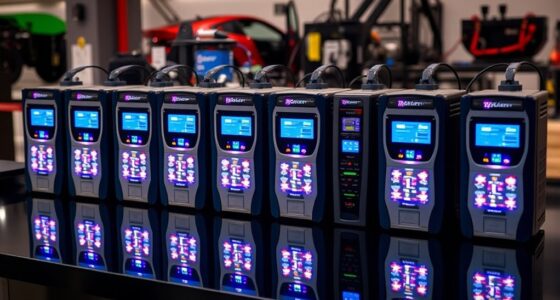
The best EV battery testers help diagnose a vehicle’s low-voltage battery and charging system; they do not measure the health or usable capacity of a high-voltage EV traction pack. My best overall pick is the TOPDON BT600, which combines 12V/24V testing, a large screen, and a built-in printer for workshop-style reporting. The TOPDON BT200 is a simpler choice for routine checks, while the KONNWEI BK400 stands out for its unusually broad voltage range. The main tradeoff is between straightforward handheld testing, printed records, and app-based monitoring—not full high-voltage battery diagnostics. Read on for the full comparison and guidance on choosing a tester that fits your vehicle and skill level.

Get backup power and energy gear delivered free with Prime
- Fast, free delivery on millions of items
- Prime Video, Amazon Music and more included
- Member-only deals all year
Key Takeaways
These testers focus on low-voltage systems. Most products here test 12V batteries; several support 24V, and the KONNWEI BK400 spans 6V–48V. None should be treated as a high-voltage EV traction-pack analyzer.
The TOPDON BT600 is the most workshop-oriented pick. Its 3.5-inch screen and built-in printer favor users who want readable results and paper records, while simpler models avoid those extra functions.
Voltage support varies more than the shared battery-testing purpose. The FOXWELL BT780 and TOPDON BT300P add printing to 12V/24V testing, while the BT100 and ANCEL BA101 target 12V checks.
Bluetooth models serve a different routine. The ANCEL BM200, Feronix FX17, and KONNWEI BK400 are aimed at app-connected monitoring or testing, which suits users who prefer phone-based access over a dedicated handheld display.
Choose by workflow, not feature count alone. A single-vehicle owner may favor a basic 12V tester, while a shop or multi-vehicle user may gain more from broader voltage support, printed reports, or ongoing monitoring.
| FOXWELL BT780 12V/24V Automotive Battery Tester with Printer |  | Best for Printed Test Records | Supported systems: 12V and 24V | Battery test range: 100–2000 CCA | Battery types: Flooded, AGM flat plate, AGM spiral, EFB, GEL, compatible Start-Stop | VIEW LATEST PRICE | See Our Full Breakdown |
| BT90 PRO Automotive Battery Tester, 6V/12V/24V, 30–3800 CCA |  | Best for Broad Battery Compatibility | Voltage: 6V, 12V, and 24V | CCA range: 30–3800 CCA | Battery capacity range: 2–360 Ah | VIEW LATEST PRICE | See Our Full Breakdown |
| FOXWELL BT705 12V/24V Car Battery, Alternator, and Load Tester |  | Best for Guided Garage Checks | System voltage: 12V and 24V | CCA range: 100–2000 CCA | Battery types: Flooded, AGM, GEL, EFB lead-acid | VIEW LATEST PRICE | See Our Full Breakdown |
| TOPDON BT100 12V Car Battery Tester |  | Best Compact Pick | System voltage: 12V | CCA range: 100–2000 CCA | Battery types: Flooded, AGM flat plate, AGM spiral, EFB, GEL | VIEW LATEST PRICE | See Our Full Breakdown |
| MOTOPOWER MP0515A 12V Automotive Battery Tester, 100–2000 CCA |  | Best for Basic 12V Checks | Battery voltage: 12V | CCA range: 100–2000 CCA | Compatible devices: Car batteries | VIEW LATEST PRICE | See Our Full Breakdown |
| TOPDON BT300P 12V/24V Automotive Battery Tester with Built-In Printer | 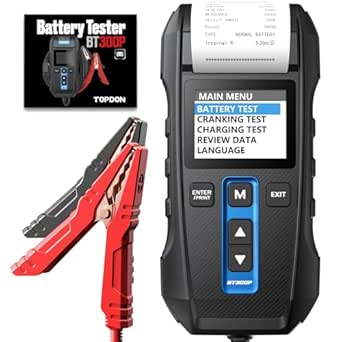 | Best for Printed Shop Reports | Battery compatibility: 12V lead-acid; flooded, AGM, Gel, and EFB | CCA range: 100–2000 CCA | System tests: 12V/24V cranking and charging; 12V battery | VIEW LATEST PRICE | See Our Full Breakdown |
| TOPDON BT200 12V/24V Car Battery Tester, 100–2000 CCA | 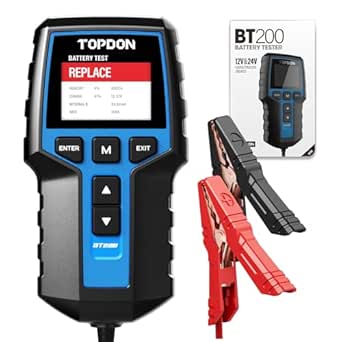 | Best for Broad Vehicle-System Checks | Battery voltage: 12V and 24V | CCA range: 100–2000 CCA | Compatible battery types: Flooded, AGM, GEL, and deep-cycle | VIEW LATEST PRICE | See Our Full Breakdown |
| TOPDON BT600 12V/24V Automotive Battery Tester with 3.5-Inch Screen and Built-In Printer |  | Best Premium Feature Set | Battery voltage: 12V and 24V | Battery types: Regular flooded, AGM flat, AGM spiral, GEL, EFB | CCA range: 100–2000A | VIEW LATEST PRICE | See Our Full Breakdown |
| ANCEL BM200 Bluetooth 12V Automotive Battery Monitor |  | Best for Ongoing 12V Monitoring | Battery voltage: 12V | Compatible battery types: Lead-acid and LiFePO4, including Flooded, AGM, EFB, and Gel | Data recording interval: Every 2 minutes | VIEW LATEST PRICE | See Our Full Breakdown |
| ANCEL BA101 12V Car Battery Tester |  | Best Lightweight 12V Diagnostic Pick | Battery voltage: 12V | CCA range: 100–2000 CCA | Compatible battery types: Flooded, AGM, GEL, EFB | VIEW LATEST PRICE | See Our Full Breakdown |
| Feronix FX17 12V–24V Battery Tester with Bluetooth App |  | Best for Multi-System Diagnostics | Battery voltage: 12V–24V | Working voltage: 6V–30V | Battery types: STD, AGM, GEL, EFB | VIEW LATEST PRICE | See Our Full Breakdown |
| KONNWEI BK400 Bluetooth Battery Monitor and Tester, 6V–48V |  | Best for Ongoing Multi-Battery Monitoring | Supported battery systems: 6V, 12V, 24V, and 48V | Operating voltage range: 3–60V | Battery types: Flooded, AGM Flat, AGM Spiral, EFB, VRLA, GEL, lithium | VIEW LATEST PRICE | See Our Full Breakdown |
| EV battery tester | CCA range | Battery types | Display | Weight |
|---|---|---|---|---|
| FOXWELL BT780 12V/24V Automoti | — | Flooded, AGM flat plate, AGM spiral, EFB, GEL, compatible Start-Stop | 3.2-inch LCD | — |
| BT90 PRO Automotive Battery Te | 30–3800 CCA | Flooded, AGM, EFB, GEL, lithium | — | — |
| FOXWELL BT705 12V/24V Car Batt | 100–2000 CCA | Flooded, AGM, GEL, EFB lead-acid | 2.8-inch screen | 325 g |
| TOPDON BT100 12V Car Battery T | 100–2000 CCA | Flooded, AGM flat plate, AGM spiral, EFB, GEL | — | 9 ounces |
| MOTOPOWER MP0515A 12V Automoti | 100–2000 CCA | — | — | 340 g |
| TOPDON BT300P 12V/24V Automoti | 100–2000 CCA | — | 2.4-inch color screen | 16 ounces |
| TOPDON BT200 12V/24V Car Batte | 100–2000 CCA | — | 2.4-inch color LCD | 15.52 ounces |
| TOPDON BT600 12V/24V Automotiv | 100–2000A | Regular flooded, AGM flat, AGM spiral, GEL, EFB | 3.5-inch color screen | — |
| ANCEL BM200 Bluetooth 12V Auto | — | — | — | — |
| ANCEL BA101 12V Car Battery Te | 100–2000 CCA | — | Black-and-white screen with adjustable contrast and white backlight | 5 ounces |
| Feronix FX17 12V–24V Battery T | — | STD, AGM, GEL, EFB | — | — |
| KONNWEI BK400 Bluetooth Batter | — | Flooded, AGM Flat, AGM Spiral, EFB, VRLA, GEL, lithium | — | — |
More Details on Our Top Picks
FOXWELL BT780 12V/24V Automotive Battery Tester with Printer
The FOXWELL BT780 is the clearest fit for buyers who want a paper record of battery and charging-system checks without relying on a phone. Its built-in thermal printer can make workshop handoffs or maintenance files easier, and the tester’s own battery lets it operate even when the vehicle battery is weak. It checks 12V and 24V systems and reports CCA, voltage, resistance, state of charge, and state of health. Compared with the FOXWELL BT705, the BT780 adds printed results and a longer cable, but both share a 100–2000 CCA range and do not test deep-cycle batteries. The tradeoff is compatibility: buyers must select a supported battery type and rating standard, and this is not a tester for every EV auxiliary or traction battery.
Pros:- Built-in printer produces paper reports without a phone or subscription.
- Tests battery health, cranking, and charging systems on supported 12V and 24V vehicles.
- Internal battery supports operation and printing when the vehicle battery is weak.
- 6.5-foot cable, reinforced leads, clamps, and carrying case suit garage use.
Cons:- Does not support deep-cycle batteries.
- Requires the battery type, rating standard, and electrical system to match its supported options.
Best for: Independent garages and fleet owners who want printed records from supported 12V or 24V lead-acid battery checks without using an app.
Not ideal for: EV owners seeking traction-battery diagnostics or anyone testing deep-cycle batteries, since those uses are unsupported.
- Supported systems:12V and 24V
- Battery test range:100–2000 CCA
- Battery types:Flooded, AGM flat plate, AGM spiral, EFB, GEL, compatible Start-Stop
- Measurements:CCA, voltage, internal resistance, SOC, SOH
- Printer:Built-in thermal printer; 3 rolls included
- Cable length:6.5 ft
- Display:3.2-inch LCD
- Deep-cycle support:Not supported
Our verdict“Choose the BT780 if you need printed records from compatible 12V or 24V batteries; skip it for deep-cycle or EV traction-battery testing.”
BT90 PRO Automotive Battery Tester, 6V/12V/24V, 30–3800 CCA
The BT90 PRO covers more battery and vehicle scenarios than the other wired testers in this group: it supports 6V, 12V, and 24V systems, a 30–3800 CCA range, and chemistries including lithium. That breadth makes it a stronger candidate for a mixed shop than the FOXWELL BT705, which is limited to 12V/24V lead-acid batteries and 100–2000 CCA. Beyond battery condition, the BT90 PRO checks cranking, charging, and ripple, while temperature-aware analysis can add context to test results. Its cloud reports and saved notes help users keep a service history, but sharing depends on scanning a QR code. The main compromise is corded power: it may be less convenient for mobile roadside checks than battery-powered models, and its connected reporting is more involved than the BT780’s built-in paper output.
Pros:- Supports 6V, 12V, and 24V systems and a broad 30–3800 CCA range.
- Works with flooded, AGM, EFB, GEL, and lithium batteries.
- Checks battery condition, cranking, charging, and ripple.
- Cloud reports, test history, and notes support repeat service documentation.
Cons:- Corded electric power can restrict mobility during roadside or remote checks.
- Cloud report sharing requires scanning a QR code.
Best for: Repair shops and technically confident owners who test a varied mix of 6V, 12V, and 24V batteries, including lithium, and want a digital service history.
Not ideal for: Mobile users who prioritize a self-powered handheld tester or buyers who want offline, paper-based records rather than QR-linked cloud reports.
- Voltage:6V, 12V, and 24V
- CCA range:30–3800 CCA
- Battery capacity range:2–360 Ah
- Supported standards:SAE, EN, IEC, CA, MCA
- Battery types:Flooded, AGM, EFB, GEL, lithium
- Vehicle modes:Car, motorcycle, truck
- Measurements:SOH, SOC, voltage, resistance, cranking, charging, ripple
- Power source:Corded electric
Our verdict“Pick the BT90 PRO for broad chemistry and voltage coverage with digital records, but choose a battery-powered model for greater field mobility.”
FOXWELL BT705 12V/24V Car Battery, Alternator, and Load Tester
The FOXWELL BT705 favors a straightforward test flow over extras: guided checks lead to a plain-language GOOD, RECHARGE, or REPLACE result. That makes it easier to act on than a tester focused on presenting raw measurements, while still covering battery health, cranking, and charging output. It handles 12V and 24V lead-acid batteries across a 100–2000 CCA range, so it suits routine vehicle service but not every battery type. Compared with the BT780, it gives up the built-in printer and has a shorter cable, but avoids paper handling and keeps the setup simpler. Its 2.8-inch screen, durable clamps, protective housing, and case support garage use. The main limits are its lead-acid-only compatibility and corded power, which make it less flexible than the BT90 PRO for mixed-chemistry or mobile work.
Pros:- Guided results summarize outcomes as GOOD, RECHARGE, or REPLACE.
- Checks battery health, cranking performance, and charging output.
- Supports 12V and 24V systems with a 100–2000 CCA range.
- Includes durable clamps, protective housing, and a hard carrying case.
Cons:- Compatible with lead-acid battery types only.
- Corded operation and lack of a built-in printer limit convenience compared with the BT780.
Best for: DIY mechanics and small garages that want guided battery, starter, and alternator checks on conventional 12V or 24V lead-acid vehicles.
Not ideal for: Owners testing lithium or deep-cycle batteries, or technicians who need printed reports, cloud records, or cordless operation.
- System voltage:12V and 24V
- CCA range:100–2000 CCA
- Battery types:Flooded, AGM, GEL, EFB lead-acid
- Tests:Battery health, cranking performance, charging output
- Display:2.8-inch screen
- Cable length:5.9 ft
- Power source:Corded electric
- Weight:325 g
Our verdict“Choose the BT705 for guided routine checks on lead-acid vehicles; look to the BT90 PRO for lithium support or the BT780 for printed reports.”
TOPDON BT100 12V Car Battery Tester
At 9 ounces and roughly 5.3 inches long, the TOPDON BT100 is the most portable straightforward choice in this set. Its 12V-only design suits owners checking cars, motorcycles, boats, ATVs, and other equipment with compatible lead-acid batteries; color LEDs and a menu interface make key results easier to read without adding a printer or app workflow. It checks battery health, cranking, and charging systems across 100–2000 CCA. Compared with the FOXWELL BT705, it is lighter and lists a wider range of compatible vehicle types, but gives up 24V testing. Its copper clamps include reverse-polarity and spark protection, though the unit must be connected correctly to power on. That connection-dependent operation, plus the 12V ceiling, makes it a focused portable tool rather than a flexible shop tester.
Pros:- Compact 9-ounce design is easy to store and carry.
- Checks battery health, cranking, and charging systems.
- Supports several 12V lead-acid types across 100–2000 CCA.
- Copper clamps include reverse-polarity and spark protection.
Cons:- Limited to 12V batteries, unlike the FOXWELL BT705’s 12V/24V coverage.
- Requires a proper battery connection to power on.
Best for: Owners of 12V cars, motorcycles, boats, or lawn equipment who want a compact tester for routine lead-acid battery and charging checks.
Not ideal for: Truck or fleet technicians needing 24V coverage, and buyers seeking lithium or deep-cycle battery diagnostics.
- System voltage:12V
- CCA range:100–2000 CCA
- Battery types:Flooded, AGM flat plate, AGM spiral, EFB, GEL
- Tests:Battery health, cranking, charging system
- Compatible vehicles:Cars, trucks, motorcycles, boats, ATVs, SUVs, golf carts, RVs, yachts, lawnmowers
- Power source:Battery powered; requires battery connection
- Weight:9 ounces
- Dimensions:5.3 × 3 × 1 inches
Our verdict“Pick the BT100 for compact 12V lead-acid checks across household vehicles and equipment, but not for 24V systems or broader battery chemistries.”
MOTOPOWER MP0515A 12V Automotive Battery Tester, 100–2000 CCA
The MOTOPOWER MP0515A keeps its scope narrow: it checks 12V car batteries, cranking, and charging performance, without the printer on the FOXWELL BT780 or the BT90 PRO’s broader voltage, chemistry, and cloud-report options. That simpler setup suits a car owner who wants core system checks and does not need a saved digital or paper record. It covers 100–2000 CCA and includes a storage bag and instruction manual, while its battery-powered design avoids a separate mains connection. The limitation is equally clear: it is specified for 12V car batteries, so it is a poor match for 24V vehicles or a mixed fleet. Its listed operating-voltage ceiling of 12.29V also makes its electrical operating window unusually narrow; buyers wanting broader flexibility should choose the BT100 or BT705 instead.
Pros:- Checks battery, cranking, and charging system performance.
- Covers a 100–2000 CCA range for 12V car batteries.
- Battery-powered design does not require a mains connection.
- Includes a storage bag and instruction manual.
Cons:- Designed for 12V car batteries rather than 24V systems or varied vehicle types.
- Listed maximum operating voltage is 12.29V, limiting the stated operating window.
Best for: Car owners who need a basic tester for a supported 12V car battery and want battery, cranking, and charging checks in one device.
Not ideal for: Fleet operators, 24V vehicle owners, and buyers who need broad chemistry support, printed results, or digital test history.
- Battery voltage:12V
- CCA range:100–2000 CCA
- Compatible devices:Car batteries
- Measurements:Battery, cranking, and charging system performance
- Power source:Battery powered
- Operating voltage:Minimum 12V; maximum 12.29V
- Weight:340 g
- Included components:Tester, storage bag, instruction manual
Our verdict“Choose the MP0515A for basic 12V car checks, but move to the BT100 or BT705 if you need broader vehicle coverage or clearer guided diagnostics.”
TOPDON BT300P 12V/24V Automotive Battery Tester with Built-In Printer
The TOPDON BT300P makes the most sense when a battery check needs a paper record: its built-in thermal printer produces results without ink or cartridges, which can help shops document customer recommendations. It tests 12V lead-acid batteries across several common chemistries and checks cranking and charging systems on 12V and 24V vehicles. That split is useful, but its battery-health testing itself is limited to 12V batteries. Compared with the TOPDON BT600, the BT300P has a smaller 2.4-inch screen and fewer stated playback and update features; the BT600 is the stronger choice if a larger display matters more than a straightforward printout. The BT300P also needs thermal paper, and its 31.5-inch cable may constrain where you can position the tester. Neither unit tests high-voltage EV traction packs.
Pros:- Built-in thermal printer creates reports without ink or cartridges.
- Tests 12V lead-acid batteries from 100–2000 CCA across flooded, AGM, Gel, and EFB types.
- Checks cranking and charging systems on both 12V and 24V vehicles.
- Reverse-polarity protection and insulated components add safeguards during connection.
Cons:- Battery-health testing is limited to 12V batteries.
- Printing requires a supply of compatible thermal paper.
- The 2.4-inch screen is smaller than the BT600’s 3.5-inch display.
Best for: Independent mechanics and service writers who test 12V batteries and want to hand customers printed results, including when working with 24V vehicle starting systems.
Not ideal for: EV owners seeking traction-battery diagnostics, or technicians who need battery-health testing beyond 12V or do not want to keep thermal paper on hand.
- Battery compatibility:12V lead-acid; flooded, AGM, Gel, and EFB
- CCA range:100–2000 CCA
- System tests:12V/24V cranking and charging; 12V battery
- Display:2.4-inch color screen
- Printer:Built-in thermal printer
- Cable length:31.5 inches
- Supported standards:CCA, JIS, EN, DIN, SAE, IEC
- Weight:16 ounces
Our verdict“Choose the BT300P if you need printable records from 12V battery tests and 12V/24V system checks, but not high-voltage EV pack diagnostics.”
TOPDON BT200 12V/24V Car Battery Tester, 100–2000 CCA
For a buyer who wants one handheld unit to check batteries and vehicle systems across voltage classes, the TOPDON BT200 offers a practical combination: it tests 12V and 24V batteries, then adds battery-health, cranking, and charging checks. Its support for flooded, AGM, GEL, and deep-cycle batteries gives it wider stated battery coverage than the TOPDON BT300P, whose battery testing is 12V-only. The BT200 also skips the BT300P’s printer, so it is less suited to producing customer-facing paper records. A color LCD, memory function, and clear Good/Replace prompts make results easier to follow, though the listed 100–2000 CCA range rules out batteries beyond that band. Product information does not specify a carrying case or included accessories, so buyers assembling a mobile kit may need to source those separately. This tests conventional batteries, not EV traction packs.
Pros:- Tests 12V and 24V batteries rated from 100–2000 CCA.
- Supports flooded, AGM, GEL, and deep-cycle batteries.
- Combines battery-health, cranking, and charging-system tests.
- Color LCD, memory function, copper clamps, and rugged housing support regular workshop use.
Cons:- The 100–2000 CCA range excludes batteries outside the stated limits.
- No built-in printer for producing paper reports.
- Product information does not specify whether a carrying case or other accessories are included.
Best for: Mobile mechanics and owners of mixed 12V/24V vehicles who want battery, cranking, and charging checks in one tester without needing printed reports.
Not ideal for: Technicians who need a built-in printer, or EV owners looking for diagnostics of a high-voltage traction battery.
- Battery voltage:12V and 24V
- CCA range:100–2000 CCA
- Compatible battery types:Flooded, AGM, GEL, and deep-cycle
- Test functions:Battery health, cranking, and charging system
- Display:2.4-inch color LCD
- Operating temperature:-4°F to 140°F (-20°C to 60°C)
- Supported standards:CCA, DIN, JIS, EN, IEC, GB, SAE, MCA, BCI, CA
- Weight:15.52 ounces
Our verdict“Pick the BT200 for broad 12V/24V conventional-battery and vehicle-system checks when a printer is not a priority.”
TOPDON BT600 12V/24V Automotive Battery Tester with 3.5-Inch Screen and Built-In Printer
The TOPDON BT600 is the feature-rich choice here for technicians who want a larger screen, printed reports, and tests across both 12V and 24V lead-acid batteries. Its 3.5-inch color display gives results more room than the BT300P’s 2.4-inch screen, while the built-in thermal printer and last-test playback can help with recordkeeping and repeat checks. It also covers flooded, AGM, GEL, and EFB batteries and tests battery, cranking, and charging systems across vehicles ranging from motorcycles to heavy-duty trucks and boats. Against the TOPDON BT200, the BT600’s printer and larger screen are the main practical upgrades; the BT200 avoids paper and is a simpler pick if those features are unnecessary. Tradeoffs include Windows-only software updates and a stated 12V minimum operating voltage, plus no high-voltage EV traction-pack testing.
Pros:- Large 3.5-inch color screen presents test information more clearly than the BT300P’s smaller display.
- Built-in thermal printer and last-test playback support documentation and repeat checks.
- Tests battery, cranking, and charging systems on 12V and 24V lead-acid batteries.
- Supports multiple battery types and vehicle categories, including heavy-duty trucks and boats.
Cons:- Software updates through mini-USB are compatible only with Windows systems.
- The stated minimum operating voltage is 12V.
- Printed reports require thermal paper, and the unit does not test high-voltage EV traction batteries.
Best for: Repair shops and fleet technicians who need a larger display, printed test results, and conventional battery checks across varied 12V/24V vehicles.
Not ideal for: Buyers who want a compact, no-paper tester, use only non-Windows computers for updates, or need high-voltage EV battery diagnostics.
- Battery voltage:12V and 24V
- Battery types:Regular flooded, AGM flat, AGM spiral, GEL, EFB
- CCA range:100–2000A
- Tests:Battery, cranking, and charging systems
- Display:3.5-inch color screen
- Printer:Built-in thermal printer
- Compatible vehicles:Cars, motorcycles, pickup trucks, heavy-duty trucks, boats
- Software updates:Mini-USB; Windows compatibility
Our verdict“Choose the BT600 when a larger screen and printed, replayable results matter more than a simpler tester without paper requirements.”
ANCEL BM200 Bluetooth 12V Automotive Battery Monitor
The ANCEL BM200 takes a different approach from the handheld TOPDON testers: it stays connected to a compatible 12V battery and logs voltage, charge level, temperature, and startup and charging behavior over time. Readings every two minutes and up to 72 days of local storage can help an owner spot patterns that a one-time check with the BT200 or BT600 would miss. It supports lead-acid and LiFePO4 batteries, but this does not make it an EV traction-battery tester; it monitors a compatible low-voltage 12V battery. Its low 1.5 mA draw and IP67-rated housing suit ongoing vehicle monitoring. The tradeoff is app dependence: reviewing and preserving records requires Bluetooth syncing, while trip and parking functions need phone GPS and location services. It does not replace a dedicated CCA or internal-resistance test.
Pros:- Tracks voltage, charge level, temperature, and startup and charging readings over time.
- Stores readings locally for up to 72 days, including periods without a connected phone.
- Low 1.5 mA power draw supports continuous monitoring.
- IP67-rated housing and reverse-polarity and short-circuit protections support under-hood installation.
Cons:- Requires Bluetooth syncing with a compatible iOS or Android app to review and preserve records.
- Trip and parking features depend on the phone’s GPS and location services.
- Not a substitute for CCA or internal-resistance testing and does not test high-voltage EV traction batteries.
Best for: Owners of stored cars, RVs, boats, or motorcycles who want a running record of a compatible 12V battery’s condition through a phone app.
Not ideal for: Technicians who need immediate CCA or internal-resistance testing, buyers without a compatible smartphone, or EV owners seeking traction-pack diagnostics.
- Battery voltage:12V
- Compatible battery types:Lead-acid and LiFePO4, including Flooded, AGM, EFB, and Gel
- Data recording interval:Every 2 minutes
- Local data storage:Up to 72 days
- App compatibility:iOS and Android
- Power consumption:1.5 mA
- Vehicle capacity:Up to 4 monitors in one app
- Protection:Reverse-polarity and short-circuit protection; IP67-rated housing
Our verdict“Choose the BM200 for app-based trend monitoring of a 12V vehicle battery, not for the direct diagnostic tests offered by the BT200 or BT600.”
ANCEL BA101 12V Car Battery Tester
The ANCEL BA101 is a straightforward option for buyers who need detailed checks on conventional 12V batteries without moving up to a 12V/24V unit like the TOPDON BT200. It reports state of health, state of charge, voltage, current, and CCA, and also checks cranking and charging systems. Its broad support for flooded, AGM, GEL, and EFB batteries, plus protection against reverse polarity, short circuits, overcurrent, and overvoltage, makes it a practical fit for routine checks on cars, trucks, boats, and other listed vehicles. The 5-ounce weight is notably lighter than the BT200, though the BA101 gives up 24V battery support and a color display. It also requires a battery of at least 30Ah and accurate entry of battery type, rating, and temperature; it cannot test lithium batteries or EV traction packs.
Pros:- Reports battery health, charge, voltage, current, and CCA, with cranking and charging-system tests.
- Supports flooded, AGM, GEL, and EFB 12V batteries from 30Ah.
- Backlit screen with adjustable contrast aids reading in varied lighting.
- Protection covers reverse polarity, short circuits, overcurrent, and overvoltage.
Cons:- Does not support lithium or non-12V batteries.
- The 30Ah minimum excludes smaller motorcycle batteries.
- Results depend on entering the correct battery type, rating, and temperature.
Best for: DIY owners and small repair shops checking 12V lead-acid batteries of at least 30Ah who want CCA, health, charge, cranking, and charging results in one lightweight unit.
Not ideal for: Owners of lithium batteries, 24V systems, or small motorcycles with batteries below 30Ah, and anyone seeking high-voltage EV battery diagnostics.
- Battery voltage:12V
- CCA range:100–2000 CCA
- Compatible battery types:Flooded, AGM, GEL, EFB
- Minimum battery capacity:30Ah
- Measurements:Battery health, state of charge, voltage, current, and CCA
- Display:Black-and-white screen with adjustable contrast and white backlight
- Supported standards:CCA, BCI, CA, MCA, JIS, DIN, IEC, EN, SAE, GB
- Weight:5 ounces
Our verdict“Pick the BA101 for lightweight, detailed testing of conventional 12V batteries, but choose the BT200 if you need 24V support.”
Feronix FX17 12V–24V Battery Tester with Bluetooth App
The Feronix FX17 is a better fit for drivers or technicians who want to check more than battery condition: its five tests also cover cranking, maximum load, and the charging system. It reads 12V–24V batteries across STD, AGM, GEL, and EFB types, with ten listed test standards to accommodate different battery ratings. Compared with the simpler TOPDON BT200, the FX17 adds Bluetooth app reports and broader test coverage; unlike the KONNWEI BK400, it is a handheld diagnostic tester rather than a monitor intended for ongoing installation. That focus comes with a tradeoff: readings and reports depend on the YMOBD app, and the unit draws power from the battery under test. Its compact size and electrical protections make it practical for checking vehicles and equipment, but it is not a fit for 48V systems.
Pros:- Runs five tests spanning battery condition, cranking, load, and charging-system performance.
- Supports STD, AGM, GEL, and EFB batteries and ten listed testing standards.
- Bluetooth app reporting can keep diagnostic results together for later reference.
- Compact, battery-powered design includes reverse-polarity, overvoltage, overcurrent, and short-circuit protection.
Cons:- Wireless readings and reports require a compatible smartphone and the YMOBD app.
- Power comes from the battery being tested, which limits use if that battery cannot supply power.
- Its 12V–24V battery support excludes 48V systems monitored by the KONNWEI BK400.
Best for: DIY owners and mobile technicians checking 12V or 24V cars, trucks, RVs, boats, or golf carts who want battery, starter, and charging-system results in one app.
Not ideal for: Owners of 48V battery systems or buyers who want a tester with a built-in screen and no app dependency.
- Battery voltage:12V–24V
- Working voltage:6V–30V
- Battery types:STD, AGM, GEL, EFB
- Supported standards:CCA, DIN, EN, IEC, GB, SAE, BCI, MCA, CA, JIS
- Diagnostic tests:Voltage monitoring, battery performance, cranking load, maximum load system, charging system
- Connectivity and app:Bluetooth; YMOBD
- Dimensions and weight:3.27 × 1.46 × 0.71 inches; 115 g
- Electrical protection:Reverse polarity, overvoltage, overcurrent, short circuit
Our verdict“Choose the FX17 if you want app-based battery, cranking, and charging diagnostics for 12V–24V vehicles; skip it if you need 48V coverage or app-free operation.”
KONNWEI BK400 Bluetooth Battery Monitor and Tester, 6V–48V
The KONNWEI BK400 stands apart from handheld testers such as the Feronix FX17: it is designed to stay installed and track battery conditions over time, rather than only provide a session of diagnostics. Its 6V–48V system support and compatibility with flooded, AGM, EFB, VRLA, GEL, and lithium batteries make it the more flexible pick for mixed-voltage setups. Through the app, it reports live voltage, waveform, and temperature, stores history, and can send abnormal-voltage alerts within Bluetooth range. It can monitor up to six batteries, a useful advantage over a single-battery diagnostic tool. The tradeoff is reliance on a smartphone and nearby Bluetooth access; its sleep mode also draws about 1.5mA. For quick checks without an installed monitor, a tester such as the FX17 is more direct.
Pros:- Supports 6V, 12V, 24V, and 48V systems and a broad range of lead-acid and lithium battery types.
- App provides live voltage, waveform, temperature, cranking and charging tests, history, and voltage alerts.
- One app can monitor up to six batteries.
- Bluetooth 5.2, low-power sleep mode, and reverse-polarity and circuit protection suit ongoing installation.
Cons:- Monitoring and alerts require a smartphone within Bluetooth range.
- Sleep-mode consumption is approximately 1.5mA, so it continues to draw some power while the vehicle is inactive.
- Its installed-monitor design is less convenient for occasional testing than a handheld diagnostic tester such as the Feronix FX17.
Best for: Owners of RVs, boats, fleets, or multi-battery equipment who want app-based monitoring and alerts across several 6V–48V batteries.
Not ideal for: Shoppers who need a standalone handheld tester with an on-device display, or who want readings and alerts away from Bluetooth range.
- Supported battery systems:6V, 12V, 24V, and 48V
- Operating voltage range:3–60V
- Battery types:Flooded, AGM Flat, AGM Spiral, EFB, VRLA, GEL, lithium
- Connectivity and app:Bluetooth 5.2; iOS and Android
- Monitoring capacity:Up to six batteries
- App readings and tests:Live voltage, waveform, temperature, cranking and charging tests, history, voltage alerts
- Sleep-mode consumption:Approximately 1.5mA
- Dimensions and weight:2.16 × 1.34 × 0.63 inches; 1.28 ounces
Our verdict“Choose the BK400 for ongoing, app-based monitoring of multiple battery systems up to 48V; pick a handheld tester instead for occasional checks without an installed monitor.”
How We Picked
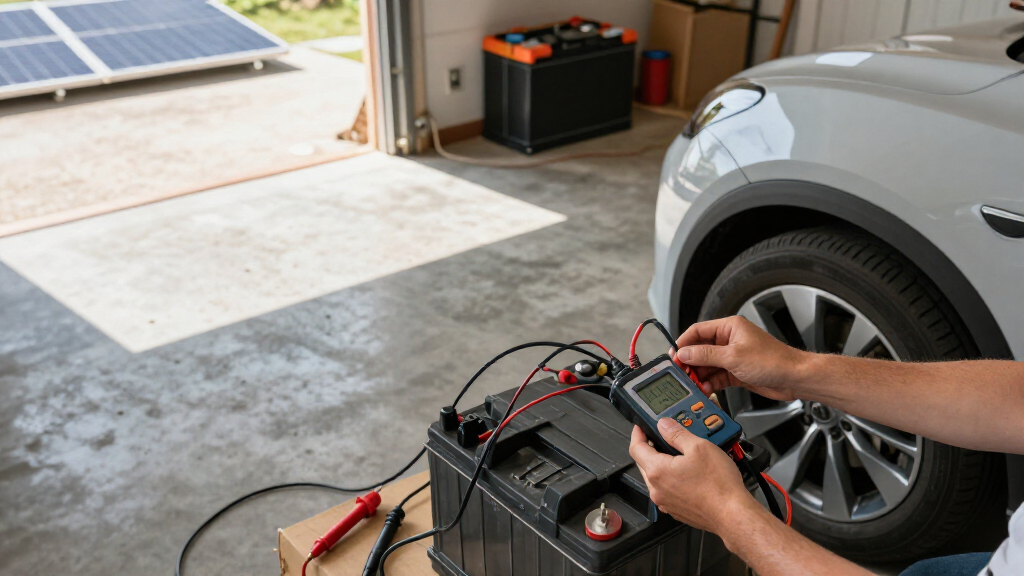
I compared these 12 products on the capabilities that change how useful an EV owner’s low-voltage battery check can be: supported voltage, stated CCA range where supplied, battery and charging-system test functions, display or app workflow, and added features such as printing. I also separated handheld testers from Bluetooth monitors because they suit different habits: a direct readout is convenient for a quick check, while an installed monitor or phone connection can support ongoing access.
The order gives priority to usable diagnostic scope and clarity, then to the match between features and likely buyer needs. Models with 12V/24V support and richer reporting rank ahead of simpler 12V-only options for broader use, but extra functions do not automatically make a tester right for every owner. I treat the stated specifications as product claims, not proof of high-voltage traction-pack testing; buyers should verify vehicle compatibility and follow the manufacturer’s safe testing instructions.
Factors to Consider When Choosing Best EV Battery Testers
Before choosing a tester, separate the problem you want to diagnose from the battery you want to inspect. Most tools in this roundup are for the low-voltage auxiliary battery, not the high-voltage pack that drives an EV. These factors can help you avoid buying a capable-looking tool that cannot answer your actual diagnostic question.
Confirm Which EV Battery You Need to Test
An EV usually has a high-voltage traction battery and a separate low-voltage battery for vehicle electronics and control systems. The testers in this roundup are primarily intended for conventional low-voltage battery checks, so do not assume that a 24V label or a broad voltage range means a tool can inspect a traction pack. High-voltage pack diagnostics can require vehicle-specific software, trained procedures, and equipment designed for that voltage. Check the vehicle manual or service information to identify the battery type and its nominal voltage before buying. If you need pack-level capacity or cell diagnostics, seek a compatible EV service tool rather than relying on a general automotive battery tester.
Match Voltage and Battery Type to the Vehicle
Voltage support is an early filter: a 12V-only model suits many passenger-vehicle auxiliary batteries, while 12V/24V support can help users who also work with commercial or multi-vehicle setups. The BK400’s 6V–48V range is broader, but range alone does not establish compatibility with every chemistry or vehicle system. Check whether the tester supports the battery chemistry and test standard specified by the battery maker, as well as the correct rating unit for its CCA input. A common mistake is entering an incorrect rating or selecting the wrong battery type, which can make a result hard to interpret. Confirm supported battery standards and vehicle fit before treating a reading as a diagnosis.
Decide Whether a Test or Ongoing Monitoring Fits Your Need
A handheld tester is designed for a check when you connect it, while a Bluetooth monitor is intended to provide phone-based access to battery information over time. That distinction matters if you are tracking a vehicle that sits unused, but a monitor is not a substitute for a full diagnostic test or a repair. App-based tools also depend on phone compatibility, connection setup, and the maker’s software support. For occasional maintenance, a direct screen may be simpler; for repeated checks, an app workflow may be more convenient. Choose the method you are likely to use consistently rather than paying for connectivity that will go untouched.
Pay for Printing Only If You Need Records
Built-in printers on models such as the BT600, BT300P, and BT780 can make results easier to share or attach to a service record. That feature matters most for repair shops, fleet maintenance, or owners who keep documentation across repeated tests. It adds bulk and introduces a consumable-paper requirement, so it may be unnecessary for someone who only wants a quick home check. Before choosing a printer model, confirm what information the report contains and how the paper is replenished. A clear screen or app history may be enough when printed records are not part of your workflow.
Interpret CCA and Test Results in Context
CCA describes a battery’s cold-cranking capability, and a tester’s supported CCA range sets limits on the batteries it can evaluate using that rating. A wider stated range can support more battery sizes, but it does not by itself guarantee a more useful diagnosis. Battery age, temperature, charge state, and connection quality can affect readings, so a single result should be treated as evidence rather than an automatic replacement verdict. Follow the tester’s instructions for entering the battery’s rating and preparing the vehicle. If the reading conflicts with vehicle symptoms, repeat the check under the recommended conditions or consult a qualified technician.
Balance Extra Features Against Setup and Maintenance
Large screens, Bluetooth, and printing can make a tester better suited to particular users, but each feature adds a step or dependency. An app may need pairing and permissions; a printer needs paper; a multi-voltage tool may require careful selection before testing. For a first-time owner, fewer steps and clear instructions may matter more than a longer feature list. For a shop, broader compatibility and records may justify added complexity. Check what comes in the package, how the device is powered, and what upkeep its extra functions require before choosing.
Frequently Asked Questions
Can these testers check an EV’s high-voltage traction battery?
No product in this roundup should be assumed to measure traction-pack capacity or diagnose high-voltage cells. The listed tools are aimed at low-voltage automotive batteries, charging systems, or battery monitoring, with voltage ranges that do not establish traction-pack compatibility. High-voltage work can expose users to dangerous electrical levels and often needs vehicle-specific diagnostic equipment and training. Check the tool’s documentation and your vehicle service information before connecting anything. For pack-level faults, use an EV-qualified service provider or equipment explicitly rated for that job.
Is a 12V tester enough for my electric car?
It can be enough if your goal is to check the vehicle’s 12V auxiliary battery and the tester supports that battery’s type and rating. EVs still use low-voltage systems, but the auxiliary battery’s role and charging behavior can differ by model. A 12V reading will not explain the condition of the high-voltage traction pack. Check the owner’s manual for battery specifications and any approved testing procedure. If you maintain 24V vehicles as well, consider a compatible dual-voltage model instead of a 12V-only option.
Should I choose a Bluetooth monitor or a handheld tester?
Choose a handheld tester if you mainly want an on-demand result without relying on a phone app. Bluetooth options suit owners who prefer phone-based access or want a monitoring-oriented workflow, but they depend on app compatibility and successful setup. A monitor may help track changes, yet it does not replace a proper test when diagnosing a suspected fault. Think about whether the vehicle is used regularly or sits for long periods, and whether you will check the app often. For occasional checks, a direct display is usually the more straightforward format.
Do I need a tester with a built-in printer?
A printer is useful when you need paper records for customer handoffs, fleet files, or repeat service visits. For personal maintenance, a printed slip may add little if you only need to know whether the low-voltage battery needs attention. Printer-equipped testers also require paper and take up more space than simpler handheld options. Compare the report information with what you actually document before choosing one. If you need a record but not paper, check whether the model offers a suitable digital history or report workflow.
How should I act if the tester reports a weak battery?
Do not replace the battery based on one result alone, especially if the vehicle has been sitting, the battery is discharged, or the clamps made poor contact. Review the tester’s instructions, confirm the correct battery rating and type were entered, and repeat the check under the recommended conditions. If the tool also checks the charging system, use that result as a separate clue rather than treating it as a complete diagnosis. Persistent warnings, starting problems, or EV electrical faults deserve attention from a qualified technician. Avoid opening or probing high-voltage components while investigating a low-voltage warning.
Conclusion
For the broadest workshop-style feature set in this group, I would choose the TOPDON BT600 as best overall, especially when its large screen and printed reports fit the job. The TOPDON BT200 is my value-oriented choice for users who want 12V/24V handheld testing without prioritizing a built-in printer. Beginners who only need routine 12V checks can start with a simpler option such as the TOPDON BT100 or ANCEL BA101, after confirming battery compatibility. For premium-style reporting, compare the BT600 with the FOXWELL BT780 and TOPDON BT300P; for app-based monitoring or unusually broad voltage support, look at the ANCEL BM200, Feronix FX17, or KONNWEI BK400. The best choice depends on whether you need a quick low-voltage check, service records, or ongoing monitoring—and none of these should be mistaken for a high-voltage EV pack tester.