
TL;DR

Get backup power and energy gear delivered free with Prime
- Fast, free delivery on millions of items
- Prime Video, Amazon Music and more included
- Member-only deals all year
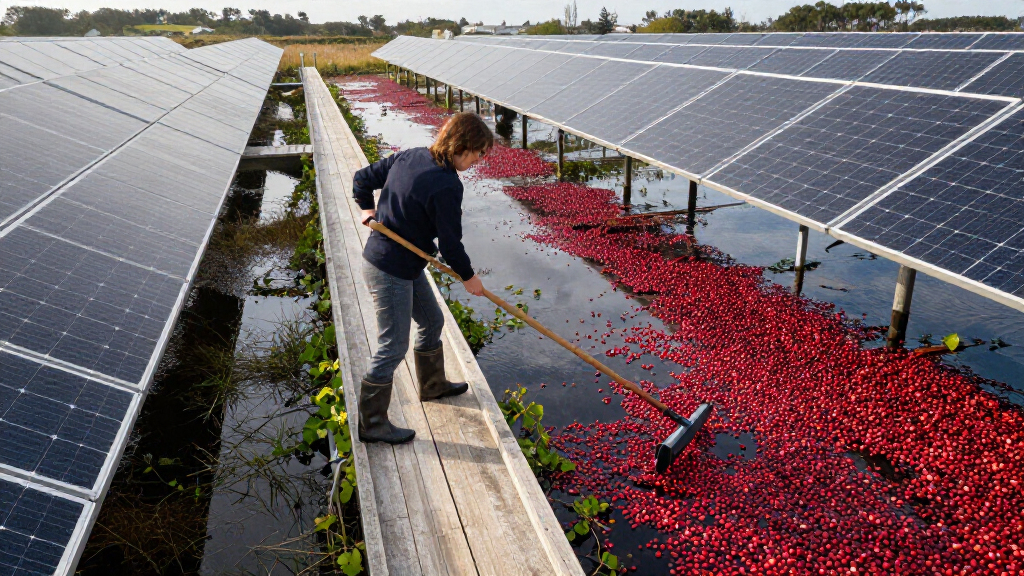
Two Massachusetts cranberry farms harvested berries for a second season beneath operating solar panels, in projects described by their developer as the first of their kind in the country. The arrays combine cranberry growing with community solar, while showing how dual-use projects might help keep some bogs economically viable. Their long-term agricultural output and the status of a stalled project in Carver remain uncertain.
The Kingston site has a 4.4-megawatt solar array paired with a 13.5-megawatt-hour battery; the Plymouth installation has a 1-megawatt array. Developer Distributed Energy Infrastructure built both projects. Greenbacker Renewables bought the land from farmers who had operated cranberry businesses there for decades, then worked with the developer on construction. Solar consultant and longtime local cranberry farmer Iain Ward manages the growing operations.
The panels sit about 10 feet above the bogs and can tilt to follow the sun. Project designers spaced the support pilings farther apart than in a typical array so harvesting equipment can pass between them. Because the ground is wet and soft, the pilings had to reach deeper to find stable support, and wiring was hung overhead rather than buried in the bog.
Both sites use a community solar model, selling electricity to customers seeking renewable power and lower prices, according to the report. The source does not give customer numbers, electricity sales, cranberry yields or project revenue. It also does not establish whether crop production beneath the panels matches output from comparable bogs without solar.
A Dual Use for Protected Bogs
The projects address a land-use problem in Massachusetts, where solar developers face resistance to building on undeveloped land, while rooftops and parking lots can be more expensive or offer less generating capacity. Putting panels over active crops aims to combine electricity production and farming on the same site rather than replace agriculture with energy infrastructure.
The approach may matter particularly for cranberry growers. According to the source report, Massachusetts is the second-largest cranberry-producing state after Wisconsin, and cranberry bogs are protected wetlands that cannot be converted to housing or commercial development even when they stop producing. For a bog with a suitable grid connection, solar income could provide a financial option where conventional development is not available. Ward described the projects as a “farm viability opportunity,” but the report provides no financial figures to show how much income the arrays generate for farming or landowners.
Massachusetts has encouraged dual-use solar through its incentive program. The report says arrays with capacity between 1 and 5 megawatts receive a base rate of 23.17 cents per kilowatt-hour, with an additional 9 cents per kilowatt-hour for agrivoltaic projects. Those rates are the figures cited in the report; their current status is not independently established here.
Products Worth Considering

EcoFlow Delta 3 Max Portable Power Station – 2048 Wh LiFePO4 Battery, 2400 W Output (3400 W X‑Boost)

Anker SOLIX S2000 Solar Powered Generator, 2010 Wh, 1500 W

EcoFlow Delta 3 Portable Power Station – 1024 Wh, 1800 W
As an affiliate, we earn on qualifying purchases.
How the Bogs Were Adapted
Massachusetts began offering a financial incentive for dual-use solar in 2018, according to the report. Agrivoltaics places solar panels above active agricultural operations, allowing crops to grow or livestock to graze below. The state has pursued the model as one response to disputes over where new solar projects should be sited.
Building over a cranberry bog required changes to standard solar construction. Developer co-founder and executive vice president Prateek Tare said ordinary solar foundations may extend 8 to 10 feet into the ground, but the bog installations needed deeper pilings to reach stable soil. The bog’s wet conditions also ruled out buried wiring. Equipment access was built into the layout through elevated panels and wider spacing between supports.
The farms’ second harvest marks a step beyond construction: cranberries have been grown and gathered beneath panels that are operating. The source characterizes the projects as the first of their kind nationally, while noting they may also be the first worldwide. That broader claim is presented with uncertainty rather than as an independently verified global record.
““We are literally proving it can be done.””
— Prateek Tare, co-founder and executive vice president of Distributed Energy Infrastructure
Crop Yields and Project Economics
The source report does not provide cranberry yield data, comparisons with conventional bogs, or measurements of how the panels affect growing conditions. It also gives no figures for electricity generated, battery use, customer savings, lease payments or the projects’ financial returns. The second harvest confirms that cranberry production has continued under the operating arrays, but it does not by itself establish long-term agricultural or economic performance.
The claim that these are the first cranberry agrivoltaic projects is attributed to the report and its sources; the suggestion they may be the first in the world is expressly uncertain. It is also unclear from the available material how many additional bogs could support solar, since access to the electricity grid is a limiting factor.
A separate project in Carver, Massachusetts, remains unresolved. Arrays were built over two bogs and crops are growing beneath them, but the company responsible went bankrupt before the sites began operating. Ward said the new bog owner intends to complete the work. The source does not specify a construction schedule, financing plan or date when the project might start generating electricity.
More Bogs and Carver’s Restart
Preliminary work is underway at another cranberry bog, according to the report. Distributed Energy Infrastructure is also pursuing agrivoltaic projects involving apple orchards, cattle pasture and a Christmas tree farm. No capacities, completion dates or operating results for those developments are included in the source material.
The next significant test will be whether the Kingston and Plymouth farms can maintain cranberry production over time while their solar arrays operate. Published yield, electricity and financial data would help show whether this design can be replicated and whether it works for growers beyond these two sites.
In Carver, the new bog owner’s stated intention to finish the stalled installations is not yet an operating milestone. A confirmed restart plan, funding details and a timeline have not been reported in the source material. Until those details emerge, the Kingston and Plymouth farms remain the operating examples described in the report.
Key Questions
Where are the cranberry farms with solar panels?
The operating projects are in Kingston and Plymouth, Massachusetts. The Kingston site has a 4.4-megawatt array and battery storage; Plymouth has a 1-megawatt array.
Are cranberries still being grown beneath the panels?
Yes. The report says the sites completed a second cranberry harvest beneath their operating solar arrays. It does not provide crop-yield comparisons with bogs without panels.
How are the solar panels arranged above the bogs?
The panels are mounted about 10 feet above the ground and can tilt to follow the sun. Wider spacing between support pilings allows harvesting equipment to move through the bogs; wiring is suspended overhead because the ground is too wet for buried cables.
What happened to the cranberry solar project in Carver?
Arrays were built over two bogs and crops are growing beneath them, but the company behind the project went bankrupt before the sites began operating. Ward said the new bog owner intends to finish the work, but the source report gives no confirmed schedule or restart plan.
Source: canarymedia.com