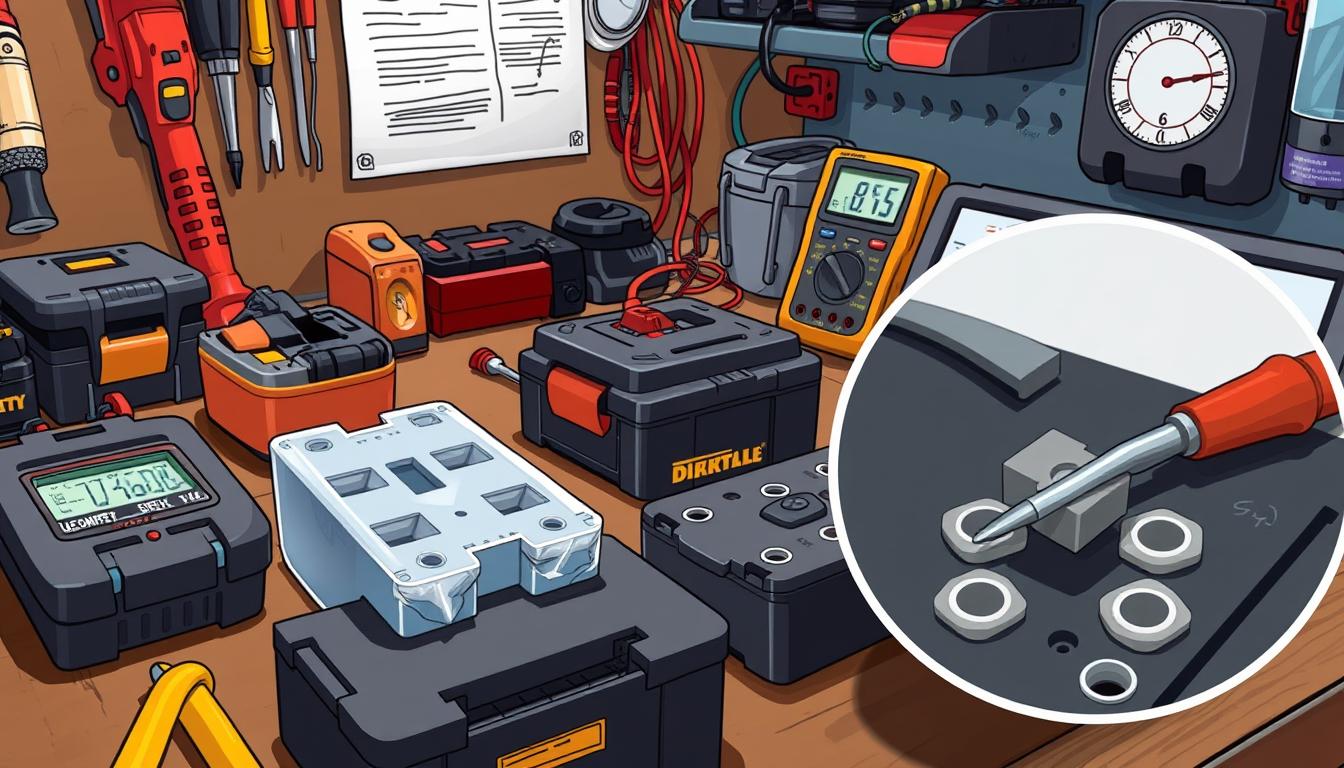
To avoid misleading results with a battery capacity tester, calibrate your device regularly and connect it properly, ensuring good contact and correct polarity. Always test under consistent conditions—fully charged for capacity tests and fully discharged for remaining capacity checks. Wait for the voltage to stabilize before testing and keep external factors like temperature in mind. If you want to learn more about accurate testing methods, keep exploring these essential tips.
Key Takeaways
- Calibrate the tester regularly and ensure correct connections before each test.
- Test the battery after it has been at rest for several hours to stabilize voltage.
- Conduct tests under consistent conditions, avoiding extreme temperatures or recent heavy use.
- Use multiple tests over time to track capacity changes rather than relying on a single reading.
- Compare results with manufacturer specifications and consider the battery’s age and cycle history.

Testing your battery’s capacity is essential to guarantee it’s functioning properly and to avoid unexpected failures. When you evaluate a battery’s health, it’s important to understand how factors like charging cycles and battery chemistry influence the results. Charging cycles refer to the number of complete charge and discharge processes a battery undergoes. Over time, each cycle causes wear, gradually diminishing the battery’s ability to hold a full charge. If you test a battery too early or too often without considering its cycle count, you might get misleading readings that don’t accurately reflect its true capacity. For example, a battery with many cycles may appear weaker than it actually is, simply because it’s nearing the end of its useful life. Similarly, the battery chemistry plays a critical role in how the battery performs and how you should interpret test results. Different chemistries—like lithium-ion, nickel-metal hydride, or lead-acid—have unique characteristics, including discharge rates and voltage curves. Understanding the chemistry helps you set realistic expectations and interpret the tester’s readings correctly.
When you use a battery capacity tester, start by ensuring the battery is at a stable state. Avoid testing immediately after heavy use or charging, as this can skew the results. Instead, let the battery rest for a few hours so its voltage stabilizes. Next, familiarize yourself with the specifications of your battery, including its typical voltage and capacity based on its chemistry. This knowledge allows you to compare the test results against the manufacturer’s ratings and avoid false alarms. As you connect the tester, make sure it’s calibrated properly; an uncalibrated device can lead to inaccurate readings. When performing the test, ensure the battery is fully charged if you’re testing its maximum capacity, or fully discharged if you’re checking its remaining capacity. Incorrect testing conditions can produce misleading data—like overestimating a degraded battery’s health or underestimating a healthy one.
Remember that multiple tests over time give you a clearer picture of your battery’s health, especially when considering its charging cycles and chemistry. If you observe a significant drop in capacity over successive tests, it’s a sign that replacement might be due. Avoid relying solely on one reading, as external factors—such as temperature or test conditions—can influence the results. Additionally, taking note of battery age and usage history can help contextualize the results and lead to more accurate assessments. By understanding these elements and taking careful, consistent measurements, you ensure your battery capacity testing provides accurate, actionable insights, helping you maintain reliable power sources and prevent unexpected failures.

RC Cellmeter 7 Digital Battery Capacity Checker Controller Tester Voltage Tester for LiPo Life Li-ion NiMH Nicd Cell Meter
- Battery Types Supported: LiPo, LiFe, Li-ion, NiMH, Nicd
- Cell Range: 4-7 Cells for NiCd/NiMH, 2-7 Cells for Lithium
- Display Modes: Cell voltages, Total voltage, Min/Max voltage, Voltage gap, Capacity percentage
As an affiliate, we earn on qualifying purchases.
As an affiliate, we earn on qualifying purchases.
Frequently Asked Questions
Can a Battery Capacity Tester Work on All Types of Batteries?
A battery capacity tester doesn’t work on all types of batteries because of battery compatibility and tester limitations. You need to check if your battery type corresponds with the tester’s specifications, like voltage and chemistry. Some testers are designed for specific batteries, such as lead-acid or lithium-ion, so using one outside its intended range can give misleading results. Always verify compatibility before testing to ensure accurate, reliable readings.
How Often Should I Test My Batteries for Accuracy?
You should test your batteries regularly, ideally every 3 to 6 months, to monitor their accuracy and extend their lifespan. Frequent testing helps catch issues early, preventing unexpected failures. Adjust your testing frequency based on your battery’s usage and type. Consistent checks guarantee you stay aware of their condition, so you can replace them before they lose significant capacity, ultimately prolonging their battery lifespan and keeping your devices reliable.
What Environmental Conditions Affect Testing Results?
Did you know that high humidity interference can skew your battery testing results by up to 15%? Environmental conditions like temperature fluctuations, humidity, and testing environment markedly impact accuracy. Keep your testing area cool, dry, and stable to guarantee reliable readings. Avoid testing in humid or excessively hot environments, as these can cause misleading results. Maintaining consistent conditions helps you get precise battery capacity measurements every time.
Is a Higher Capacity Reading Always Better?
A higher capacity reading isn’t always better because it shows the current capacity measurement, which can fluctuate over the battery’s lifespan. As your battery ages, its capacity decreases, even if the reading seems high. Focus on consistent, accurate capacity measurements over time to gauge your battery’s health and lifespan. Remember, a lower reading might indicate wear, but it doesn’t necessarily mean your battery is unusable.
How Do Temperature Changes Impact Test Outcomes?
Temperature changes cause thermal effects that can skew your test results. When it’s too hot or cold, battery performance appears lower, leading to misleading readings. Always make sure your tester is properly calibrated, especially in varying temperatures, to maintain accuracy. Keep the battery and tester in a stable environment, and be aware of how thermal effects influence capacity measurements for reliable outcomes. Proper calibration helps you get consistent, trustworthy results regardless of temperature fluctuations.
Conclusion
Now that you know how to properly use a battery capacity tester, you can avoid ending up with misleading results that could cause chaos like a domino effect of dead devices. Think of your battery as a tiny hero on a mission—if you don’t test it right, it might collapse at the worst moment, leaving you stranded like a stranded sailor in a storm. Master these steps, and keep your devices powered like a well-oiled machine!