
For an AGM battery bank for solar, I’d start with the Renogy 12 Volt 200Ah Deep Cycle AGM Battery as the best overall balance of substantial capacity and straightforward 12V system fit. The Renogy 100Ah AGM two-pack stands out for buyers who want modular capacity, while the four-battery VMAX 6V bank suits larger systems built around a 12V series connection. The main tradeoffs are storage capacity, usable energy, bank voltage, weight, and the limits of AGM charging and discharge. This lineup also includes a small LiFePO4 battery, which is a chemistry alternative rather than an AGM option. Read on for the full breakdown and guidance on matching a battery bank to your solar setup.

Get backup power and energy gear delivered free with Prime
- Fast, free delivery on millions of items
- Prime Video, Amazon Music and more included
- Member-only deals all year
Key Takeaways
- Capacity changes the shortlist: the 20Ah lithium and paired 35Ah AGM batteries fit modest loads, while the 200Ah AGM models and four-battery VMAX set target longer runtimes or larger banks.
- Bank configuration matters as much as amp-hours: the VMAX batteries are 6V units that require a suitable series arrangement for a 12V bank; most other options are 12V batteries.
- Modular capacity has practical value: Renogy’s two 100Ah batteries can be arranged to suit compatible system designs, while a single 200Ah unit keeps the bank simpler but less modular.
- AGM remains the category focus, not the only chemistry: the ERYY 20Ah LiFePO4 option offers a different battery chemistry and should be chosen only when its charging requirements and system compatibility match.
- Large capacity brings real installation demands: high-capacity AGM batteries can weigh heavily and need suitable mounting, cable sizing, charging, and ventilation planning.
| 12V 35Ah Deep Cycle AGM Battery – Pack of 2 |  | Best for Modular Small Solar Banks | Voltage: 12 V | Capacity: 35 Ah per battery | Pack quantity: 2 | VIEW ON AMAZON | See Our Full Breakdown |
| Interstate Batteries 12V 110AH Deep Cycle AGM Battery for Solar, Wind, RV, Wheelchairs, and Scooters |  | Best for Cross-Use Compatibility | Voltage: 12V | Capacity: 110Ah | Dimensions: 12.99 × 6.81 × 8.35 inches | VIEW ON AMAZON | See Our Full Breakdown |
| Renogy Deep Cycle AGM Battery 2-Pack 12V 100Ah |  | Best for a Matched Two-Battery Bank | Voltage: 12V per battery | Capacity: 100Ah per battery | Pack quantity: 2 | VIEW ON AMAZON | See Our Full Breakdown |
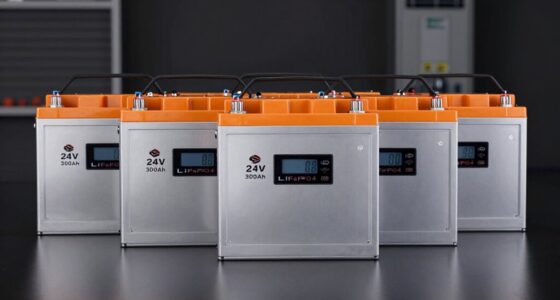
| ERYY 12V 20Ah LiFePO4 Lithium Battery with 30A BMS and LCD Voltmeter |  | Best Lightweight Alternative | Voltage: 12.8V | Capacity: 20Ah (listed as true 22Ah) | Battery type: LiFePO4 | VIEW ON AMAZON | See Our Full Breakdown |
| Renogy 12 Volt 200Ah Deep Cycle AGM Battery |  | Best for High-Capacity AGM Storage | Voltage: 12V | Capacity: 200Ah | Battery type: Deep-cycle AGM lead-acid | VIEW ON AMAZON | See Our Full Breakdown |
| Renogy 12 Volt 100Ah Deep Cycle AGM Battery |  | Best for Smaller 12V Solar Banks | Voltage: 12V | Capacity: 100Ah | Chemistry: AGM lead acid | VIEW ON AMAZON | See Our Full Breakdown |
| VMAX Xtreme Series 6V AGM Deep Cycle 235Ah Batteries (Qty 4) |  | Best for High-Capacity Solar Banks | Quantity: 4 batteries | Voltage: 6V per battery | Capacity: 235Ah per battery | VIEW ON AMAZON | See Our Full Breakdown |
| Mighty Max 12V 200Ah SLA AGM Battery Replacement for Solar Systems |  | Best Single-Battery Capacity | Voltage: 12V | Capacity: 200Ah | Type: Sealed lead-acid AGM | VIEW ON AMAZON | See Our Full Breakdown |
| agm battery bank for solar | Voltage | Capacity | Battery type | Warranty |
|---|---|---|---|---|
| 12V 35Ah Deep Cycle AGM Batter | 12 V | 35 Ah per battery | AGM deep-cycle sealed lead-acid | 1 year |
| Interstate Batteries 12V 110AH | 12V | 110Ah | Deep-cycle AGM | — |
| Renogy Deep Cycle AGM Battery | 12V per battery | 100Ah per battery | AGM deep-cycle | 2 years |
| ERYY 12V 20Ah LiFePO4 Lithium | 12.8V | 20Ah (listed as true 22Ah) | LiFePO4 | — |
| Renogy 12 Volt 200Ah Deep Cycl | 12V | 200Ah | Deep-cycle AGM lead-acid | 2-year prorated |
| Renogy 12 Volt 100Ah Deep Cycl | 12V | 100Ah | — | 2-year prorated |
| VMAX Xtreme Series 6V AGM Deep | 6V per battery | 235Ah per battery | — | — |
| Mighty Max 12V 200Ah SLA AGM B | 12V | 200Ah | — | 1 year |
More Details on Our Top Picks
12V 35Ah Deep Cycle AGM Battery – Pack of 2
This two-battery set suits buyers who want to build a 12V AGM bank in smaller increments rather than handle one large battery. Each unit is rated at 35Ah, so the pair offers 70Ah of nominal capacity when wired appropriately; the separate batteries can also make placement easier in a compact RV or cabin setup. The sealed, maintenance-free design and vibration-resistant ABS cases fit mobile use better than a stationary-only battery. Compared with the Interstate 110Ah AGM, this pack has less capacity and may need more wiring space for a similar bank, but each battery is easier to place. The tradeoff is lead-acid weight: it is heavier than a lithium option such as the ERYY 20Ah, and the 35Ah capacity per battery limits how long it can support substantial loads.
Pros:- Two 35Ah batteries provide flexible placement and 70Ah combined nominal capacity when configured appropriately.
- Sealed AGM construction avoids routine electrolyte maintenance.
- Heavy-duty ABS cases are designed to resist vibration and leaks.
- Suitable for solar, RV, marine, camping, and listed medical-equipment uses.
Cons:- Each battery’s 35Ah capacity may require frequent recharging under substantial loads.
- Two units can take more wiring and mounting space than a single higher-capacity battery.
- Heavier than comparable lithium options.
Best for: RV and cabin owners assembling a modest 12V solar bank who value two separately placeable sealed batteries.
Not ideal for: Buyers running high or sustained loads who want long runtime from a single battery, or anyone prioritizing low weight over AGM chemistry.
- Voltage:12 V
- Capacity:35 Ah per battery
- Pack quantity:2
- Battery type:AGM deep-cycle sealed lead-acid
- Casing material:Heavy-duty ABS
- Mounting bolts:Zinc-plated M6
- Warranty:1 year
Our verdict“Choose this pack for a small, modular AGM solar bank, but pick a higher-capacity model if you need longer runtime without adding batteries.”
Interstate Batteries 12V 110AH Deep Cycle AGM Battery for Solar, Wind, RV, Wheelchairs, and Scooters
The 110Ah capacity gives this Interstate battery a practical middle ground for buyers who want more reserve than the 35Ah units in the 12V 35Ah two-pack without stepping up to the 200Ah Renogy. Its maintenance-free, spill-proof AGM construction suits solar installations that also need to serve an RV or mobility device, making it a flexible choice when one battery has several jobs. The insert-with-bolt terminal is a fit detail worth checking against existing cables before purchase; it is less forgiving than a broadly compatible connection if your wiring uses another terminal style. The listed dimensions also mean this is not a tiny battery to tuck anywhere. Compared with the Renogy 12V 200Ah, it is less suited to extended loads, but its smaller capacity may be easier to fit in mixed-use setups.
Pros:- 110Ah capacity offers substantially more nominal storage than the 35Ah batteries in the two-pack.
- Maintenance-free, spill-proof construction suits multiple installation settings.
- Designed for solar, wind, RV, medical-equipment, and mobility-device applications.
- Dimensions are specified, helping buyers check fit before installation.
Cons:- Insert-with-bolt terminals may not match existing battery cables.
- Its listed size can rule it out for tight battery compartments.
- Not compatible with golf cart batteries.
Best for: Solar owners who also need a 12V battery for an RV, wheelchair, scooter, or other listed compatible equipment and have matching terminal connections.
Not ideal for: Buyers who need 200Ah-class storage, have limited installation space, or require golf-cart battery compatibility.
- Voltage:12V
- Capacity:110Ah
- Dimensions:12.99 × 6.81 × 8.35 inches
- Terminal:Insert with bolt
- Battery type:Deep-cycle AGM
- Design:Maintenance-free and spill-proof
Our verdict“Pick the Interstate for a versatile mid-capacity AGM battery when its terminal type and dimensions fit your system.”
Renogy Deep Cycle AGM Battery 2-Pack 12V 100Ah
For buyers building a substantial AGM solar bank from the outset, this Renogy set supplies two 12V, 100Ah batteries rather than asking them to combine smaller units later. Its stated 3% self-discharge rate can help stored capacity hold up between charging periods, while the two-year warranty is longer than the one-year coverage listed for the 35Ah two-pack. Renogy also cites operation in extreme temperatures, a useful distinction for cabins and seasonal setups where conditions vary. Compared with the Interstate 110Ah, this package provides more total nominal capacity across two batteries, but takes more room and adds lead-acid weight. It is not the pick for buyers focused on portability: the ERYY LiFePO4 is much lighter, though it has far less capacity per battery and requires lithium-compatible charging.
Pros:- Two 100Ah batteries provide 200Ah of combined nominal capacity when configured appropriately.
- Stated 3% self-discharge rate supports storage between charging periods.
- Designed to operate in extreme temperatures.
- Two-year warranty is specified.
Cons:- Two AGM batteries are bulky and heavy compared with lithium alternatives.
- The set requires space and suitable wiring for two separate batteries.
- Lead-acid chemistry does not offer the cycle-life claims listed for the ERYY LiFePO4.
Best for: Off-grid cabin and RV owners who want two matching 100Ah AGM batteries for a higher-capacity solar bank.
Not ideal for: Weight-sensitive campers, buyers without room for two batteries, or anyone seeking lithium cycle life and lower carrying weight.
- Voltage:12V per battery
- Capacity:100Ah per battery
- Pack quantity:2
- Battery type:AGM deep-cycle
- Self-discharge rate:3%
- Maximum discharge current:2000A
- Warranty:2 years
Our verdict“Choose this Renogy pair when matched 100Ah AGM units and substantial nominal storage matter more than compactness.”
ERYY 12V 20Ah LiFePO4 Lithium Battery with 30A BMS and LCD Voltmeter
This is the lineup’s clear choice for buyers willing to step outside AGM: the 5.5-pound LiFePO4 battery is far easier to carry and place than the 200Ah AGM Renogy, but its 20Ah stated capacity makes it a poor substitute for that battery’s storage. The built-in LCD voltmeter and 30A BMS give users a quick voltage check and battery protection in a compact package. Its claimed 5,000-plus cycle life and 100% usable capacity may appeal to frequent-use solar setups, though those claims do not change the small capacity per unit. Charging compatibility is a serious tradeoff: use a LiFePO4-compatible charger or MPPT setup, not a lead-acid charger. Charging is also restricted to 32°F–113°F per the supplied product information, despite the wider operating-temperature range.
Pros:- Weighs 5.5 pounds, making transport and installation easier than the listed AGM batteries.
- Built-in LCD voltmeter provides an at-a-glance voltage reading.
- 30A BMS and stated 5,000-plus cycle life are suited to a lithium-based setup.
- Supports series and parallel expansion up to 4P4S, as specified.
Cons:- 20Ah stated capacity is far below the 100Ah and 200Ah AGM options.
- Requires a LiFePO4-compatible charger; lead-acid chargers may damage it.
- Charging is limited to 32°F–113°F, and expansion requires matching batteries.
Best for: Portable solar users and small-system builders who prioritize low weight, onboard voltage monitoring, and lithium chemistry over high capacity per battery.
Not ideal for: Buyers specifically seeking AGM, substantial overnight storage, or a battery that can be charged with a standard lead-acid charger.
- Voltage:12.8V
- Capacity:20Ah (listed as true 22Ah)
- Battery type:LiFePO4
- BMS:30A
- Weight:5.5 lbs
- Dimensions:7.1 × 3 × 6.8 inches
- Cycle life:5000+ cycles
- Operating temperature:-20°C to 60°C
- Maximum expansion:4P4S (48V/80Ah)
Our verdict“Choose the ERYY for a light, small lithium solar battery with onboard monitoring, not as a high-capacity AGM bank replacement.”
Renogy 12 Volt 200Ah Deep Cycle AGM Battery
When the priority is more nominal capacity in one AGM battery, this Renogy 200Ah model leads the products in this batch. A single unit can simplify a bank compared with the Renogy 100Ah two-pack, which uses two batteries to reach the same combined nominal capacity. Its maintenance-free, valve-regulated design and stated low-temperature capacity stability suit stationary solar installations and other setups where the battery can remain upright. That installation requirement is a meaningful constraint: the product data says side placement should be used only when necessary, and the unit’s weight may call for help during handling. Compared with the Interstate 110Ah, it offers substantially greater capacity but is a larger commitment for fit and lifting. Buyers should also note that the listed warranty is prorated.
Pros:- 200Ah capacity offers the largest single-battery nominal storage in this batch.
- Maintenance-free, leak-proof AGM design avoids routine electrolyte service.
- Low self-discharge and long shelf life suit storage between charging periods.
- Specified to operate well at low temperatures and support high discharge currents.
Cons:- Heavy weight can make installation difficult without assistance.
- Upright installation is preferred; side installation is described as a fallback.
- Warranty is two-year prorated rather than stated as full-term coverage.
Best for: Stationary solar users who need a single 200Ah-class AGM battery and can provide upright mounting and suitable handling support.
Not ideal for: Portable-system owners, people with tight compartments that require side mounting, or buyers who want an unqualified full-term warranty.
- Voltage:12V
- Capacity:200Ah
- Battery type:Deep-cycle AGM lead-acid
- Warranty:2-year prorated
- Model number:RNG-BATT-AGM12-200
- Number of batteries:1
- Mounting orientation:Upright preferred; side installation only if necessary
Our verdict“Choose this Renogy when a high-capacity, stationary AGM battery matters more than easy handling or flexible mounting.”
Renogy 12 Volt 100Ah Deep Cycle AGM Battery
The Renogy 12V 100Ah is a practical choice for a modest solar bank where a single-battery, 12V setup is easier to fit and wire than a larger bank. Its sealed AGM construction avoids routine water checks, while the listed 1,100A five-second discharge rating suits brief high-demand loads. Compared with the Mighty Max 12V 200Ah, this battery stores less energy, but its smaller capacity can make sense when space and system demand are limited. It also avoids the four-battery arrangement required by the VMAX Xtreme Series set. The tradeoff is typical of AGM: substantial weight relative to lithium, plus care around charging and discharge is needed to support service life. Its two-year prorated warranty is another limit for buyers seeking longer coverage.
Pros:- 12V, 100Ah format fits smaller solar banks
- Sealed AGM design requires no routine water topping
- 1,100A discharge rating for up to five seconds supports brief high-current demands
- Specified operating range spans -4°F to 140°F
Cons:- 100Ah capacity may be limiting for sustained or high daily loads
- Heavy and bulky compared with lithium alternatives
- Two-year prorated warranty and proper charging care may not suit buyers seeking minimal ownership constraints
Best for: Solar users building a compact 12V bank for an RV, cabin, or backup system with moderate energy needs.
Not ideal for: Buyers running high daily loads or seeking a lightweight battery; its 100Ah capacity is lower than the Mighty Max 200Ah, and AGM is heavier than lithium.
- Voltage:12V
- Capacity:100Ah
- Chemistry:AGM lead acid
- Discharge current:1,100A for 5 seconds
- Temperature range:-4°F to 140°F (-20°C to 60°C)
- Warranty:2-year prorated
Our verdict“Choose this Renogy for a moderate-demand 12V solar setup where sealed AGM simplicity matters more than low weight or large capacity.”
VMAX Xtreme Series 6V AGM Deep Cycle 235Ah Batteries (Qty 4)
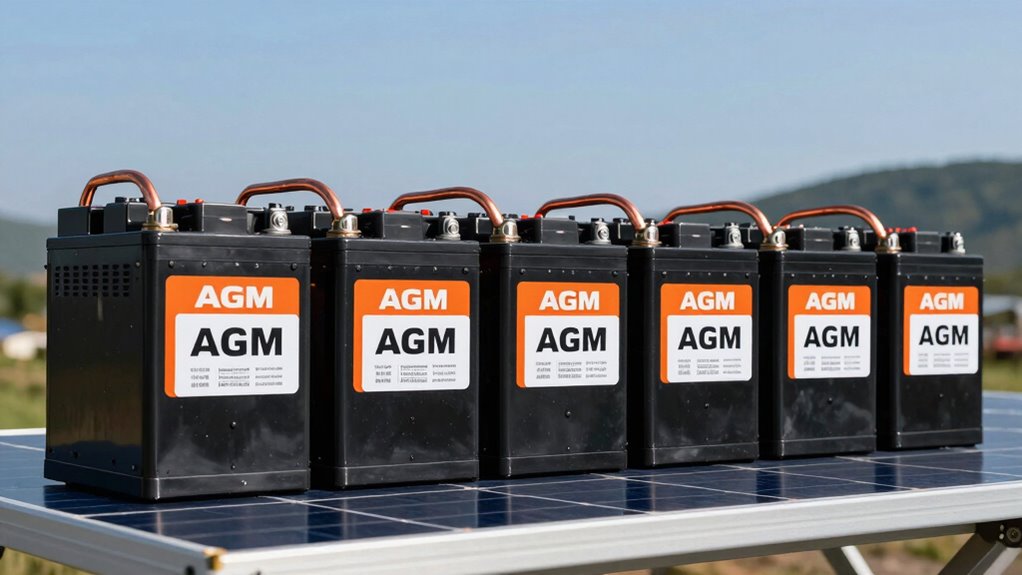
This four-battery VMAX set is the capacity-focused pick here, with 6.48kWh of stated total energy for solar users who can dedicate room to a substantial AGM bank. Four 6V batteries offer a different system layout from the single-unit Renogy 12 Volt 100Ah or Mighty Max 12V 200Ah; the larger combined storage is better suited to broader energy needs, but requires more space and careful planning for the bank’s wiring and installation. Its AGM deep-cycle design makes it relevant for solar, RV, and industrial use, though the supplied details do not specify a discharge-current rating, dimensions, or warranty. Compared with the single 12V batteries, this set is harder to handle and less convenient for a compact installation. It makes the most sense when capacity outweighs simplicity.
Pros:- Four batteries provide 6.48kWh of stated total energy
- 235Ah capacity per 6V battery
- AGM deep-cycle design is specified for solar, RV, and industrial applications
Cons:- Four-unit set takes more installation space than a single-battery bank
- Combined weight makes transport and positioning difficult
- Product details provided do not state discharge-current rating, dimensions, or warranty
Best for: Off-grid property owners or RV users with space for a multi-battery bank and higher storage needs than a single 12V unit can meet.
Not ideal for: Small-space installations or buyers who need a simple, easy-to-move battery; four bulky, heavy units require more room and handling than either 12V option here.
- Quantity:4 batteries
- Voltage:6V per battery
- Capacity:235Ah per battery
- Total energy:6.48kWh
- Chemistry:AGM deep cycle
- Stated applications:Solar energy systems, RVs, and industrial applications
Our verdict“Pick the VMAX set when substantial solar storage is the priority and you have the space and setup capacity for four AGM batteries.”
Mighty Max 12V 200Ah SLA AGM Battery Replacement for Solar Systems
The Mighty Max 12V 200Ah packs more stated capacity into one 12V battery than the Renogy 12 Volt 100Ah, making it a stronger fit when a solar system needs more storage without moving to the VMAX four-battery arrangement. Its maintenance-free SLA AGM design and any-position mounting claim offer flexibility for backup installations with constrained mounting options. That flexibility does not remove the space problem: at 20.87 x 9.45 x 8.74 inches, it needs a suitable mounting area, and the listing says no wire harness or mounting accessories are included. Compared with the VMAX set, it is a simpler single-unit format, but the provided specifications do not state total energy or a discharge-current figure. The one-year warranty is also shorter than the Renogy 100Ah battery’s prorated coverage.
Pros:- 200Ah capacity in a single 12V battery
- Maintenance-free, rechargeable SLA AGM construction
- Can be mounted in any position
- Specified dimensions help buyers plan installation space
Cons:- Large 20.87 x 9.45 x 8.74-inch footprint may not fit compact battery compartments
- Wire harness and mounting accessories are not included
- One-year warranty is shorter than the Renogy 100Ah battery’s prorated warranty
Best for: Solar and backup-power users who want a single 12V AGM battery with 200Ah capacity and have room for its specified dimensions.
Not ideal for: Buyers with tight mounting space, those who need included installation hardware, or anyone prioritizing longer stated warranty coverage.
- Voltage:12V
- Capacity:200Ah
- Type:Sealed lead-acid AGM
- Dimensions:20.87 x 9.45 x 8.74 inches
- Mounting:Can be mounted in any position
- Warranty:1 year
- Accessories:Wire harness and mounting accessories not included
Our verdict“Choose the Mighty Max when you want a single 12V AGM battery with more capacity than the Renogy 100Ah and can accommodate its size.”

How We Picked
I ranked these options by how clearly their voltage, capacity, and configuration suit common solar-storage needs. Capacity alone does not show how much energy a system can use: I also considered whether each product is a single 12V battery, a pair of 12V batteries, or a set of 6V batteries that must be wired into a compatible bank. Larger ratings can support longer runtimes, but they bring added weight, space needs, and installation demands.
The ranking favors solar-relevant AGM choices with useful capacity and a practical path to building a bank. The Renogy 200Ah model takes the lead for its substantial capacity in a straightforward 12V format; the paired 100Ah Renogy batteries rank well for modularity. Smaller batteries rank for lighter-duty needs, while the VMAX set is aimed at buyers prepared to plan around 6V units. The ERYY lithium battery is included as a chemistry comparison, not treated as an AGM equivalent. I also weighed the information provided in each product name and avoided assuming unlisted charging limits, cycle life, dimensions, or included accessories.
| agm battery bank for solar | Battery type |
|---|---|
| 12V 35Ah Deep Cycle AGM Batter | AGM deep-cycle sealed lead-acid |
| Interstate Batteries 12V 110AH | Deep-cycle AGM |
| Renogy Deep Cycle AGM Battery | AGM deep-cycle |
| ERYY 12V 20Ah LiFePO4 Lithium | LiFePO4 |
| Renogy 12 Volt 200Ah Deep Cycl | Deep-cycle AGM lead-acid |
| Renogy 12 Volt 100Ah Deep Cycl | — |
| VMAX Xtreme Series 6V AGM Deep | — |
| Mighty Max 12V 200Ah SLA AGM B | — |
Factors to Consider When Choosing Agm Battery Bank For Solar
Choosing a solar battery bank starts with the system around it, not just a capacity label. I’d work through daily energy use, system voltage, charging compatibility, and installation constraints before comparing individual models. These checks help prevent an expensive mismatch between panels, controller, inverter, and storage.
Size the bank from your actual loads
List the appliances you expect to run, their wattage, and the number of hours they operate each day. Convert that use into watt-hours, then account for inverter losses and days when solar production is low. A battery’s amp-hour rating needs to be read alongside its voltage: multiplying the two gives a rough measure of stored energy, not a promise of fully usable energy. AGM batteries generally should not be routinely drained to their full rated capacity, so build in a reserve rather than sizing to the exact load total. A common mistake is buying a high-Ah battery without checking whether it can cover the overnight or cloudy-day requirement. If your loads are modest, a smaller bank may be easier to install and maintain than excess capacity you rarely use.
Match battery voltage to the rest of the system
Check the battery-bank voltage expected by your inverter and charge controller before choosing a battery. A 12V battery is not automatically suitable for every solar setup, and connecting batteries in series or parallel changes the bank’s voltage or capacity. The VMAX 6V units in this roundup need a planned configuration to serve a 12V system, while the listed Renogy and Interstate options are 12V batteries. Series and parallel connections also call for compatible batteries and correctly sized cables, fuses, and protection. Avoid mixing different capacities, ages, or battery chemistries in one bank unless the manufacturers and system design explicitly allow it. Confirm the wiring plan first; the wrong configuration can prevent equipment from operating properly or create safety risks.
Check solar charging compatibility, not just panel wattage
Your charge controller must support the battery’s chemistry and voltage, with settings that match the battery manufacturer’s charging instructions. Panel wattage alone does not determine whether charging is suitable; controller limits, charging stages, temperature, and the battery’s accepted current all matter. AGM batteries need appropriate charging settings and should not be left undercharged for long periods, which can reduce service life. A controller set for another chemistry may apply the wrong charging profile. Before buying, compare the battery documentation with the controller’s available settings and verify any low-temperature or temperature-compensation requirements. If those details are missing from a listing, plan to obtain the manufacturer’s specifications rather than guessing.
Account for weight, space, and ventilation
High-capacity lead-acid batteries are substantial components, so check the installation surface, enclosure dimensions, access for wiring, and safe lifting needs. A pair of smaller batteries may be easier to position than one large unit, but it also creates more connections that need sound installation. AGM batteries are sealed, yet charging can still call for ventilation and adherence to the manufacturer’s installation directions. Keep the bank protected from moisture, extreme heat, and accidental short circuits. Plan cable routes and fusing before placing batteries; long or undersized wiring can waste power and create hazards. Buyers who need a portable or frequently moved setup should weigh portability against the longer runtime of larger batteries.
Compare AGM with lithium on system fit
AGM and LiFePO4 batteries differ in charging needs, usable capacity, weight, and system management, so a lithium option is not a drop-in substitute by default. The ERYY battery in this lineup is a small LiFePO4 model, making it a chemistry alternative rather than a direct large-bank AGM choice. Check whether the charge controller and inverter settings support the intended chemistry, and whether the lithium battery’s BMS limits align with your loads and charging source. AGM may make sense when the existing system is designed for lead-acid batteries or when a compatible replacement is the priority. Lithium may appeal when its system-level benefits fit the installation, but compare total system compatibility rather than choosing from chemistry claims alone. Do not combine AGM and lithium batteries in the same bank without explicit manufacturer approval.
Choose between one large battery and a modular bank
A single high-capacity battery can simplify the number of connections, while multiple batteries can give more flexibility in how a bank is arranged or expanded. That flexibility comes with extra wiring, space, and a need for batteries in a bank to be appropriately matched. The Renogy 100Ah pair offers a modular path compared with a single 200Ah battery, but the best choice depends on the inverter voltage, controller, and installation layout. Before planning future expansion, confirm that adding batteries later is allowed and that new units can be matched to the existing bank. Buying a complete, matched bank at the outset is often simpler than extending a bank after the original batteries have aged. Consider service access and replacement logistics as well as the initial capacity.
Frequently Asked Questions
Can I connect two 12V AGM batteries to make a 24V solar bank?
Two compatible 12V batteries can typically be wired in series to form a 24V bank, but the inverter, charge controller, and other equipment must also support 24V. Series wiring raises voltage; it does not double amp-hour capacity. Use batteries with matching chemistry, capacity, age, and condition, and follow the manufacturers’ wiring and protection instructions. Check the controller’s battery settings and maximum charging voltage before connecting the bank. If your system is designed for 12V, changing the bank voltage may require replacing or reconfiguring other components.
Is a 200Ah AGM battery enough to run my home during a power outage?
That depends on the battery voltage, the loads you need to support, and how long you want them to run. Calculate each load’s watt-hours, include inverter losses, and allow for the fact that routinely using all of an AGM battery’s rated capacity can shorten its service life. A 200Ah rating by itself does not say whether the battery can power a refrigerator, pump, or other high-demand appliance for your target duration. Check inverter surge capacity and continuous output as well as battery energy. For essential backup, plan around conservative usable capacity and the solar production available during poor-weather periods.
Can I add a new AGM battery to an older one I already own?
Adding a new battery to an older one can lead to uneven charging and discharging because their capacities and condition may differ. That mismatch can reduce bank performance and place extra strain on one battery. The safer route is usually a matched set with the same chemistry, voltage, capacity, and similar age, wired as directed by the manufacturer. If you are considering expansion, have the existing battery checked and confirm that the manufacturer permits the proposed arrangement. A separate bank with an appropriate charging setup may be a better fit than mixing batteries.
Does the VMAX set work with a 12V solar inverter?
The VMAX units listed here are 6V batteries, so a suitable series arrangement is needed to create a 12V bank from pairs of batteries. Confirm the battery count and wiring plan against the inverter and charge controller before purchase. The finished bank must meet the equipment’s required voltage, and all batteries in a series string should be matched. Use properly rated cables, overcurrent protection, and manufacturer-approved connections. If you want a simpler 12V installation, a listed 12V battery may involve less configuration work.
Should I choose the ERYY LiFePO4 battery instead of an AGM battery for solar?
Choose it only if a lithium battery suits your system and the 20Ah capacity meets your load needs. LiFePO4 has different charging requirements from AGM, so verify compatibility with the charge controller, inverter, and any battery-management limits before connecting it. Its small capacity makes it a different scale of option from the 100Ah and 200Ah AGM batteries in this roundup. Do not wire it into an AGM bank unless the manufacturers explicitly approve that configuration. For a replacement in an existing AGM setup, a compatible AGM model may be the more direct choice.
Conclusion
For most buyers seeking a substantial 12V solar-storage battery, I’d choose the Renogy 12 Volt 200Ah AGM as the best overall pick in this lineup. The Renogy 100Ah two-pack is my best value choice for buyers who want a modular pair, while the high-capacity options suit installations where runtime matters more than easy handling. Beginners with modest loads should start by calculating their needs and may find the 12V 35Ah AGM two-pack easier to plan around than a large bank. For specific needs, consider the VMAX 6V set when your system is designed for its series configuration, the Interstate 110Ah battery when its stated application range fits your setup, or the ERYY 20Ah LiFePO4 only when lithium compatibility is confirmed. Before deciding, match the battery to your inverter, controller, wiring plan, and realistic usable-energy target.
Halloween Picks
halloween
As an affiliate, we earn on qualifying purchases.