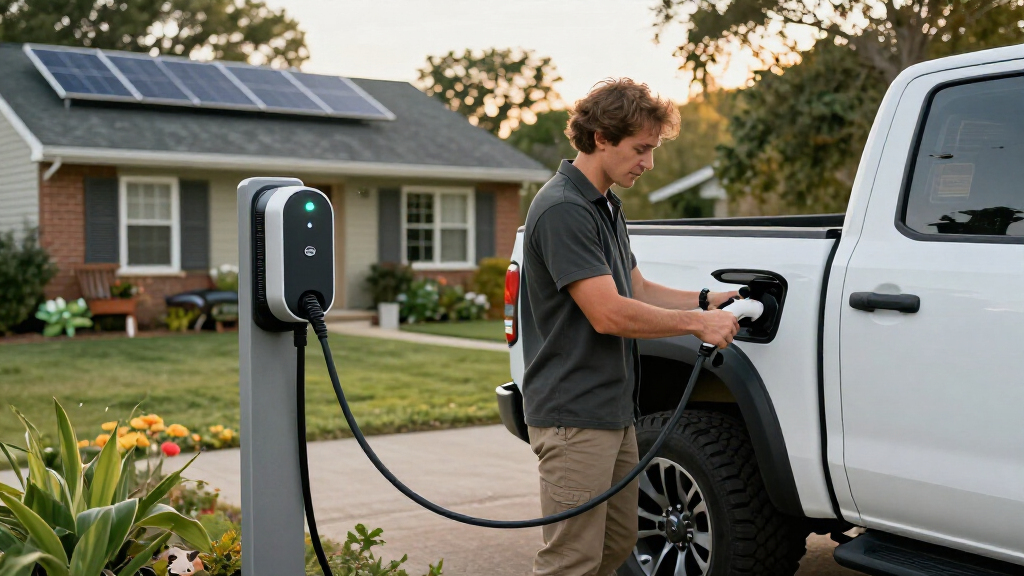

The best electric truck charger for most home setups is the EVIQO Level 2 40A: it pairs a practical charging rate with a plug-in NEMA 14-50 connection. The Autel MaxiCharger 80A stands out for drivers with compatible vehicles and electrical capacity who want higher power, while the ApexCharger Mach 3 suits buyers who need a portable unit with Level 1 and Level 2 flexibility. The main tradeoffs are charging speed, the cost and complexity of installing a suitable circuit, and whether you want a fixed wall station or a portable charger. Truck charging needs can vary widely with battery size, daily mileage, and onboard AC charging limits. Read on for the full comparison and guidance on matching a charger to your truck and home.

Get backup power and energy gear delivered free with Prime
- Fast, free delivery on millions of items
- Prime Video, Amazon Music and more included
- Member-only deals all year
Key Takeaways
- The EVIQO 40A is the most balanced pick in this group: it combines Level 2 output with a NEMA 14-50 plug rather than requiring a hardwired installation.
- The Autel 80A is a specialist upgrade, not a universal speed boost. Its higher output only helps when the truck, circuit, and home electrical service can all support it.
- Portable flexibility separates the ApexCharger Mach 3 from the wall-focused options; its Level 1 and Level 2 capability can help drivers who charge in more than one location.
- Four chargers in this lineup offer 40A charging, so installation style, app features, and intended use matter as much as the headline amperage.
- The 32A AIMILER trades some maximum output for app control and a plug-in format, while the Grizzl-E Classic favors a straightforward 40A setup without making app features its focus.


| electric truck charger | Cable length | Connector | Warranty | Voltage |
|---|---|---|---|---|
| EVIQO Level 2 EV Charger | 25 ft | J1772 | 3 years | 240V |
| Autel MaxiCharger Level 2 EV C | 25 ft | SAE J1772 | 5 years | — |
| ApexCharger Mach 3 40A Level 1 | 25 ft | — | 5 years | — |
| DEWALT Level 2 EV Charger | 25 ft | SAE J1772 | 3-year limited warranty | — |
| Grizzl-E Classic Level 2 40A E | 24 ft | — | — | 240V |
| AIMILER Level 2 Electric Vehic | 25 ft | J1772 | — | 220V–240V |
More Details on Our Top Picks
EVIQO Level 2 EV Charger, J1772, 40A, NEMA 14-50, 240V
I’d put the EVIQO near the top for electric-truck owners who want a capable home charger without committing to hardwiring. Its 40A output and 25-foot cable give it useful reach for a driveway or garage, while scheduling and energy tracking add practical control over daily charging. Compared with the Autel MaxiCharger, it gives up peak output but avoids that model’s hardwired installation and 100A circuit recommendation. The plug-in setup still depends on having a dedicated 50A circuit and NEMA 14-50 outlet, so it isn’t a workaround for limited electrical capacity. Its weather protection and illuminated holster are welcome for outdoor parking, though app features require 2.4 GHz Wi-Fi. I’d choose it as the most balanced option here, not as the fastest charger for a truck that can accept higher amperage.
Pros:- 40A output and 25-foot cable suit many home parking layouts
- Plug-in NEMA 14-50 connection avoids hardwired charger installation
- App offers scheduling, remote controls, and energy tracking
- IP66/NEMA 4 protection and glow-in-the-dark holster support outdoor use
Cons:- Requires a dedicated 50A circuit and compatible 240V outlet
- Wi-Fi app features require a 2.4 GHz network
- 40A output is below the Autel MaxiCharger’s 80A maximum
Best for: Truck owners with a dedicated NEMA 14-50 outlet who want 40A charging, a long cable, and scheduling without hardwired installation.
Not ideal for: Drivers seeking the highest possible home charging output or buyers without a 240V NEMA 14-50 outlet and dedicated 50A circuit.
- Connector:J1772
- Maximum amperage:40A
- Voltage:240V
- Outlet and circuit:NEMA 14-50 outlet; dedicated 50A circuit
- Cable length:25 ft
- Weather protection:IP66 / NEMA 4
- Connectivity:2.4 GHz Wi-Fi
- Certifications:UL, ETL, FCC, Energy Star
- Warranty:3 years
Our verdict“Choose the EVIQO for a well-rounded 40A plug-in setup if your home already has the required circuit.”
Autel MaxiCharger Level 2 EV Charger, 80A, Hardwired, J1772
For a truck that can make use of high-amperage AC charging, the Autel MaxiCharger is the standout on raw output: up to 80A and 19.2 kW. That puts it well above the 40A EVIQO, DEWALT, and Grizzl-E options, but the extra capacity comes with a substantial electrical requirement: Autel recommends a 100A circuit for full output. It is hardwired, so I’d plan for a professional electrician rather than treating installation as a simple outlet swap. The 25-foot J1772 cable and app-based scheduling, current adjustment, and energy monitoring make it flexible once installed. Compared with the portable ApexCharger Mach 3, Autel is a fixed high-output station, not a take-along charger. Tesla drivers also need a separate NACS adapter. Its five-year warranty and theft protection strengthen the case, but only for homes equipped to support it.
Pros:- Up to 80A and 19.2 kW output exceeds the other chargers in this group
- 25-foot J1772 cable serves a range of North American EVs and PHEVs
- App includes scheduling, remote control, current adjustment, and energy monitoring
- Theft protection and a five-year warranty
Cons:- Full 80A output calls for a recommended 100A circuit
- Hardwired installation is best handled by a professional electrician
- Tesla NACS adapter is not included
Best for: Electric-truck owners with a high-capacity home electrical service, a compatible vehicle, and plans for a professionally installed hardwired charger.
Not ideal for: Renters, households without capacity for a 100A circuit, or buyers who need a portable plug-in unit.
- Charger type:Level 2, hardwired
- Maximum output:19.2 kW
- Maximum amperage:80A
- Output voltage:240V AC
- Connector:SAE J1772
- Cable length:25 ft
- Circuit recommendation:100A circuit for full 80A output
- Certifications:CSA, UL
- Warranty:5 years
Our verdict“Pick the Autel when your truck and home electrical system can take advantage of its unusually high 80A output.”
ApexCharger Mach 3 40A Level 1 and Level 2 Portable EV Charger
The ApexCharger Mach 3 is the most versatile choice here for truck owners who may charge at home, at a second property, or from a standard outlet in a pinch. It supports 120V Level 1 and 240V Level 2 charging, includes both a NEMA 5-15 adapter and a J1772-to-Tesla adapter, and packs into a carrying bag. That flexibility sets it apart from the fixed DEWALT wall station and the plug-in-only Grizzl-E Classic. On a 240V supply, it reaches up to 9.6 kW; on 120V, charging is much slower, so that mode is better treated as a fallback than a daily truck-charging plan. Bluetooth and Wi-Fi controls plus adjustable current add convenience, but the product information lists conflicting current ratings, including a 40A maximum and a 48A figure. I’d verify the supported setting and supply requirements before relying on the higher rating.
Pros:- Supports Level 1 at 120V and Level 2 at 240V
- Includes NEMA 5-15 and J1772-to-Tesla adapters
- Portable design includes a carrying bag and 25-foot cable
- Adjustable current, LED display, and Bluetooth/Wi-Fi app control
Cons:- Level 2 operation requires a compatible 240V NEMA 14-50 outlet
- Product information gives conflicting current ratings
- 120V charging is limited to 1.44 kW and is slow for routine truck charging
Best for: Truck owners who want one portable charger for 120V backup charging and 240V use, including drivers who need the included Tesla adapter.
Not ideal for: Buyers who want a fixed wall station, need unambiguous amperage documentation, or expect practical fast charging from a standard 120V outlet.
- Charging levels:Level 1 and Level 2
- Input voltage:120–240V
- Charging power:Up to 9.6 kW at 240V; 1.44 kW at 120V
- Listed maximum current:40A; product information also lists a conflicting 48A figure
- Cable length:25 ft
- Included adapters:NEMA 5-15 and J1772-to-Tesla
- Amperage settings:16–40A
- Connectivity and display:Bluetooth, Wi-Fi, 2.4-inch LED
- Warranty:5 years
Our verdict“Choose the Mach 3 if portability and dual-voltage flexibility matter more than having a fixed, clearly specified high-output station.”
DEWALT Level 2 EV Charger, 40 Amps 240V, Wi-Fi & Bluetooth App Control, Indoor/Outdoor Wall Mounted Station with 25 ft Cable
The DEWALT is a sensible choice for owners who want a permanent 40A wall-mounted station with remote controls, rather than the portability of the Grizzl-E Classic or ApexCharger Mach 3. Its 9.6 kW output and 25-foot cable suit a regular home parking spot, while the app can manage schedules over Wi-Fi or Bluetooth. The rugged, weather-resistant design makes it a better fit for an exposed installation than a charger chosen mainly for travel. This isn’t the highest-output option: the Autel MaxiCharger reaches 80A, though it also demands a much larger circuit and hardwired installation. The DEWALT’s description recommends professional installation for a hardwired setup, and Tesla drivers need a separate adapter. Its CSA certification and three-year limited warranty provide useful product credentials, but buyers comparing it with the EVIQO should note that the EVIQO is a plug-in option rather than a wall-mounted station.
Pros:- 40A, 9.6 kW output suits routine home Level 2 charging
- 25-foot cable offers useful reach from a fixed mounting point
- Wi-Fi and Bluetooth support app monitoring and scheduling
- Weather-resistant construction is intended for indoor or outdoor installation
Cons:- Hardwired installation is recommended to be performed by a professional
- Tesla vehicles require a separate adapter
- 40A maximum is lower than the Autel MaxiCharger’s 80A output
Best for: Truck owners who park in a fixed indoor or outdoor spot and want a durable wall-mounted 40A charger with app scheduling.
Not ideal for: Drivers who need a portable charger, Tesla owners without an adapter, or homes looking for output beyond 40A.
- Model:DXPAEV040
- Maximum current:40A
- Input voltage:240V
- Power output:9.6 kW
- Connector:SAE J1772
- Cable length:25 ft
- Connectivity:Wi-Fi, Bluetooth
- Certification:CSA certified
- Warranty:3-year limited warranty
Our verdict“Choose the DEWALT for a permanent, weather-ready 40A wall station, not for portability or maximum charging output.”
Grizzl-E Classic Level 2 40A EV Charger with NEMA 14-50 Plug
I’d steer buyers toward the Grizzl-E Classic when dependable, adjustable charging matters more than app features. Its current settings of 40A, 32A, 24A, and 16A let owners match output to the circuit available, which can make it easier to use across different installations than a charger with one fixed setting. The plug-in NEMA 14-50 design and 24-foot cable also make it portable, though it still needs a compatible 240V outlet. Compared with the EVIQO, it gives up Wi-Fi scheduling and energy tracking; compared with the ApexCharger Mach 3, it lacks Level 1 charging and a listed Tesla adapter. In return, the Grizzl-E focuses on a weather-resistant enclosure and built-in electrical protections. Charging speed will vary with the selected amperage and the truck’s onboard charger, so adjustable settings are useful but do not guarantee the same rate in every setup.
Pros:- Four current settings allow adjustment from 16A to 40A
- 24-foot cable and plug-in format support flexible placement
- IP67 water resistance supports indoor and outdoor use
- UL tested and certified with built-in electrical protections and power outage recovery
Cons:- Requires a compatible 240V outlet and circuit
- No app connectivity or remote scheduling is listed
- Charging rate depends on selected amperage and vehicle capability
Best for: Truck owners who want a straightforward plug-in charger with selectable current settings for different compatible circuits or locations.
Not ideal for: Buyers who want app-based scheduling, 120V backup charging, or a charger that works without a NEMA 14-50 outlet.
- Voltage:240V
- Maximum current:40A
- Adjustable current:40A, 32A, 24A, 16A
- Plug type:NEMA 14-50
- Cable length:24 ft
- Weather protection:IP67
- Compatibility:North American EVs and PHEVs
- Certification:UL tested and certified
- Weight:16.61 lb
Our verdict“Pick the Grizzl-E Classic for adjustable, weather-resistant plug-in charging when connected app features are not a priority.”
AIMILER Level 2 Electric Vehicle (EV) Charger, 32A, 25ft Cable, ETL Certified, 220V-240V NEMA 14-50P Plug, J1772 Connector, WiFi App Control
The AIMILER suits electric truck owners who want scheduled home charging and a portable plug-in setup rather than the higher output of a hardwired unit. Its adjustable 16A–32A range reaches 7.68kW on a suitable 220V–240V circuit, while the 25-foot cable gives more flexibility when a truck’s charge port is far from the outlet. WiFi tools add remote monitoring, scheduling, and cost tracking; compared with the Autel MaxiCharger, however, this is a lower-power choice and is not aimed at buyers who need an 80A hardwired installation. ETL certification and NEMA Type 4 protection support indoor or outdoor use, but the app’s reliance on 2.4GHz WiFi may frustrate owners with unreliable coverage. J1772 also means Tesla and NACS vehicles need a separate adapter.
Pros:- Adjustable 16A–32A output delivers up to 7.68kW on a suitable circuit.
- WiFi app supports remote monitoring, scheduled charging, and cost tracking.
- 25-foot cable offers useful reach around larger vehicles and parking areas.
- ETL certification and NEMA Type 4 weather resistance support indoor or outdoor placement.
Cons:- Lower maximum output than the 80A hardwired Autel MaxiCharger.
- WiFi features require a 2.4GHz network, and connectivity may require troubleshooting.
- Tesla and NACS vehicles need a separate adapter; a 110V adapter reduces charging to Level 1 speeds.
Best for: Truck owners with a J1772 port, a compatible NEMA 14-50 outlet, and dependable 2.4GHz WiFi who want scheduling and a long cable.
Not ideal for: Owners seeking maximum charging output, a hardwired installation, or native Tesla/NACS compatibility without an adapter.
- Connector:J1772
- Input plug:NEMA 14-50P
- Voltage:220V–240V
- Adjustable amperage:16A–32A
- Maximum power:7.68kW
- Cable length:25 ft
- Weather resistance:NEMA Type 4; IP66
- Certifications:ETL, FCC, and listed SAE/UL standards
- Smart features:WiFi app control, LED touch screen
Our verdict“Choose the AIMILER if you want a weather-resistant, app-controlled 32A charger with a long cable and already have a compatible 240V outlet.”
How We Picked
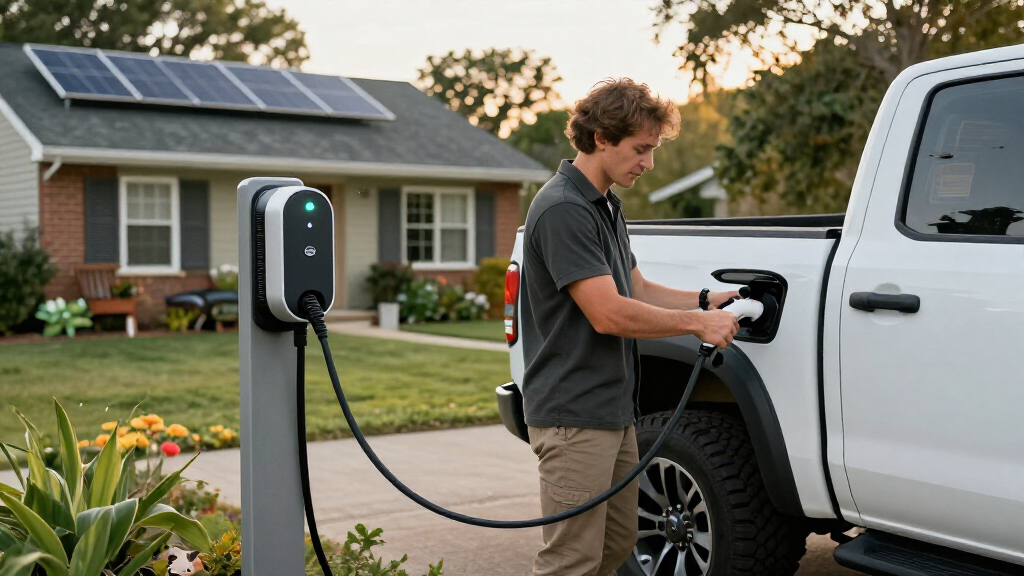
I ranked these chargers around the needs of electric-truck owners: usable charging output, compatibility with common J1772-equipped vehicles, installation requirements, cable reach, portability, and the usefulness of included controls. I gave greater weight to a practical balance of capability and installation demands than to the highest amperage alone, since a charger can only deliver useful power when the truck and home circuit support it.
That puts the EVIQO 40A first as the most broadly approachable balance, with the Autel 80A second for buyers who can make use of its higher output and accept a hardwired installation. The ApexCharger earns a distinct place for portable Level 1 and Level 2 use; DEWALT and Grizzl-E offer different takes on 40A wall charging, while AIMILER is a lower-amperage, app-connected plug-in option. I also treated electrical-panel capacity and connector fit as gating factors: the best-ranked charger may not be the right choice if the home circuit or truck cannot support it.
| electric truck charger | Connector | Certifications |
|---|---|---|
| EVIQO Level 2 EV Charger | J1772 | UL, ETL, FCC, Energy Star |
| Autel MaxiCharger Level 2 EV C | SAE J1772 | CSA, UL |
| ApexCharger Mach 3 40A Level 1 | — | — |
| DEWALT Level 2 EV Charger | SAE J1772 | — |
| Grizzl-E Classic Level 2 40A E | — | — |
| AIMILER Level 2 Electric Vehic | J1772 | ETL, FCC, and listed SAE/UL standards |
Factors to Consider When Choosing Best Electric Truck Chargers
For an electric truck, a charger decision starts with the home electrical setup, not the truck’s advertised battery capacity. These factors can help you avoid paying for output your vehicle cannot use or buying a plug-in unit that does not suit your installation.
Match Charger Output to the Truck’s AC Charging Limit
A charger’s amperage rating describes its available output, but the truck’s onboard AC charger sets the actual limit when charging at home. Check the vehicle manual or specifications before choosing an 80A model over a 40A option; the extra capacity may bring no charging-time benefit if the truck cannot accept it. Also compare the truck’s daily energy use with the hours it sits at home, rather than sizing around a completely empty battery every night. Larger batteries make planning worthwhile, but a steady overnight refill may be enough for many owners. If you expect to change vehicles, ask an electrician whether installing a higher-capacity circuit now makes sense. The goal is a setup that meets your routine without overbuilding for a number on a product label.
Check the Circuit, Outlet, and Continuous Load
Plug-in chargers and hardwired chargers place different demands on a home installation, and neither format bypasses electrical-code requirements. A NEMA 14-50 receptacle must be connected to a properly sized circuit and installed for the intended continuous load; an existing range or welder outlet is not automatically suitable. A 40A charging load commonly calls for a circuit rated above 40A, while higher-output charging can require a substantial dedicated circuit and panel capacity. Have a licensed electrician inspect the panel, wiring, breaker, and receptacle before buying around a specific amperage. Avoid using extension cords or adapters to bridge a mismatch. Installation limits often matter more than the difference between two chargers’ feature lists.
Choose a Plug-In or Hardwired Installation for Your Routine
A plug-in model can be easier to remove or relocate, which is useful for renters with an approved outlet or homeowners planning a future move. Hardwiring can suit a permanent outdoor or garage installation and may support higher output, but it ties the unit to the location and calls for professional electrical work. Do not assume that a plug-in charger is portable in the everyday sense: it still needs a compatible outlet, and its cable and storage setup may not suit travel. Think about where the truck parks, where the cable will hang, and whether the charger must serve more than one vehicle. If you are installing a new circuit either way, compare the full installation plan rather than treating the charger’s plug as the whole cost. That choice shapes flexibility, output, and future changes to the setup.
Plan Cable Reach Around the Truck’s Parking Position
Truck length and charge-port placement can make cable reach more challenging than it is with a smaller car. Measure from the proposed charger location to the truck’s port with the vehicle parked in its usual position, allowing room to route the cable without stretching it across a walkway or driveway. A 25-foot cable can offer more parking flexibility, but extra length also needs a tidy storage plan and should not be left where tires, doors, or foot traffic can damage it. Consider whether the cable can reach the port from either side of the parking space if you expect to change vehicles. Wall placement matters too: mounting the charger at a convenient height can reduce strain and make plugging in easier. Measure first instead of relying on a product’s cable length in isolation.
Decide Whether App Features Solve a Real Problem
Wi-Fi or Bluetooth controls can help with scheduled charging, status checks, and managing charging around household electricity use. They are most useful when you plan to use those controls regularly or need remote visibility; otherwise, a simpler unit may be easier to live with. Check whether the charger can still operate conveniently if the home network drops, and review what setup the app requires. Smart scheduling can also overlap with controls already built into the truck, so compare both systems before choosing a charger for its software. If multiple household members drive the truck, straightforward controls may matter more than a long feature list. Pay for connectivity when it supports a specific routine, not just because it is available.
Treat Outdoor Installation and Certification as Setup Questions
For an outdoor charger, check the manufacturer’s stated weather protection and installation instructions rather than assuming a rugged-looking case can handle every exposure. Direct rain, snow, sun, and temperature swings can affect the location choice and how the cable and connector are stored. Keep the unit within the specified mounting and operating conditions, and use a qualified installer for wiring and protection requirements. Certification can help identify products evaluated against relevant safety standards, but it does not replace correct installation or verify that a particular home circuit is suitable. Ask about warranty coverage for the location where you plan to install the charger. A well-chosen mounting spot can protect the equipment and make daily connection less awkward.
Frequently Asked Questions
Will an 80A charger make my electric truck charge faster than a 40A charger?
Only if the truck’s onboard AC charging system can accept more power and the home installation can supply it. If either limit is below the charger’s output, the truck will charge at the lower supported rate. That makes the Autel 80A a better fit for buyers who have confirmed both vehicle and electrical compatibility, not an automatic upgrade for every truck owner. Check the truck manual and ask an electrician to review the proposed circuit before selecting a high-output unit. If those checks point to a 40A ceiling, a 40A charger may be the more practical choice.
Can I plug a NEMA 14-50 charger into an outlet I already have?
Do not assume an existing NEMA 14-50 outlet is suitable just because the plug fits. The outlet, wiring, breaker, and circuit condition all need to support continuous EV charging at the charger’s specified current. A shared circuit or an outlet installed for a different appliance may not meet the charger’s requirements. Have a licensed electrician inspect it and confirm the allowable charging setting before use. If the circuit is unsuitable, choosing a lower-current setting or installing a dedicated circuit may be safer than relying on an adapter.
Is a portable Level 1 and Level 2 charger a good choice as my only truck charger?
It can work if the Level 2 connection available at home can restore the energy you use during your normal parking window. Level 1 charging is much slower and may be more useful as a backup or for light daily driving than for regularly replenishing a truck after long trips. The ApexCharger Mach 3’s dual-mode design offers flexibility, but its usefulness still depends on access to compatible power sources. Estimate your typical daily driving and compare the required recharge with your overnight hours. If you regularly return with a low battery and need a quick refill, a dedicated Level 2 installation may fit better.
Do I need Wi-Fi on a home truck charger if my vehicle already has charging schedules?
Not necessarily. If the truck reliably supports scheduled charging and you do not need remote charger status or app-based controls, a charger without connected features may cover your routine. Charger apps can still be useful for monitoring or managing charging from another location, but overlapping controls can add setup without adding much value. Compare the specific scheduling and status features in the vehicle and charger apps before choosing. Also consider whether the charger remains easy to operate when Wi-Fi is unavailable.
What should I check before mounting a charger outdoors for an electric truck?
Check the charger’s published outdoor-use instructions, weather protection, operating limits, and warranty terms for the planned location. Then confirm the mounting surface, cable reach, outlet or hardwired connection, and electrical protection with a qualified installer. A spot exposed to direct weather may call for a different placement than a covered garage wall, even when the unit is rated for outdoor use. Keep the connector and cable clear of standing water, vehicle tires, and walkways when stored. The DEWALT listing specifies indoor and outdoor use, but installation still needs to follow its instructions and local electrical requirements.
Conclusion
For most drivers, I would start with the EVIQO 40A as the best overall: it offers a useful balance of output and plug-in convenience for a compatible NEMA 14-50 installation. The Grizzl-E Classic is my best value-style choice for buyers who want a straightforward 40A plug-in setup, while the Autel MaxiCharger is the best premium pick for a truck and home system that can use its higher hardwired output. Beginners who want an accessible plug-in format can compare EVIQO with the AIMILER 32A, especially if app control matters more than maximum charging power. Choose the ApexCharger Mach 3 for portability and Level 1/Level 2 flexibility, or the DEWALT 40A if its connected controls and indoor/outdoor wall-mounted design suit your installation. Before ordering, verify the truck’s AC charging limit, circuit capacity, connector compatibility, and cable reach; those checks should decide the final pick.
Halloween Picks

Haunted Hill Farm 4.6-Foot Spinning Beatrix Halloween Animatronic

10 ft Halloween Inflatable Archway – Pumpkin, Skeleton & Candy Yard Décor

11.2-Foot Halloween Inflatable Pumpkin with LED Lights
As an affiliate, we earn on qualifying purchases.