TL;DR

Get backup power and energy gear delivered free with Prime
- Fast, free delivery on millions of items
- Prime Video, Amazon Music and more included
- Member-only deals all year
A homeowner planning a small attic office in a circa-1950 Massachusetts house asked how to combine EPS foam, mineral wool and ventilation without trapping moisture. The source is a homeowner’s question, not a reported building-science finding: no completed assembly, professional assessment or confirmed moisture damage is described.
A Massachusetts homeowner planning a small office in an unfinished attic has raised a moisture-control question about placing EPS foam and mineral-wool insulation between the room and the roof deck. The homeowner’s account describes a proposed assembly, not completed work or confirmed damage, and does not establish whether the design is safe or code-compliant.
The homeowner said the house is a circa-1950 Colonial in Climate Zone 5A and that the attic is currently unconditioned. The immediate goal is a limited-use place for a desk and guitar, while a larger roof project involving exterior insulation and a dormer is planned in about five years. The homeowner acknowledged that the interim project would fall short of current energy-code requirements and said comfort could require a window air conditioner or space heater.
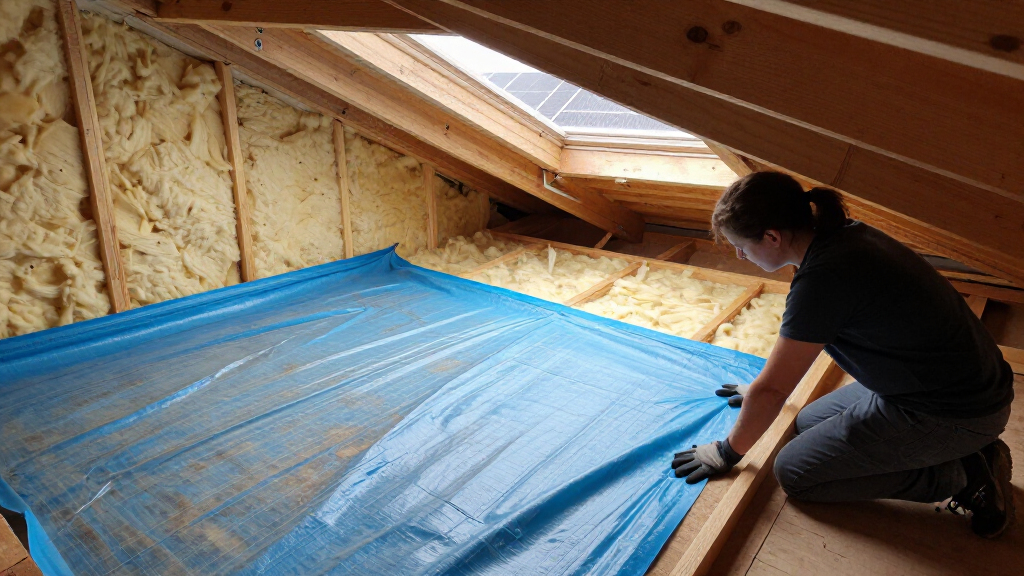
The proposed room would have new 2-by-4 knee walls insulated with mineral-wool batts. Above the room, the homeowner described limited space for insulation below the rafters: furring strips and about one inch of foam board, followed by 3.5 inches of mineral wool and a gap below the roof sheathing. The question was whether to add another inch of foam board and leave a narrower air gap, or use plastic baffles to preserve a larger, roughly two-inch ventilation channel.
The concern is that mineral wool could sit between foam layers, with some readily available foam boards carrying foil facers. The homeowner said the EPS shown in the drawings was selected because it is comparatively vapor-open, but also noted that a faced product may have a perm rating below 1. The source gives no final material selection, measured conditions, inspection findings or expert answer.
Moisture Risk in a Tight Roof Assembly
The question matters because a roof assembly needs a workable balance among insulation, air control and drying. If moisture enters an assembly and cannot dry adequately, building materials may remain damp; the actual risk depends on the complete design, construction quality, indoor humidity, climate and ventilation conditions. The homeowner’s description alone cannot establish that condensation or damage will occur.
For readers considering a similar attic conversion, the practical takeaway is that product labels or a single perm rating do not settle the design. Foam facers, insulation placement and the size and continuity of any ventilation channel interact with the roof details. The homeowner also describes a temporary room in an attic that remains unconditioned, so comfort and performance may differ from those of a fully designed, conditioned living space.
The planned exterior insulation and dormer could change the roof’s thermal and moisture behavior later. That makes the interim assembly a project-specific decision rather than a detail that can be safely copied from a short description. A qualified building-science professional or designer can assess the full roof section and local requirements before materials are installed.
As an affiliate, we earn on qualifying purchases.
A Temporary Attic Office Plan
The homeowner’s question was published by GreenBuildingAdvisor under the title “Vapor Issue w/ EPS & Mineral Wool in Attic.” The source describes an attic-office project in Massachusetts and says the future plan is to add insulation outside the roof structure and build a dormer when the roof is replaced, roughly five years later.
As described, the attic has six box vents near the ridge and two soffit vents that the homeowner installed to keep the area outside the proposed room open. The homeowner said there is no ridge vent and characterized the ventilation as decent but not ideal. These are details reported by the homeowner; the source contains no independent inspection or calculation of ventilation performance.
The account also makes clear that the project is constrained by space and budget. The question is not a report of a building failure, but a request for advice on choosing between more foam insulation and a larger air space beneath the roof deck while avoiding vapor-retarding layers on both sides of the mineral wool.
“The red hot question is regarding the mineral wool being sandwiched by foamboard.”
— The homeowner, in the GreenBuildingAdvisor question
Assembly Details Still Unverified
The source does not provide a final design or confirm that any of the proposed insulation layers have been installed. It also does not include a response from a building professional, local code review, moisture analysis or inspection of the roof. No leaks, condensation, mold or other damage are reported.
Important details needed to evaluate the proposal are not established in the supplied account, including the precise products and facer properties, how air leakage will be controlled, whether a ventilation path can remain continuous from eaves toward the roof vents, and the full construction of the roof and room boundaries. The source also does not say whether the attic will be heated or cooled regularly, or how indoor moisture will be managed.
Because those conditions can affect performance, the question’s proposed options cannot be ranked from the available information. The stated climate zone and vent locations provide useful context, but they are not a substitute for evaluating the complete assembly and applicable local requirements.
Design Review Before Installation
The source does not identify a scheduled inspection, permit decision or follow-up answer, so no next project milestone is confirmed. Before choosing between additional foam and a larger ventilation gap, the homeowner would need a review of the complete roof section, including the intended air barrier, vapor-control layers and ventilation route.
A building-science professional or qualified designer familiar with local conditions can assess whether the proposed assembly is suitable and what code or permit requirements apply. The eventual roof replacement, exterior insulation and dormer will also need to be coordinated with any temporary attic work. Until those details are reviewed, the homeowner’s post remains an open technical question rather than evidence of a settled recommendation.
Key Questions
Has the homeowner reported a moisture problem or damaged roof?
No. The source describes a design question about a proposed attic-office assembly. It does not report condensation, leaks, mold or confirmed damage.
What materials is the homeowner considering?
The proposal includes mineral-wool batts and EPS foam board, with a possible second foam layer near the roof deck. The homeowner is also considering plastic baffles to maintain a larger air gap.
Does the source establish that the proposed assembly will work?
No. It contains the homeowner’s description and question, but no completed design review, professional assessment or confirmed construction outcome. The available information is not enough to determine performance.
What should happen before the attic work proceeds?
The full roof assembly should be reviewed by a qualified building-science professional or designer, including ventilation continuity, air leakage, vapor-control layers and local code requirements. The future roof renovation should be considered in that review.
Source: rss
Halloween Picks
halloween
As an affiliate, we earn on qualifying purchases.