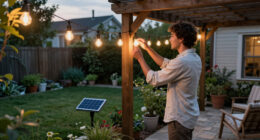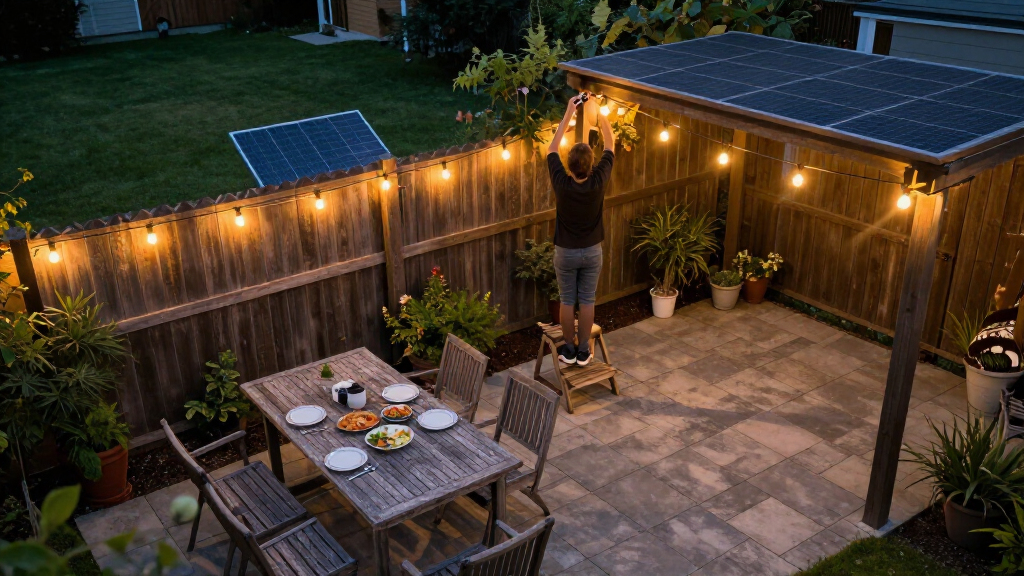
When choosing solar-powered outdoor string lights, the central question is not simply which set has more bulbs. It is where the solar panel can get useful sunlight relative to where you want the lights. An integrated-panel set keeps the panel attached to the string or its control housing, making setup straightforward; a separate-panel set connects the lights to a panel you can position elsewhere.

Get backup power and energy gear delivered free — and shop member deals
- Fast, free delivery on millions of items
- Access to Prime Big Deal Days deals on October 6–7
- Prime Video, Amazon Music and more included
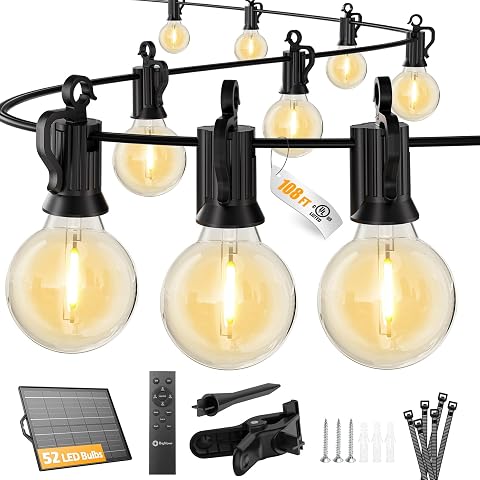
Brightown 108 ft Solar String Lights with Remote and USB Charging
- ✔ Length: 108 ft
- ✔ Bulbs: 50 G40 LEDs plus 2 spares
- ✔ Bulb spacing: 2 ft

Brightown 100 ft Solar String Lights with 31+2 Shatterproof LED Bulbs
- ✔ Length: 100 ft
- ✔ Bulbs: 31 LED bulbs plus 2 spares
- ✔ Light color: 2700K warm white
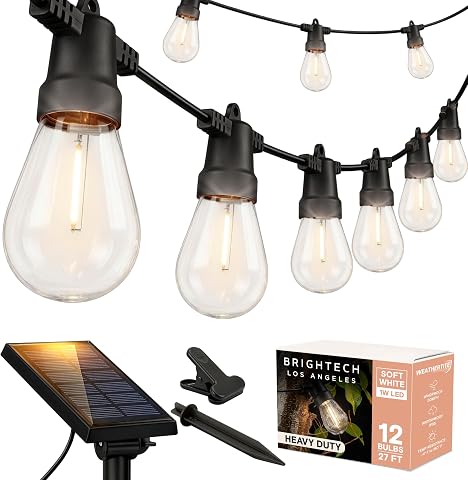
Brightech Ambience Pro Solar-Powered Outdoor String Lights, 27 ft, 12 Shatterproof LED Bulbs
- ✔ Length: 27 ft
- ✔ Bulbs: 12 shatterproof S14 LEDs
- ✔ Light color: Soft white, 3000K
That difference affects charging, placement, and the effort required to install the lights. If your patio, balcony, or pergola gets sun where the lights will hang, the integrated design is usually the easier, lower-cost choice. If the seating area is shaded, or the string needs to run beneath a roof or trees, a separate panel is usually the better bet. The comparison below focuses on the practical tradeoffs that matter most: installation, sun exposure, runtime, brightness, placement, upkeep, and value.
At a Glance
| Criteria | Solar string lights with an integrated panel | Solar string lights with a separate panel | Winner |
|---|---|---|---|
| Installation | Simplest setup; fewer parts and no panel cable to route | Requires mounting or placing a panel and routing its cable | A |
| Solar-panel placement | Panel stays close to the lights and may be constrained by the hanging location | Panel can be set in a sunnier spot, away from shaded lights | B |
| Charging reliability | Good when the light string itself receives ample direct sun | More reliable when the panel can receive direct sun for several hours | B |
| Runtime consistency | More vulnerable to short or cloudy-day charging if the hanging area is shaded | Often steadier in shaded patios when the panel has a good sun position | B |
| Layout flexibility | Best for compact, sunny layouts | Better for roofed, shaded, or spread-out spaces, subject to cable reach | B |
| Upkeep and weather exposure | Fewer pieces to position, though the panel may be hard to angle independently | Panel and cable add placement and inspection points; connections need sensible protection | A |
| Typical value | Often the less expensive choice when its fixed panel location gets sun | Extra cost can pay off when flexible placement improves charging | Depends |
Brightown 108 ft Solar String Lights with Remote and USB Charging
The Brightown 108 ft is the most adaptable choice here for buyers lighting a long fence, pergola, or outdoor dining area. Its 50 warm-white G40 bulbs, set two feet apart, offer more points of light than the 31-bulb Brightown 100 ft model. That makes it the stronger pick when the goal is a broad, continuous run rather than simply marking a small seating area. The extra length also means more planning: measure the route before buying, and remember that the strand cannot connect to additional strands.Its main advantage over the other two options is charging flexibility. The 3 W adjustable solar panel supports solar charging, while USB-C provides an alternative when cloudy weather or a shaded panel undermines a full solar charge. The maker lists up to 36+ hours of runtime, but that figure should not be treated as a nightly promise from solar alone; placement and sun exposure matter. Brightown’s 100-foot set also offers USB-C, but its stated runtime is up to 26 hours. Brightech, by contrast, has no wired charging backup and lists just 5–6 hours per full charge.Remote dimming at four levels, three lighting modes, and six- or eight-hour timers help tailor the strand to a quiet dinner or a brighter gathering. IP65 protection and shatterproof bulbs make it better equipped for outdoor use than a delicate indoor-only decorative string. Still, buyers should not confuse weather resistance with immunity to wear: connections and the panel need sensible placement, and solar performance remains dependent on daylight. Choose this model for maximum listed coverage and control, but skip it if you want expandable strands or a short, uncomplicated setup.
Pros:
- 108-foot length with 50 bulbs spaced two feet apart
- Solar and USB-C charging offer more flexibility than solar-only operation
- Remote includes four brightness levels, three modes, and two timer options
- IP65-rated design, shatterproof bulbs, and two spare bulbs
Cons:
- The string lights cannot be connected to additional strands
- Solar charging performance depends on adequate sunlight and panel placement
Best for: Buyers who need a long, densely spaced run and want USB-C charging as a backup to solar.
Not ideal for: Anyone who needs to link multiple strands together or expects dependable solar-only charging in a persistently shaded spot.
Bottom line: We rank it first for combining the longest coverage, extensive controls, and USB-C backup, with the caveat that its single-strand design limits expansion.
“We rank it first for combining the longest coverage, extensive controls, and USB-C backup, with the caveat that its single-strand design limits expansion.”
Brightown 100 ft Solar String Lights with 31+2 Shatterproof LED Bulbs
Choose the Brightown 100 ft when you want a long, controllable strand but do not need the 108-foot model’s denser bulb count or longer listed runtime. It covers most of the same kinds of spaces—patios, fences, and garden edges—while using 31 bulbs plus two spares. Compared with its 108-foot sibling, the bulbs are less numerous across a slightly shorter run, so the visual effect may feel more spaced out. That is a useful distinction for buyers who prefer broad coverage without as many light points.The feature set is still unusually complete for a solar-focused option. Solar and USB-C charging give it the same practical backup advantage as the longer Brightown, and the remote provides four brightness levels, three lighting modes, and timer choices. Its stated runtime is up to 26 hours, shorter than the 108-foot model’s 36+ hours but well beyond the Brightech’s 5–6-hour figure on paper. Solar charging is listed at 7–8 hours, so the panel needs a suitable stretch of daylight; USB-C is the more predictable alternative when conditions do not cooperate.The 2700K warm glow is a straightforward fit for relaxed outdoor use, and the IP65 rating and shatterproof PET bulbs support a more weather-ready setup than the Brightech’s IPX4 specification. One unusual caveat is the built-in light sensor: daytime operation may require covering the panel, which can be inconvenient if you want to test or control the lights while it is bright. Compared with the 108-foot pick, this model gives up some coverage and stated runtime, not the core remote features. It makes sense when those features matter more than maximum bulb count; skip it if you want a basic, low-intervention strand.
Pros:
- 100-foot run with 31 shatterproof bulbs and two spares
- Solar and USB-C charging, including a wired fallback
- Remote offers dimming, timers, and three lighting modes
- IP65 protection and a warm 2700K light color
Cons:
- Listed runtime is up to 26 hours, shorter than the 108-foot Brightown’s claim
- Solar charging is listed at 7–8 hours and depends on sunlight
- The light sensor may need the panel covered for daytime operation
Best for: Buyers who want a long outdoor run with remote dimming and dual charging but do not need 50 bulbs.
Not ideal for: People who want the simplest possible solar setup, need the longest listed runtime, or dislike working around a light sensor.
Bottom line: We recommend it as the control-rich alternative to the 108-foot Brightown when a slightly shorter, less densely lit run is enough.
“We recommend it as the control-rich alternative to the 108-foot Brightown when a slightly shorter, less densely lit run is enough.”
Brightech Ambience Pro Solar-Powered Outdoor String Lights, 27 ft, 12 Shatterproof LED Bulbs
The Brightech Ambience Pro is the clear small-space option: at 27 feet with 12 S14 bulbs, it is better suited to a balcony, compact patio, or short pergola than the two 100-foot-plus Brightown strands. That shorter run can be an advantage when a long string would be awkward to route or store. But it is not a like-for-like alternative for buyers trying to illuminate a large yard. Compared with either Brightown, it offers far less coverage and fewer listed controls.This model keeps the setup straightforward with a detachable solar panel that can be positioned using its included stake or clip. That lets buyers place the panel where sunlight is better without forcing the whole strand to follow. It is solar-only, however, so there is no USB-C fallback if a run of cloudy days leaves the battery short. Brightech lists 5–6 hours of light from a full charge, making it the least convincing choice for late nights. Both Brightown options list much longer runtimes and can be topped up by USB-C, which makes them safer choices when evening length or weather is unpredictable.The 3000K soft-white light and shatterproof S14 bulbs suit buyers who value a decorative, modest-scale glow rather than lots of remote-controlled adjustments. The cord is described as weather-resistant and rated IPX4, while the Brightown models carry IP65 ratings; we would therefore give the Brightowns the edge for more exposed placements. Brightech counters with a two-year limited warranty and a 20,000-hour LED lifespan specification. Pick it for compact coverage, panel-placement flexibility, and a simpler solar-only design. Skip it if you need all-evening runtime, USB charging, or substantial weather protection for a very exposed installation.
Pros:
- Compact 27-foot length is easier to fit into small outdoor spaces
- Detachable solar panel can be placed separately using a stake or clip
- Shatterproof S14 bulbs provide soft-white 3000K light
- Includes a two-year limited warranty
Cons:
- Solar-only charging leaves no USB-C backup
- Listed runtime is about 5–6 hours per full charge
- IPX4 weather resistance is below the Brightown models’ IP65 rating
Best for: People lighting a small patio or balcony who prefer a compact solar-only set with a detachable panel.
Not ideal for: Buyers covering a large area, staying outdoors late, or needing USB charging and stronger listed water protection.
Bottom line: We’d choose Brightech for a small, simply lit patio, but its short runtime and solar-only charging make it the least versatile pick for long evenings.
“We’d choose Brightech for a small, simply lit patio, but its short runtime and solar-only charging make it the least versatile pick for long evenings.”
As an Amazon Associate we earn from qualifying purchases.
Key Differences
The most consequential distinction is the relationship between the panel and the lights. An integrated panel reduces installation work, but it ties charging conditions to the location and orientation of the light string. That is a reasonable trade when the string can hang in a sunny yard or open patio. It is a weak fit when the lights belong under a covered porch, beside a north-facing wall, or beneath dense tree cover: convenient installation cannot make up for a panel that gets too little sun.
A separate panel addresses that constraint by letting you put the collector in a sunnier location and run a cable to the lights. The payoff is potential charging consistency, not a guarantee of a specific brightness or runtime. Actual performance still depends on panel size, battery capacity and age, weather, season, and the light setting. In exchange for that flexibility, you handle an extra component, cable, and mounting decision. For sunny, simple layouts, integrated is the more sensible value; for shaded layouts, paying more for a separate panel can be worthwhile because it tackles the underlying placement problem.
Detailed Comparison
Installation (Solar string lights with an integrated panel wins — moderate)
Integrated-panel lights win by a moderate margin. They typically need fewer placement decisions: hang the string, position its attached panel or control unit, and follow the maker’s setup instructions. A separate-panel set adds a panel to secure, a cable to route, and a connection to keep appropriately protected. That work is manageable, but it can take longer around a pergola or along a fence. Choose the integrated format if you want a quick seasonal setup and the mounting area is sunny enough.
Solar-panel placement (Solar string lights with a separate panel wins — major)
Separate-panel lights win by a major margin. The panel can be positioned in a sunnier patch while the bulbs remain over a shaded table or walkway. Integrated panels are limited by where the string can hang and how the attached panel can face the sun. This matters more than a small difference in bulb count if the intended lighting area receives little direct sun. Check cable reach and the manufacturer’s placement guidance before buying a separate-panel kit.
Charging reliability (Solar string lights with a separate panel wins — major)
Separate-panel lights usually win by a moderate-to-major margin in shaded settings; in full sun, the gap may be minor. A panel with a clear, sunny position has a better chance of collecting useful daylight than one tucked under an eave or facing away from the sun. Neither design can remove the effects of cloudy weather, shorter winter days, dirty panels, or battery wear. For an open, sunny garden, an integrated panel may charge adequately; for a shaded porch, separate placement is a meaningful advantage.
Runtime consistency (moderate difference)
Separate-panel lights generally win when their panel has better sun exposure, but this is not a guaranteed runtime victory. More effective charging can support longer evening use, while inadequate daylight can leave either style dimmer or shorter-lived. Runtime also depends on battery capacity, the selected lighting mode, temperature, and the product’s controls. Compare stated runtime and battery details rather than assuming every separate-panel model will outlast every integrated one. The design advantage is strongest where it solves a real shade problem.
Layout flexibility (Solar string lights with a separate panel wins — moderate)
Separate-panel lights win by a moderate margin. They are better suited to layouts where the string and the best charging location are not the same place, including covered seating areas and long runs across a yard. The cable creates a limit of its own, so confirm that it reaches the intended sunny spot without becoming a trip hazard or requiring an unsafe extension. Integrated sets are simpler for compact layouts where the panel can sit near the string and still receive sun.
Upkeep and weather exposure (Solar string lights with an integrated panel wins — minor)
Integrated-panel lights have a minor convenience advantage. With fewer separate pieces, there is less to mount, reposition, or inspect. A separate panel and cable add potential points that need sensible placement and occasional checks, especially after wind or outdoor cleaning. But either design needs outdoor-rated components, careful handling, and periodic removal or storage if the manufacturer recommends it for severe weather or winter conditions. The difference is small compared with panel placement and should not outweigh a serious sunlight mismatch.
Typical value (moderate difference)
There is no universal winner; value depends on sunlight at the installation site. Integrated-panel models often cost less and deliver better value when their panel will receive direct sun. Paying extra for a separate panel makes sense when it can sit in sunlight that the lights cannot reach. If both styles would put the panel in equally good sun, the added placement flexibility may have little practical return. Compare the total kit, including panel, battery, cable length, controls, and bulb replacements where relevant.
Solar string lights with an integrated panel: Pros and Cons
Pros:
- Simpler installation with fewer parts to mount or route
- Often costs less when the hanging area receives direct sun
- A tidy fit for compact patios, open yards, and seasonal setups
Cons:
- Panel position is tied to the string or its nearby housing
- Shaded hanging locations can limit charging
- Less adaptable when the lights need to be far from the best sun
Solar string lights with a separate panel: Pros and Cons
Pros:
- Panel can sit in sun while the lights remain in shade
- More flexible for covered patios, pergolas, and spread-out layouts
- Can improve charging prospects when the integrated position would be shaded
Cons:
- More installation work and another component to position
- Cable length can restrict where the panel can go
- May cost more without adding much value in an already sunny location
Who Should Choose What
Choose Solar string lights with an integrated panel if:
- Your string will hang in an open area where the panel can receive several hours of useful direct sunlight.
- You value quick installation and fewer components more than flexible panel placement.
- You want a lower-cost, straightforward choice for a small patio, balcony, or sunny garden.
Choose Solar string lights with a separate panel if:
- Your lights need to hang under a roof, pergola, trees, or another shaded structure.
- A sunny spot is available within the panel cable’s reach, even though the seating or walkway is not sunny.
- You are willing to spend more and route a cable to improve the panel’s access to daylight.
Skip both if: Skip solar-powered string lights if the available panel locations stay heavily shaded and you need dependable bright lighting for long evenings. A plug-in or hardwired outdoor set may suit that need better, provided the outlet and installation are appropriate.
Value for Money
Do not pay extra for a separate panel just because it sounds more capable. Pay for it when you can name a real placement advantage: for example, the lights must sit beneath a covered roof, but a nearby fence or garden edge receives sun. In that situation, the higher upfront cost buys flexibility that may help the battery recharge more effectively. If the panel would receive the same sun either way, the integrated model is usually the better value, with fewer parts and less setup.
Before comparing prices, check panel placement options, cable length, battery specifications, controls, bulb type, and the manufacturer’s outdoor-use instructions. A low price does not compensate for a panel that cannot reach sunlight, and a higher price does not guarantee brighter light or a longer evening runtime. The useful question is whether the more expensive design solves a specific limitation at your site.
Final Verdict
For most buyers with a genuinely sunny mounting spot, choose integrated-panel solar string lights. They are easier to install, often less expensive, and avoid extra cable and hardware without giving up the main benefit of solar power when the panel gets good sun.
Choose a separate-panel set if the lights must hang in shade but you can place the panel in a sunnier location within cable reach. That is the clearest case where paying more is justified. The deciding factor is not a general claim about brightness or quality; it is whether the panel can collect enough daylight where you intend to install it. If neither format can put its panel in a useful sunny position and dependable illumination is a priority, choose an outdoor electric set instead.
Frequently Asked Questions
Are separate-panel solar string lights brighter?
Not automatically. A separate panel may charge better if you can place it in stronger sun, which can support better evening performance. Brightness also depends on the bulbs, power settings, battery, and product design. Compare the stated light output and modes rather than relying on panel style alone.
Will solar string lights work under a covered patio?
They can, but the panel needs usable daylight. A separate-panel design is often the better fit because you can leave the lights under the cover and place the panel outside in sun. With an integrated panel, the attached collector may remain shaded along with the string.
How much sunlight do solar string lights need?
Requirements vary by panel and battery, so follow the product instructions. In general, more direct daylight gives the panel a better chance of charging the battery. Shade, clouds, season, panel angle, and dirt all affect results; a separate panel helps only if it can reach a brighter spot.
Is a separate solar panel worth paying more for?
Yes when it solves a placement problem, such as charging in a sunny part of the yard while the lights hang beneath a roof. If the integrated panel already has clear sun, the extra cost and installation work may bring little benefit. Base the decision on your actual layout and the cable length included.
Fall Picks
fall essentials
As an affiliate, we earn on qualifying purchases.