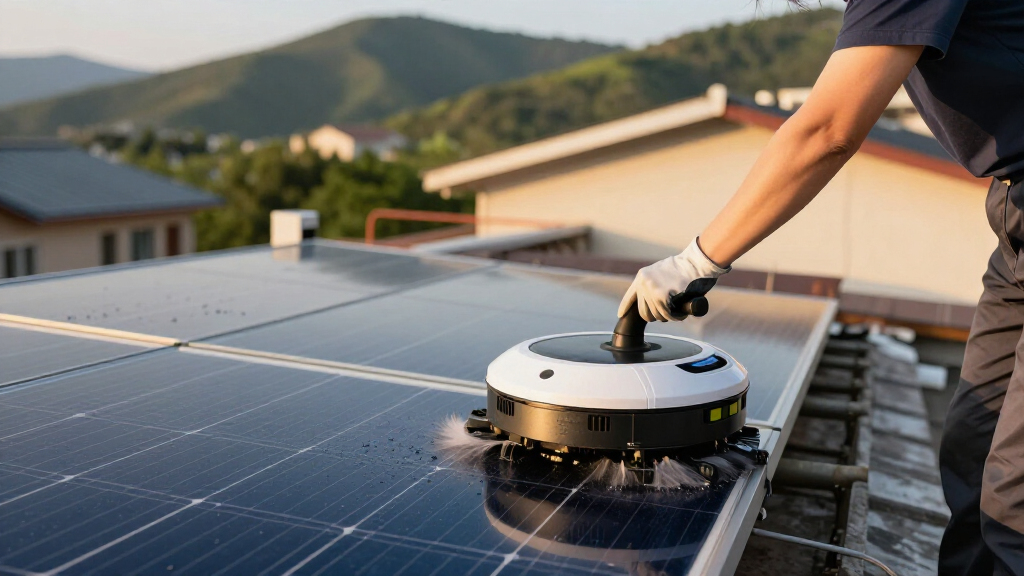
Choosing among solar panel cleaning robots starts with a practical distinction: two picks here are tracked machines that travel across panels, while two are motorized brushes operated from the ground with telescopic poles. For larger arrays, the SICWEDIM 130 cm tracked robot stands out for its wide cleaning path, remote control, and included 100 m hose. The Xoiasth tracked robot is the more manageable tracked alternative, with a stated 20° slope limit and a narrower 80 cm brush. For homeowners who can reach panels safely from below, the Telescopic Electric Cleaning Brush Kit avoids putting a heavy machine on the array.

Get backup power and energy gear delivered free with Prime
- Fast, free delivery on millions of items
- Prime Video, Amazon Music and more included
- Member-only deals all year
Those distinctions matter more than a single cleaning-speed figure. Tracked robots can reduce the need to move a pole across a broad surface, but they weigh roughly 35–53 kg and have slope limits. Pole brushes are lighter and simpler to store, yet their reach and handling depend on pole length, power access, and the operator. I ranked these options by how clearly their design matches a real cleaning job, while weighing setup, stated specifications, and the drawbacks each buyer should plan around.
Key Takeaways
For wide arrays and fewer passes, the SICWEDIM has the broadest brush at 130 cm, but its 53 kg body and 15° slope ceiling narrow the sites where it fits.
For tracked cleaning with a less restrictive stated slope limit, the Xoiasth reaches 20° and weighs about 35 kg, though its brush is 80 cm wide.
For ground-based cleaning, the Telescopic Electric Kit offers three pole lengths and wet or dry modes without driving a robot onto the panels.
For a double-head pole brush and flexible power choices, the Telescopic Double-Head model offers battery or converter configurations, but its stated battery runtime is inconsistent.
Before choosing any model, compare safe access, array slope, power and water setup, and the machine’s handling requirements—not just advertised cleaning capacity.
| Solar Panel Cleaning Robot with 130 cm Rotating Brush, Remote Control, Battery, and 100 m Hose |  | Best Overall for Broad, Low-Slope Arrays | Cleaning width: 130 cm | Cleaning speed: Up to 20 m/min | Battery: 24 V, 45 Ah lithium | VIEW LATEST PRICE | See Our Full Breakdown |
| Tracked Solar Panel Cleaning Robot with Remote Control and Rechargeable Battery |  | Best Tracked Pick for a Higher Stated Slope Limit | Cleaning width: 80 cm | Brush rotation: 360° | Walking speed: 10–20 m/min | VIEW LATEST PRICE | See Our Full Breakdown |
| Telescopic Electric Solar Panel Cleaning Brush Kit |  | Best Value-Style Pole Alternative for Ground-Based Cleaning | Pole lengths: 3.5 m, 5.5 m, or 7.5 m | Pole material: Aluminum alloy | Cleaning width: 600 mm | VIEW LATEST PRICE | See Our Full Breakdown |
| Telescopic Double-Head Solar Panel Cleaning Brush |  | Best Double-Head Pole Brush with Battery or Mains Options | Pole lengths: 3.5 m, 5.5 m, or 7.5 m | Cleaning width: Up to 65 cm | Power options: 24 V 10 Ah lithium battery or 100–240 V converter | VIEW LATEST PRICE | See Our Full Breakdown |
| solar panel cleaning robot | Cleaning width | Weight | Battery | Maximum slope |
|---|---|---|---|---|
| Solar Panel Cleaning Robot wit | 130 cm | 53 kg | 24 V, 45 Ah lithium | 15° |
| Tracked Solar Panel Cleaning R | 80 cm | About 35 kg including brush | 24 V, 30 A rechargeable | 20° |
| Telescopic Electric Solar Pane | 600 mm | 2.2 lb | — | — |
| Telescopic Double-Head Solar P | Up to 65 cm | 2.2 lb | — | — |
More Details on Our Top Picks
Solar Panel Cleaning Robot with 130 cm Rotating Brush, Remote Control, Battery, and 100 m Hose
I rank the SICWEDIM tracked robot first for buyers whose main problem is covering a broad panel surface without repeatedly repositioning a handheld tool. Its 130 cm rotating brush is the widest in this group, and the stated cleaning speed reaches 20 m/min. The remote control, edge detection, and 90° auto-turn feature are designed to keep operation away from the panel surface; edge detection is particularly relevant when the machine is working near an array boundary. The included 100 m hose also gives the water-fed setup more reach than a short connection would.
Its advantage over the Xoiasth is coverage: the SICWEDIM brush is 50 cm wider, and its stated 4–5-hour battery runtime slightly exceeds the Xoiasth’s stated four hours. But that broader format comes with a meaningful cost in handling. At 53 kg, this is the heaviest option listed, and its stated slope limit is only 15°, compared with 20° for the Xoiasth. The speed and capacity figures should be treated as product claims rather than a promise for every array; panel spacing, dirt, water supply, and route planning can change real work rates.
This is my pick for an operator who has a large, relatively gentle array and the equipment and procedures to move and use a heavy tracked machine safely. It is not a sensible default for a small home system, a steep roof, or a buyer expecting a compact, easy-to-carry cleaner. Compared with either pole brush, it reduces the need to manually sweep a long tool across each reachable panel, but adds substantial weight and a more involved operating setup.
Pros:- 130 cm cleaning width is the broadest in this lineup.
- Remote control, edge detection, and 90° auto-turn support controlled operation on the array.
- Includes a 100 m hose and a 24 V, 45 Ah battery with a stated 4–5-hour runtime.
- Offers dry and wet cleaning with a rotating brush and scraper.
Cons:- At 53 kg, it is difficult to transport and position compared with the other listed options.
- The stated maximum slope is 15°, below the Xoiasth’s 20° limit.
- Its stated coverage and speed may not match real conditions on every array.
Best for: Owners or operators cleaning broad, low-slope arrays who can safely transport and operate a 53 kg tracked machine.
Not ideal for: Buyers with steep panels, compact residential systems, limited storage or lifting capacity, or no suitable safety plan for elevated machine use.
- Cleaning width:130 cm
- Cleaning speed:Up to 20 m/min
- Battery:24 V, 45 Ah lithium
- Stated runtime:4–5 hours
- Maximum slope:15°
- Weight:53 kg
- Water hose:100 m
- Operating modes:Dry and wet
Our verdict“I would choose the SICWEDIM for broad, gentle arrays where its wide brush justifies the weight and 15° slope limit.”
Tracked Solar Panel Cleaning Robot with Remote Control and Rechargeable Battery
The Xoiasth is the tracked option I would compare most closely with the SICWEDIM. Its 20° stated slope limit is five degrees higher, while its listed weight is about 35 kg including the brush—roughly 18 kg less than the SICWEDIM. That makes it the more plausible choice when an installation is too sloped for the other tracked model’s stated limit or when handling weight matters. Remote control keeps the operator off the panels, and the 100 m hose supports a water-fed cleaning arrangement.
The tradeoff is a narrower 80 cm brush and a stated four-hour battery life. The SICWEDIM’s 130 cm brush is better suited to wide, open runs where fewer passes matter, while the Xoiasth’s smaller brush may suit a more constrained route. Its stated walking speed is 10–20 m/min, and its daily capacity is listed as 1,000–2,000 m²; I would not use those figures alone to estimate a job, since layout, dirt, and setup affect actual results.
Some supplied specifications need careful reading. The water-flow figure is given as 45–60 L without a time unit, so it does not tell a buyer how much water the robot uses over a working period. The machine is still heavy compared with a pole tool, and a 20° rating is not a substitute for checking panel condition, edge protection, and the manufacturer’s safe operating guidance. I place it second because its slope and handling figures make it a more flexible tracked alternative, but buyers should accept the narrower coverage and verify the unclear water-flow detail before planning a job.
Pros:- Stated maximum slope of 20° is higher than the SICWEDIM’s 15° limit.
- About 35 kg including the brush, lighter than the other tracked model listed here.
- Remote control, rechargeable battery, and dry or wet cleaning support flexible operation.
- Includes a 100 m hose, water pump, scraper, and 80 cm rotating brush.
Cons:- The 80 cm brush is narrower than the SICWEDIM’s 130 cm cleaning width.
- The stated water-flow rate of 45–60 L has no time unit.
- At about 35 kg, it remains a heavy machine to move and position.
Best for: Buyers who want remote tracked cleaning and need the higher stated slope limit or a lighter listed body than the SICWEDIM.
Not ideal for: Anyone who needs the widest brush, a lightweight hand-carried tool, or a clearly specified water-flow rate for detailed planning.
- Cleaning width:80 cm
- Brush rotation:360°
- Walking speed:10–20 m/min
- Battery:24 V, 30 A rechargeable
- Stated battery life:4 hours
- Maximum slope:20°
- Weight:About 35 kg including brush
- Water hose:100 m
Our verdict“I would pick the Xoiasth over the wider SICWEDIM when its 20° slope rating and lower listed weight matter more than maximum brush width.”
Telescopic Electric Solar Panel Cleaning Brush Kit
This is the simplest choice in the roundup for buyers who can clean panels from a safe position without placing a tracked machine on the array. The aluminum telescopic pole comes in 3.5 m, 5.5 m, or 7.5 m lengths, letting a buyer match reach to the installation instead of accepting one fixed format. A 600 mm rotating nylon brush supports dry or water-fed cleaning, and the included 24 V DC submersible pump is listed with a 7–8 m lift. Compared with both tracked robots, the kit avoids a 35–53 kg machine and the slope limits attached to those options.
That lower machine burden does not make it effortless: the operator still has to guide the pole, manage its reach, and keep control of the brush against a panel. The kit also requires a power supply, unlike the rechargeable tracked models, and its 8 m power cord may affect where the operator can work. Its 600 mm width is less than half the SICWEDIM’s 130 cm brush and narrower than the double-head model’s stated width of up to 65 cm, so large arrays may require more manual passes.
I give it this role because its format suits a different buyer rather than because it replaces a true robot. It makes sense for residential panels, mixed outdoor glass, or a site where ground-based reach is available and machine transport is not. The brush can also be used on windows and RV glass, which adds utility beyond a fixed solar array. Buyers should note that the product is shipped in two separate packages; if the order arrives in parts, allow for that split before planning a cleaning session.
Pros:- Available in three pole lengths, from 3.5 m to 7.5 m.
- Supports dry brushing and water washing with a rotating nylon brush.
- Lighter to store and position than either tracked robot.
- Can also be used on windows, RV glass, and other outdoor surfaces.
Cons:- Requires a power supply and has an 8 m power cord.
- The operator must guide the pole rather than control an autonomous tracked cleaner.
- Ships in two separate packages.
Best for: Homeowners who can reach panels safely from the ground and want an electric brush that can also clean other outdoor glass.
Not ideal for: Operators cleaning large arrays who want autonomous movement, cordless operation, or the broad coverage of a tracked robot.
- Pole lengths:3.5 m, 5.5 m, or 7.5 m
- Pole material:Aluminum alloy
- Cleaning width:600 mm
- Brush speed:150–300 RPM
- Power:100–240 V
- Power cord:8 m
- Water pump:24 V DC submersible; 7–8 m lift
- Weight:2.2 lb
Our verdict“I would choose this kit over a tracked robot for reachable home panels when light handling and multi-surface use matter more than automated coverage.”
Telescopic Double-Head Solar Panel Cleaning Brush
The Telescopic Double-Head brush is the pole-mounted alternative for buyers who want a wider brushing setup without moving to a heavy tracked machine. Its motorized double head has a stated cleaning width of up to 65 cm, slightly more than the 600 mm single-head Telescopic Electric Kit. It is offered with a 3.5 m, 5.5 m, or 7.5 m reinforced alloy pole, and buyers can select either a 24 V battery or a 100–240 V converter. That power choice is its clearest difference from the single-head kit, which is listed as requiring a power supply.
It can be a better fit than the single-head option when a buyer wants two brush heads and the freedom to choose battery operation or a mains-powered configuration. It remains a manually guided pole tool, though, not a robot that traverses the array. Compared with the tracked models, it is far lighter and does not carry a listed machine slope limit, but it also does not offer remote movement, edge detection, or the same broad coverage as the SICWEDIM’s 130 cm head.
The biggest planning concern is the conflicting battery information: the product description says up to four hours, while other supplied details state four to eight hours. I would not base a work schedule on the longer figure without confirming it with the seller. A 15 m water pipe is included, and the converter configuration has an 8 m power cable. The longest pole may also be awkward in tight areas, where maneuvering a long double-head tool can be harder than using the shorter single-head kit. I rank it fourth because its extra brush and power flexibility are useful, but the runtime inconsistency leaves buyers with more uncertainty than the other pole option.
Pros:- Motorized double brush head has a stated width of up to 65 cm.
- Available with a 24 V battery or a 100–240 V power converter.
- Three telescopic pole lengths support different reach requirements.
- Includes a 15 m water pipe and cleaning accessories.
Cons:- Battery runtime information conflicts between the supplied product details.
- The longest pole may be difficult to maneuver in tight spaces.
- Like the single-head kit, it requires the operator to guide the brush across the panels.
Best for: Buyers who prefer a pole brush, want a double-head setup, and value a choice between rechargeable battery and converter power.
Not ideal for: Anyone who needs a clearly stated battery work period, automated movement, or a narrow tool for tight cleaning spaces.
- Pole lengths:3.5 m, 5.5 m, or 7.5 m
- Cleaning width:Up to 65 cm
- Power options:24 V 10 Ah lithium battery or 100–240 V converter
- Stated battery runtime:Up to 4 hours in description; 4–8 hours in other supplied details
- Water pipe:15 m
- Power cable:8 m with converter model
- Pole material:Reinforced aluminum alloy
- Weight:2.2 lb
Our verdict“I would choose the double-head model over the single-head kit only when its added brush and power options outweigh uncertainty about battery runtime.”
How We Picked
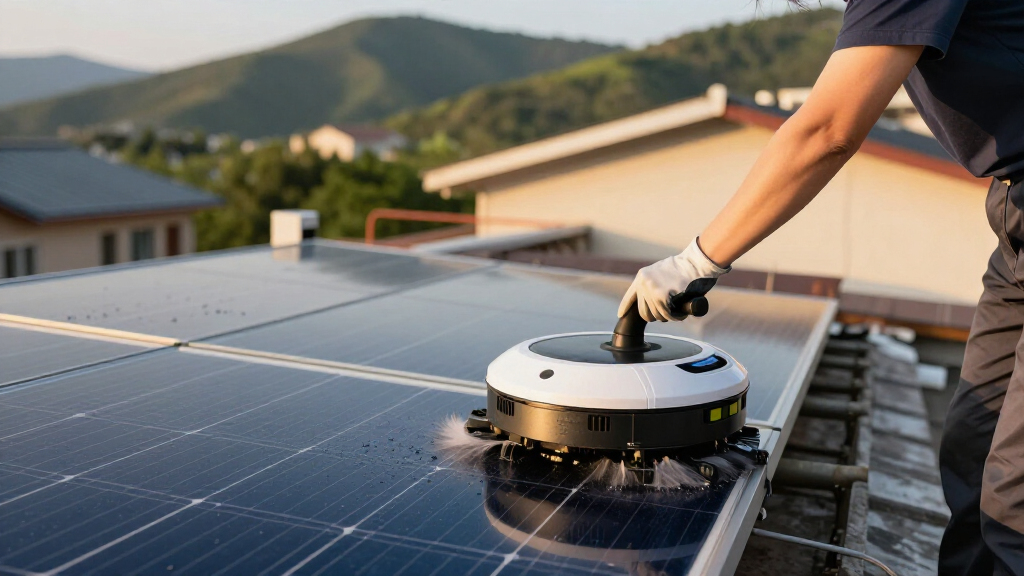
I ranked these four options by their suitability for cleaning solar panels, rather than treating every powered brush as a robot. That distinction is central to this roundup: a tracked cleaner moves across the array under remote control, while a telescopic brush remains in the operator’s hands. Neither format wins for every installation. A pole may be the sensible choice when panels can be reached from a safe position on the ground; a tracked machine is more compelling when the array is broad and its surface, access, slope, and safety plan support machine operation.
For the tracked models, I compared cleaning width, slope limits, stated runtime, weight, remote operation, and water-supply details. The SICWEDIM ranks first for large, relatively gentle arrays because its 130 cm brush and 100 m hose point toward broad coverage, although its 53 kg weight and 15° maximum slope are real constraints. The Xoiasth follows as a more adaptable tracked alternative on paper: it has a narrower 80 cm brush but a stated 20° slope limit and lower listed weight. Those figures do not remove the need to check the manufacturer’s instructions and site conditions.
I placed the two pole brushes after the tracked machines because this title focuses on robots, while still including them as alternatives for buyers whose needs fit a ground-operated tool better. The electric single-head kit gets the stronger value-oriented role for straightforward reach and dry-or-wet cleaning. The double-head model adds a second powered brush and battery or mains options, but the conflicting runtime information makes its power planning less clear. I also looked for specific tradeoffs a buyer can act on: handling a long pole, moving a heavy robot, supplying water, managing cables, and matching the device to the array. I did not assume that stated capacity, slope, or runtime will apply to every panel layout or working condition.
| solar panel cleaning robot | Pole material |
|---|---|
| Solar Panel Cleaning Robot wit | — |
| Tracked Solar Panel Cleaning R | — |
| Telescopic Electric Solar Pane | Aluminum alloy |
| Telescopic Double-Head Solar P | Reinforced aluminum alloy |
Factors to Consider When Choosing Solar Panel Cleaning Robots
I would choose the cleaning format before comparing smaller specifications. A tracked robot and a telescopic brush solve different access problems, and a wider brush cannot make an unsuitable setup safe. Use these checks to decide which type fits your array and working conditions.
Robot or pole brush: match the tool to access
A tracked robot is designed to move across the panel surface while an operator controls it remotely. That may reduce repetitive manual sweeping across a broad array, but it places a heavy machine on the installation. The SICWEDIM is listed at 53 kg and the Xoiasth at about 35 kg, so transport, loading, positioning, and safe operation deserve attention before purchase. A pole brush stays under direct operator control and avoids driving a machine over the panels, but the person cleaning must manage the brush and pole throughout the job. If the panels are safely reachable from the ground, the lighter pole format may be more practical than a robot.
I would not infer that any device is safe for a particular roof simply because a product listing provides a slope figure or edge-detection feature. Check the manufacturer’s instructions and consider the panel layout, surface condition, access route, and applicable work-at-height precautions. If a safe work plan is not clear, the cleaning method—not the advertised speed—should guide the decision.
Use brush width and array size together
The SICWEDIM’s 130 cm brush is the widest listed, which may mean fewer passes across a broad, unobstructed row. The Xoiasth’s 80 cm head offers less width, while the pole tools list 600 mm and up to 65 cm. Those numbers help compare the tools, but width alone does not predict total cleaning time. A robot must turn, travel around the array, and work within its stated slope and edge limits; a pole operator must repeatedly reposition and guide the brush. For a small home system, the broadest machine may add weight and setup without much benefit. For a large installation, a narrow tool may mean more passes and more operator time.
Check slope and handling before choosing a tracked model
The listed maximum slopes separate the two tracked options: 15° for the SICWEDIM and 20° for the Xoiasth. That makes the Xoiasth the stronger candidate on paper where the slope is between those figures, but the specification is not a guarantee for every surface or condition. The SICWEDIM’s wider brush favors coverage on gentler arrays; the Xoiasth trades some width for a higher stated limit and a lower listed weight. Both are substantial machines, so check how they will be moved from storage to the work area and what safe operating procedure the manufacturer specifies.
A pole brush avoids putting this weight on the panels, but a long pole has its own handling limits. The 7.5 m options can reach farther, yet may be unwieldy around rooflines, obstacles, and narrow rows. A shorter pole may give better control if it can reach the panels from a safe position.
Plan the water and power setup
Wet cleaning needs a workable water source and hose route. Both tracked robots include a 100 m hose; the Telescopic Double-Head brush lists a 15 m water pipe, and the single-head kit includes a 24 V DC pump with a stated 7–8 m lift. Check how far the water source is from the panels and whether the route creates tangles or obstacles. The Xoiasth lists a water-flow figure of 45–60 L without a time unit, so buyers cannot calculate use over time from that number alone. Ask for clarification if water planning is central to the job.
Power also separates the options. The tracked models use rechargeable batteries, while the single-head kit requires a power supply and lists an 8 m power cord. The double-head model offers either a battery or converter configuration, but its runtime figures conflict. Confirm the exact configuration and expected runtime before purchase rather than assuming the longest figure applies.
Treat runtime and capacity as planning inputs, not guarantees
The SICWEDIM states a 4–5-hour battery runtime, and the Xoiasth lists four hours. The double-head pole brush has inconsistent runtime details: up to four hours in one description and four to eight hours in other supplied information. Those numbers are useful for comparison, but actual working periods can vary with operating conditions and the selected setup. Ask the seller to confirm the relevant battery and runtime details if uninterrupted work matters.
The same caution applies to listed cleaning speed and area capacity. The SICWEDIM advertises up to 20 m/min and 1,170 m²/h; the Xoiasth lists 10–20 m/min and 1,000–2,000 m² per day. These are not directly comparable measures, and neither tells the whole story of turning, setup, dirt, access, or water supply. I would use them as orientation, then size the machine around the array and the operating plan.
Choose the right level of operator involvement
If you want the tool to travel across the array under remote control, compare the tracked models’ brush width, slope limit, weight, and included controls. The SICWEDIM favors width; the Xoiasth favors its higher stated slope limit and lower listed weight. If direct control from a safe position matters more than autonomous travel, a pole brush may be a better match. The single-head kit is the simpler choice of the two pole options, while the double-head model adds another brush and two power configurations but carries runtime uncertainty.
For any option, read the operating instructions before use and confirm what the package includes. The single-head kit is listed as arriving in two packages, and the double-head model’s battery configuration should be distinguished from its converter configuration. Those details can affect setup, storage, and the equipment needed on cleaning day.
Frequently Asked Questions
Are all four products actually solar panel cleaning robots?
No. The SICWEDIM and Xoiasth are tracked machines designed to move across panels under remote control. The Telescopic Electric Kit and Telescopic Double-Head Brush are motorized pole tools that the operator guides by hand. I include the pole models because they are relevant alternatives for buyers who want powered solar-panel cleaning without placing a heavy tracked device on the array.
Which tracked cleaner is better for a sloped array?
The Xoiasth lists a maximum slope of 20°, compared with 15° for the SICWEDIM, so it has the higher stated limit. That figure alone does not confirm safe use on a specific installation. Check the manufacturer’s operating guidance and assess the panel surface, layout, edge conditions, and work plan before relying on either robot on a slope.
Which option has the widest cleaning brush?
The SICWEDIM has the widest listed brush at 130 cm, ahead of the Xoiasth at 80 cm and the pole tools at 600 mm and up to 65 cm. A wider brush may reduce the number of passes on a broad, open array, but it does not automatically make the machine faster for every layout. Turns, access, slope, and safe operation also affect how well that width helps.
Can I use these cleaners without water?
The supplied details list dry and wet cleaning for the SICWEDIM, Xoiasth, and Telescopic Electric Kit. The Telescopic Double-Head model’s supplied description identifies it as a motorized brush and includes a water pipe, but does not clearly state dry and wet modes in the listed specifications. Confirm the intended cleaning modes for the exact configuration, and follow the product instructions for the panels and brush.
What should I verify before buying a battery-powered option?
Confirm the exact battery configuration, stated runtime, charging requirements, and what accessories are included. The SICWEDIM lists 4–5 hours and the Xoiasth lists four hours, while the double-head brush has conflicting runtime information in its supplied details. Also plan how to transport and position a tracked machine, since both are heavy, and check that the chosen cleaner’s operating limits fit the array.
Conclusion
For a large, gentle array, I would start with the SICWEDIM: its 130 cm brush and 100 m hose suit broad coverage, provided the 53 kg weight and 15° slope limit work for the site. For tracked cleaning on a steeper array within the stated limits, I would compare the Xoiasth first; its 20° rating and lower listed weight are appealing, though its brush is narrower and its water-flow unit is unclear. For homeowners cleaning from a safe ground position, the Telescopic Electric Kit is my practical pole-tool choice, especially when the same brush may be used on other outdoor glass. For buyers who specifically want a double-head brush and a battery-or-converter choice, the Telescopic Double-Head model offers those features, but I would confirm its runtime before relying on it for a scheduled job. The best fit depends on access, slope, array size, and how much handling the operator can safely manage—not on one headline specification.
Halloween Picks
halloween
As an affiliate, we earn on qualifying purchases.